

This post is also available in:
 Português
 Español
 Français
 Deutsch
 Italiano
 Русский
 Nederlands
 日本語
 Polski
Summary
Austria, Denmark, Germany, Greece and the Netherlands want the first transfers in 2027. One day later, Nina Gregori, head of the European Union Agency for Asylum, proposed a "processing centre" in a foreign country.
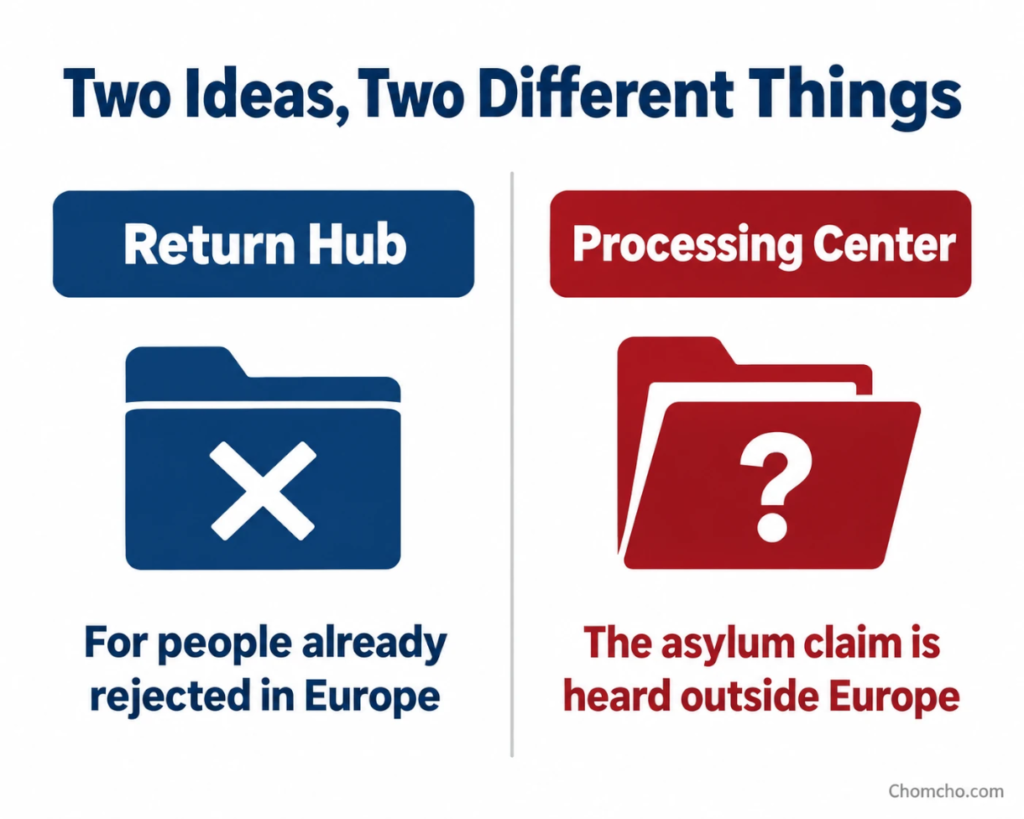
The two ideas are different. EU return hubs are for people whose asylum claim was already rejected in Europe. A processing center would move the hearing itself abroad.
The pressure is real. The foreign-born population of the EU grew from about 40 million in 2010 to about 64 million in 2025, and fewer than one in three people ordered to leave the EU are actually returned.
Europe tried this before. Italy built centers in Albania and Britain spent 700 million British pounds on its own Rwanda plan. The idea did not fail. The courts stopped it.
Now the law has changed, but the new EU return hubs have not yet been tested in court. The law is new, but the judges are the same.
The United States tried third-country deportations first, and a federal judge declared the policy unlawful before the Supreme Court removed that obstacle.
Mexico offers the clearest contradiction: a government of the left that puts the poor first prefers to send the caravans back.
President Donald Trump said of his deportation campaign, "I think it might be too tough."
Our proposal is modest. Keep the border firm. Those who leave on their own, with no criminal record, should be eligible for a small lottery of legal visas, in the tens of thousands and not in the millions. And help the rest where they live.
A country that controls its border can afford to be generous without opening its doors to everyone.

A deportation center outside Europe
Five European governments announced in Vienna on Monday, November 16, that they will negotiate a deportation center in Rwanda. Austria, Denmark, Germany, Greece and the Netherlands want the first transfers in 2027.
Austrian Chancellor Christian Stocker called the plan, in his words, “a real historic paradigm shift in migration policy.”
The center would receive migrants who already have a removal order, single men at the start. Nothing is signed yet, and the ministers gave no total number and no price.
One day later, Nina Gregori, who directs the asylum agency of the European Union (EU), went one step further. She proposed the idea of a “processing centre” in a foreign country.
The two ideas are different, and the difference matters. EU return hubs are for people whose asylum claim was already heard and rejected in Europe. A processing center would move the hearing itself abroad: the migrant who lands in Europe would wait for the answer in another country.
The first idea removes those who lost their case. The second removes the case.
A continent that changed
The foreign-born population of the EU grew from about 40 million in 2010 to about 64 million in 2025. Meanwhile, the fertility rate fell to 1.34 births per woman in 2024, the lowest level since 2001, and far below the 2.10 needed to keep a population stable.
In Germany, foreign nationals are about 46.5 percent of the working-age people who receive the basic welfare benefit, according to data from the Federal Employment Agency.
Many conservatives fear that Europe is losing its identity. That fear deserves a calm answer and not an insult, because the arithmetic behind it is real.
The concern is also about safety, and about the law that some newcomers bring with them.
In Britain, a national audit led by Baroness Louise Casey found in June 2025 clear evidence that men of Asian and Pakistani heritage were over-represented among the suspects of “grooming gangs” in three police areas.
Officials avoided the subject for years, afraid of being called racist, and ethnicity went unrecorded in two-thirds of cases.
In Pakistan itself, experts of the United Nations (UN) report that Christian and Hindu girls are abducted, forced to convert and married to their abductors, and that courts validate those marriages.
In March 2026, the Federal Constitutional Court of Pakistan upheld the marriage of a 13-year-old Christian girl to a 30-year-old man accused of abducting her. In Egypt, the group Coptic Solidarity reports hundreds of similar cases among Coptic Christian women and girls.
Many Muslims never harm anyone. But a country has the right to ask what ideas about women and children are entering with the people it receives.
The system also fails to enforce its own decisions. Fewer than one in three people ordered to leave the EU are actually returned, according to Eurostat, the statistics office of the bloc.
What Europe already tried
Italy went first, and it tried the second idea, the processing center outside Europe. Migrants rescued at sea would have their asylum claims heard in Albania and not in Italy.
Rome signed a protocol with Albania in November 2023 and opened two centers there in October 2024. The plan was to process up to 36,000 asylum seekers per year.
However, Italian judges blocked the transfers, and on August 1, 2025, the European Court of Justice supported the Italian judges and questioned the list of “safe countries” that Rome was using.
A study by the University of Bari put the cost above 74.2 million euros, about 86 million dollars.
Britain went further and failed more clearly. London spent 700 million British pounds, about 890 million dollars, on its own Rwanda plan. Only four volunteers went to Rwanda. The Labour Party government cancelled the plan in 2024.
The Netherlands also signed a smaller agreement with Uganda in 2025, a pilot for a limited number of rejected asylum seekers.
The idea did not fail in these cases. The courts stopped it.
Can the idea work this time?
Three things have changed. First, the law. On February 23, 2026, the EU revised its “safe third country” concept, so that a migrant no longer needs a personal connection to the country that will receive him.
On October 1, the Council of the EU gave final approval to new return rules that allow member states to open return hubs outside the bloc.
Second, the politics. Five governments now act together, and Germany, the most populous country of the bloc, is one of them.
Third, the design. German Interior Minister Alexander Dobrindt said the plan is “not remotely comparable” to the British one. London wanted to send asylum seekers before any decision. This plan covers only people who were already rejected.
One thing has not changed. The new EU return hubs have not yet been tested in court, and 47 aid and rights groups have already asked the five governments to abandon the plan.
The law is new, but the judges are the same.
The United States tried third-country deportations first
The Trump administration has sent migrants to third countries where they have no ties, from El Salvador to Rwanda and South Sudan.
U.S. District Judge Brian Murphy declared the policy unlawful in February 2026. On September 29, the Supreme Court removed that obstacle and the Court will decide the full question by the summer of 2027.
Kilmar Abrego Garcia, a Salvadoran man living in Maryland, was deported in March 2025 to the mega-prison that President Nayib Bukele built for gang members.
The government called him a member of the MS-13 gang, but it also admitted in court that his deportation was an administrative error, and the Supreme Court noted that the government itself admitted the deportation was illegal.
Democratic Senator Chris Van Hollen flew to El Salvador to see him. Bukele published the photo himself and wrote that the prisoner was “sipping margaritas with Sen. Van Hollen in the tropical paradise of El Salvador.”
Mexico and its contradiction
Mexico offers the clearest contradiction.
Mexican President Claudia Sheinbaum governs with the slogan of her political movement: “For the good of all, first the poor.” The caravans that cross her country are made of the poor.
Yet when Trump threatened on November 12 to double tariffs on Mexican goods, she answered that no caravan has reached the northern border since he returned to office, and she repeated the message her officials give the migrants: they will not reach the United States “because that possibility does not exist.”
Her government offers them a safe return home. It has also refused to act as a “safe third country” for the poor, for people who seek asylum in the United States.
A government of the left that puts the poor first could hear their asylum claims in Mexico and receive them while they wait. Yet, it prefers to send them back.
In our opinion, future caravans should request asylum in Mexico. Mexico is the natural processing center of North America, but it does not want the job.
Firm border, measured compassion
“I think it might be too tough,” Trump said of his deportation campaign in an interview aired on November 8, and he opened the door to legal status for workers who have been in the country for 10 to 15 years.
Vice President JD Vance, in our view the most likely Republican candidate for 2028, gives a clue about what comes next.
In September he said that “nobody who has come into the United States illegally should remain.” But then on November 4 he wrote: “I’m open to the idea that we should change enforcement.”
Many migrants are not criminals. Most are poor people who leave hard lives, and they deserve respect. But the numbers do not allow open doors.
Gallup found in 2025 that about 900 million adults would like to move to another country, and about 134 million of them name the United States.
The retirement fund of Social Security is projected to be exhausted in 2032. American workers also feel a new pressure.
Goldman Sachs estimates that artificial intelligence (AI) already reduces job growth by about 16,000 positions per month, and unemployment among recent college graduates reached 5.2 percent.
No taxpayer can pay that cost.
Our proposal is modest. Keep the border firm. Washington already pays people to leave: the Department of Homeland Security (DHS) offers a free flight and an exit bonus, now 3,000 dollars, to those who register their own departure.
We would add a real incentive to that payment. Those who leave on their own, with no criminal record, should be eligible for a small lottery of legal visas, in the tens of thousands and not in the millions.
Washington used to give up to 50,000 permanent residence cards (green cards) a year to people abroad through the Diversity Visa lottery. It suspended that program in December 2025, after the suspect in a shooting at Brown University was found to have entered through it.
A lottery for strangers was a risk. A lottery for people who are already known, and who obeyed the law by leaving, is different.
And help the rest where they live, with development that lets them stay. The old proverb says it well: “Give a man a fish and you feed him for a day; teach a man to fish and you feed him for a lifetime.”
Immigration is foreign policy, and an “America First” foreign policy can be firm and humane at the same time.
A country that controls its border can afford to be generous without opening its doors to everyone.