
This post is also available in:
 Português
  Español
  Français
  Deutsch
  Italiano
  Русский
USMCA review 2026: North America to decide its future
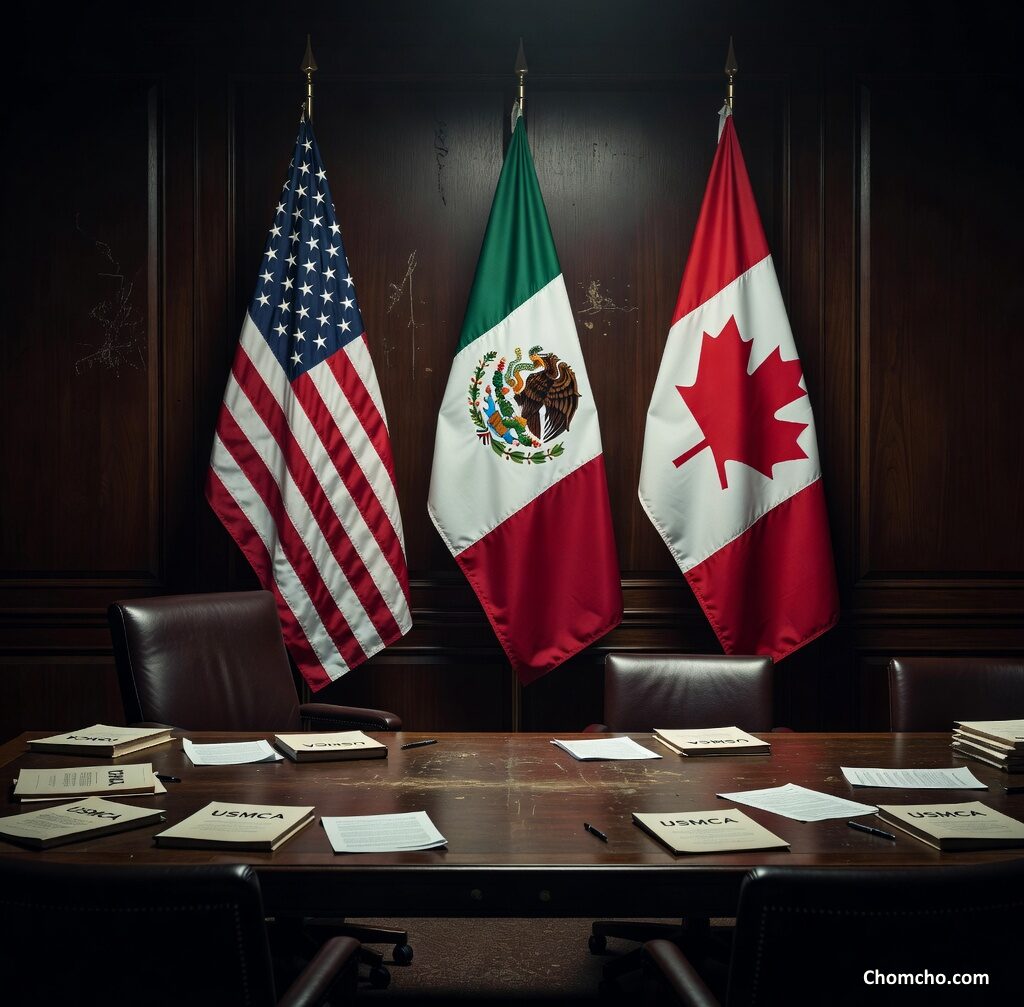
On July 1, 2026, the United States officially refused to renew the USMCA.
U.S. Trade Representative Jamieson Greer issued the statement that will reverberate across North America for the next decade:
“The United States did not agree to renew the USMCA in its current form. As a result, the USMCA is not renewed.”
The announcement came while President Trump was in Medora, North Dakota, attending the opening of the Theodore Roosevelt Presidential Library — a fitting backdrop for an America First president making a decision designed to put American interests first.
The USMCA, or United States-Mexico-Canada Agreement, is the trilateral trade pact governing commerce between the three North American nations.
In Spanish it is known as the T-MEC — Tratado entre México, Estados Unidos y Canadá. In Canada it goes by CUSMA.
It replaced the 1994 North American Free Trade Agreement — NAFTA — and took effect on July 1, 2020.
Under Article 34.7 of the agreement, July 1, 2026, marked the six-year mandatory joint review deadline.
The three parties had only two choices: extend the agreement for another 16 years until 2042, or trigger annual renegotiations with a final termination date of 2036 if no deal is reached.
Washington chose the latter.
The USMCA is not terminated. It remains in force. But it now enters a decade of annual reviews, pressure, and renegotiation.
Nothing is guaranteed. Everything is on the table.
From NAFTA to USMCA — thirty years of North American trade
To understand why July 1, 2026, matters, you need to understand what these three countries built together — and why Trump believes it stopped working.
NAFTA took effect on January 1, 1994, under President Bill Clinton. It eliminated most tariffs between the United States, Mexico, and Canada, creating an integrated North American market that became one of the most powerful economic zones on earth.
For thirty years, goods, services, and investment flowed freely across all three borders.
Trump renegotiated NAFTA in his first term, producing the USMCA in 2020 with stronger rules of origin requiring 75% of automobile content from within North America, higher minimum wage requirements for Mexican auto workers, and the 16-year sunset clause with the mandatory six-year review that just triggered.
At the time, Trump called USMCA “the fairest, most balanced, and beneficial trade agreement we have ever signed into law.” A year later he called it “the best and most important trade deal ever made.”
On July 1, 2026, he called it “irrelevant.”
What changed? The trade deficit.
The trade deficit — Trump’s primary concern
When a senior Trump administration official was asked Wednesday why the U.S. decided not to extend the agreement, the answer was direct and unambiguous.
“The primary issue that the president’s been focused on with the world, and particularly with Canada and Mexico, is our trade deficit,” the official said.
“We believe that the USMCA did not operate to control the deficit like the president intended, so that’s really the heart of it.”
The numbers are stark.
In 2025, the United States ran a goods trade deficit of 46,000 million dollars with Canada and 197,000 million dollars with Mexico.
Combined, the U.S. trade deficit with its two USMCA partners reached 243,000 million dollars — more than double the 125,000 million dollar deficit of 2020, the year USMCA took effect.
The senior official was pointed: “Trade deficits shot up during the Biden administration.” Trump reined them in somewhat through tariffs, but the problem remains.
USMCA was supposed to rebalance North American trade in America’s favor. By Trump’s measure, it did not deliver.
Beyond the raw deficit numbers, American manufacturers continue to move supply chains to Mexico, where wages remain dramatically lower.
Over 576,000 U.S. manufacturing jobs have been shed or furloughed since USMCA took effect.
The promise of USMCA — that raising Mexican wages and tightening rules of origin would slow the outflow of American jobs — has not been fully realized.
Trump’s refusal to renew is not a retreat from North American trade. It is a demand that the trade relationship finally work the way America was promised it would.
The U.S. agenda — what Washington wants
The trade deficit is the headline concern, but the U.S. agenda goes further.
The China backdoor problem is also a central issue Washington will push in negotiations.
Chinese manufacturers have been systematically routing products through Mexico to bypass American tariffs — exploiting USMCA’s duty-free provisions to access the American market through the back door.
Mexico has not yet established an investment screening mechanism comparable to America’s Committee on Foreign Investment (CFIUS) to block this.
Washington wants that gap closed urgently.
Similar to the bypass of manufactured products, Washington wants stronger automobile rules of origin specifically designed to block Chinese EV components manufactured in Mexico from qualifying for duty-free access.
The goal is simple: if a car is built in Mexico using Chinese parts, it should not enter the United States tariff-free as if it were a North American product.
Other American demands include an end to Canada’s protectionist dairy supply management system, which effectively bars American dairy farmers from fair market access; resolution of the decades-long softwood lumber dispute with Canada; a trilateral framework for critical minerals cooperation; stronger labor enforcement in Mexico’s manufacturing sector; and continued fentanyl and border security cooperation.
Trump has also raised the possibility of breaking USMCA into two separate bilateral agreements — one with Mexico and one with Canada — rather than continuing the trilateral format.
That instinct explains why Canada and Mexico have held their own bilateral meetings to present a united front.
Both believe solidarity makes them stronger.
Trump, who distrusts multilateral pressure and prefers one-on-one negotiations where American leverage is maximum, may see their united front as exactly the kind of arrangement he wants to dismantle.
Trump said it plainly in June: “We don’t need anything that Canada has. We don’t need anything that Mexico has, but they need everything that we have. And they have to treat us better.”
Mexico — the cooperative neighbor
So far of the two partners at the table, Mexico has done significantly more to earn Washington’s trust.
The senior Trump administration official was explicit in distinguishing between the two countries:
“Mexico, although we have many challenges in our relationship, including on trade, they do understand the administration’s tariff policies. In many ways they’ve been constructive in this.”
Mexico took what analysts describe as a “clear the decks” approach in the months before the review.
President Claudia Sheinbaum signed a formal letter calling for a 16-year extension. Economy Minister Marcelo Ebrard completed two rounds of bilateral negotiations with Washington before the trilateral review launched.
The first U.S.-Mexico bilateral round in late May 2026 covered automotive rules of origin, steel and aluminum trade, and economic security.
A third round is already scheduled for the week of July 20 in Mexico City.
On security, Mexico deployed an unprecedented number of soldiers and federal police along its northern border with the United States, a direct response to Trump’s demands and a condition for easing tariff pressure on Mexican exports.
Fentanyl cooperation has improved significantly. Border crossing numbers also have fallen sharply.
The 2026 FIFA World Cup, co-hosted by Mexico in Mexico City, Guadalajara, and Monterrey, gave Mexico an opportunity to demonstrate its capacity for order and security at scale.
Mexican authorities deployed massive security operations. Violence near the stadiums was largely controlled.
However analysts note a harder truth: some of the reduction in cartel violence during the World Cup may reflect a calculated strategy by criminal organizations to temporarily reduce their profile, avoid government pressure, and exploit the economic opportunities the tournament created.
In Monterrey and Guadalajara, authorities detected attempts by actors linked to illicit economies to control informal parking, transport services, and street vending near the stadiums.
Mexico’s cooperation with Washington is real and valuable. But the cartel problem is structural. It does not disappear during a soccer tournament.
Canada — the difficult neighbor
The same Trump administration official who praised Mexico’s cooperation described Canada very differently.
“Canada is in a different position,” the official said, specifically accusing Ottawa of not addressing “many of the non-tariff barriers and trade challenges” that the United States has raised.
Then came the most telling detail of the day: the official pointedly noted that Canada was one of only two countries in the world to retaliate against Trump’s tariff policies, the other being China.
That retaliation — imposed when Trump placed 25% tariffs on Canadian goods in March 2025 — was eventually vacated in February 2026, but the damage to trust was real and lasting.
And while the U.S. and Mexico have already begun serious bilateral negotiations, with a third round scheduled for July 20 in Mexico City, the U.S. and Canada have not even started their own bilateral talks.
Canada was excluded from earlier bilateral rounds specifically because of two unresolved disputes: its protectionist dairy supply management system blocking American farmers, and provincial government bans on American alcohol products in Canadian stores.
Canada was not even mentioned in Greer’s official statement — a telling omission.
The deeper problem with Canada is not tariffs. It is posture.
Prime Minister Mark Carney traveled to China seeking alternative markets for Canadian exports — a direct signal to Washington that Canada is looking for leverage, not partnership.
His public speech referencing a European-led new world order raised eyebrows in Washington and among American conservatives, as we covered at Chomcho.com.
His positioning against Trump’s America First agenda has been consistent and deliberate.
According to Rocío de los Reyes Ramírez, analyst at Spain’s Defense Ministry, Canada is also using the 2026 FIFA World Cup as political theater.
Ottawa is presenting the tournament as proof of Canadian multiculturalism and openness to the world — implicitly contrasting Canadian values with U.S. immigration and security policies.
Canadian national team head coach Jesse Marsch, an American from Vermont, publicly criticized Trump’s remarks about Canada becoming the 51st state of the United States.
Canada’s trade minister Dominic LeBlanc said after the July 1, 2026, meeting that Canada is “unwavering” in its support for the trade deal.
What Canada has not been unwavering about is addressing the American concerns that caused the United States to refuse renewal in the first place.
That asymmetry is Canada’s problem. Not America’s.
Biden’s failure — and what Trump corrected
The USMCA review 2026 is happening in a context that must be understood clearly.
Under Biden, the southern border reached historic crisis proportions. Illegal crossings hit 2.5 million in fiscal year 2023 alone — a record.
USAID-funded nonprofit organizations were effectively subsidizing illegal migration flows with American taxpayer money.
Fentanyl deaths peaked at 110,000 Americans in 2023 — more than died in the entire Vietnam War in a single year.
Meanwhile, America’s trade deficit with Canada and Mexico ballooned. From 125,000 million dollars in 2020 to 243,000 million dollars in 2025.
The Biden administration’s rhetoric claimed to care about fair trade and border security. The results told a different story.
Trump reversed course from day one of his return to office.
Illegal border crossings have fallen more than 90% since January 2025. Fentanyl seizures are up dramatically. Mexico has deployed troops to its northern border.
These are not political talking points. They are verifiable facts.
America is being taken seriously by its neighbors again because it is willing to apply real pressure. That pressure is producing results.
What comes next — and what America First demands
The July 1, 2026, announcement formally launched a decade of annual reviews.
The USMCA remains in force until 2036. Negotiations with Mexico will continue July 20. Negotiations with Canada have not yet begun.
The trade deficit is now the central issue in every conversation that follows.
Trump will not sign any renewal that does not meaningfully address the imbalance.
American manufacturers, farmers, ranchers, and workers must benefit from whatever comes next. That is the test.
The U.S. agricultural lobby — which strongly supports USMCA renewal because American farmers depend on access to Canadian and Mexican markets — gives Trump political room to demand maximum concessions while ultimately renewing on better terms.
That is likely the destination. The road there will be turbulent.
North America remains uniquely positioned to lead the world economy. The continent is energy self-sufficient. It feeds itself and much of the world. It sits on critical mineral deposits essential for batteries, defense systems, and advanced manufacturing.
North American stability is more strategically urgent than ever in the face of China’s global economic aggression.
But that potential is only realized through a partnership that is fair, reciprocal, and strategically aligned.
Trump’s refusal to rubber-stamp the USMCA on July 1, 2026, is not a rejection of North America. It is a demand that North America finally work the way it was always promised it would.
For Mexico, the message is: keep cooperating and a deal is possible.
For Canada, the message is: stop posturing and start negotiating.
America First is not isolationism. It is the insistence that America’s neighbors treat it as a partner, not as a target.