
This post is also available in:
 Português
  Español
  Français
  Deutsch
  Italiano
  Русский
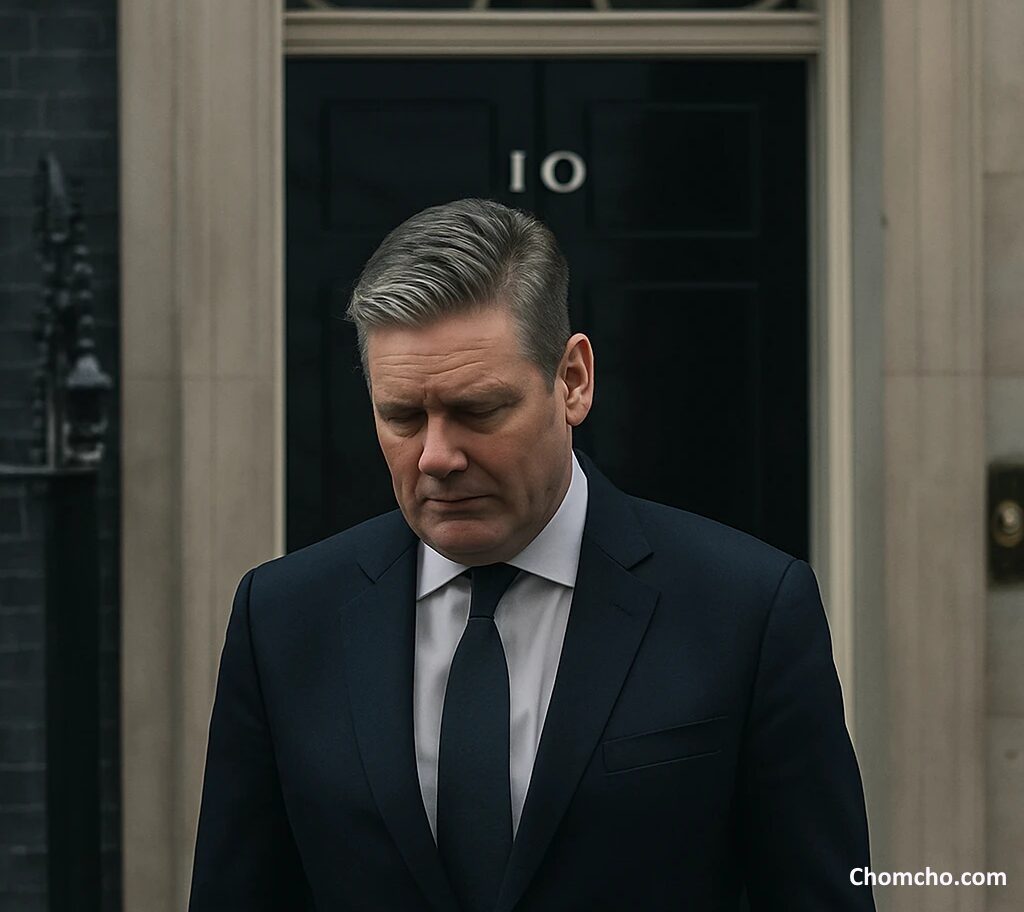
Seventh Prime Minister in Ten Years: Starmer Resignation Rocks Britain
On Monday, June 22, 2026, Keir Starmer announced his resignation outside 10 Downing Street, becoming the sixth UK Prime Minister to resign in ten years.
Standing before the cameras in a tearful statement, he said: “The question my party is asking now is whether I am best placed to lead us into the next general election. I have heard the answer of my parliamentary party to that question, and I accept that answer with good grace.”
The immediate trigger was Greater Manchester Mayor Andy Burnham winning the Makerfield by-election on June 18, entering Parliament with the explicit purpose of mounting a leadership challenge against Starmer.
Burnham won with a 9,200-vote majority, and within days, more than 95 Labour MPs had publicly called for Starmer to resign or publish an exit timetable.
Former Health Secretary Wes Streeting, once considered Burnham’s main rival for the leadership, announced he would support Burnham instead.
Starmer will remain as caretaker Prime Minister until Labour completes its leadership contest, with nominations opening July 9 and a new leader expected before Parliament returns in September.
Burnham is the overwhelming frontrunner.
We saw this coming: Labour’s long collapse
Chomcho.com reported on May 11, 2026, that a Starmer resignation was imminent, as Labour collapsed in local elections and internal pressure mounted.
It took six weeks, but it happened exactly as foreseen. The seeds of this collapse were planted long before Makerfield.
In May’s local elections, Labour cratered to a humiliating 17 percent of the vote while Nigel Farage’s (@Nigel_Farage) Reform UK surged to 26 percent, sweeping councils across England.
Dozens of Labour MPs began openly calling for Starmer to set a departure timetable.
Several senior ministers resigned in the weeks that followed, citing a loss of confidence in his leadership.
In January 2026, YouGov found that 75 percent of Britons held an unfavourable view of Starmer, a net favourability rating of minus 57, a number only previously matched by the disastrous Liz Truss.
Starmer also burned goodwill early in his tenure by appointing Peter Mandelson as British Ambassador to the United States, a choice he later called a mistake after the January 2026 release of Epstein files revealed Mandelson’s close ties to convicted sex offender Jeffrey Epstein. Mandelson was then forced out.
Later, Starmer’s Chief of Staff Morgan McSweeney resigned in February 2026, taking formal responsibility for the appointment.
The institution was already rotting from within long before the final blow arrived.
MP Rupert Lowe’s rape gang report and the real reasons Britain is celebrating on June 22, 2026
The official reason for the Starmer resignation is electoral failure.
The real reasons run far deeper, and they are the ones millions of ordinary Britons have been demanding accountability for since long before this week.
Starmer served as Director of Public Prosecutions from 2008 to 2013, the very years when predominantly Muslim Pakistani grooming gangs were systematically abusing girls across Rotherham, Rochdale, Oxford, and dozens of other British towns.
Critics have long argued that his office prioritized political sensitivity over justice for the victims.
On June 17, 2026, Restore Britain MP Rupert Lowe (@RupertLowe2) released the “Rape Gang Inquiry Report,” formally documenting an estimated 250,000 victims.
The report states that “predominantly Muslim Pakistani gangs across towns and cities throughout the United Kingdom engaged in the systematic targeting of predominantly white girls,” and that “clear evidence of organised abuse was ignored because confronting it risked accusations of racism.”
The report landed like a political bomb on a Prime Minister already fighting for survival.
There was more.
In August 2024, when three little girls were stabbed to death in Southport by a man whose parents had emigrated from Rwanda, Starmer called the outraged Britons who took to the streets “far-right thugs.”
On St. George’s Day, he banned a British patriot march while allowing a pro-Palestinian Nakba Day march in the same city the same day.
He recognized Palestinian statehood with zero conditions, prompting Conservative leader Kemi Badenoch (@KemiBadenoch) to declare: “We will all rue the day this decision was made.”
The grooming gang betrayal, the Epstein ambassador, the double-standard march bans, the Southport insult: these are the real reasons Britain is not mourning the Starmer resignation on June 22, 2026.
Trump called it first: the US perspective
@realDonaldTrump announced Starmer’s resignation before Starmer himself confirmed it, posting on Truth Social on Sunday June 21:
“Keir Starmer will resign as Prime Minister of The United Kingdom. He failed badly on two very important subjects: IMMIGRATION AND ENERGY (OPEN NORTH SEA OIL!). I wish him well!”
It was a remarkable moment, the sitting US President scooping the British press on their own Prime Minister’s departure. As we like to say in Spanish, Trump doesn’t have hairs on his tongue. In plain English: he never minces his words, and he is never afraid to say what everyone else is thinking.
Washington had found Starmer a difficult partner.
During the Iran conflict, Britain refused to grant US forces access to bases while the shooting was still happening, a decision Trump said at the time he would remember.
The contrast between Starmer’s relationship with Washington and the warm personal bonds Trump has built with Javier Milei in Argentina, Nayib Bukele in El Salvador, and now Abelardo de la Espriella in Colombia could not be more obvious.
For months many Americans and Britons on X had also demanded accountability for Starmer’s grooming gang record.
Those calls have only grown louder since the Lowe report’s release, with many arguing that resignation is not nearly enough and that prosecution for institutional failures should follow.
What comes next: Burnham, Reform, and the road to 2029
Let us be clear about one sobering reality: Labour remains in power. Starmer’s exit does not change that.
Andy Burnham, his likely successor, is another Labour man, another open-border, tax-and-spend progressive, just with a northern English accent and a talent for winning elections in places where Reform UK has been surging.
The machinery of the globalist Left runs deeper than any single leader, and Burnham himself acknowledged as much, saying the country “expects stability, seriousness and a continued focus on the issues that matter most.”
Britain does not escape the globalist grip that easily.
But here is the difference: Starmer’s fall was never just about politics. For millions of Britons, this was personal.
The grooming gang victims, their families, the communities that watched official institutions look the other way for decades while their daughters were destroyed, they did not want a policy debate.
They wanted accountability.
Starmer represented not just a left-wing party, but a system that failed them at the most intimate and devastating level imaginable.
His resignation, whatever comes next, is felt differently than a normal change of government.
What gives conservatives real hope is the continued rise of @Nigel_Farage and Reform UK.
With 26 percent of the vote in local elections and Farage building real organizational capacity across the country, the next general election, expected no later than 2029, represents a genuine shot at the first conservative government in Britain that actually governs as conservative.
The Starmer resignation closes one painful chapter.
The next chapter is still being written, and for the first time in a long time, the people writing it may not be the globalist establishment.
Britain deserves better, and for the first time in years, better looks possible.