
This post is also available in:
 Português
  Español
  Français
  Deutsch
  Italiano
  Русский
  Nederlands
  日本語
日本語  Polski
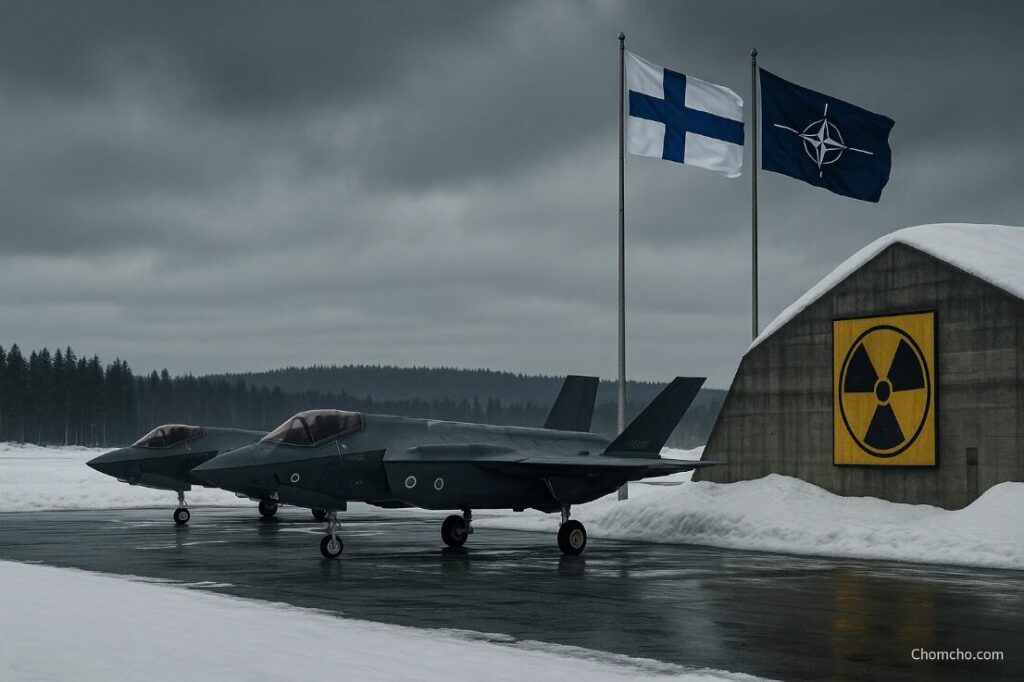
Russia Finland border: Moscow masses troops as NATO’s nuclear shadow grows
On June 27, 2026, Aleksey Zhuravlyov, first deputy chair of Russia’s State Duma Defense Committee, threatened to “blow up half of Finland.”
He made the statement publicly, citing what Moscow describes as Finnish provocations tied to NATO alignment and American weapons infrastructure on Finnish soil.
It was not a casual remark from a fringe politician.
It came from a senior member of Russia’s parliamentary defense establishment, one week after a joint Scandinavian-Baltic investigation confirmed Russia is building military capacity along the Russia Finland border at a scale not seen since the Cold War.
This is where Europe’s eastern front stands on June 29, 2026.
A brief history: why Finland changed its mind
For over 70 years after World War II, Finland walked a careful diplomatic line.
It remembered the Soviet Union’s invasion of November 1939, the Winter War, when Finnish soldiers held back a force many times their size through extraordinary courage and paid for their survival by ceding territory in the peace agreement.
Finland never forgot that lesson. It stayed officially neutral, maintained its own strong military, but kept its distance from NATO.
That changed on February 24, 2022, when Russia invaded Ukraine.
Finland watched. It drew its own conclusions.
On April 4, 2023, Finland became NATO’s 31st member, adding 1,340 kilometers of new NATO border directly with Russia, more than doubling the alliance’s land frontier with Moscow overnight.
Putin’s invasion of Ukraine clearly created the very problem he now complains about.
What satellite images reveal at the Russia Finland border
A joint investigation published on June 10, 2026 by Norwegian broadcaster NRK, Swedish broadcaster SVT, Danish broadcaster DR, and Estonia’s Delfi, based on satellite imagery from Planet Labs, documented Russia’s ongoing military expansion in detail.
New barracks, ammunition depots, reactivated Soviet-era airbases, and large equipment storage facilities are appearing at multiple locations close to Finnish territory.
At Kamenka in Russia’s Leningrad region, just 65 kilometers from the Finland border, more than 130 military tents capable of housing 2,000 troops have appeared at a restored Cold War-era base.
Military engineering vehicles are clearing land nearby, indicating permanent expansion.
In Petrozavodsk, three large hangars have appeared suitable for approximately 50 armored vehicles each, with a fourth under construction.
In Pechenga near the Norwegian border, a base previously holding 7,000 troops is expanding to accommodate up to 17,000.
Lieutenant General Pasi Välimäki, Commander of the Finnish Army, confirmed the picture.
Russia’s expanded infrastructure could eventually accommodate around 80,000 troops near Finland’s border, up from roughly 20,000 previously.
Combined with other northern European buildups, Russia could station up to 115,000 personnel along its borders with Northern Europe and the Baltic region.
Thomas Nilsson, head of Sweden’s Military Intelligence and Security Service, stated his agency does not believe the buildup is merely for show. It is aimed at preparing capabilities for a future large-scale confrontation with NATO.
Finland’s Defense Minister Antti Hakkanen kept his language measured but firm: “Russia’s moves to strengthen its armed forces have not come as a surprise to Finland. Together with our allies, we are closely monitoring and assessing Russia’s activities and intentions.”
Calm words from a country that remembers the Winter War very well.
Finland raises the nuclear stakes — and Moscow notices
Finland is not passively waiting to be defended.
Since joining NATO, it has raised its military reservist age limit to 65, effective January 2026. It can mobilize 280,000 wartime troops, backed by a reserve pool of nearly 900,000 trained citizens.
In a nation of 5.6 million, nearly one in six people has military training and can be called up if needed. In a full national emergency, Finland’s total fit-for-service population could reach nearly 2 million.
It is increasing defense spending to 3% of GDP by 2029, well above NATO’s standard 2% target.
NATO has established a permanent Forward Land Forces presence in northern Finland.
But it is Finland’s nuclear moves that have most alarmed Moscow.
In April 2026, Finland’s government submitted proposals to parliament to amend its Atomic Energy Act and Criminal Code to lift the longstanding ban on importing, storing, and possessing nuclear weapons on Finnish soil.
The specific weapon under discussion is the B61-12, America’s newest tactical nuclear gravity bomb.
The B61-12 is a precision-guided nuclear weapon with a variable yield of up to 50 kilotons, deliverable by Finland’s incoming F-35A fighter jets.
A single B61-12 carried by a Finnish F-35 could strike targets deep inside Russian territory.
The U.S. is also reportedly in discussions about a formal nuclear sharing agreement with Finland similar to those it already holds with Belgium, Germany, Italy, the Netherlands, and Turkey.
In November 2025, a U.S. Air Force B-52H strategic bomber flew over Finnish airspace escorted by Finnish F-18 fighters, one of a growing series of nuclear-capable strategic bomber operations over the territory of new NATO members.
From a purely strategic standpoint, placing nuclear-capable aircraft and potentially nuclear weapons storage on a 1,340-kilometer border with a nuclear power is not a gesture designed to lower tensions.
Russia’s frustration, expressed in threatening and unacceptable language, stems from a genuine strategic concern.
That does not make Zhuravlyov’s threats acceptable. But it does make them understandable.
Trump’s signal: don’t push Russia too far
This tension between deterrence and provocation is precisely why the Trump administration made a significant decision in May 2026.
According to Politico, citing two European officials and one U.S. official, the Pentagon canceled plans to deploy the Typhon missile system to Germany.
The Typhon is a land-based launcher capable of firing Tomahawk cruise missiles with ranges exceeding 1,600 kilometers, well within reach of Moscow from German soil.
Two official reasons were stated: first, America’s missile stockpiles were depleted after the Iran campaign. Second, Washington does not want to provoke Russia.
As we reported at Chomcho.com, Putin lowered Russia’s nuclear threshold in November 2024, formally revising Moscow’s doctrine to treat any conventional attack on Russia supported by a nuclear power as a joint nuclear attack.
Placing Tomahawk missiles capable of reaching Moscow in the heart of Europe is precisely the kind of move that tests that doctrine.
Trump is reading that signal carefully.
America First means avoiding European wars, not triggering them.
The EU’s own expansionist agenda compounds the problem.
Brussels has been actively pushing Armenia toward EU membership, with French President Emmanuel Macron even offering weapons to Yerevan.
EU expansion toward the Caucasus and Eastern Europe is steadily cornering a nuclear-armed Russia.
When you back a nuclear power into a corner, the risks are not theoretical.
Finland is still our ally and is doing its part
None of this means Finland is wrong to defend itself. Quite the opposite.
Finland may be making moves that irritate Moscow. Storing nuclear weapons on its soil, hosting U.S. missile infrastructure, raising an army of 280,000 reservists up to age 65.
These are the actions of a sovereign nation that watched its neighbor invade Ukraine and drew the rational conclusion that neutrality is no longer a guarantee of survival.
Finland is still our ally. And while the United States remains in NATO, Europe can expect America to meet its military obligations.
That has always been true regardless of political friction.
What America does not necessarily expect, however, is that European allies will return the favor in other theaters. Trump said it plainly on social media during the Iran conflict: “We will protect them, but they will do nothing for us, in particular, in a time of need.”
When the next Taiwan crisis comes, or the next Pacific confrontation, European capitals will most likely look the other way.
That asymmetry is worth remembering.
But on the Russia Finland border, the picture is clear for now. Finland has answered Trump’s call.
It is spending 3% of GDP on defense. It is training its population to fight.
It is not asking America to carry its weight.
In March 2026, NATO completed Cold Response 26, one of the largest winter warfare exercises in the alliance’s recent history, involving about 32,000 troops training for Arctic combat conditions across the Nordic region.
The message to Moscow was unmistakable.
Putin should remember what happened the last time Russia underestimated Finland. That was 1939. The result was not what Moscow expected.
For now, Finland is still our ally.