
This post is also available in:
 Português
  Español
  Français
  Deutsch
  Italiano
  Русский
  Nederlands
  日本語
日本語  Polski
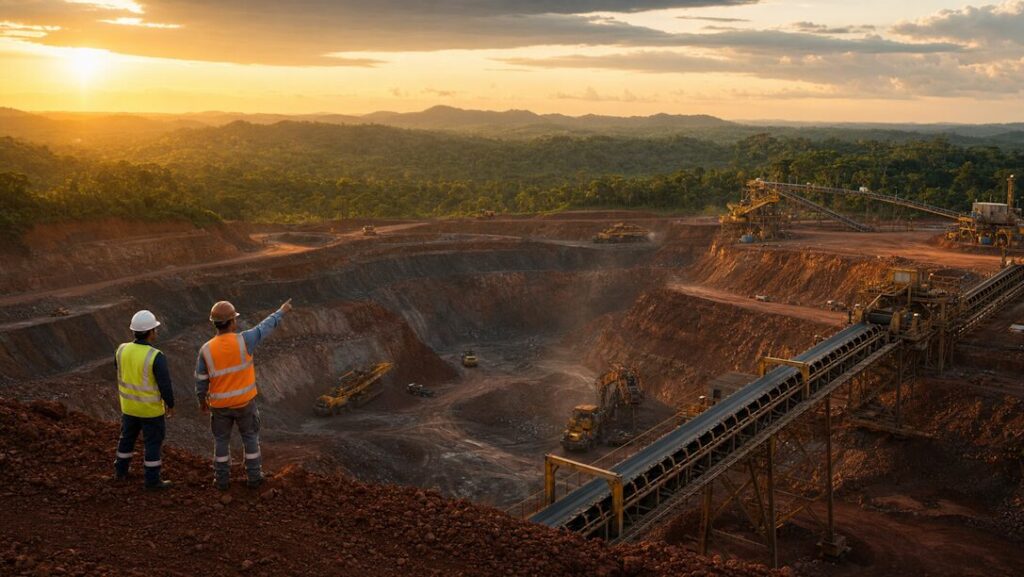
Brazil rare earths: Lula plays both sides — and holds all the cards
Brazil rare earths just became the most strategically important minerals story on the planet outside China — and most Americans have no idea it is happening.
On May 7, 2026, Brazilian President Luiz Inácio Lula da Silva (@LulaOficial) sat across from President Trump at the White House for a three-hour meeting that ran more than an hour past its scheduled time.
The main topic was not trade deficits or immigration. It was rare earths.
Lula’s message was direct: “We have no preference. What we want is to share with whoever wants to invest in Brazil.”
Brazil welcomes investment from the United States, China, Germany, France, and Japan — equally, with no vetoes and no exclusions based on geopolitical alliance.
But there is one absolute condition: all processing and refining of rare earths must happen on Brazilian soil.
No raw ore leaves the country unprocessed. Period.
Lula explicitly rejected what he called the “colonial model” — the historical pattern of developing nations shipping raw minerals abroad, only to buy back finished high-value products at a premium.
Brazil rare earths will not follow that pattern. Not under Lula. Not on his watch.
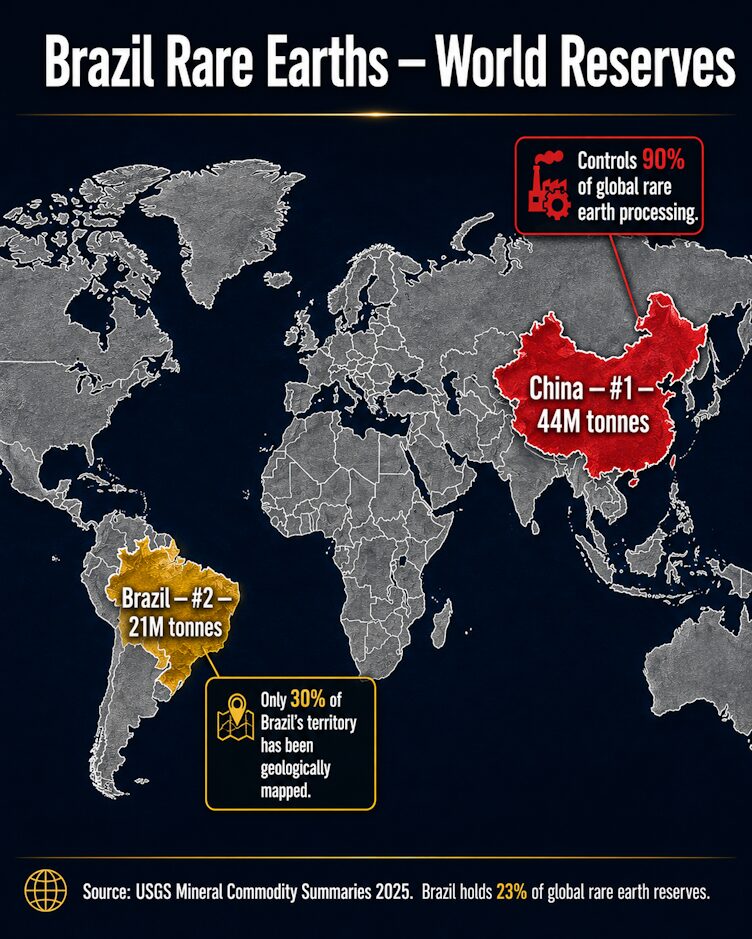
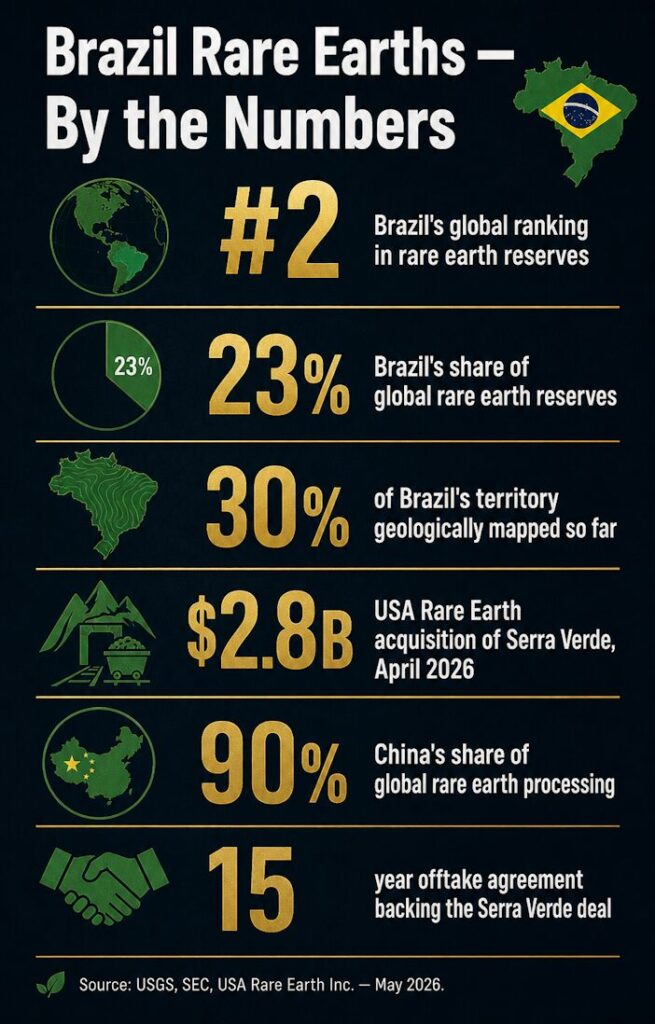
Brazil holds the world’s second-largest rare earth reserves — approximately 21 million tonnes, representing nearly 23% of global reserves, second only to China.
But here is the detail that makes this story even more extraordinary: geologists have only formally mapped — meaning scientifically surveyed and documented underground mineral deposits through drilling, seismic testing, and laboratory analysis — approximately 30% of Brazil’s 8.5-million-square-kilometer territory.
The remaining 70%, much of it deep Amazon rainforest and remote interior, has never been systematically explored.
Brazil is already the world’s second-largest rare earth holder based on a fraction of what it likely contains.
Nobody knows how much more is down there.
That geological uncertainty is itself a form of geopolitical power.
What Lula is really protecting — oil, Petrobras, and national sovereignty
Brazil rare earths are not the only piece of Lula’s sovereignty strategy — they are part of a broader resource nationalism framework that connects oil, minerals, and industrial policy into one coherent national vision.
The Lula administration halted the divestment of key Petrobras assets in early 2026 and announced a $7,400 million investment commitment through 2030 — cementing the state-controlled oil giant as a permanent national champion.
Lula spoke at Petrobras’ giant Replan refinery in São Paulo and was explicit: Brazil’s subsoil resources must drive domestic industrialization, not enrich foreign nations.
Brazil’s approach most closely resembles Indonesia’s resource nationalism playbook — but applied at significantly larger scale.
With the Strait of Hormuz effectively closed for 88 days, Brazil has become India’s fourth-largest oil supplier — a direct consequence of the US-Iran war reshaping global energy flows.
Lula is simultaneously managing a booming oil export market and a rare earth gold rush — while keeping both Washington and Beijing interested without committing to either.
That is not ideology. That is masterful strategic positioning.
The China question — and why Washington must close the Serra Verde deal
Here is the tension at the heart of the Brazil rare earths story — and it is a tension every American conservative must understand.
Lula told Trump directly at the White House that Brazil’s rare earth reserves are open to investment from China on the exact same terms as the United States.
Chinese interest is enormous — Beijing needs to secure upstream supply for its own processing industry.
We covered this in detail at Chomcho.com in our G7 rare earths article from Paris: China currently processes approximately 90% of global rare earths and between 47% and 87% of all critical minerals globally.
That monopoly is a national security weapon — one Beijing can deploy at any moment against any nation that crosses it.
That is precisely why the $2,800 million USA Rare Earth acquisition of Serra Verde — Brazil’s only commercial rare earths producer and the only scaled producer of all four magnetic rare earth elements outside Asia — is one of the most strategically important deals of 2026.
The acquisition is backed by the US Department of Commerce, the Department of Energy, and the International Development Finance Corporation.
It includes a 15-year offtake agreement with price floors for the four critical magnetic rare earths.
Serra Verde CEO Thras Moraitis said the combined company will create “best-in-class capabilities across mining, processing, separation, metallization and magnet making.”
This deal must close.
If it doesn’t — if Brazilian politics, Chinese counter-offers, or regulatory delays derail it — Beijing moves in. And the window to build a China-free rare earth supply chain gets smaller every month.
USMCA, Mercosur, and Brazil’s bigger chess game — the urgency is real
Brazil is watching the USMCA Mexico talks with intense interest — and the stakes could not be higher.
If Mexico accepts US demands to block Chinese transshipment and raise tariffs on non-North American goods, Brazil becomes the next target for identical pressure.
Both countries export cars, steel, and auto parts to the US.
If Mexico secures preferential USMCA access while Brazil faces Trump’s 15% global tariff, Brazilian exporters are directly disadvantaged — and Brazil’s leverage in rare earth negotiations weakens.
Brazil Vice President Geraldo Alckmin has already indicated Brazil wants to advance talks with the US on rare earths, big tech, and data centers.
Lula is simultaneously pursuing Mercosur-Japan trade talks, pushing the EU-Mercosur deal forward, and positioning Brazil as neutral ground for US-China mineral negotiations through BRICS.
The urgency here cannot be overstated. We wrote in our G7 rare earths Paris article that experts warn building alternative rare earth supply chains could take years or even decades.
Brazil rare earths represent the single fastest path to breaking China’s monopoly outside of Asia — right now, today, with an operational mine already producing.
The Serra Verde deal is not just a business transaction. It is a national security imperative.
The Bible reminds us in Proverbs 13:4 that the soul of the sluggard craves and gets nothing, while the soul of the diligent is richly supplied.
America has been sluggish on critical minerals for three decades. The Serra Verde deal is the moment to change that. The diligent act now.
Washington cannot afford to wait.