
This post is also available in:
 Português
  Español
  Français
  Deutsch
  Italiano
  Русский
  Nederlands
  日本語
日本語  Polski
Canada Arctic NATO — the frozen frontier is now a hot war zone
For most of modern history the Arctic was considered a geopolitical afterthought — too remote, too frozen, and too expensive to matter strategically.
That calculation is now obsolete.
Climate change — whatever one thinks of its causes and politics — is producing one undeniable military consequence: the Arctic is melting, and as it melts, it is opening.
New shipping lanes are becoming navigable for the first time.
Vast reserves of oil, natural gas, and critical minerals that were previously locked under permanent ice are becoming accessible.
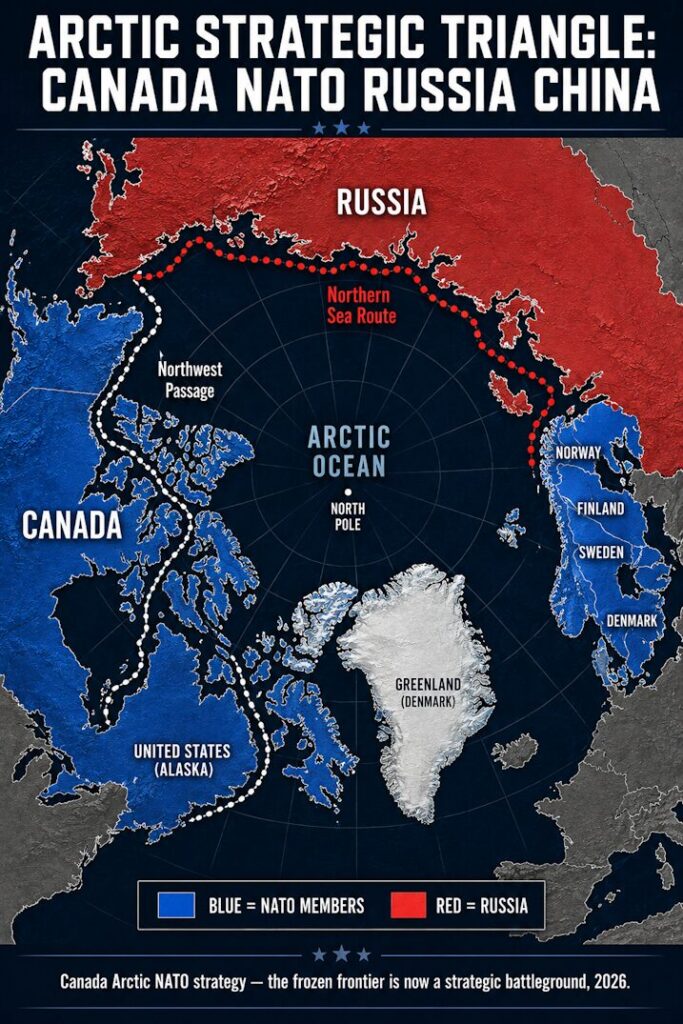
The Northwest Passage — the legendary Arctic route connecting the Atlantic and Pacific oceans through Canadian territory — is transitioning from a historical curiosity into a potential global shipping corridor.
Some analysts already compare its emerging strategic importance to the Panama Canal — which is itself facing reduced water levels and operational constraints due to climate change.
If both trends continue, the Northwest Passage may not just complement existing global trade routes. It may eventually rival them. Whoever controls that corridor controls a new chokepoint in world commerce.
Russia understood this first. China understood it second. The West is now scrambling to catch up.
Canada Arctic NATO policy is no longer a niche defense discussion.
It is the emerging front line of great-power competition in the 21st century.
Canada’s core Arctic priorities and NORAD modernization
Canada’s response to this new strategic reality has been substantial and overdue.
At the center of that response is the modernization of the North American Aerospace Defense Command (NORAD) — the joint U.S.-Canada military command founded in 1958 to detect and defend against threats approaching North America from the Arctic.
Originally designed to track Soviet nuclear bombers crossing the polar region during the Cold War, NORAD today monitors threats from Russia, China, and North Korea across aerospace, missile, and maritime domains.
It is the backbone of continental defense — and it is badly in need of an upgrade for the threats of the 21st century.
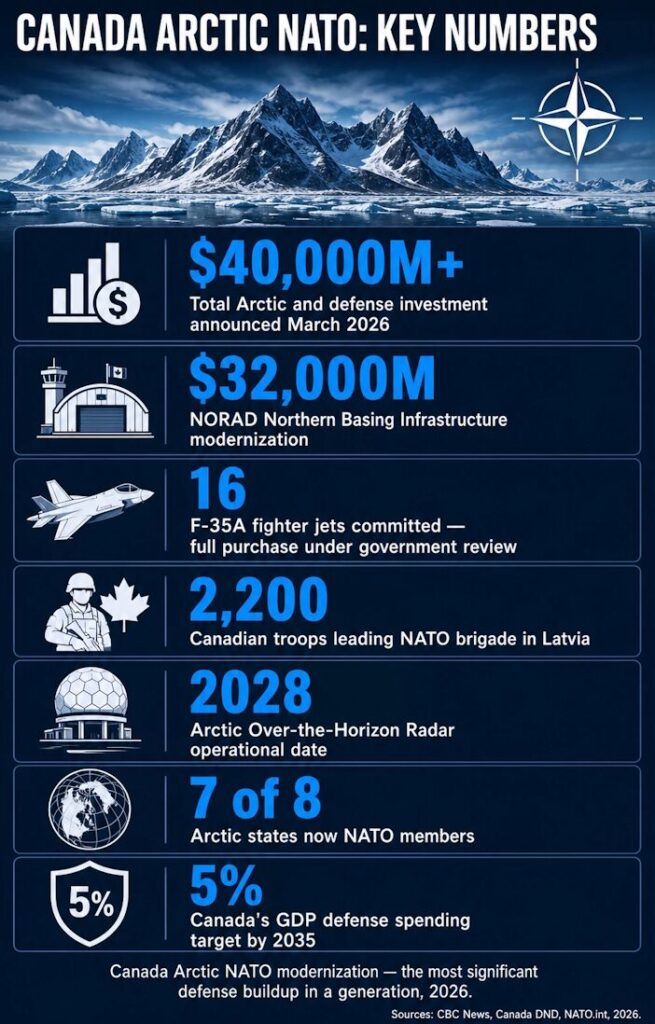
On March 12, 2026, Prime Minister Mark Carney announced more than $40,000 million in combined Arctic investments — including approximately $32,000 million allocated specifically to NORAD Northern Basing Infrastructure modernization.
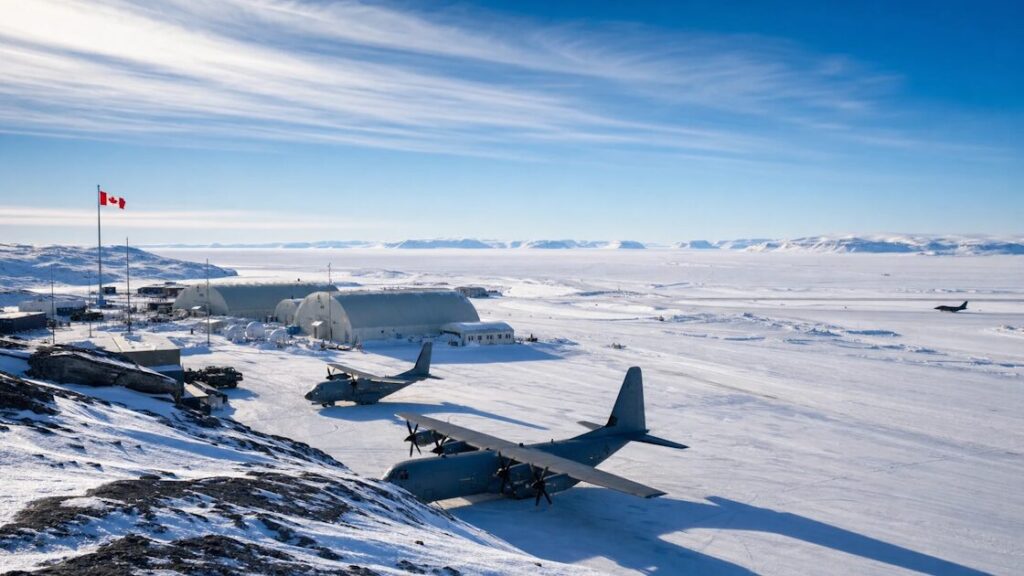
The plan includes upgrades to forward operating locations in Yellowknife, Inuvik, Iqaluit, and Goose Bay — the four critical bases that form Canada’s Arctic military backbone.
New airfield improvements, aircraft hangars, fuel storage, ammunition facilities, and advanced IT infrastructure are all included.
Canada legally committed to the first 16 F-35A Joint Strike Fighters with deliveries expected by end of 2026 — but Prime Minister Carney placed the remaining 72 aircraft under review after Trump imposed tariffs on Canada, with the final decision still pending and European alternatives under consideration.
The Arctic Over-the-Horizon Radar system — designed to provide early warning coverage from the Canada-U.S. border all the way to the Arctic circle — is expected to be operational by 2028.
A Polar Over-the-Horizon Radar system covering the northernmost Arctic approaches is planned for 2032.
These are not symbolic investments.
Canada Arctic NATO modernization is now the most significant defense buildup in a generation — driven by a threat environment that is accelerating faster than the original timelines anticipated.
Carney himself acknowledged it plainly: “We will no longer rely on others to defend our Arctic security. We’re taking full responsibility for defending our sovereignty.”
Canada’s NATO role — why it matters now
Canada’s Arctic commitment extends beyond its own borders.
In February 2026 NATO launched Arctic Sentry — a new dedicated military activity designed to strengthen deterrence and defense across the entire Arctic and High North region.
Seven of the eight Arctic states are now NATO members — a dramatic shift from just a few years ago before Finland and Sweden joined the alliance.
Canada leads a multinational NATO brigade in Latvia on NATO’s eastern flank and has committed to expanding its presence to 2,200 troops — directly linking the Arctic theater with Europe’s eastern front in a single unified deterrence posture.
Canada and its Arctic allies — Denmark, Finland, Iceland, Norway, Sweden, and the United States — issued a joint statement in May 2026 emphasizing that Russia’s military activity and China’s growing strategic interest require a coordinated allied response.
“With Russia’s increased military activity and China’s growing strategic interest, we seek to bolster stability in the Arctic region,” the statement read.
The message from Ottawa and Brussels is consistent: the Arctic is no longer a peripheral concern. It is a core component of NATO’s collective security architecture.
The Russia-China-US triangle in the Arctic
Three great powers are now competing for Arctic dominance — and their interests could not be more divergent.
Russia derives at least 20% of its entire GDP from Arctic resource extraction and has constructed military bases all along its Northern Sea Route — the passage connecting European Russia to the Pacific along Siberia’s northern coast.
Moscow’s Northern Fleet is the largest in the Russian Navy. Russia views Arctic dominance as both an economic lifeline and a strategic imperative.
China — despite having no Arctic coastline — has declared itself a “near-Arctic state” and is pursuing its Polar Silk Road strategy as an extension of the Belt and Road Initiative.
Beijing has invested in scientific research stations, icebreaker construction, and Greenland mining interests.
China’s Arctic ambitions are economic on the surface and strategic underneath.
The United States and Canada — joined through NORAD — represent the third corner of this triangle.
NORAD modernization will only work if the Arctic approaches can actually be monitored and defended — a reality that makes Canada’s $40,000 million investment directly relevant to American national security.
Continental defense has never been an American project alone.
The fastest route to attack the continental United States runs through the Arctic — a fact that former NATO Secretary General Stoltenberg made explicit in a visit to Canada’s Arctic in 2022.
America First — Canada must pay its share and pull its weight
From an America First perspective the Canada Arctic NATO story has both encouraging and frustrating elements.
The $40,000 million Arctic investment, the Royal Canadian Air Force rearmament, and NORAD radar upgrades — these are genuine commitments that strengthen North American continental defense.
Canada has now reached the NATO 2% of GDP defense spending target and has committed to reaching 5% by 2035 — one of the most aggressive defense spending trajectories in the alliance.
The frustrating part: it took Donald Trump’s pressure, his pointed comments about Greenland, and his consistent demands for allied burden-sharing to accelerate what should have happened years earlier.
Canada spent decades underfunding its Arctic defenses while benefiting from American military presence and nuclear deterrence.
The Arctic gap was real and dangerous — and Washington carried the weight of filling it.
President Trump’s demand that allies pay their share is not isolationism. It is accountability.
Canada Arctic NATO cooperation is most valuable to America when Canada is a genuine equal partner — not a dependent.
The investments announced in 2026 are a step in the right direction.
The question is whether future Canadian governments will stay the course or revert to the chronic underfunding that created the vulnerability in the first place.
The Arctic is no longer frozen. Neither is the competition for it.