

This post is also available in:
 Português
  Español
  Français
  Deutsch
  Italiano
  Русский
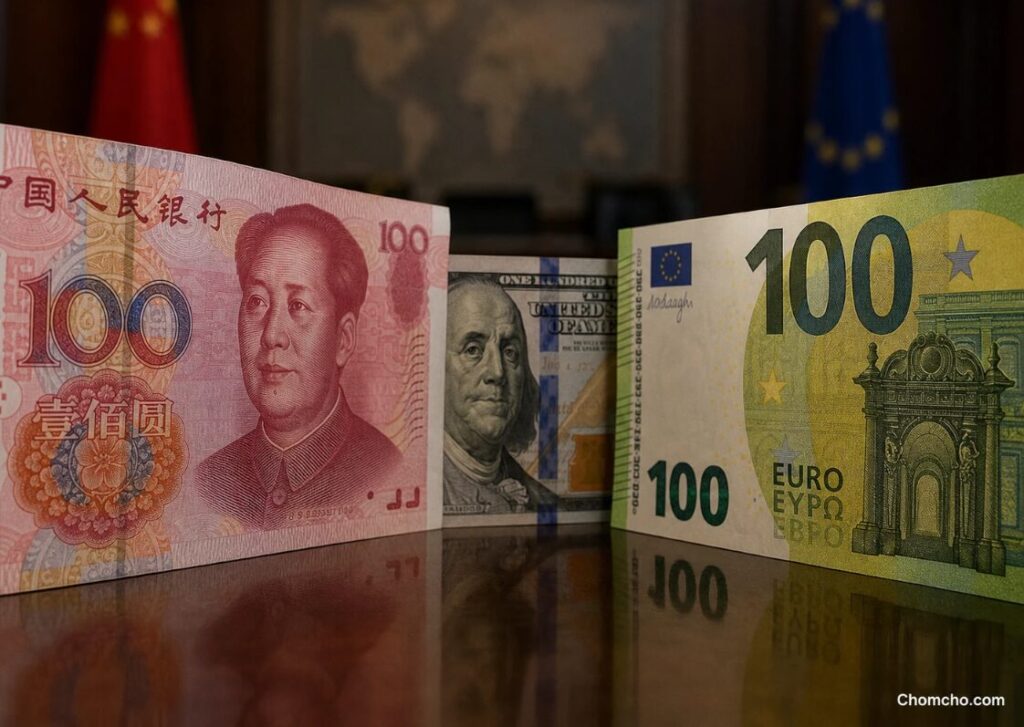
Merz says the yuan is rigged, and he just exposed the contradiction inside China currency goals.
German Chancellor Friedrich Merz told students at Cologne University on Monday, July 13, that China’s currency, the yuan (not to be confused with the Japanese yen), has been undervalued by 25 percent “for years.”
He said the European Union cannot win, no matter how innovative it is, against a competitor that artificially manipulates its own money.
His demand is simple: China must let the yuan float freely, with its price set by the market like the dollar or the euro.
The numbers behind his frustration are brutal. The EU’s trade deficit with China reached 360,000 million euros in 2025, a jump of almost 20 percent in one year. German car exports to China have collapsed 66 percent from their 2022 peak.
What exactly is Germany accusing China of?
In most Western countries, the market decides what a currency is worth. In China, the central bank announces a daily reference price and only lets the yuan move inside a narrow, controlled band.
Thus, the value of China’s money is a government decision.
A cheap yuan makes Chinese cars, machines, and solar panels artificially cheap in Europe.
Merz’s proposed fix is an international agreement to raise the yuan’s value, similar to the 1985 Plaza Accord that revalued the Japanese yen.
China knows that history well. Many in Beijing blame that deal for Japan’s economic “lost decades,” and they have no intention of repeating it.
What does China really want its currency to become?
Here is where it gets interesting. China really has two separate goals for the yuan, and it helps to keep them apart.
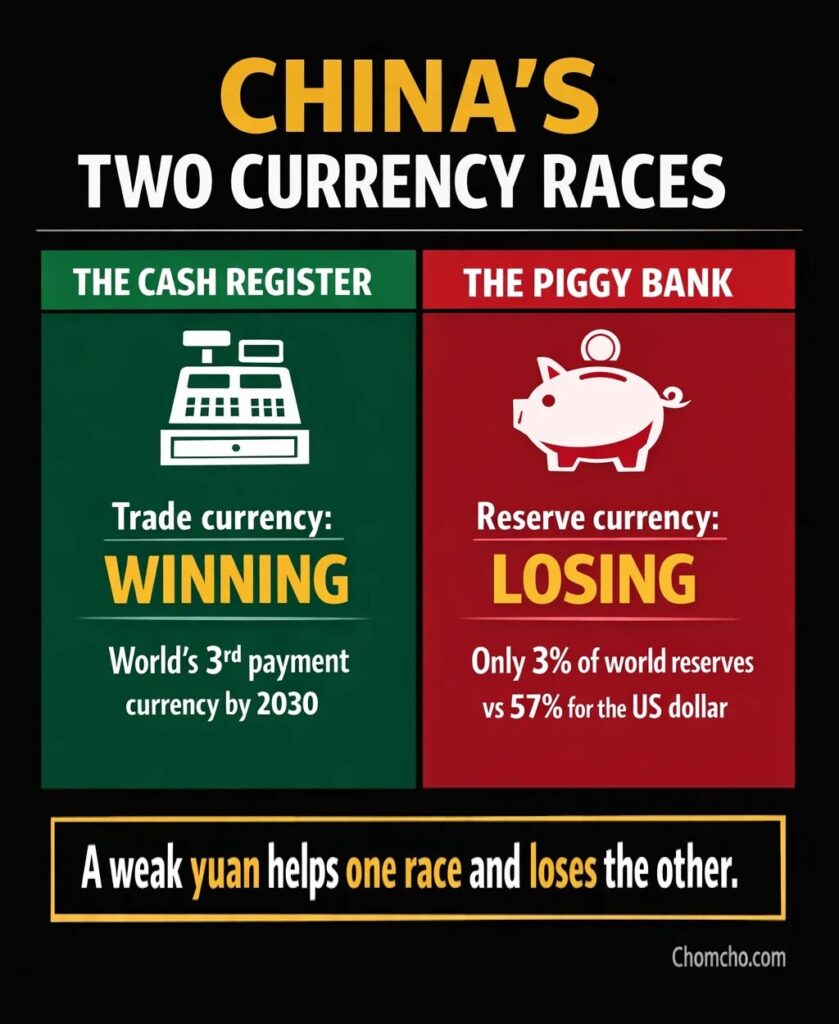
Objective one: the piggy bank. China wants the yuan to become a reserve currency, the money that governments, central banks, and pension funds trust to store value safely for the long term.
Today, the world fills that piggy bank mostly with US dollars.
Objective two: the cash register. China wants the yuan to become a trade currency, the money used to actually pay for goods crossing borders.
President Xi Jinping has openly declared both ambitions. In a speech officially published by Beijing in February 2026, Xi said the yuan “should be widely used in international trade, investment, and foreign exchange markets while achieving global reserve currency status.”
There is even a technical wrinkle inside this second objective.
The yuan already has real influence as a settlement currency, the money used to make the payment, but it lags as an invoicing currency, the money the price is written in.
A Brazilian importer, for example, can sign a contract priced in dollars but pay the bill in yuan.
The world sometimes pays in yuan, but it still prefers to write its prices in more stable dollars.
Can a weak currency become the world’s piggy bank?
A trade currency is like a hot potato, metaphorically speaking. You receive it, you spend or consume it, and you never need to trust the value of the money for long.
A weak yuan is no obstacle here. It may even help, since cheap Chinese goods give everyone a reason to use it.
But nobody stores their life savings in a hot potato. A reserve currency requires stability, predictability, and trust, exactly what a government-managed currency cannot promise.
If Beijing can push its currency down to help exporters, it can push down the value of your country’s savings too.
Edwin Lai, professor of economics at the Hong Kong University of Science and Technology and author of a leading book on the yuan, predicts the yuan will become the world’s third payment currency by 2030.
Yet he also argues that trade settlement will not have a first order impact on reserve status, because global financial transactions are far larger than trade.
The numbers prove the point.
The yuan handles a growing share of world payments, but it represents only about 3 percent of global reserves, against 57 percent for the dollar.
China is winning the cash register race and losing the piggy bank race. Its own weak yuan policy is one big reason why.
The digital yuan, a weapon for only one goal
China is also promoting the e-CNY, its official digital currency.
The technical name is a central bank digital currency, or CBDC, digital money issued and controlled directly by the state bank.
Under the new five year plan, Beijing is pushing the e-CNY for international payments through platforms that bypass the Western banking system entirely.
This is a powerful tool for the cash register goal. But a digital version of a controlled currency is still a controlled currency.
In fact, it gives the state even more control than paper money ever did. Every transaction is visible to Beijing, and a centralized digital system gives the government the technical power to freeze or cancel balances remotely.
Chinese trials have even tested digital money with expiration dates.
Would you keep your national savings in money the government can freeze or expire with one command?
Technology cannot manufacture trust.
Europe pays the bill either way
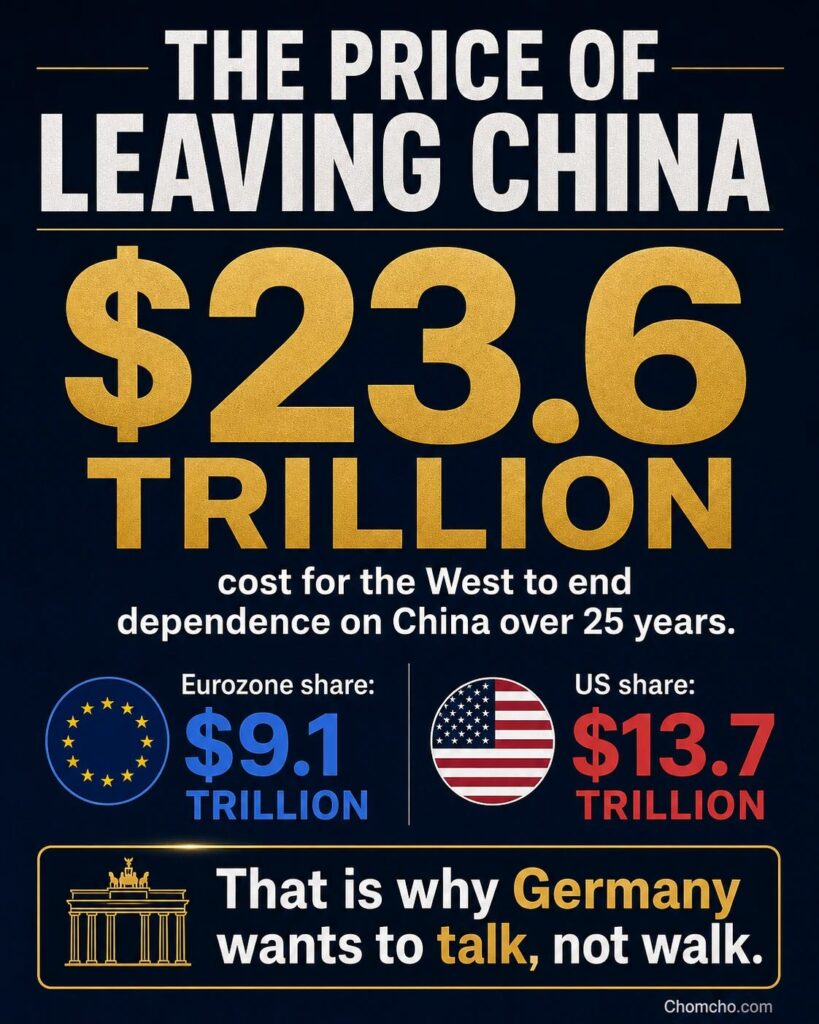
Why does Merz prefer talking to Beijing instead of breaking away from it?
Because the price of leaving is astronomical. EY-Parthenon, the consulting arm of the global accounting giant EY, calculates that the United States, the eurozone, and the United Kingdom would need to invest an extra 23.6 trillion dollars over 25 years to end their dependence on China, with the eurozone’s share at 9.1 trillion.
Europe’s actual plan is partial independence.
The new Industrial Accelerator Act creates “Made in Europe” rules: electric cars and other products must be largely built in Europe to qualify for public contracts, subsidies, and tax breaks.
But the rules only bite where public money is involved.
Purely private purchases remain largely open to Chinese products, a loophole critics say leaves the front door unlocked.
A tougher “overcapacity instrument” is still being debated, and Beijing has already threatened “resolute countermeasures” if it passes.
Germany’s problem is America’s problem
Everything Merz complains about applies to America too.
The same trade imbalances. The same struggle for industrial sovereignty.
And behind it all, the BRICS project of de-dollarization, which sits at the very core of China currency goals, is aimed directly at the dollar’s crown.
If the yuan ever wins the piggy bank race, the biggest loser is Washington, not Berlin.
The difference between these two powers is in the response.
President Trump acts: tariffs, reciprocity, and pressure that brings countries to the negotiating table.
Brussels debates: minimum price deals, content quotas with loopholes, and instruments that exist on paper while Chinese market share keeps growing.
Europe is slowly waking up to what America First supporters said years ago. No nation stays sovereign while its industry depends on a rival.
China wants the world’s trust and the world’s factories at the same time. However, it cannot really have both forever, and the free world still has the advantage.
The China currency goals have a contradiction at their core, and truth, like markets, always wins in the end!