
This post is also available in:
 Português
  Español
  Français
  Deutsch
  Italiano
  Русский
  Nederlands
  日本語
日本語  Polski
Putin at SPIEF 2026: the BRICS dollar replacement plan is no longer a secret
At the St. Petersburg International Economic Forum, Putin warned the world that dollar assets can be frozen at any moment.
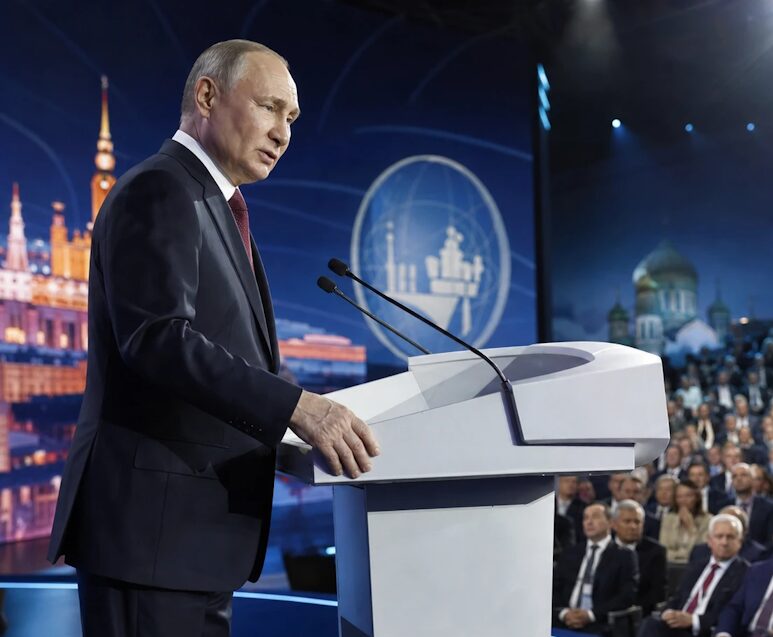
On June 5, 2026, Russian President Vladimir Putin delivered the keynote address at the plenary session of the 29th St. Petersburg International Economic Forum, known as SPIEF.
SPIEF is Russia’s flagship annual economic summit — roughly the Russian equivalent of Davos — and this year’s edition drew representatives from more than 130 countries under the theme “Pragmatic Dialogue: The Path to a Stable Future.”
Saudi Arabia was the guest nation of honor. China’s Vice President Han Zheng attended in person. The presidents of Uzbekistan and Tanzania were present.
And in a notable development, the Trump administration sent an official US representative — the first American delegation to attend SPIEF in several years.
What Putin said — and what BRICS is building to replace SWIFT
Putin’s central message was direct. “Any country can at any moment be deprived of access to its legitimate assets, which are placed in dollars or euros, as well as to Western financial payment infrastructure.”
He stated that Russia was never against US trade or the dollar itself — but that the SWIFT system and Western sanctions had been “weaponized like a financial nuclear weapon against anyone they don’t like.”
SWIFT, which stands for Society for Worldwide Interbank Financial Telecommunication, is the global messaging network that banks use to transfer money across borders.
Think of it as the internet of international payments — without access to it, a country’s banks cannot easily send or receive money globally.
Russia was largely cut off from SWIFT in 2022 following the Ukraine invasion.
The BRICS dollar replacement initiative aims to build a blockchain-based alternative — a decentralized payment network that no single government can freeze, block, or control.
Russia already has its own answer to SWIFT. It is called SPFS, short for System for Transfer of Financial Messages, a domestic interbank network used inside Russia and with select trading partners.
The more ambitious project is BRICS Bridge, a cross-border blockchain payment platform that would connect all BRICS member economies in a decentralized system no Western government could freeze or block.
Why BRICS wants to replace the dollar — and what China really wants
The BRICS bloc — originally Brazil, Russia, India, China, and South Africa, now expanded to include several new members — currently represents approximately 40% of global Gross Domestic Product measured by Purchasing Power Parity.
The G7, by comparison, accounts for less than 29%.
At SPIEF 2026, Putin noted that BRICS provided half of all global GDP growth in recent years, while the G7 contributed only 18%.
Russia’s stated reason for pursuing a BRICS dollar replacement is defensive — to avoid being punished by US sanctions.
But China’s motivations are different and more ambitious.
Beijing wants the Chinese yuan to become the dominant global reserve currency, replacing the dollar in international trade settlements.
China deliberately keeps its currency undervalued to make Chinese exports cheaper — a policy that fundamentally contradicts what a true global reserve currency requires.
No country trusts a currency that its own government manipulates for trade advantage.
That is China’s core problem and the reason the yuan has not gained meaningful traction in global trade despite Beijing’s enormous economic weight.
Why the dollar will not be replaced — and what Tether has to do with it
The arguments for dollar permanence are stronger than BRICS wants to admit.
The US dollar now handles 49% of all global SWIFT transactions — its highest share in 12 years — and nearly 60% when intra-Eurozone payments are excluded.
Despite all the BRICS blockchain summits and de-dollarization rhetoric, the dollar’s share of SWIFT payments actually ROSE by 9 percentage points in just two years. The euro collapsed from 39% to 21% in the same period. De-dollarization in SWIFT payments is not happening — it is reversing.
No other currency comes close. The euro handles about 22%. The Chinese yuan accounts for less than 5%.
More importantly, the dollar’s dominance is being reinforced from an unexpected direction — US dollar-backed stablecoins.
Tether and Circle, the two largest dollar stablecoin issuers, are essentially exporting digital dollars to every corner of the world, including nations that lack access to traditional banking.
We wrote about this recently at Chomcho.com — dollar digital dominance is being built not just by governments but by private American technology companies moving faster than any BRICS blockchain initiative.
The BRICS dollar replacement project is real as a long-term ambition.
As a near-term threat to American financial supremacy, it remains years behind schedule and internally divided.
The warning America should not ignore
Here is what nobody in Washington likes to say out loud.
When the US and its allies froze approximately $300 billion in Russian sovereign reserves in 2022, every government on earth took note.
Not just adversaries — allies too.
The message received was clear: dollar assets are not neutral. They are political.
That calculation is driving every BRICS meeting, every blockchain pilot project, and every bilateral currency swap agreement being signed from Riyadh to Beijing.
Russia is inviting everyone who fears Washington’s financial weapons to join the exit. Whether that fear is justified or not, America handed them the argument.
Trump’s America First strategy — energy dominance, manufacturing revival, fiscal discipline, and rebuilding American productive capacity — is the correct long-term answer.
A strong, productive, solvent America does not need to weaponize its currency. It wins on merit.
The dollar stays king when America earns that title, not just when it demands it.