
This post is also available in:
 Português
  Español
  Français
  Deutsch
  Italiano
  Русский
  Nederlands
  日本語
日本語  Polski
South Korea’s 500,000 drone warriors and the new war of drones
South Korea just made a bold military move.
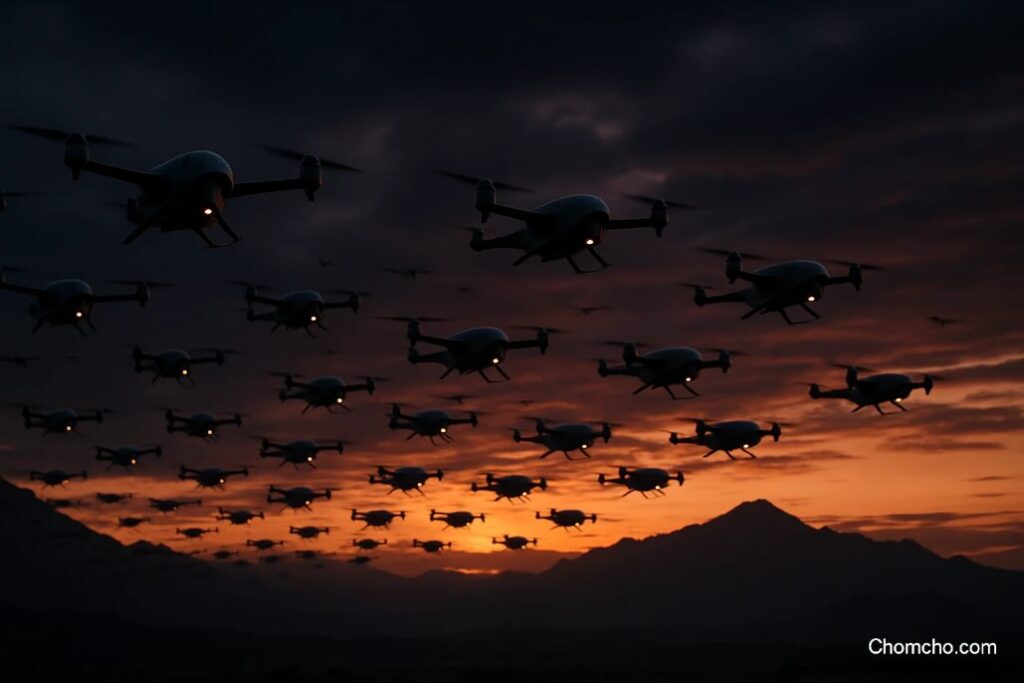
The country announced it will acquire 20,000 low-cost military drones, deploy AI-powered drone swarms along its frontline with North Korea, and train 500,000 soldiers to operate drones as a “second personal weapon.”
Half a million drone warriors. Let that sink in.
Defense Minister Ahn Gyu-back was direct about why.
The wars in Ukraine and the Middle East proved that cheap, mass-produced drones are now game changers on the battlefield.
North Korea is developing its own drone capabilities, posing growing threats not just to military targets but to South Korean civilian infrastructure.
And South Korea is still technically at war with the North. The 1950-1953 conflict ended in an armistice, not a peace treaty. That war never officially ended.
The new plan includes short-range reconnaissance drones, loitering munitions, a domestic long-range combat drone system, and counter-drone defenses along the frontline beginning next year.
Longer term, South Korea wants directed-energy weapons: lasers and high-power microwave systems.
This is not a minor procurement decision. It is a complete rethinking of what modern war looks like.
Ukraine is proving cheap drones can hold back a giant
Ukraine has been teaching the world something important.
Just on June 26, Ukraine launched one of the largest drone attacks of the entire war: more than 660 drones in a single night against Russia and occupied Crimea.
Targets included naval ships in Kerch, air defense radars, military airfields, fuel depots, and industrial infrastructure.
Russia was forced to defend Moscow, Crimea, and dozens of interior regions simultaneously.
You cannot defend everything at once.
That is exactly Ukraine’s strategy. Rather than relying on expensive cruise missiles, Ukraine floods Russian air defenses with waves of cheap strike drones, decoys, and reconnaissance platforms.
Russia then burns through interceptors. Gaps open. Follow-on drones hit the targets.
Ukraine went from producing a few thousand drones in 2022 to an estimated 4.5 million in 2025, with a target of 7 million or more in 2026.
More than 160 Ukrainian drone manufacturers are now operating.
A country devastated by war built the most prolific drone industry on earth.
This is the central lesson: a smaller, poorer nation held back a nuclear superpower in part because it mastered the production of cheap, smart drones at massive scale.
We covered this in depth in our earlier article on Ukraine war lessons at Chomcho.com.
Engineers are the new generals.
The war of drones goes global
Every serious military on earth is now racing to get this right.
The United States is buying Ukrainian-tested interceptor drones.
Army Secretary Dan Driscoll (@SecDriscoll) told Congress his service purchased 13,000 Merops interceptors in roughly 8 days, cutting through years of bureaucratic procurement.
“When the conflict kicked off, within about eight days, we were able to purchase 13,000 Merops, which are incredible,” Driscoll said. The U.S. also just deployed its own LUCAS drone in combat for the first time.
Here is the irony: the LUCAS is reverse-engineered from Iran’s Shahed-136.
America, the most powerful military on earth, copied a weapon from a country it was fighting. That tells you everything about how effective cheap drones have become.
Five NATO nations, the UK, France, Germany, Italy, and Poland, announced a joint program to build low-cost interceptor drones using Ukrainian battlefield expertise.
Iran has been a drone pioneer since the 1980s. Its Shahed family of cheap attack drones has been supplied to Russia, the Houthis, and Shiite militias across the Middle East.
Even after the U.S. and Israel struck its drone factories, Iran claimed a tenfold surge in production within months by dispersing assembly to smaller, hidden facilities.
Iran proved that even a sanctioned, isolated country can produce drones by the thousands.
Turkey took a different path. Its Bayraktar TB2 has been exported to more than 30 countries, including many in Africa.
Colombia’s Air Force is now reportedly in talks to purchase the newer Bayraktar TB3 to replace its aging Israeli-made fleet.
The war of drones is not a Ukraine story. It is a global story.
China’s double game
Beijing claims neutrality. The facts say otherwise.
China supplies roughly 80% of the critical components used in Russian drones: engines, batteries, optical systems, microchips, and fiber-optic guidance cables.
Three European intelligence agencies confirmed that China secretly trained 200 Russian military personnel on drone operations in late 2025, some of whom went on to fight in Ukraine.
China also ran a cynical dual supply line for years.
Before imposing formal export restrictions, Chinese drone components flowed to both Russia and Ukraine through a re-export network spanning the UAE, Hong Kong, Turkey, Kazakhstan, Kyrgyzstan, and Serbia.
As President Zelensky stated bluntly in May 2025: “Chinese Mavic is open for Russians but closed for Ukrainians.”
Beijing cut Ukraine off while continuing to arm Russia.
That is not neutrality. That is choosing a side while pretending not to.
China understands that a weakened, distracted West benefits its long-term ambitions in Taiwan and the Pacific.
Helping Russia bleed NATO countries dry of weapons and money is perfectly aligned with that goal.
One Pentagon official warned that China could shut down the global drone industry for an entire year if it chose to.
That is a national security threat hiding in plain sight.
Latin America’s wake-up call: from Ukraine to the cartels
Latin America is watching Ukraine and Iran. But the real alarm is not coming from overseas.
It is coming from within.
In Mexico, cartels are already operating a shadow drone war at the U.S. border.
According to U.S. Customs and Border Protection, nearly 35,000 drone flights were detected within 500 meters of the southern border in fiscal year 2025 alone.
That is roughly 1,000 drones per month crossing into the United States for reconnaissance and drug smuggling.
Cartels are now using homemade drones capable of carrying up to 100 kilograms of cargo, including fentanyl, pre-programmed to precise landing sites inside American territory.
In October 2025, three explosive-laden cartel drones struck a government building in Tijuana, just one mile from the California border.
In Colombia, FARC dissident guerrillas carried out the country’s first lethal drone attack on government forces in July 2024, killing a 10-year-old child.
By early 2025, drone attacks had already caused at least 11 deaths.
Colombia spent 25 million dollars on U.S.-made anti-drone systems to protect its military bases, and is now shopping for Turkish Bayraktar TB3 combat drones.
In Brazil, criminal gangs in Rio de Janeiro use drones to surveil police movements and smuggle contraband into prisons. The city government launched an emergency program to acquire 80 anti-drone systems.
The hard truth is this: in Latin America, criminal organizations and terrorist groups got to drones before most governments did.
Non-state actors used commercially available technology to gain tactical advantages over state forces.
And it is already happening in our own hemisphere.
America is moving in the right direction
Washington paid attention to Ukraine and Iran.
Under President Trump and Defense Secretary Pete Hegseth (@PeteHegseth), it is finally acting with urgency.
Hegseth told West Point’s graduating class of 2026 exactly what the moment demands: “We want high, uniform, unwavering standards. Readiness means preparation; it means training, realistic, tough training.”
He also killed the DEI cancer inside the ranks. “Diversity is not our strength,” Hegseth said at West Point. “Unity is our strength.”
That is the right call. A military distracted by gender ideology and diversity quotas cannot win a war of drones.
The U.S. Army deployed 13,000 Merops interceptors in days, not years. The Pentagon committed over 600 million dollars to counter-drone procurement since the Iran conflict opened. The LUCAS drone entered combat.
And negotiations are underway to buy Ukrainian drone interceptors directly.
But the bigger urgency is industrial.
The United States burned through enormous stockpiles of Patriot missiles, Tomahawks, and precision munitions in the Iran operation. Shipbuilding is too slow. Missile production is too slow.
We need to produce more. Faster. Cheaper.
The war of drones has rewritten the economics of modern warfare.
The question is no longer which country has the most advanced weapon. The question is which country can produce enough of them, fast enough, to sustain a long conflict.
Ukraine is answering that question from the rubble of a bombed city.
America needs to answer it from a position of strength, before we are forced to learn it the hard way.