
This post is also available in:
 Português
  Español
  Français
  Deutsch
  Italiano
  Русский
Carney opens the door to China cars in Canada — and Beijing walks right in
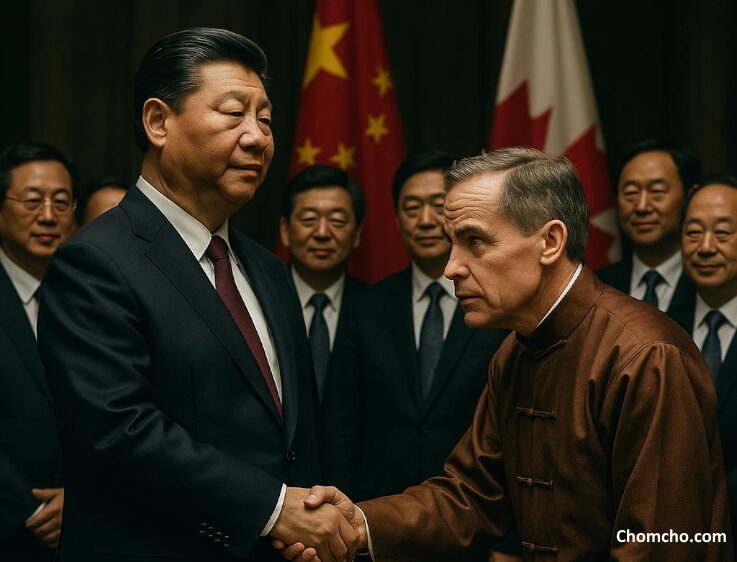
In January 2026, Canadian Prime Minister Mark Carney quietly made one of the most consequential trade decisions in North American history.
He slashed Canada’s tariff on Chinese electric vehicles from 100% down to 6.1%. Up to 49,000 Chinese cars per year can now enter Canada at near-zero cost, rising to 70,000 units after five years.
Carney attached conditions. Chinese automakers must build local assembly plants, form joint ventures with majority Canadian ownership, follow Canadian labor codes, source supplies locally, and guarantee that vehicle data will not be sent to the Chinese government.
The data privacy condition is almost laughable. This is the same Beijing that surveils its own citizens by the millions.
But conditions or not, China moved instantly.
Within two weeks of Carney’s announcement, China’s biggest auto exporter Chery held its first meetings with Canadian dealers. The race was on.
Canada as a beachhead — Beijing’s real plan for China cars in Canada
Do not let the modest quota numbers fool you. This is not about selling 49,000 cars in Canada.
Industry experts are saying it clearly. “Canada is the practice run for the U.S.,” said Robert Kerwal, director of automotive solutions at JD Power Canada.
Dan Hearsch, global co-leader at consultancy AlixPartners, put it even more bluntly: moving from Canada to the U.S. later would be like “flipping a switch.”
Canada and America share nearly identical consumer tastes, safety standards, and emissions regulations.
BYD is already planning to open six dealerships in Canada. Lotus, owned by China’s Geely, is opening another six just to sell a few hundred cars. Chery flew 20 Canadian dealers to China to inspect its vehicle lineup. State-owned Changan has a team working on a Canadian launch.
There is little profit in any of this at current quota levels. But profit is not the point.
Chery International President Zhang Guibing said it himself: “We definitely have the idea of selling cars in the United States. Everyone definitely has that idea.”
That quote should be read in every boardroom in Detroit.
And Chery is not alone. Consider the size of the company leading this charge.
BYD outsold Tesla in pure electric vehicles in 2025 for the first time, and surpassed Ford in total global sales. Two American icons knocked down in a single year.
These are not Chinese startups. These are state-backed industrial giants with a global conquest strategy.
How Beijing built its auto empire
None of this happened by accident.
The Chinese government has poured an estimated 230,000 million dollars into its EV industry between 2009 and 2023, according to the Center for Strategic and International Studies.
That figure does not even include the massive subsidies flowing into raw materials, battery manufacturing, and critical mineral processing, all sectors that China also dominates.
Beijing’s “Made in China 2025” industrial strategy deliberately targeted global automotive dominance as a national priority.
State subsidies allow Chinese automakers to price cars impossibly low.
Some models sell in Europe for as little as 10,290 euros. No Western company operating under normal market conditions can compete with that pricing.
This is not free market competition. It is state-directed economic warfare.
China has also been accused of deliberate oversupply: flooding global markets with cheap goods to bankrupt private Western competitors, then moving in to fill the vacuum.
It has happened in solar panels. It is happening in steel. It is now happening in automobiles.
And the human cost of China’s “competitive” manufacturing is becoming clearer.
In 2025, Brazilian authorities sued BYD over alleged labor violations at its flagship factory in Bahia, describing conditions as “analogous to slavery” involving more than 200 migrant Chinese workers.
Human rights groups reported similar forced labor concerns at BYD’s factory in Hungary.
Cheap cars built on exploitation. Beijing calls it progress.
Europe is already being flooded — and Trump was right
Trump was sounding the alarm about Chinese subsidies, dumping, and industrial overcapacity as far back as 2018.
He imposed tariffs. He warned allies.
Europe criticized him for it. Brussels called his approach disproportionate. European leaders lectured Washington about free trade and multilateralism.
Then China turned its sights on Europe, and the Old Continent had no choice but to protect its own industries.
Despite EU tariffs of up to 35% on Chinese electric vehicles introduced in 2024 on top of a 10% import duty, Chinese vehicle sales in Europe nearly doubled between 2024 and 2025, with more than 500,000 Chinese models sold in just the first nine months of 2025.
European Commission President Ursula von der Leyen then accused China of “flooding global markets with cheap, subsidized goods,” warning of a new “China shock.”
Chinese EVs are 20 to 30% cheaper than European-made models due largely to government subsidies, directly threatening Germany’s automotive hub and its entire supply chain.
Now French President Emmanuel Macron is calling for “the European equivalent of Section 301” — the exact same trade weapon Trump used that Europe spent years mocking.
Europe’s auto industry employs 13.2 million people. Its future now hangs in the balance.
BYD is building a 4,600 million dollar factory inside Hungary, within the EU itself, bypassing future tariffs entirely.
Chery is already producing cars in Barcelona through a joint venture with Spain’s Ebro-EV Motors. Chinese automakers have also set up plants in Serbia.
Trump was right. Europe just needed to feel the pain before it could admit it.
Latin America is next — and it starts in Mexico
If Europe is being flooded and Canada is being used as a staging ground, Latin America is already well into the invasion.
In Mexico, Chinese brands represented 20% of the total new car market in 2025.
BYD and Geely are now bidding to acquire a shuttered Nissan-Mercedes plant in Aguascalientes, Mexico.
The goal is to produce vehicles for Latin America and, when the time comes, use Mexico as another back door into the United States market through USMCA trade rules.
In Brazil, BYD opened its first Latin American factory in Bahia in July 2025. The plant already produces the Dolphin Mini, Song Pro, and BYD King models.
BYD has already received export orders for 50,000 vehicles to Argentina and 50,000 to Mexico from that single factory. Capacity is planned to expand from 150,000 to 300,000 units per year.
In Colombia, BYD held a 42% market share in electric vehicles in 2024. At least seven out of ten electric vehicles sold in Brazil were BYD models.
This is not organic market growth. This is a coordinated, state-backed global expansion moving region by region, using each market as a supply base and political foothold for the next.
Latin America is not just a new market for China. It is the next staging ground.
America is holding the line — for now
Elon Musk (@elonmusk) said it plainly on a Tesla earnings call: “If there are no trade barriers established, they will pretty much demolish most other companies in the world.”
He was right. And Washington has been listening.
President Trump maintained Biden’s 100% tariff on Chinese electric vehicles and added a 25% national security tariff on all imported vehicles in March 2025.
The combined tariff burden on any Chinese-manufactured car attempting to enter the United States now exceeds 125%. No Chinese passenger vehicle is sold in the U.S. market at any meaningful volume.
Trump also signed rules through the Commerce Department banning Chinese software and hardware in connected vehicles sold in America, effective for model year 2027.
Even if a Chinese automaker built a factory on U.S. soil, its vehicles could not contain Chinese-developed software in their connected or autonomous systems.
Trump’s message to Beijing has been clear: build here, or stay out. But the Canada deal proves the threat is real and growing.
Beijing does not just want to sell cars in Canada.
It wants to own the global auto industry the same way it already owns global drone components, global solar panel production, and global battery manufacturing.
The factory of the world strategy is not a conspiracy theory. It is a documented, state-funded, decades-long plan already in motion on every continent.
China is patient. Beijing plays the long game.
America must play it too.