
This post is also available in:
 Português
  Español
  Français
  Deutsch
  Italiano
  Русский
  Nederlands
  日本語
日本語  Polski
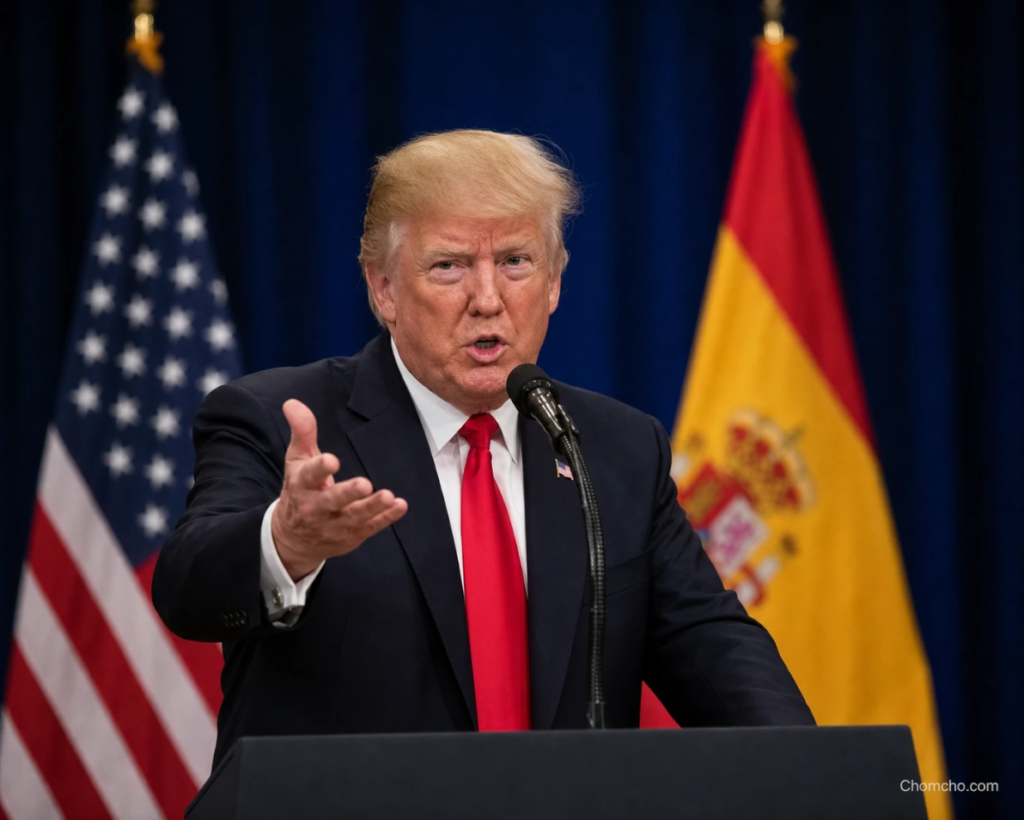
Trump’s warning on GB News
President Trump told GB News that Spain “will be a ruined country.”
Madrid called it an insult; world media made “Spain ruined country” a headline. But behind the words stands a record: a NATO ally that will not pay, a border that will not hold, an immigration system in collapse, and a military that disarmed itself for ideology.
This is the anatomy of a warning.
Four words that stung Madrid
In an interview with British broadcaster GB News released this week, President Trump repeated a judgment he has been building for months:
“Spain will be a ruined country. I have had my own problems with Spain because Spain does not behave very well regarding NATO. It does not pay what it should pay.”
The timing was not casual.
Tens of thousands of Spaniards marched on September 3 against their own government’s handling of the border crisis in Ceuta.
Trump has made Spain a recurring theme ahead of the November legislative elections in the United States, and the monthslong feud with Prime Minister Pedro Sánchez now touches defense, migration, trade and foreign policy at the same time.
Is Trump exaggerating? Follow the numbers.
The ally that will not pay
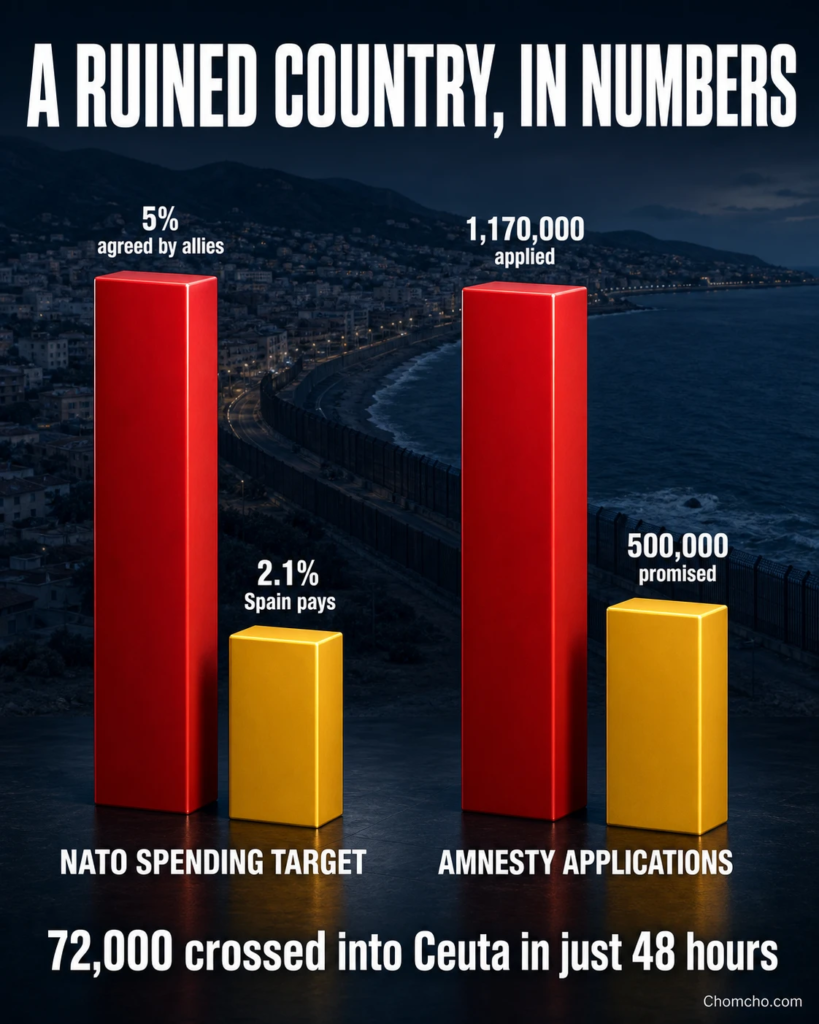
At the NATO summit in The Hague in June 2025, the alliance adopted a defense spending target of 5 percent of GDP by 2035.
Every member committed except one.
Spain capped its spending at 2.1 percent, not even half of what its allies agreed to pay, and Sánchez called that cap “sufficient, realistic and compatible with the welfare state.”
Trump’s answer at Ankara was blunt: “Spain is a terrible partner in NATO.”
He called the country a lost cause and, at a joint press conference with the NATO Secretary General, instructed his Treasury Secretary on the spot to halt commerce with Spain.
A welfare state defended by other nations’ soldiers is not a policy; it is a subsidy. And the money is only the surface of the problem. The deeper ruin is at the border.
The Spanish immigration system in collapse
In January, the Sánchez government approved a decree to give one-year residence and work permits to an estimated 500,000 illegal immigrants.
By the June 30 deadline, more than 1.17 million people had applied, more than double what the government promised. Spain’s own police intelligence center had estimated up to 1 million illegals in the country; even that looks short now.
Elon Musk called the amnesty “a cynical power-grab.” Sánchez answered him with a slogan: “Mars can wait.” Vox leader Santiago Abascal wrote that the measure “harms all Spaniards.”
The human cost is measurable.
Spain’s National Institute of Statistics has reported that about 46 percent of sexual assault convictions correspond to foreigners, several times their share of the population.
The squatting crisis tells the same story: 16,426 illegal home occupations were reported in 2024, up 7.4 percent in one year, and the Spanish press estimates the real number above 100,000, with official data showing foreigners now a majority of identified squatters, many tied to organized networks.
Meanwhile Irene Montero, the far-left former equality minister, gave Spain a consent law so badly written that courts were forced to reduce sentences for hundreds of convicted sex offenders.
A state that legalizes the queue jumpers, loses count of its own borders, and frees the predators is not managing immigration. It is dissolving citizenship.
Ceuta, the stress test
Then came July 30. In two days, about 72,000 people crossed from Morocco into Ceuta, a Spanish city of 80,000 on the North African coast.
Dozens died.
The crowds exploited a June Supreme Court ruling that barred immediate returns of migrants arriving “by water”: they simply walked into the sea on the Moroccan side and waded ashore a few meters later on Spanish soil.
Trump saw it clearly: “What is happening there is very sad to watch. I have never seen anything like it.”
And Sánchez?
This week in parliament he insisted there had been no warnings, promised a dossier, and begged Brussels for a permanent Frontex presence.
Regarding Morocco, he went further: cooperation with Rabat is “frankly positive,” he said, rejecting any Moroccan involvement, even while reports from his own police commanders described prior coordination and Moroccan border forces standing still during the critical hours.
Sánchez knows this playbook because he already lost to it.
In 2021, Morocco pushed thousands of migrants into Ceuta as diplomatic pressure, and Sánchez responded by abandoning 40 years of Spanish policy on Western Sahara to please Rabat.
Appeasement bought him five years and a bigger invasion. In geopolitics, weakness always sends an invoice.
Europe closes the door on Spain
The European reaction was unprecedented.
Italian Prime Minister Giorgia Meloni called the Ceuta images “shocking” and said Spain should be suspended from the Schengen free-travel area.
Italy reintroduced border checks on travelers arriving from Spain and has extended them; three member states are now pushing for Spain’s removal from Schengen.
Think about that: the European Union is debating whether to build a passport border against a founding-era member because its government cannot hold the external one.
At the same time, Sánchez celebrated lifting border controls with Gibraltar.
Open doors for everyone, control for no one.
The military that disarmed itself
While the borders failed, the Sánchez government was busy disarming the future.
In August 2025 Spain rejected the American F-35, the only fifth-generation fighter available to allies, and chose politics instead: 45 more Eurofighters for about $7,000 million and a bet on the European FCAS fighter of the future.
Then France and Germany abandoned the FCAS fighter without even consulting Madrid, leaving only a modest drone and data project where Europe’s jet of the future was supposed to be.
What comes next is almost satire.
The Spanish Navy is now buying five retired US Marine Corps Harriers, jets from the 1970s design era, to cannibalize for spare parts.
Spain’s flagship Juan Carlos I, an assault ship that serves as an almost-carrier, will lose its entire fixed-wing aviation after 2032, because the only vertical-takeoff jet in production on Earth is the F-35 that Sánchez refused for ideological reasons.
A navy without naval aviation, chosen on purpose.
The bases and the empty threat
The final insult came during the Iran conflict.
Madrid refused to let US forces use the jointly operated bases at Rota and Morón for strikes, with the foreign minister invoking the UN charter and the government calling the American operation “illegal.”
Trump’s reply was pure deterrence: “We could just fly in and use it. Nobody’s going to tell us not to use it, but we don’t have to.”
Trump has twice ordered trade with Spain cut off, in March and again at Ankara. So far it remains a threat, and his trade representative admits it may stay one, though the legal tools exist.
Here honesty requires a caveat that favors America: the United States runs a trade surplus of about $4,800 million with Spain. If commerce stops, Madrid loses a market; Washington loses ham and olive oil.
What America should do
So what does an America First foreign policy do with an ally like this? Three things.
First, keep the pressure precise. Targeted measures hurt the Sánchez government more than a blanket trade war that punishes American exporters.
Second, play the Morocco card. A US House committee described Ceuta and Melilla as located in Moroccan territory while approving $40 million for Rabat.
The State Department then affirmed Spain’s sovereignty but blamed the crisis on “the Spanish government’s refusal to defend their sovereignty, secure their borders, and protect their people.”
Washington holds leverage on the exact issue where Sánchez is weakest.
Third, wait him out. Spain votes by 2027. The polls show PP and Vox together near 190 of the 350 seats in Congress, far past an absolute majority, with Vox surging after Ceuta and 74 percent of Spaniards demanding early elections while corruption scandals close around Sánchez’s party and family.
Vox in particular shares the goals of the Trump administration: real borders, national sovereignty, faith and family.
Montero’s Podemos, meanwhile, polls in single digits.
Spain is not a ruined country yet; it is a great nation ruined by its government, and its people are already correcting the mistake at the ballot box.
Trump did not insult Spain. He described Sánchez. The difference will be visible the morning after the next Spanish election.
Strong borders make strong nations.