
This post is also available in:
 Português
 Español
 Français
 Deutsch
 Italiano
 Русский
 Nederlands
 日本語
 Polski
Summary
At the last minute, Croatia had the target date for Montenegro's accession talks removed. One country objected, and the timetable was removed. That is the EU veto at work.
The objection came days after the European Commission published a plan to move sanctions, tax measures and steps of accession talks from unanimity to majority voting.
EU Enlargement Commissioner Marta Kos said she wants EU institutions "leaner and able to take decisions faster."
Conservatives see three problems.
The unelected Commission controls the agenda. Germany, France and Italy hold almost half of the EU population. And once a nation gives up its veto, getting it back is practically impossible.
Eleven countries, led by Germany, asked the EU High Representative, Kaja Kallas, to explore majority voting in foreign policy.
But activating the change itself requires unanimity, and the leaders of Slovakia, Czechia and Poland do not support it. Hungary's new government kept a limit of its own.
The veto has served American interests before.
In 2017 and 2018, Hungary and its neighbors blocked EU statements against U.S. President Donald Trump's decisions on Jerusalem. A Europe of nations is a stronger partner for America First.
Keep the veto. Keep the nations free.
The veto showed its power at the October summit
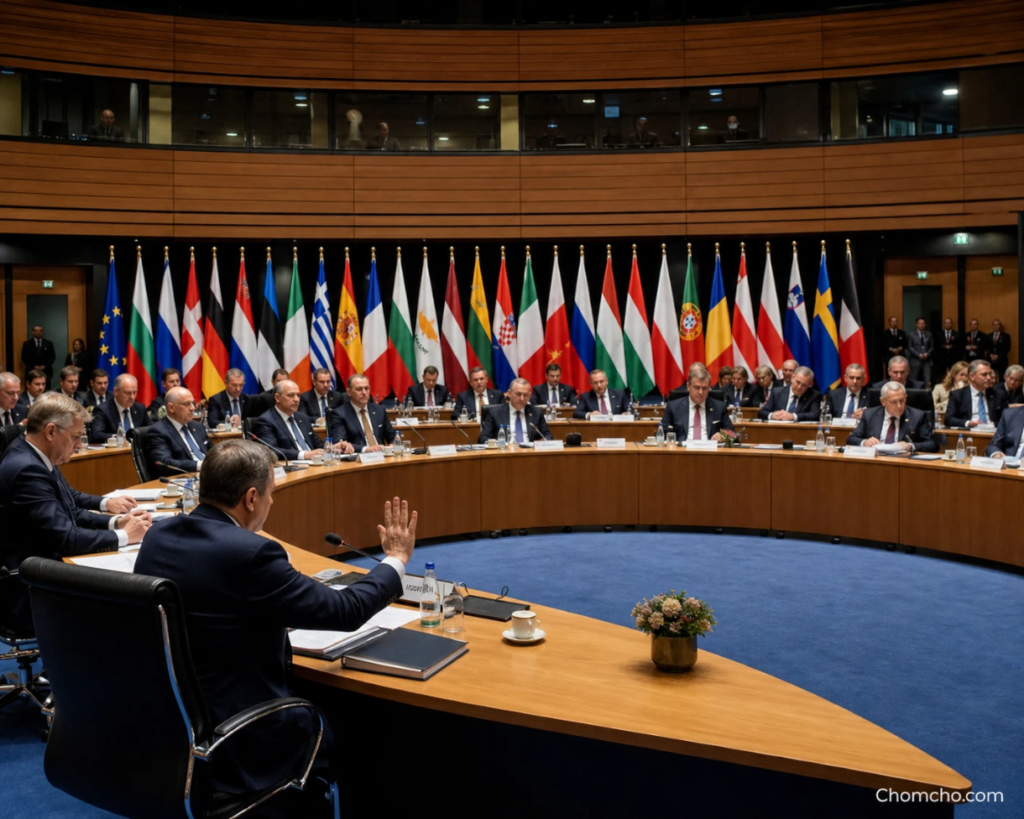
EU leaders met in Brussels on October 15 and 16, 2026, for what was billed as a strategic debate on enlargement and internal reform. They left without a clear long-term plan.
The summit’s main promise for the Western Balkans was also dropped.
The draft conclusions set a goal for Montenegro to close its accession talks by the end of 2026. At the last minute, the target date was removed at the request of Croatia.
Croatian Prime Minister Andrej Plenković said he wants Montenegro to move forward, but also to “resolve issues relating to good-neighbourly relations.”
On October 21, 2026, in Podgorica, Montenegro, EU Enlargement Commissioner Marta Kos said she still sees Montenegro signing its accession treaty by summer 2027, but only if Montenegro completes its reforms and resolves its disputes with Croatia.
One country raised one objection, and the timetable was gone.
That is the EU veto at work, and the veto was used only days after the European Commission presented a plan to weaken it.
A small nation with a long memory
Croatia’s demands come from the Yugoslav wars of the 1990s.
Among them: compensation for Croatians held in Montenegrin prison camps, the search for 14 people still missing from the 1991 to 1995 Croatian War of Independence, war crimes prosecutions, and confiscated property.
The Croatian government also wants a maritime border settlement, the return of the Jadran, a former Yugoslav navy training ship, and protection for the memorial plaque at the former Morinj prison camp in Montenegro.
Croatia argues that the EU should not import unresolved conflicts between neighbors. EU institutions see obstruction. The Croatian government says it is defending its former prisoners and the families of its missing.
The European Commission plan to weaken the veto
On October 6, 2026, the European Commission published “Preparing for a wider Union.”
The plan proposes using passerelle clauses, treaty provisions that allow a change in voting rules without a new treaty, to move sanctions, tax fraud and energy tax measures from unanimity to qualified majority voting.
The plan also proposes majority voting for opening negotiating clusters and other middle steps of accession talks.
New members would face stricter terms. In the most serious cases, they could lose their Council voting rights.
For a limited period, a new member could also promise not to block future enlargements over bilateral disputes.
Commissioner Marta Kos said she wants EU institutions that are “leaner and able to take decisions faster.” Faster, yes. But faster for whom?
Who sets the agenda
The founders of the European project had ambitious goals. The 1950 Schuman Declaration spoke of “a European federation,” and the 1957 Treaty of Rome of “an ever closer union among the peoples of Europe.”
Many voters, however, were promised an association of free nations, not a country.
In Britain’s 1975 referendum, the leaflet of the official Yes campaign, Britain in Europe, assured voters that “all decisions of any importance must be agreed by every member.”
One of the last remains of that promise is unanimity in foreign policy, which lets Malta or Estonia say no to Germany and France.
About 80 percent of EU laws already pass by majority vote. The veto survives only in the sensitive areas: foreign policy and sanctions, defense, taxation, the long-term budget, and admitting new members.
Conservatives see three problems with removing the EU veto.
First, agenda power. In most EU lawmaking, nothing moves unless the unelected Commission proposes it.
In foreign policy, proposals come from the EU High Representative for Foreign Affairs and Security Policy, Kaja Kallas, or from member states.
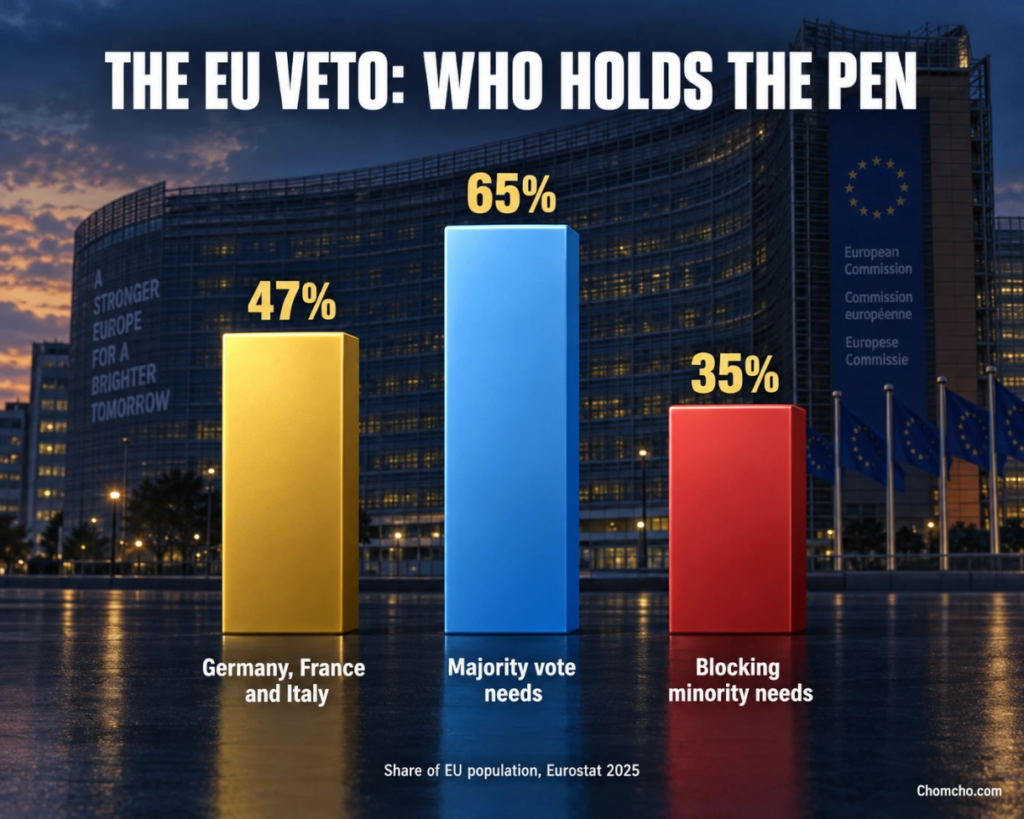
Under majority voting, a proposal from Kallas’s office needs only 55 percent of member states holding 65 percent of the population, while other proposals need 72 percent of member states.
Second, size. Germany, France and Italy alone hold almost half of the EU population. A blocking minority needs at least four countries with 35 percent of the population.
The governments of the large countries would set the direction, and small nations would follow.
Third, permanence. Once a nation gives up its veto, getting it back is practically impossible.
A union where a few large countries and an unelected Commission decide for everyone is no longer an association of free nations.
History shows that power concentrated far from the people tends toward tyranny.
A legal trap and a closing window
In a letter reported on September 1, 2026, 11 countries asked EU High Representative Kaja Kallas to explore majority voting in foreign policy: Austria, Belgium, Denmark, Finland, France, Germany, Luxembourg, the Netherlands, Romania, Spain and Sweden, with Germany leading.
Supporters argue that one government should not be able to block the other 26 member states. Hungary under former Prime Minister Viktor Orbán gave supporters examples: of 48 vetoes recorded, 21 came from Hungary.
On April 13, 2026, the day after Orbán’s election defeat, Commission President Ursula von der Leyen called majority voting in foreign policy “an important way to avoid systemic blockages.”
But there is a legal trap. Activating a passerelle clause requires unanimity, so the reform needs the approval of every country that would lose its veto.
The reformers also see an opportunity that may end soon. France holds the first round of its presidential election on April 18, 2027, with a runoff on May 2, and a win by Marine Le Pen’s National Rally would give France a Eurosceptic president.
The veto still has defenders
Orbán is gone, but the veto’s defenders are not.
Slovak Prime Minister Robert Fico has warned: “The abolition of the veto is a step toward the dissolution of the Union.”
Czech Prime Minister Andrej Babiš has said he is fundamentally against ending the veto.
Polish Prime Minister Donald Tusk has urged caution, noting that unanimity has helped small and medium-sized countries defend their interests.
None of the three Baltic states, Estonia, Latvia and Lithuania, signed the September letter.
Even Hungary’s new Prime Minister Péter Magyar kept a limit of his own: Magyar promised a binding referendum before Ukraine can join.
What the United States should watch
The Trump administration’s National Security Strategy accused the EU and other transnational bodies of activities that “undermine political liberty and sovereignty.”
The strategy wants Europe to operate as “a group of aligned sovereign nations.”
The veto has served American interests before.
In December 2017, Hungary blocked an EU statement condemning U.S. President Donald Trump’s recognition of Jerusalem as Israel’s capital.
In 2018, Hungary, the Czech Republic and Romania blocked a French-led statement criticizing the move of the U.S. embassy.
Under majority voting, statements like those would have been issued in the name of all 28 members at the time.
Taxation is another area to watch. The Commission wants to start moving parts of tax policy to majority voting.
Once friendly governments lose their veto, an EU majority could shape taxes and sanctions that fall on American companies.
The United States works better with sovereign governments than with a European Commission that outvotes them. A Europe of nations is a stronger partner for America First.
Keep the veto. Keep the nations free.