
This post is also available in:
 Português
  Español
  Français
  Deutsch
  Italiano
  Русский
Summary
He named no country. He did not have to. China accounts for most rare earth refining and permanent magnets, and Indian buyers still face limited approvals. The host was scolding his most powerful guest in public, in diplomatic language.
The 18th BRICS summit met on September 12 and 13 in New Delhi under India’s chairship. Ten member delegations filled the hall: Brazil, Russia, India, China, South Africa, Egypt, Ethiopia, Indonesia, Iran, and the UAE. Saudi Arabia kept its distance.
Putin came in person for photographs and proof that he is not isolated. India does not belong to the International Criminal Court, so he could appear in the room. Xi sought a platform for Chinese technology and trade on his first India visit since 2019. Iran sought allies in a war and received mainly support for existing payment channels. Egypt came for financing and calm shipping lanes. Brazil’s Lula stayed home to campaign and sent his foreign minister.
The New Delhi Declaration runs 45 pages and 140 paragraphs.
It demands reform of the IMF, the World Bank, the WTO, and the UN Security Council. It condemns terrorism and mentions the 2025 Pahalgam attack without naming Pakistan.
In all those pages it never writes United States or Donald Trump.
It criticizes tariffs in the abstract, with no author named.
India took the most from the text and the chair. Russia took silence about Ukraine. China took process on AI and supply chains. Iran consolidated channels outside Western banking.
What they did not get matters more. There was no common BRICS currency. Iran got no collective backing for its war. China was rebuked by its own host on minerals.
The bloc’s scale is real in population and purchasing power, but measured in dollars the G7 remains larger. Average income in the bloc is far below the G7. China alone is about 64 percent of BRICS nominal GDP.
This is not a coalition of equals. Payment systems like BRICS Pay are real machinery, not a united political alliance. When the chair has to remind members to move from files to real impact, the reminder says more than the document.
For the United States, the lesson is bilateral.
Eleven governments resent American tariffs yet would not name their author, because access to the American market is worth more than bloc solidarity.
No common currency appeared, and the dollar is not threatened in the near term. The real chokepoint is critical minerals and refining. Every chair has its own agenda.
Deal by deal is stronger than one family photograph. Eleven governments did the arithmetic and chose anonymity.
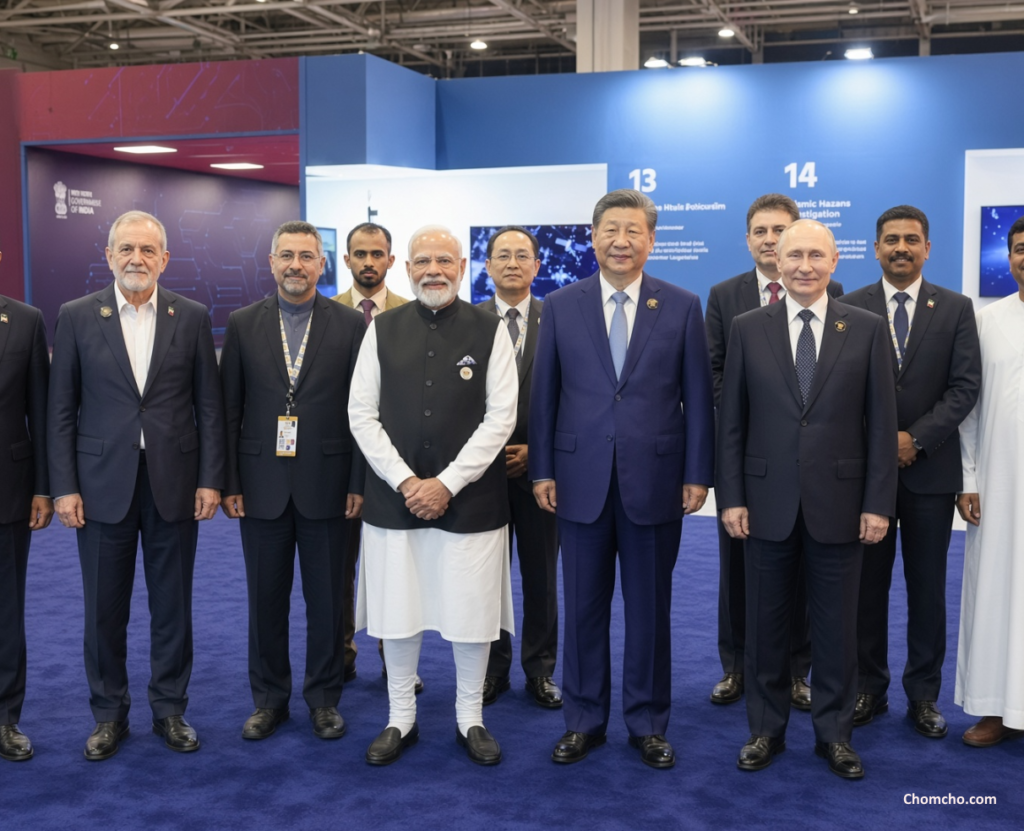
The warning Modi gave his own guests
The sharpest moment of the BRICS summit in New Delhi came from the host.
With Xi Jinping seated beside him, Prime Minister Narendra Modi warned that the “weaponisation of technology and critical minerals can hinder our shared progress,” and called for inclusivity in the adoption of technology.
He named no country. He did not have to.
Two meanings were packed into that sentence.
The weaponisation of technology means using export controls on advanced chips, software, and artificial intelligence systems as instruments of pressure, a game both Washington and Beijing now play.
The weaponisation of critical minerals is far less ambiguous: China accounts for roughly 60 percent of the world’s mined rare earths, 91 percent of refining, and 94 percent of permanent magnets, and it has already restricted those exports as leverage.
Reuters reported this month that approvals for Indian buyers remain limited. The host of the summit was scolding his most powerful guest, in public, in diplomatic dialect.
Reading that dialect is the whole job.
Statements at this level are never blunt; the foreign policy of eleven countries is visible only in what a document includes, what it omits, and whom it declines to name.
What the summit was
The 18th BRICS summit met on September 12 and 13 at the Bharat Mandapam convention center in New Delhi, under India’s chairship, amid heavy security.
Ten member delegations filled the hall: Brazil, Russia, India, China, South Africa, Egypt, Ethiopia, Indonesia, Iran, and the United Arab Emirates, with Saudi Arabia, invited years ago and still undecided about formal membership, keeping its customary distance.
Vladimir Putin came in person, seeking proof that the West has not isolated him.
The choice of venue mattered: last year he addressed the Rio summit only by video link, because Brazil belongs to the International Criminal Court that has issued a warrant for him, while India does not.
In New Delhi he could walk off the plane, shake hands, and be photographed among eleven flags.
Xi Jinping came seeking a bloc that functions as a platform for Chinese technology and trade, and it was his first visit to India since 2019, returning Modi’s own trip to China last year.
Iran’s Masoud Pezeshkian came seeking allies in a war: political cover, a text that named the aggressors, and support for the money and oil channels it already relies on. Only the last was on offer.
Egypt’s Abdel Fattah el-Sisi came for money and for calm. Cairo joined the bloc in 2024 while short of hard currency and heavy with debt, so development bank financing and trade settled in local currencies matter to it; and as the state that owns the Suez Canal, it needs the shipping lanes of the region quiet.
Brazil’s Lula da Silva did not: he stayed home campaigning before October elections and sent his foreign minister.
Uzbekistan, a partner country, saw its president skip the gathering altogether for a state visit to South Korea.
The document built to look united
The New Delhi Declaration runs 140 paragraphs across 45 pages and was adopted unanimously on the first day, with Modi emerging from a closed session to report that no member had objected.
Its contents are a catalogue of the Global South’s grievances with the international order.
The New Delhi Declaration demands reform of the International Monetary Fund and the World Bank, meaning more voting weight for developing economies and less for the founders.
It calls for restoring the World Trade Organization’s dispute settlement system, which has been paralyzed for years and is the main international venue where tariffs can be legally challenged.
The document backs reform of the United Nations Security Council, which in practice means the long campaigns of India and Brazil for permanent seats.
The text condemns terrorism and references the 2025 Pahalgam attack that killed 26 people in Jammu and Kashmir, without ever naming Pakistan.
The New Delhi Declaration also calls for inclusive governance of artificial intelligence. It establishes an integrated early warning system for infectious diseases. And it addresses energy security, Sudan, Syria, and the wider West Asian conflict, among other matters.
And in 45 pages, it never writes the words United States or Donald Trump.
It criticizes the indiscriminate raising of tariffs in the abstract, as a phenomenon without an author.
Last year the American president threatened members of this bloc with additional tariffs over what he called their anti-American policies. Eleven governments did the arithmetic and chose anonymity.
What each capital took home
India took the most. It secured the condemnation of the Pahalgam attack that its families had waited for, support for its Security Council ambitions, a declaration written in its own preferred language of de-risking rather than confrontation, and the prestige of the chair.
Modi closed by urging the Global South to move from being rule-takers to becoming rule-shapers.
Russia took silence. In 140 paragraphs about the world’s conflicts, the war in Ukraine does not appear.
For a leader under Western sanctions, a family photograph in New Delhi and a text that ignores his war is a substantial diplomatic return.
China took process: an open artificial intelligence ecosystem for the bloc, meaning shared standards and joint development on terms Beijing can shape, plus a proposed special economic zone and language on supply chain stability.
Iran took channels. Under sanctions and at war, Tehran already sells most of its oil in yuan and settles with Moscow in rubles and rials; every additional channel outside Western banking is oxygen.
It also took a bilateral meeting with the crown prince of Abu Dhabi, which produced warm words about de-escalation and nothing else.
What they did not get
Iran wanted the bloc behind it and received a call for maximum restraint addressed to everyone and no one.
That vagueness has a cause: the same room now holds Saudi Arabia and the United Arab Emirates, whose interests in the region collide with Tehran’s and with each other’s.
China wanted a summit without criticism and was rebuked by its host on the minerals question, in front of the cameras.
The champions of a single BRICS currency got nothing.
The declaration concedes that there is “no one-size-fits-all approach” to settlement, which is diplomatic language for irreconcilable national interests.
And the bloc itself did not get the unity the family photograph implies, the portrait where everyone looks at the camera and smiles on cue.
Its own foreign ministers met in May and ended without a joint statement at all, split over the war.
Kazakhstan’s president spent the margins of the summit shaking hands with everyone, met President Trump’s envoy Sergio Gor, said he looks forward to the G20 in Miami, and observed that he prefers “concrete actions… rather than just words.”
Machinery, not an alliance
What the BRICS summit did build is real, and it is pragmatic machinery rather than a reinforced political alliance.
BRICS Pay, still under development, is meant to connect India’s instant payment network (UPI), China’s yuan clearing system (CIPS), and the Russian messaging system (SPFS), which was built after 2014 to survive being cut off from SWIFT, the Belgian network through which Western banks move money and through which sanctions are enforced.
Proposals for a gold-backed settlement token continue to circulate. The goal is to let members trade in their own currencies without passing through dollar rails.
That is a genuine step, and it deserves to be taken seriously rather than dismissed as a mere pet project. But machinery is not a bloc, and the host said so himself.
Closing the summit, Modi urged members to convert their agreements into tangible and time-bound action, to move them “from files to real-life impact,” and described BRICS as an “ecosystem of solutions” rather than a mere group of countries.
When the chairman has to remind the members that documents are not results, the honest reader learns more from the reminder than from the document.
The numbers behind the bloc
The scale is not imaginary.
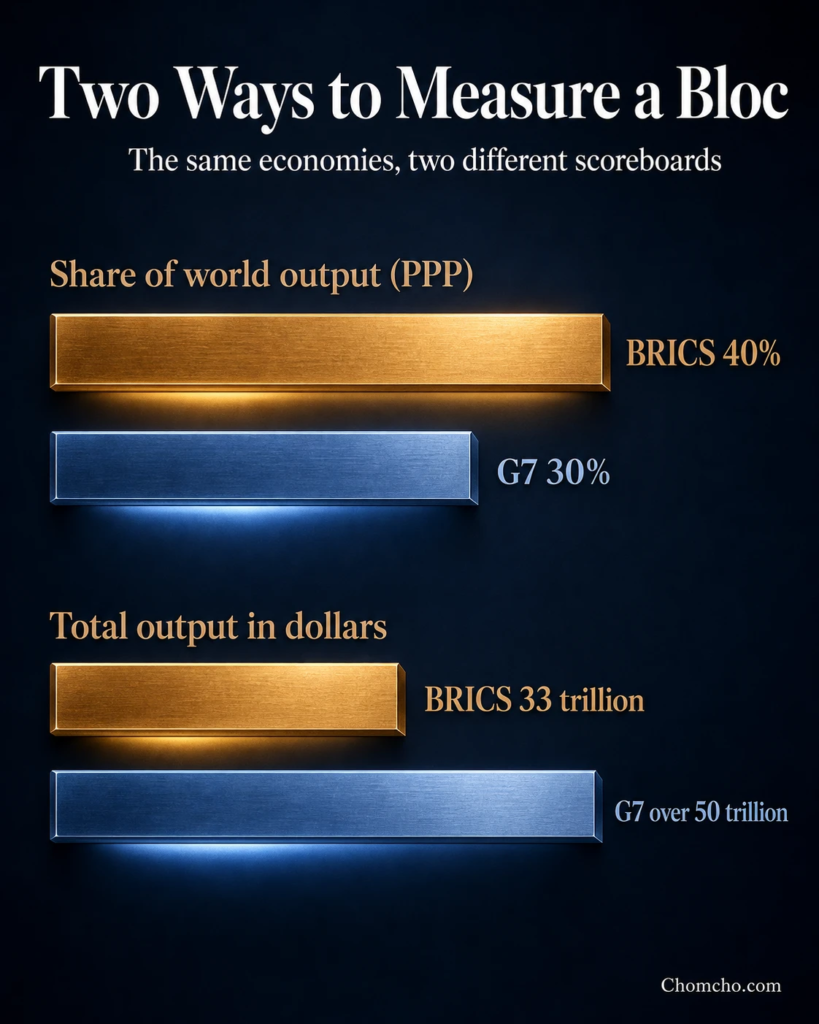
The ten members and Saudi Arabia hold close to half the world’s population and about 40 percent of global output measured by purchasing power parity, against roughly 30 percent for the G7.
At the summit’s business forum Putin claimed the bloc produced nearly half of recent global growth, compared with 18 percent for the G7.
Now the numbers the press releases omit.
Measured in actual dollars, the currency in which debts are paid and weapons are bought, the G7 remains far larger, and BRICS combined output is roughly 33 trillion dollars against a G7 total well above 50 trillion.
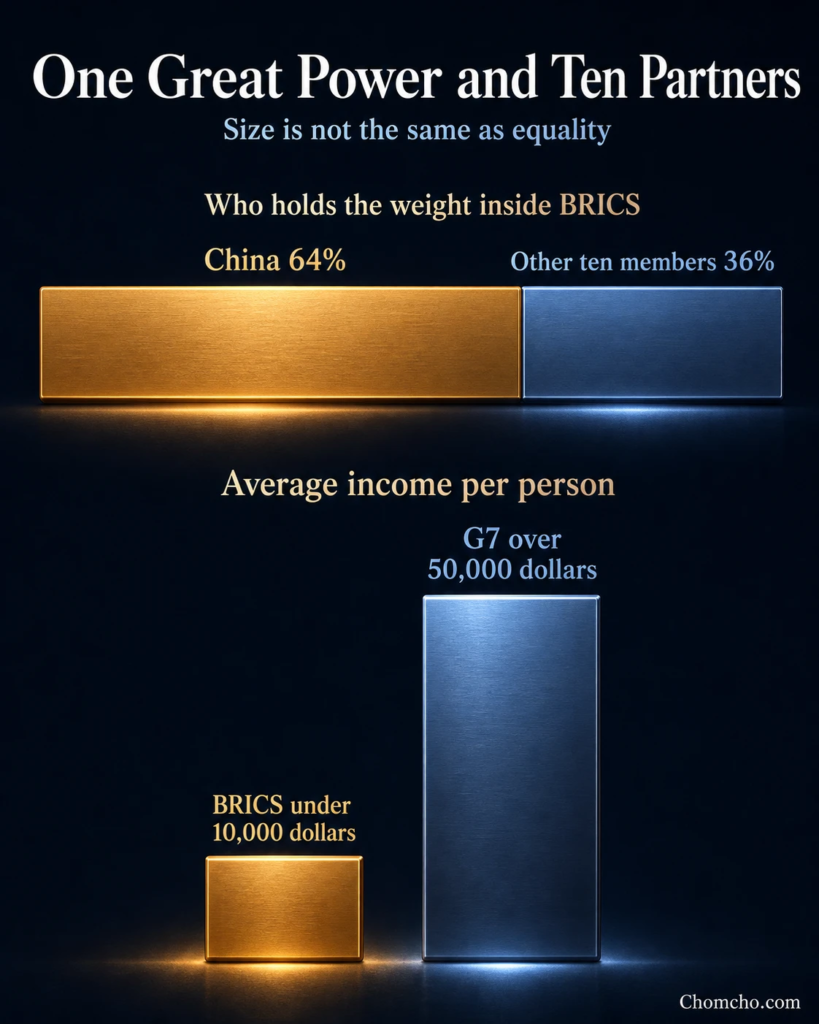
Average income per person in the bloc runs under 10,000 dollars a year against more than 50,000 in the G7.
And China alone accounts for about 64 percent of BRICS nominal GDP.
This is not a coalition of equals. It is one great power, one rising rival that just scolded it, and nine passengers.
Europe and Israel in the small print
For Europe the summit was a lesson in shrinking relevance.
The bloc’s demands on trade, finance, and governance were aimed at an order Europeans helped build, and a 45-page text that never mentions the invasion of Ukraine quietly rehabilitates the man who launched it.
A continent that lectures the world about values now appears in other people’s documents mainly as a rule-taker.
For Israel the vagueness was the best available outcome.
With the Gulf states in the room, the language on Iran’s war stayed general; the document named Israel only over Lebanon and Gaza, not over Iran.
A bloc containing Iran that cannot bring itself to endorse Iran’s war is, in practice, a limit on Iran.
Tehran arrived at the summit as the member with the most urgent request and left with the least: no condemnation of Washington or Jerusalem over the war, no collective backing, only a call for restraint aimed at all sides.
Its partners in the Global South were willing to trade with it, and unwilling to stand behind it.
What it means for the United States
Start with tariffs, because that is what the declaration attacks without daring to say whose tariffs they are.
President Trump’s position has always been about reciprocity: for decades other nations taxed American goods, subsidized their own, and enjoyed access to the American consumer on terms no American negotiator ever demanded in return.
Correcting that is not aggression; it is arithmetic that should have been done a generation ago.
The proof is in the room: eleven governments that resent the policy still would not name its author, because access to the American market is worth more to each of them than solidarity is worth to all of them.
Next, the dollar. Nothing in New Delhi threatens it in the near term.
No common currency was created, settlement in local currencies remains voluntary and marginal, and the dollar’s strength rests on American interest rates, deep capital markets, and the fact that nobody wants to hold rubles.
Payment rails are worth watching over a decade, not over a news cycle.
The genuine vulnerability is the one Modi raised: critical minerals.
Rare earths run through nearly every weapon system, electric motor, and much of the equipment that makes advanced chips, and China refines the overwhelming majority of them.
That is the chokepoint, and the answer is domestic mining, domestic refining, and allied supply, not speeches.
Note also who was doing the complaining. Modi was not defending Washington; he was defending India, which is exactly how international relations works.
Finally, Central Asia. The states between Russia and China hold serious mineral wealth and keep drifting toward the West, meeting American envoys, seeking investment, asking for old trade restrictions to be lifted.
The map of this rivalry is not closed.
Every chair has its own agenda
A bloc that cannot name its adversary, cannot agree about a war on its own doorstep, cannot mention the war in Europe, and cannot create a currency is not a rival order.
It is a negotiating table where every chair has its own agenda.
That observation is not cynicism; it is the founding assumption of the discipline.
In economics we assume every firm seeks to maximize profit. In international relations we assume every state pursues its own national interest.
These assumptions have served economists, businesspeople, and foreign policy makers for decades, precisely because they predict behavior better than declarations do.
Modi defended Indian industry. Putin bought silence about his war. Xi sold a platform. Tehran bought oxygen. Brasilia stayed home to win an election.
Which is precisely why the American approach should be bilateral.
President Trump prefers to negotiate with Mexico and with Canada separately rather than through one continental document, and the same logic applies here with greater force.
Eleven countries with eleven agendas are eleven negotiations, and America holds the strongest hand in nearly every one of them: the market they need, the currency they use, the technology they want, the security many of them quietly rely on.
Peace through strength, deal by deal. The family photograph will be forgotten by Christmas. The leverage will not.
Every chair has its own agenda.