
This post is also available in:
 Português
  Español
  Français
  Deutsch
  Italiano
  Русский
  Nederlands
  日本語
日本語  Polski
Two war games in one month
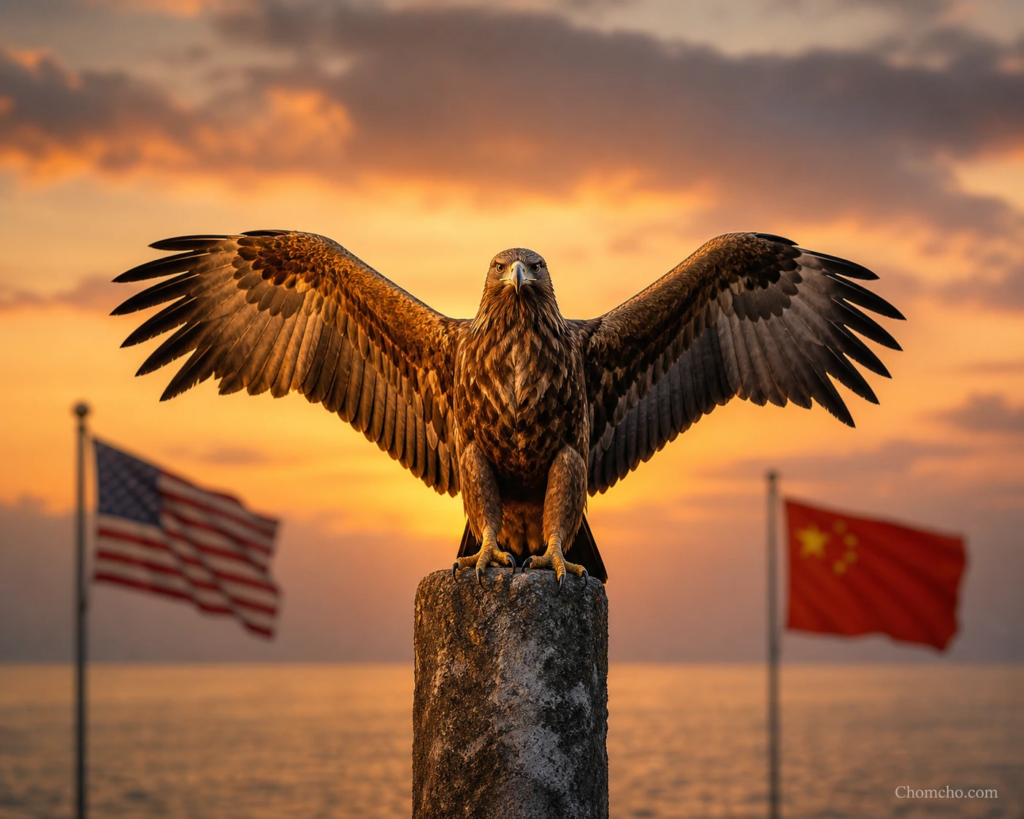
In one single month, non-aligned Indonesia trained its soldiers with the United States and its sailors with China.
One suitor can protect her. The other one she fears, but it is he who pays the bills.
This is the story of the world’s most important fence-sitter, and of why the fence is about to disappear.
One country, two rival lovers
Start with the map. Indonesia is a chain of about 17,000 islands in Southeast Asia, stretching between the Indian and Pacific oceans, just south of the South China Sea.
With 285 million people it is the fourth most populous country on Earth and the largest Muslim-majority nation anywhere. Its president since 2024 is Prabowo Subianto, a former army general. Its capital is Jakarta.
Now the news. From August 31 to September 11, Indonesia hosted Super Garuda Shield, its biggest annual military exercise with the United States: 4,700 troops from 13 nations, with the declared goal to “deter aggression” in the Asia-Pacific.
It came four months after Washington and Jakarta signed a Major Defense Cooperation Partnership. A US general called Indonesia a “vital anchor to regional stability.”
But in August, Indonesia also held its first-ever joint navy drill with China, which Taiwan blasted as a “provocation.”
Days before Garuda Shield opened, China’s foreign and defense ministers were in Jakarta promising more joint drills and military technology transfer, and later this year the Indonesian army will train with the Chinese military again in their Heping Garuda exercise.
Same month. Both rivals.
That is the flirting Garuda, named for the mythical eagle on Indonesia’s coat of arms.
Born free and active in Bandung
Indonesia calls its foreign policy “free and active”: free of alliances, active in diplomacy.
The doctrine has deep roots. In 1955, the city of Bandung hosted the famous conference that gave birth to the non-aligned movement of poor, newly independent nations.
History winked this month: Garuda Shield’s opening ceremony was held in Bandung itself, the birthplace of non-alignment, now hosting American troops.
And the country that invented the doctrine is no longer poor or weak.
It is a G20 economy that joined the BRICS bloc of China and Russia last year, while also signing a trade deal with President Trump and joining his Board of Peace for Gaza.
A superpower romance on each arm.
The man she fears
Why fear China? Because Beijing claims Indonesian waters.
China’s infamous “nine-dash line” map swallows almost the entire South China Sea, and its southern edge cuts into the waters around Indonesia’s Natuna Islands, an Indonesian archipelago rich in gas.
An international tribunal in The Hague ruled the Chinese claim baseless in 2016. Beijing ignores the ruling anyway.
Chinese coast guard ships keep entering the zone; one incursion began the day after Prabowo’s inauguration, and Indonesian patrol boats had to expel a Chinese vessel harassing a gas survey by Pertamina, the state energy company.
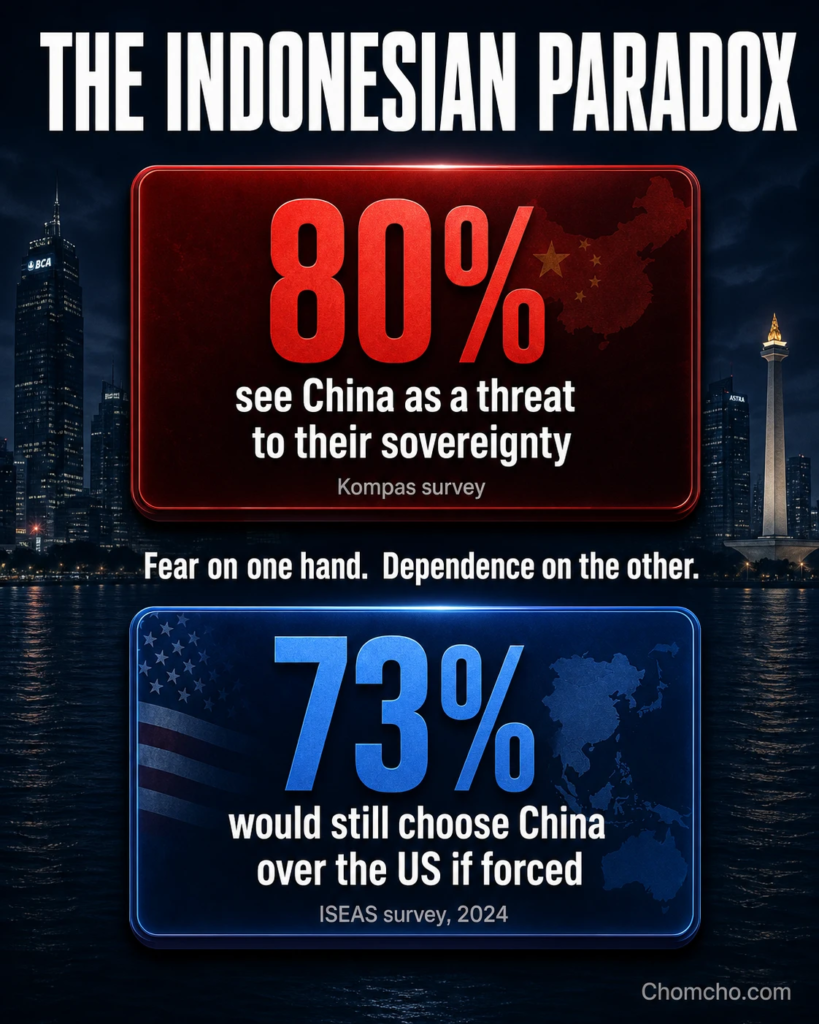
Indonesians have noticed. A survey by Kompas, the country’s leading newspaper, found nearly 80 percent of Indonesians view China’s actions in those waters as a threat to their sovereignty.
The sugar daddy
So why smile at Beijing anyway? Money.
Indonesia produces more than half of the world’s nickel, the metal of batteries and stainless steel, and Chinese firms spent thousands of millions of dollars building the processing plants on Sulawesi, a large Indonesian island east of Borneo.
China is Indonesia’s largest trading partner, with two-way trade above $167,000 million a year.
When Jakarta tightened nickel quotas this year, China’s Chamber of Commerce openly warned President Prabowo about the consequences. That is not how partners talk; that is how creditors talk.
And here is the second statistic, the one that explains everything. The ISEAS think tank in Singapore asks Southeast Asians every year which superpower they would choose if forced.
In 2024, 73 percent of Indonesians chose China over the United States, and 72 percent repeated it in 2025.
Read those two numbers together: 80 percent call China a threat to their sovereignty, yet 7 in 10 would still pick Beijing over Washington.
Fear on one hand, dependence on the other. The flirting is not just the government’s policy; it is the national condition.
The Muslim silence
There is a moral price, and it is paid in silence.
China has held more than a million Uyghur Muslims in internment camps in its Xinjiang region.
Indonesia, the largest Muslim-majority country on Earth, a nation that marches for Palestine and defends the Rohingya, says nothing.
Its officials declared they would “not meddle in the internal affairs of China.”
In 2022, Indonesia even voted at the UN Human Rights Council against merely debating Xinjiang, and it has deported a Uyghur refugee back to China.
Beijing worked for this silence, flying Indonesian clerics on guided tours of sanitized camps.
Money talks; the ummah walks.
The protector’s courtship
Washington is courting seriously, and this is where US foreign policy enters the story.
The Trump administration elevated Indonesia to a Major Defense Cooperation Partnership in April, covering modernization, training, and exercises.
Secretary of State Marco Rubio raised South China Sea security with his Indonesian counterpart in one of his first calls in office.
The trade deal gave Jakarta better terms than most of its neighbors.
And Defense Secretary Pete Hegseth has said plainly that America needs more from its Asian partners to balance China.
Think tanks see the balancing act clearly.
ISEAS researcher Sharon Seah notes the region’s pragmatism: “there is no choice but to trust the powers that they are familiar with because geopolitical dynamics is shifting so rapidly.”
Political scientist Ja Ian Chong is sharper: “Southeast Asia is an arena for contention between Washington and Beijing despite desires ‘not to choose sides’ in the region.”
Why America bothers
Why does Washington keep courting a country that trains with the Chinese navy? Three reasons, in plain terms.
Geography first. Indonesia sits on the exits of the world’s most important sea lanes: the Malacca, Sunda, and Lombok straits, the narrow doors through which most of China’s imported oil must pass.
Chinese strategists themselves call this vulnerability the “Malacca Dilemma.”
After this year’s crisis in the Strait of Hormuz, the whole world relearned what a chokepoint means. Whoever holds those doors holds leverage no missile can match.
Minerals second. Indonesia mines more than half of the world’s nickel, the metal America needs for batteries, ammunition and stainless steel.
Today Chinese companies control most of its processing; leaving that treasure to Beijing’s supply chain alone would be a strategic gift America cannot afford.
Weight third. Unlike the small claimant states around the South China Sea, Indonesia is a neighbor with mass: 285 million people, the region’s largest economy, the natural leader of ASEAN.
In geopolitics, whichever way Indonesia leans, the Indo-Pacific tilts with her.
The clock is ticking on neutrality
Now the opinion, from an American perspective.
Non-alignment made sense in 1955, when Indonesia was poor, weak, and new.
In 2026, a G20 power that accepts Chinese weapons technology while Chinese ships violate its waters is not practicing independence; it is practicing indecision.
And indecision has a clock, and the clock is Taiwan.
If war comes to the Taiwan Strait, the straits of Indonesia become the valves of the world economy, and “free and active” collapses into a single word: choose.
America should keep courting, with clear eyes.
Sure, buy the nickel, sign the deals, train the troops, exactly as we argued when Japan began building warships for Australia: allies that build together stay together.
But guard the technology, because a partner that drills with the People’s Liberation Army cannot receive America’s crown jewels.
Reward every step Jakarta takes toward the free world, and price every step toward Beijing.
The Garuda is a proud eagle; let her fly free. Just remind her, respectfully, that one of her two suitors already claims her waters, silences her faith, and holds her economy by the throat.
That is not a lover. That is an owner in waiting.
Freedom is the only partner that never sends an invoice.