
This post is also available in:
 Português
  Español
  Français
  Deutsch
  Italiano
  Русский
The Pentagon says China Naval Expansion is accelerating rapidly
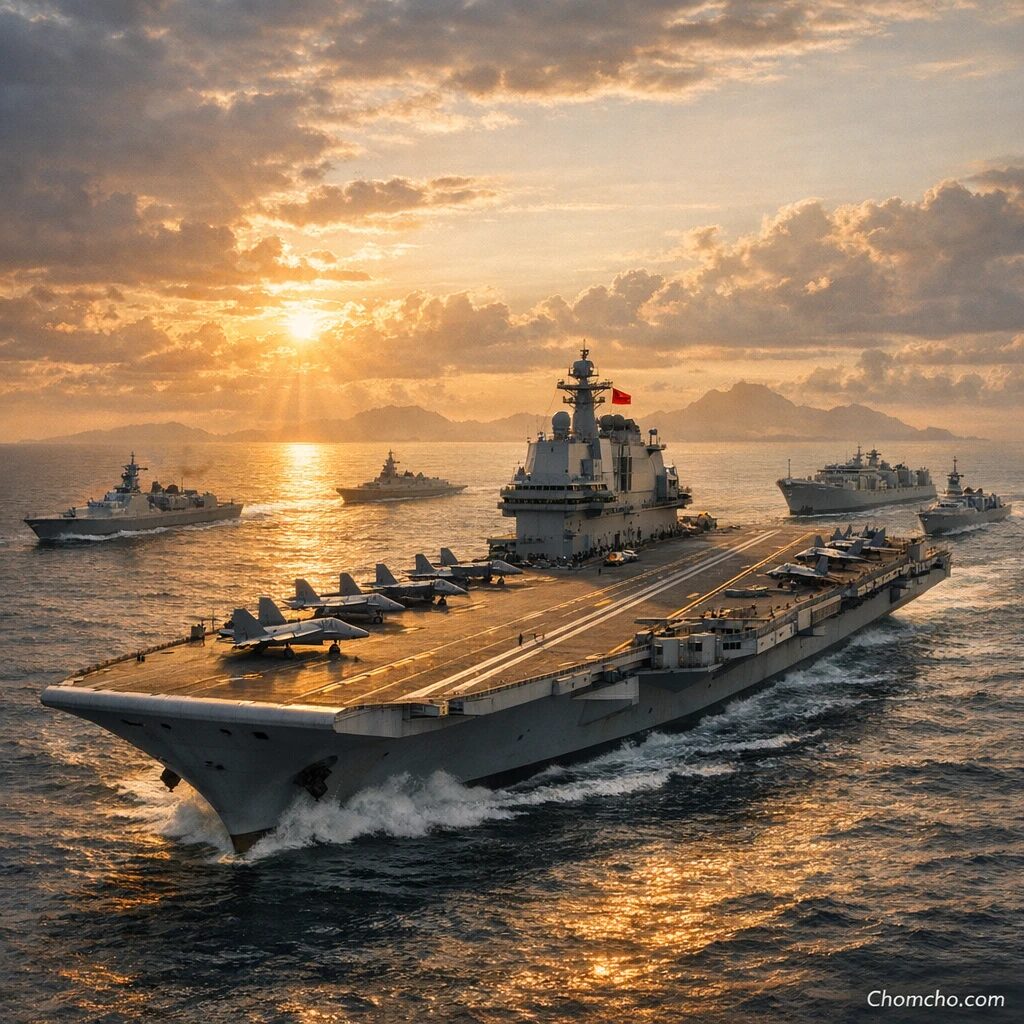
A new Pentagon assessment has renewed concerns about China’s naval expansion. China already operates the world’s largest navy by number of battle-force ships.
The report also estimates that China could eventually operate as many as nine aircraft carriers. Nine carriers remain a projection, not a confirmed shipbuilding plan.
Even so, the estimate shows how quickly China’s naval power is growing.
The Pentagon report highlights more than the number of ships. China is steadily improving its ability to operate far from its own coastline.
New satellite imagery, additional support ships, and advances in naval aviation all point in the same direction. China is preparing for long-range naval operations.
The latest Pentagon assessment is therefore about more than fleet size. It also reflects China’s broader foreign policy objectives.
A larger navy gives Beijing more options to protect its interests far from mainland China.
The aircraft carrier Fujian marks an important technological step
China’s newest aircraft carrier, the Fujian, represents a major technological improvement.
China’s first two aircraft carriers used ski-jump launch ramps. The Fujian uses an electromagnetic aircraft launch system.
This technology is very similar in concept to the launch system used on the newest American Ford-class aircraft carriers.
Electromagnetic launch systems allow aircraft to take off with heavier payloads. They also improve operational efficiency and support more advanced aircraft.
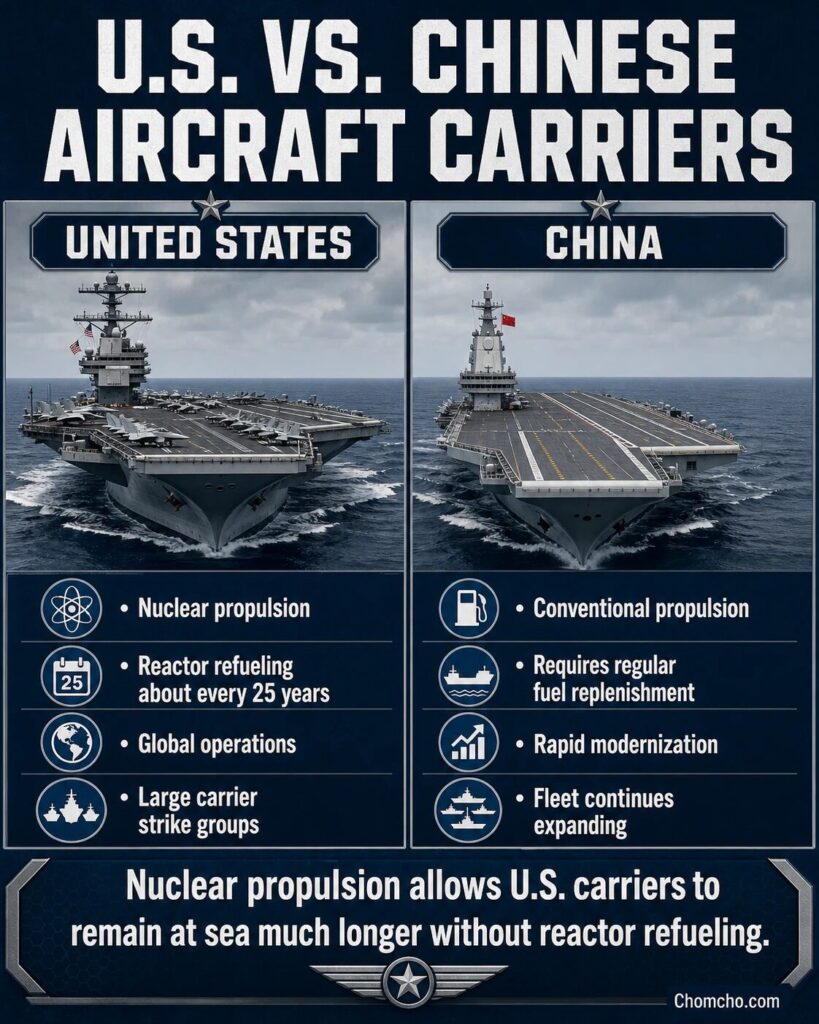
The Fujian is still conventionally powered. It is not a nuclear-powered aircraft carrier like the American Ford class.
Modern U.S. nuclear-powered aircraft carriers are designed so that their nuclear reactors do not need refueling for about 25 years, which is roughly the carrier’s mid-life overhaul interval.
In practice, the limiting factors are food, aviation fuel for aircraft, ammunition, maintenance, and crew endurance—not the reactor itself.
The United States still holds a clear advantage in this area. China is nevertheless making steady progress.
Defense analysts expect Beijing to continue building more advanced aircraft carriers during the coming years.
Whether China eventually builds six, eight, or nine aircraft carriers, the trend remains the same.
China is building a navy that can project military power well beyond the Western Pacific.
That objective supports China’s broader foreign policy.
Aircraft carriers support global operations
Aircraft carriers are designed to project military power far from home.
A nation that only wants to defend its coastline does not need a large carrier fleet.
Coastal defense can rely on land-based aircraft, missile systems, submarines, and smaller warships. Aircraft carriers support much broader military objectives.
Carrier strike groups can protect commercial shipping routes. They can support allies during regional crises. They can enforce maritime blockades. They can deliver humanitarian assistance after natural disasters.
They also allow military aircraft to operate without depending on foreign air bases.
For these reasons, aircraft carriers have become symbols of global military influence.
China depends heavily on international trade. China also depends on imported energy that travels through major sea lanes.
Many of those sea lanes cross the South China Sea, the Indian Ocean, and the Middle East. Chinese leaders have repeatedly described those routes as vital national interests.
A larger aircraft carrier fleet gives China more options to protect those interests far from its own shores.
Many defense analysts therefore believe China’s naval expansion represents a major strategic shift.
China is moving beyond regional coastal defense.
This country is building a navy that can conduct long-range operations across the Indo-Pacific and eventually other regions of the world.
No one knows exactly how Beijing will use that capability in the future. However, history shows that military reach often increases political influence.
That trend deserves the attention of anyone interested in U.S. military strategy and foreign policy.
China is building an entire naval system
An aircraft carrier cannot fight alone.
Every carrier strike group depends on destroyers, frigates, submarines, supply ships, surveillance aircraft, satellites, and logistics.
Without those supporting forces, an aircraft carrier becomes much more vulnerable.
China has spent many years building that complete naval system.
The People’s Liberation Army Navy continues to launch modern destroyers with advanced air-defense systems.
China is also building large amphibious assault ships, modern submarines, and replenishment ships. Those vessels allow Chinese naval forces to operate farther from home for longer periods.
Space systems also play an important role.
China has expanded its satellite network to improve surveillance, communications, and targeting across the Indo-Pacific.
Better information gives naval commanders greater awareness during military operations.
Logistics are equally important.
Replenishment ships allow warships to receive fuel, ammunition, food, and supplies without returning to port.
China has also expanded access to overseas facilities, including its military support base in Djibouti. China has also strengthened commercial relationships with ports across Asia, Africa, and the Middle East.
Most of those ports are commercial facilities, not military bases. However, those ports could provide valuable logistical support during future crises.
China is therefore building much more than additional warships. Beijing is building the infrastructure needed for sustained naval operations far from mainland China.
That broader effort is one of the strongest indicators that China’s naval expansion supports its global ambitions.
China’s shipbuilding industry supports China’s naval expansion
China’s naval expansion depends on more than military spending.
Beijing also benefits from one of the world’s largest commercial shipbuilding industries.
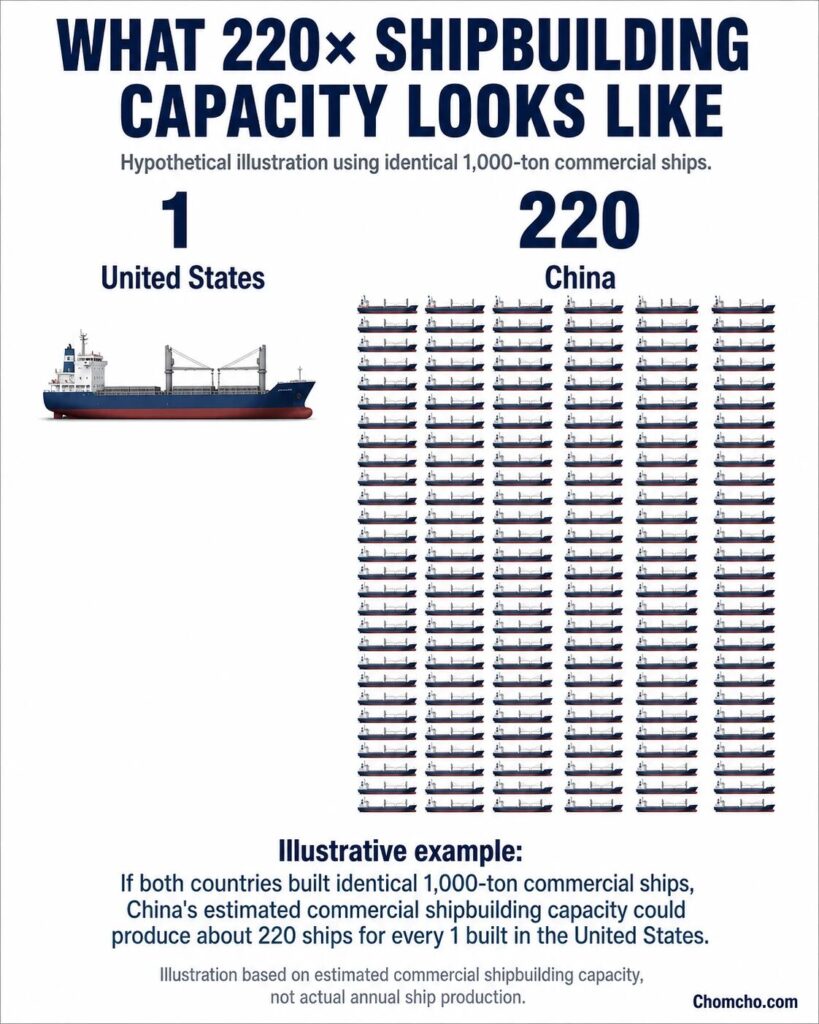
According to U.S. Navy officials, China’s shipbuilding industry has roughly 220 times the production capacity of the United States.
Put another way, for every 1 ton of commercial shipping capacity the United States can produce, China can produce about 220 tons.
That massive industrial advantage also strengthens Beijing’s ability to expand its navy.
Commercial shipyards build hundreds of vessels every year. That industrial base provides skilled workers, engineering experience, and extensive manufacturing capacity.
Commercial shipyards do not automatically become military shipyards. However, a large commercial industry strengthens the nation’s ability to expand military production during a national emergency.
History shows why industrial capacity matters.
During the Second World War, the United States converted large parts of its civilian economy to military production.
American shipyards built transport ships, merchant ships, and warships at an extraordinary pace. Industrial production became one of the decisive advantages of the Allied victory.
Britain demonstrated a similar principle during the 1982 Falklands War.
The British government requisitioned civilian merchant vessels to support military operations. One example was the Atlantic Conveyor. The ship transported helicopters, aircraft, and military supplies to the South Atlantic.
Although Argentine missiles later sank the ship, the mission demonstrated how commercial shipping can support military operations during wartime.
China now possesses the world’s largest maritime industrial base.
Military warships still require specialized shipbuilding facilities and expertise. A commercial shipbuilding industry cannot simply become a military shipbuilding industry overnight.
Even so, China’s commercial shipbuilding industry gives Beijing strategic depth that few nations can equal.
Therefore, many defense planners view China’s naval expansion as a major strategic challenge.
America’s allies are strengthening deterrence
China’s naval expansion has encouraged a stronger response from the United States and its allies.
Many Indo-Pacific nations are increasing defense spending, expanding military cooperation, and improving maritime security.
The goal is not to build a larger fleet than China. The goal is to strengthen deterrence and preserve freedom of navigation.
Japan has adopted one of its largest defense reforms since the Second World War. Japan has increased defense spending and strengthened cooperation with the United States.
Japan has also reinforced the defense of its southwestern islands.
Australia continues to modernize its armed forces through programs such as AUKUS.
The Philippines has expanded military cooperation with the United States by providing access to additional military facilities.
Taiwan also continues to invest in asymmetric defense capabilities, including anti-ship missiles, drones, naval mines, mobile launchers, and coastal defenses.
This strategy seeks to deter aggression by convincing Beijing that the military, economic, and political costs of an attack would be unacceptably high.
Joint military exercises have also become more important.
Those exercises improve cooperation among allied forces. They also demonstrate political unity.
Strong alliances reduce the risk of miscalculation because potential adversaries understand that aggression could trigger a broader international response.
Several defense studies have warned that a major conflict over Taiwan would place enormous pressure on American military resources, including long-range precision munitions.
Those studies reinforce one important lesson. Strong deterrence is less costly than fighting a major war.
Strong alliances, military readiness, and capable regional partners remain essential parts of effective U.S. foreign policy.
America First means preserving peace through strength
China’s naval expansion does not mean war is inevitable.
History shows that military competition does not always lead to conflict. Strong deterrence reduces the risk of war. Clear political leadership also reduces the risk of miscalculation.
The United States should continue rebuilding the military capabilities needed to deter major competitors.
The United States should also encourage its allies to assume a larger share of their own defense.
European nations should assume greater responsibility for security in Europe.
That approach allows the United States to focus more attention on the Indo-Pacific, where China presents the principal long-term strategic challenge.
President Donald Trump (@realDonaldTrump) repeatedly argued that allies should invest more in their own defense instead of relying heavily on American taxpayers.
Since then, many allied governments have increased defense spending and accelerated military modernization.
Greater burden-sharing strengthens the alliance system.
It also allows the United States to concentrate more resources on protecting American interests in the Indo-Pacific.
China’s naval expansion should therefore be viewed realistically.
Panic is unnecessary. Complacency is also dangerous.
Military power, industrial capacity, economic strength, and foreign policy remain closely connected.
The United States can preserve peace by maintaining credible deterrence, strengthening alliances, rebuilding industrial capacity, and protecting American national interests.
Final thoughts
China’s naval expansion will continue to influence global security for many years.
The exact number of future aircraft carriers is less important than the overall direction. China is steadily building the military, industrial, and logistical capabilities needed to operate across the world’s oceans.
The United States still possesses major advantages.
Those advantages include the world’s most experienced blue-water navy, a strong alliance network, decades of operational experience, and unmatched global logistics.
Those advantages should never be taken for granted. They require continued investment, innovation, and military readiness.
An America First foreign policy does not seek unnecessary wars.
An America First foreign policy also does not ignore emerging threats.
Peace is more likely when potential adversaries understand that the United States and its allies possess both the capability and the determination to defend their interests.
China’s naval expansion is about much more than ships. It reflects Beijing’s broader military ambitions.
China Naval Expansion will remain one of the defining security challenges of the Indo-Pacific for years to come.
Peace through deterrence.