
This post is also available in:
 Português
  Español
  Français
  Deutsch
  Italiano
  Русский
  Nederlands
  日本語
日本語  Polski

An earthquake in eastern Germany
The AfD victory in Saxony-Anhalt is historic: a projected 44 percent, the best result the party has ever recorded, and more than double the vote of Chancellor Merz’s “conservatives.”
Yet Germany’s establishment may still lock the winners out. This is the story of a firewall against the voters, and of why America has seen this movie before.
A record night in Saxony-Anhalt
First, what this was: a state election, not a national one.
Saxony-Anhalt is one of Germany’s 16 states, a former East German region of about 2.1 million people west of Berlin, with its capital in Magdeburg.
Think of it as a governor’s race in one American state.
Chancellor Merz’s federal government was not on the ballot, and that is exactly why the result matters: it is the voters’ message to Berlin, delivered in the middle of Merz’s term.
On Sunday that message was an earthquake.
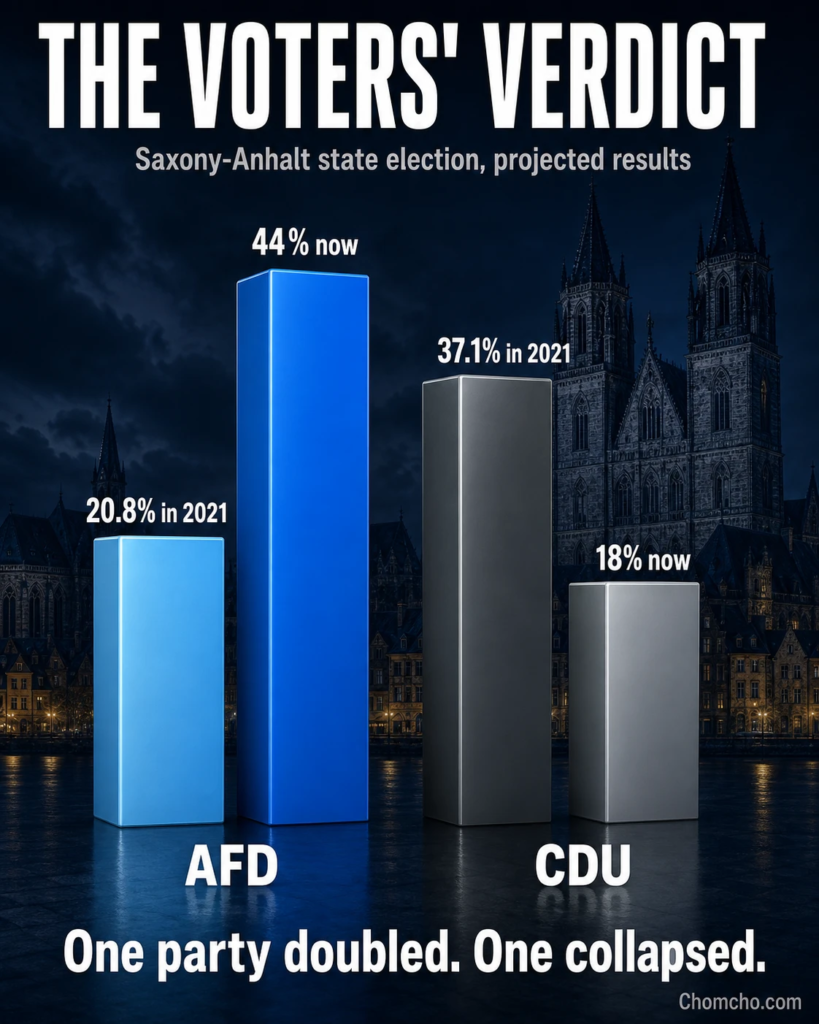
Projections give the Alternative for Germany (AfD) around 44 percent of the vote, more than double its own 2021 result.
The east is the party’s strongest ground, and no one expects 44 percent across all of Germany; nationally the AfD polls in first place, but far below that mark.
Chancellor Friedrich Merz’s Christian Democratic Union (CDU) collapsed here from 37.1 percent to about 18 percent, losing more than half its voters.
Whether 44 percent converts into the 42 of 83 seats needed to govern alone depends on the final count; if it does, Germany would see its first state government of this kind in the postwar era.
AfD leader Alice Weidel called the result “a very clear mandate to govern.”
The party’s local lead candidate, Ulrich Siegmund, offered cooperation to everyone: “As a democrat, I will always extend my hand to all forces that will help us achieve a political turnaround.”
What the voters actually said
Read the numbers as a message, because that is what they are.
Conservative voters did not drift to the AfD; they stampeded.
The CDU, a party that calls itself conservative, lost more than half of its 2021 support in a single election. Its voters told it, in the clearest language democracy has, to stop fighting the AfD and start working with it.
AfD co-leader Tino Chrupalla drew the obvious conclusion: “the firewall has been definitively rejected by the voters.”
The firewall is real
For readers new to German politics: the “firewall,” or cordon sanitaire, is the establishment parties’ standing agreement never to govern with the AfD, no matter how many citizens vote for it.
Merz has ruled out any coalition with the party. Bavaria’s Markus Söder put the doctrine plainly: “we decide ourselves with whom we form a coalition.”
They decide by themselves, not with the voters.
During the campaign, Merz warned that an AfD victory could frighten off foreign investors. The voters heard him and answered with 44 percent.
The sitting CDU premier, Sven Schulze, at least respected the verdict: “Some say this would be a black day for Saxony-Anhalt. I say: This is democracy.”
So the likely outcome, if the AfD falls short of an absolute majority, is grotesque: a CDU minority government with the left-wing Social Democrats and the Greens, tolerated by Die Linke, the direct descendant of the communist party that ran East Germany.
To exclude the “extremists,” the conservatives would govern with the heirs of the SED.
That is not a firewall against extremism; it is a firewall against the people.
The party they surveil
Here the story turns darker. Saxony-Anhalt’s AfD branch is officially classified as a “confirmed right-wing extremist” organization by the state’s own intelligence agency.
In plain words: the government surveils the party that 44 percent of the state just voted for.
Americans have seen this movie.
A political outsider rises, the establishment closes ranks, the intelligence agencies get involved, and the courts fill with cases.
It happened to Trump, and he still won. The Deep State is not an American exclusive.
Washington said so on the record.
Vice President JD Vance told the Munich Security Conference: “Democracy rests on the sacred principle that the voice of the people matters. There’s no room for firewalls.”
When Germany formalized the surveillance, Secretary of State Marco Rubio wrote that this is “not democracy” but “tyranny in disguise.”
Elon Musk went further: “only the AfD can save Germany.”
Why the revolt happened: economics and immigration
The revolt has reasons, and honesty requires the hard numbers.
Germany’s economy shrank in 2023, shrank again in 2024, and grew only 0.2 percent last year. Three lost years.
This month Volkswagen approved a plan to cut 50,000 jobs in Germany and probably close four German plants, while Chinese carmakers build new factories in Europe.
BMW is buying out 8,000 workers; Bosch is cutting 13,000. These are the companies that defined Germany.
The once-mocked comparison is now reality: Mississippi, the poorest US state, sits within about 1,500 euros of Germany’s GDP per person, and West Virginia, the second poorest, has already passed Germany by more than 5,000 euros.
The country that lectured the world on economics is being caught by the states its media laughed at.
And there is Magdeburg itself.
In December 2024, in this state’s own capital, a Saudi-born doctor drove a car through the Christmas market, killing six people, including a nine-year-old boy, and injuring more than 300.
Saudi Arabia had warned German authorities about him repeatedly. The warnings went nowhere. Voters remember.
A rising tide, not yet a wave
Europe’s populists cheered. Italy’s Matteo Salvini: “it’s called DEMOCRACY. Another Europe is possible.” France’s Eric Zemmour: “The cordon sanitaire has never protected anyone. It has only delayed the hour of truth.”
But honesty requires a distinction.
In Latin America, the conservative wave took actual power: Milei governs Argentina, Bukele governs El Salvador, Noboa governs Ecuador.
In Europe, the populists win voters and stay locked out of office: AfD polls first in all of Germany, Reform UK leads in Britain, Vox surges in Spain, and the same establishment coalitions wait for them all.
A rising tide, not yet a wave. The difference is not the voters; it is the firewall.
What America should learn
For US foreign policy, the lesson of the AfD victory is uncomfortable and clarifying at once.
Germany is not a stable ally led by consensus; it is a country whose government is at war with its own electorate, whose flagship industries are shrinking, and whose answer to losing arguments is surveillance of the opposition.
In geopolitics, that is a weak partner, whatever its GDP.
Trump and Vance told Germany the truth in 2025, and Germany called it interference. Sunday, the voters of Saxony-Anhalt said it louder.
If the establishment overrides them again, it will not stop the AfD; it will manufacture the AfD’s national victory, exactly as lawfare manufactured Trump’s.
You cannot firewall a people out of their own country forever.
The voice of the people is not a threat to democracy. It is democracy.