
This post is also available in:
 Português
 Español
 Français
 Deutsch
 Italiano
 Русский
 Nederlands
 日本語
 Polski
Summary
The markets answered first: São Paulo stocks fell 13.88 percent in a day, the first circuit breaker since 2020, and the Brazil fund in New York lost 25 percent before the opening bell.
Polls were to close at 5 pm. At 5:03 p.m., Supreme Federal Court (STF) Justice Cristiano Zanin, Lula's former personal lawyer, ordered every polling station in the country to stay open two more hours.
Kassio Nunes Marques, president of the Superior Electoral Court (TSE), said no rule authorized the extension: "Never, in the history of the TSE, was there any extension."
The Constitution, he reminded the Supreme Court, gives his court the "exclusive competence to manage the electoral process."
Stations already closed could not reopen; others stayed open. That is not equal treatment.
The numbers raise their own questions.
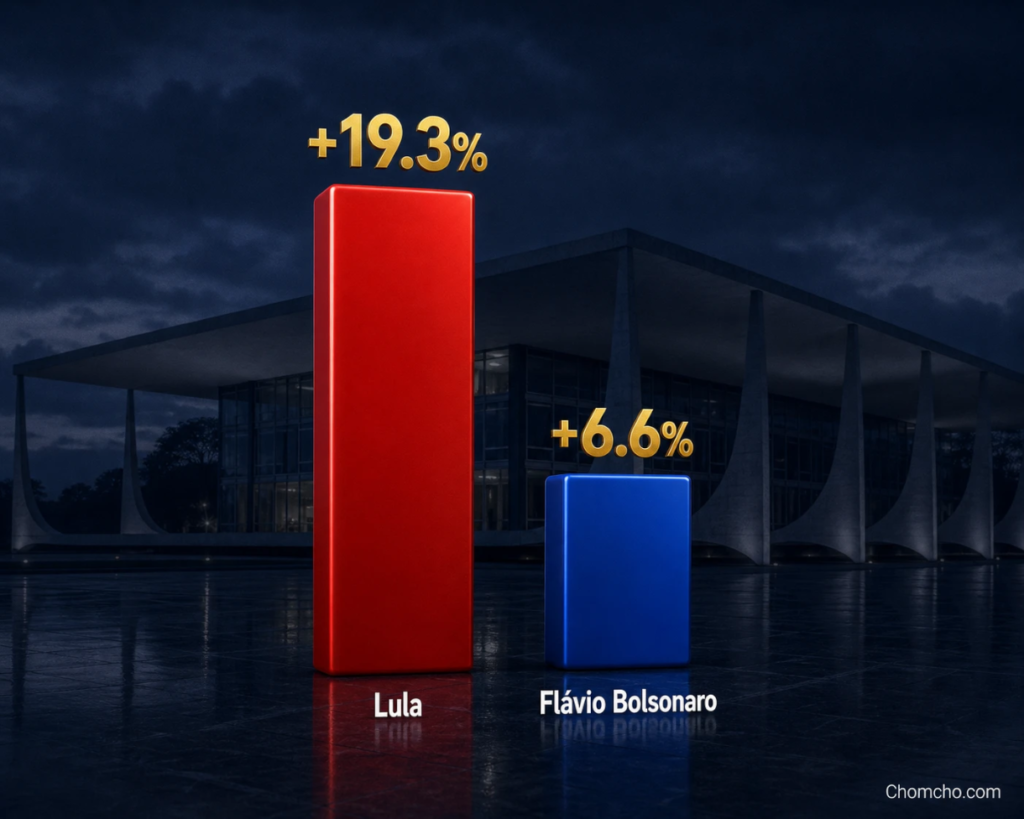
Between the first round and the runoff, Lula gained 10.4 million votes, a rise of 19.3 percent. Flávio Bolsonaro gained 3.7 million, a rise of 6.6 percent. All the eliminated first-round candidates together had 9.33 million.
Elon Musk's verdict: "Math doesn't add up."
That night, Justice Alexandre de Moraes ordered Flávio's passports seized, citing a sealed money laundering probe. Flávio: "Is this justice?"
Justice Alexandre de Moraes himself appears in Brazil's largest financial fraud case, with 52 messages from banker Daniel Vorcaro and a 131 million reais contract with the law firm of Moraes's wife.
The Supreme Federal Court vote on investigating Moraes was suspended six weeks before the election.
Lula's first promise after winning was to regulate social media. U.S. President Donald Trump said the vote "looked like another rigged election." Steve Bannon wants the United States to cut diplomatic relations with Brazil.
The lesson for America: paper ballots, real audits, and no judge changing the rules AFTER election hours.
Count the votes in the light. Keep compromised judges away from the clock.
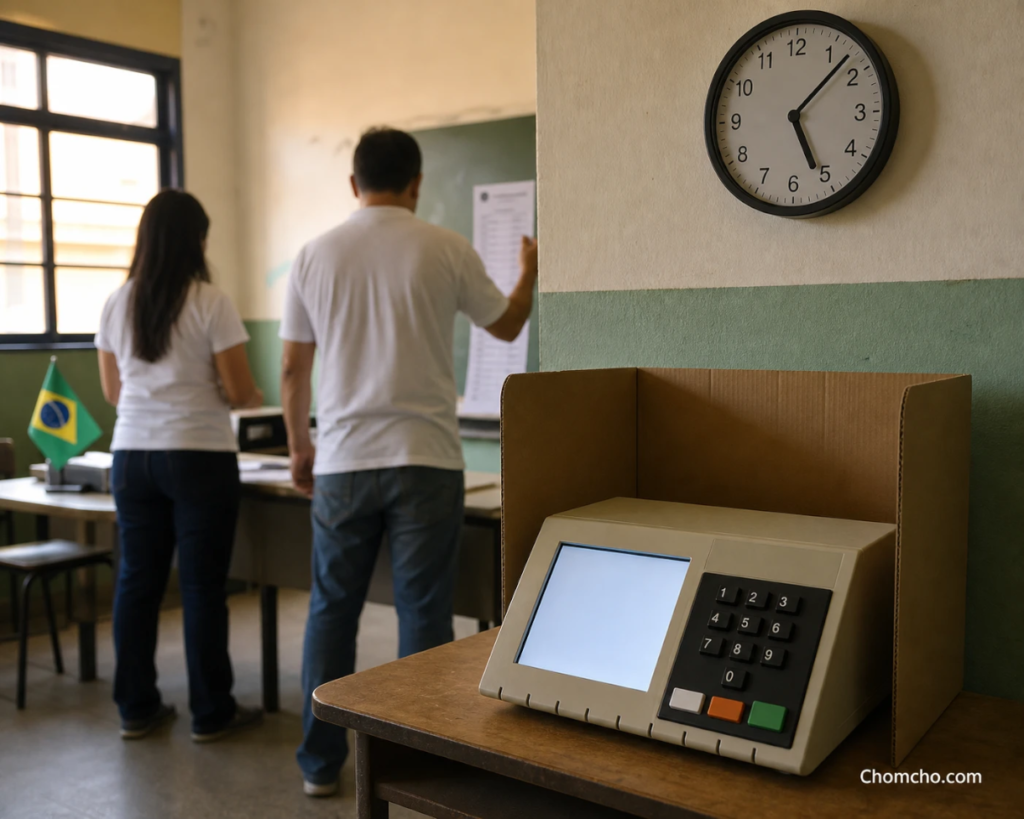
Lula’s fourth term, declared after a two-hour extension
The 2026 Brazil election ended on October 25, 2026, with the Superior Electoral Court (TSE) declaring Luiz Inácio Lula da Silva reelected with 51.79 percent of the valid votes against 48.21 percent for Senator Flávio Bolsonaro, a margin of 4.43 million votes.
Flávio first said he would not recognize the result, then shifted: “The election is over, but the fight for a different Brazil goes on.” He now plans a court action to remove Lula’s ticket for abuse of economic power.
Later on Monday, October 26, 2026, Flávio’s party, the Liberal Party (PL), recognized the result in a statement by its president, Valdemar Costa Neto: “We recognize the presidential election results,” adding that “the issues raised need to be properly clarified.”
The victory gives Lula his fourth term. Brazil limits only consecutive terms: two in a row, one term out, and a former president may run again.
Contrast that with the two-term limit in the United States, and the one-term limit in Latin American countries such as Mexico and Colombia. The reason is the same in all three: a president who can keep running has every incentive to bend the courts, the clock and the count to keep the job.
The markets gave their verdict before the lawyers did
After this Brazil election, the markets did not wait for the lawyers.
On Monday, October 26, 2026, the Ibovespa, the São Paulo stock index, fell 13.88 percent, and trading was halted by a circuit breaker for the first time since March 2020. Brazil’s currency, the real, lost about 8.4 percent against the dollar, closing near 5.41 reais per dollar.
In New York, the iShares MSCI Brazil fund, the main way American investors buy Brazilian stocks, fell 25 percent before the opening bell. Magazine Luiza, Vamos and Hapvida each lost more than half their value in a single day.
Two hours, ordered after the polls closed
Polls were scheduled to close at 5 pm.
Lula’s coalition asked the Supreme Court to keep every polling station in the country open for two more hours, citing bus shortages in Salvador and other cities. The case was assigned to Supreme Federal Court (STF) Justice Cristiano Zanin.
Zanin is no ordinary judge for this request.
Zanin was Lula’s personal lawyer through the Lava Jato (Car Wash) corruption cases, the probe that sent Lula to prison for 580 days before the Supreme Court annulled his convictions in 2021. Lula nominated him to the court in 2023.
Zanin’s order was released at 5:03 p.m., three minutes after polls were to close.
The clarification that only stations still open were covered came about an hour later, and the Superior Electoral Court spoke at 6:35.
Not all polling places were treated the same. That is not equal treatment.
Kassio Nunes Marques, president of the Superior Electoral Court (TSE), the body the Constitution charges with running elections, said no rule authorized the extension. “Never, in the history of the TSE, was there any extension,” he said, using the court’s initials.
The order “created difficulties for the electoral process,” because “thousands of voting machines in Brazil had already closed, and their programming prevents them from reopening.”
He also reminded the Supreme Court that the Electoral Justice holds the “exclusive competence to manage the electoral process.”
In plain words: control of election closing times belonged to Nunes Marques’s court, not to Lula’s former lawyer.
Nineteen percent versus six
The first round on October 4, 2026, was nearly even. Flávio Bolsonaro received 56.1 million votes and Lula 53.9 million, with Flávio ahead by 2.2 million.
Three weeks later, Lula received 64.3 million votes, 10.4 million more than in the first round, a gain of 19.3 percent. Flávio received 59.8 million, 3.7 million more, a gain of 6.6 percent. Lula’s growth was about three times Flávio’s.
Abstention fell only from 21.1 to 19.2 percent.
The two hours do not explain it either: TSE data show 34,330 votes recorded after 5 pm. And all the candidates eliminated in the first round together had 9.33 million votes, fewer than Lula alone gained.
Elon Musk shared that calculation on October 26 with three words: “Math doesn’t add up.” So where did ten million new Lula voters come from in three weeks?
Nobody in the Brazilian government is answering.
Four legal questions
First, authority. The Constitution gives the Electoral Justice the exclusive power to manage elections, and the Superior Electoral Court had already received requests from both campaigns that afternoon. It was weighing them.
One Supreme Federal Court justice, Zanin, acting alone on a complaint from Lula’s own coalition, took the decision out of the Superior Electoral Court’s hands and moved the closing time of a presidential election. Was that his to decide?
Second, certainty. Election rules are published in advance so that every voter and every campaign plays by the same clock.
By 5 pm, about 128 million Brazilians had voted under one set of rules. Changing those rules after the fact, by an emergency order no law provides for, breaks the promise that makes a result believable.
Third, equality. Stations that shut their machines at 5 pm could not reopen, as Nunes Marques explained.
Stations that had not yet shut stayed open until 7. A voter in one city had two more hours than a voter in the next, depending on how quickly a local official followed the law and how fast the news traveled.
The clarification an hour later did not restore anything to the voters already turned away.
Fourth, proportion. The complaints were about buses in a handful of cities. The remedy was nationwide.
A targeted order for the affected cities, issued by the Electoral Court, was the obvious tool. It was not used.
When the smallest remedy is ignored and the largest is chosen, in favor of the sitting president, by the president’s former lawyer, people are entitled to ask why.
Machines nobody can audit
Brazil votes on electronic machines that print no paper ballot the voter can check. The count rests entirely on software.
After the 2022 election, the Ministry of Defense inspected the system. Its technicians reported restricted access to a source code of more than 17 million lines and flagged that computers had access to the electoral court’s network while the code was compiled.
The ministry found no proof of fraud, but said its report “does not rule out the possibility.”
Nothing in that gap was closed before 2026.
A country that cannot fully audit its machines is asking its citizens for faith, not verification.
The passports, hours after the vote
On the night of October 25, hours after the vote, Justice Alexandre de Moraes ordered Flávio Bolsonaro to hand over his passports, including his diplomatic one, within 24 hours, and cancelled them.
The stated basis is a sealed money laundering investigation involving Flávio and a lawyer.
Flávio says the real trigger was a remark by his brother Eduardo Bolsonaro on an American podcast published October 23, 2026: “If my brother doesn’t win, I’m in favor of my brother leaving the country.”
Flávio’s answer: “I never said that.” And: “Is this justice?”
Eduardo knows the court. In June 2026, the Supreme Federal Court sentenced Eduardo to four years and two months for asking the U.S. government to sanction the judges trying his father, Jair Bolsonaro.
Brazil has no lobbying law, so the charge was “coercion” (coação in Portuguese).
His public defender argued that a congressman’s political statements are covered by parliamentary immunity, that criticizing judges is part of democratic debate, and that public statements cannot be the “serious threat” the crime requires.
Eduardo’s own words: Justice Alexandre de Moraes “served as both judge and alleged victim simultaneously.”
Their father, former President Jair Bolsonaro, is serving a 27-year prison sentence under house arrest. In July 2026, Moraes suspended Flávio’s visits for 90 days over a letter supporting Flávio’s campaign.
The judges’ own troubles
The court that polices the Bolsonaro family has questions of its own.
In the Banco Master case, described in Brazil as the largest financial fraud in the country’s history, Federal Police reports cite 52 messages from banker Daniel Vorcaro to Justice Alexandre de Moraes and a 131 million reais contract between Vorcaro-linked companies and the law firm of Moraes’s wife, Viviane Barci de Moraes.
Moraes calls the messages “fantasy dialogues” and denies any interference in his rulings.
On September 15, 2026, six weeks before the election, the Supreme Federal Court opened an unprecedented session on whether to investigate Moraes.
One justice asked for more time, and the vote on whether to investigate Moraes was suspended.
Moraes is not alone. Vorcaro’s phone records also show messages, meetings or payments involving five other justices or their sons. Six of the court’s ten members, in one file, and not one of them under investigation.
Lula’s eldest son, Fábio Luís, known as Lulinha, is the subject of three Federal Police inquiries for influence peddling and corruption, authorized by the Supreme Federal Court in July and August 2026. His lawyers deny any wrongdoing.
What the United States should learn
Lula’s first promise after winning was aimed at speech.
The election, he said, had to overcome interference “coming from social media platforms, and we’re going to have to regulate them.”
A government that just extended its own election by judicial order now wants authority over what Brazilians may say about it.
U.S. President Donald Trump, asked on Monday, October 26, 2026, kept his distance and his doubts: “I didn’t take sides, but it looked like another rigged election.” The extra voting time, he said, “was very strange.”
Musk knows the court too. In April 2024 Musk said Moraes should “resign or be impeached”; four months later Moraes shut down X in Brazil.
In late October 2026, Steve Bannon went further: “cut off diplomatic relationships, shut down everything with Brazil, no trade, nothing.”
And a warning about the United States: “If you don’t think this election stealing is coming here, you’re dead wrong.”
For American foreign policy, the Brazil election is a test.
Breaking relations with the largest country in South America is a heavy step, and the United States should weigh it carefully.
But the U.S. State Department can speak plainly about a judge who orders a candidate’s passports seized hours after an election, about a court that rewrites election rules after the polls close, and about a president who answers questions with censorship.
Sanctions already exist against Moraes. They can be extended to those who helped.
The lesson for American elections is simpler. Paper ballots the voter can see. Audits anyone can check. Closing times that close. And no judge changing the rules after election hours.
Count the votes in the light. Keep the courts out of the clock.