

This post is also available in:
 Português
  Español
  Français
  Deutsch
  Italiano
  Русский
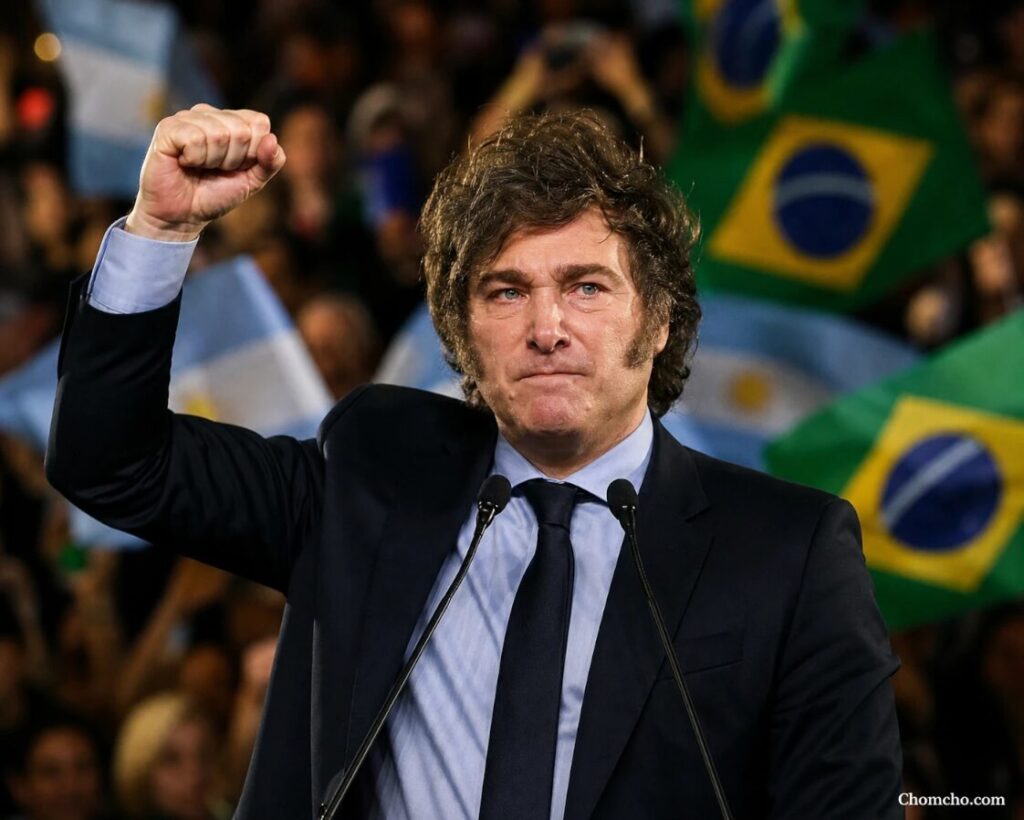
Brazil withdraws its ambassador for the first time in history
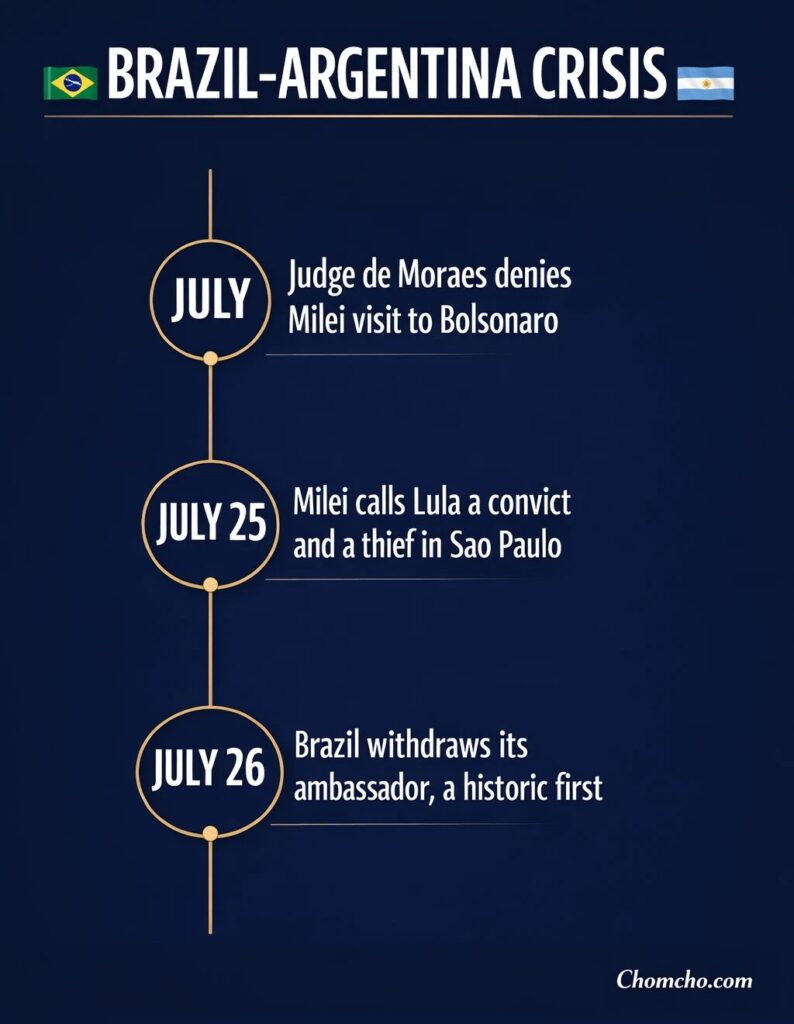
Brazil withdrew its ambassador, Julio Bitelli, from Buenos Aires on Sunday, July 26. The same day, the Lula government summoned Argentina’s ambassador in Brasilia, Brazil’s capital.
Brazilian Foreign Minister Mauro Vieira said the summons expressed Brazil’s “revulsion” in response to the words of President Javier Milei (@JMilei).
Here is the key fact. In the entire history of foreign relations between the two neighbors, this had never happened before.
Brasilia and Buenos Aires never reached this point, not even during the years of military rule, which ended in both countries during the 1980s.
A veteran Argentine diplomat used a soccer comparison: the double move was like showing two very strong yellow cards at once.
The Brazil Argentina crisis is now the worst diplomatic rupture between the two largest economies of South America.
And it started with words, not weapons.
What Milei said in Sao Paulo
On Saturday, July 25, President Milei flew to Sao Paulo for the convention that formally nominated Senator Flavio Bolsonaro (@FlavioBolsonaro) as the presidential candidate of the Brazilian right.
Milei called President Lula a “convict” and a “thief.”
He also warned Brazilian voters about the “Lula risk” that threatens their country.
Brazil’s foreign ministry accused the Argentine president of insulting two branches of government, and also the Brazilian people and Brazilian democracy.
In an interview with Radio Mitre, President Milei rejected the accusation of electoral interference.
He also reminded everyone who interfered against whom. In 2023, Lula sent a team of nearly two dozen campaign strategists to Argentina to help Sergio Massa, the Peronist candidate who ran against Milei.
Lula tried to defeat Milei in that election and failed.
Now President Lula feels offended by a speech.
The Brazilian judge behind Milei’s anger
Milei did not insult Brazil. Milei described a reality that has a name: Justice Alexandre de Moraes of the Supreme Federal Court.
De Moraes denied Milei permission to visit former President Jair Bolsonaro.
Jair Bolsonaro is under house arrest, serving a sentence of 27 years over an alleged coup plot. A foreign head of state wanted to visit a political prisoner, and one judge said no.
The history of de Moraes goes far beyond one visit.
In 2024, the judge ordered the shutdown of the X platform across all of Brazil after the conflict between the judge and Elon Musk about censorship orders.
On July 30, 2025, the U.S. Treasury sanctioned de Moraes under the Global Magnitsky Act, a law reserved for the worst violators of human rights.
Secretary of State Marco Rubio (@marcorubio) said the judge created a system of persecution and censorship that reaches beyond the borders of Brazil.
When a judge can silence a former president, prohibit visits to that prisoner, and censor an entire nation, the problem is not the manners of Milei.
The decisive election of October
Brazil votes on October 4. If no candidate passes 50 percent, the runoff will be held on October 25.
The contest repeats two famous names: Lula, 80 years old, seeks a fourth term, and Flavio Bolsonaro represents his imprisoned father.
Here is a detail that surprises many American readers.
In several Latin American countries, such as Mexico and Colombia, a president can never be reelected, not even once.
Brazil has different rules: Lula governed two terms from 2003 to 2011, returned to power in 2023, and now he wants a fourth term.
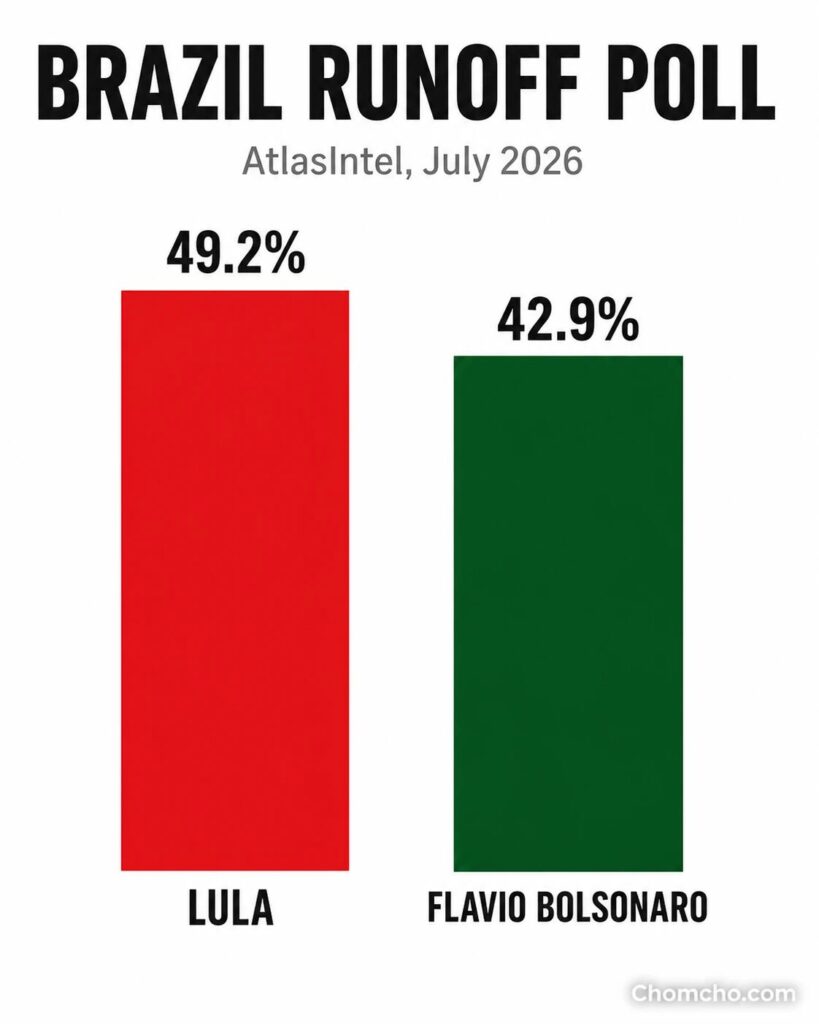
The latest AtlasIntel poll, taken July 22 to 27, shows Lula ahead of Flavio Bolsonaro 49.2 to 42.9 percent in a runoff scenario.
AtlasIntel was among the most accurate pollsters in the last Brazilian elections, when several traditional firms underestimated the conservative vote.
In March, the same pollster showed Flavio Bolsonaro slightly ahead, so this election can still change.
Still, the issues favor the right.
An AtlasIntel survey found that corruption and crime are the top concerns of Brazilian voters, far ahead of the economy.
More than 91 percent of Brazilians believe that criminal organizations control important spheres of politics and the judiciary. That number deserves a moment of reflection.
The regional pattern is clear.
Kast in Chile, Fujimori in Peru and De la Espriella in Colombia won their elections because they made the fight against crime their first priority.
The conservative wave in Latin America is a wave of voters demanding order. Brazil is the next test.
The consequences for America
Javier Milei is the closest ally of President Trump (@realDonaldTrump) in South America. Lula is the opposite: he is a BRICS enthusiast who moves closer to China every year.
The list of conflicts between Washington and the Lula government keeps growing.
President Trump imposed a 50 percent tariff on Brazilian goods in 2025 and linked the tariff to the judicial persecution of Jair Bolsonaro.
The State Department restricted visas for de Moraes and other judicial officials.
In July 2026, Brazil denied visas to two U.S. State Department officials.
Lula answered with an opinion column in the Washington Post calling the tariffs “a strategic mistake.”
The foreign policy consequences are bigger than tariffs.
Brazil holds the second largest rare earth reserves on the planet after China, about 21 million tonnes.
America needs those minerals outside of Chinese control. A Brazil aligned with BRICS delivers that treasure to Beijing.
The censorship question connects all of these conflicts.
The same judicial machine that silences Brazilians has fined and persecuted American companies and citizens.
Free speech and national sovereignty rise or fall together in the Americas. That is why Milei spoke, and that is why Brasilia panicked.
The Brazil Argentina crisis will pass, but October will decide much more.
Pray for Brazil.