
This post is also available in:
 Português
  Español
  Français
  Deutsch
  Italiano
  Русский
Summary
US Energy Secretary Chris Wright says crude should flow again within days. Analysts reading the satellite images say weeks, and one says months. Riyadh has cancelled late-September cargoes, which suggests it does not expect the line back before its stocks run out.
The global fuel crisis has already reached the streets. Syria saw its largest protests since the fall of Assad after a 40 percent diesel increase, Guatemalan truckers blocked highways, Portuguese drivers filled a Lisbon bridge with car horns, and Bangladesh is rationing power and closing garment factories.
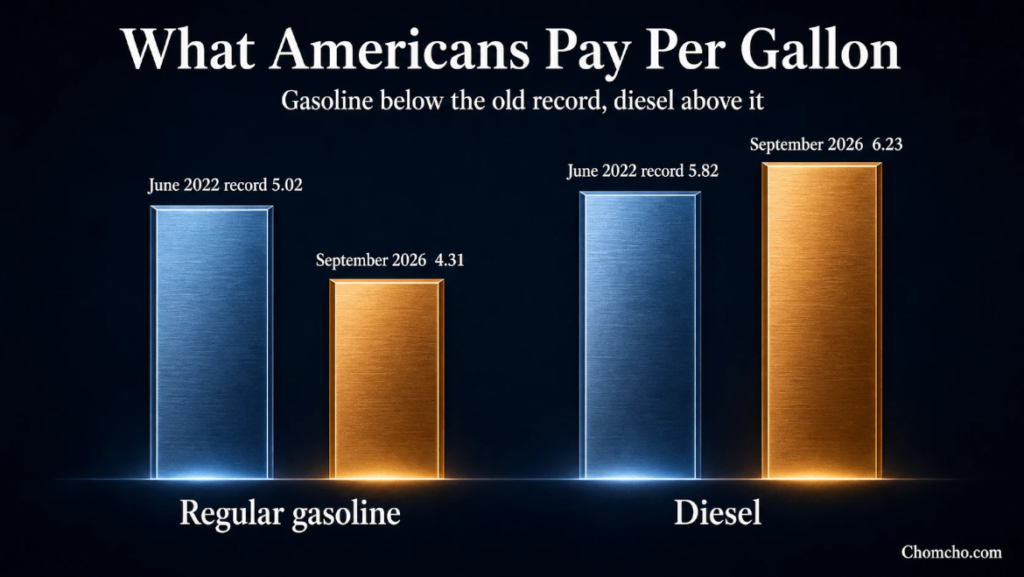
Americans feel it too. Diesel set a record above 6 dollars a gallon, and the Federal Reserve raised rates for the first time in over three years. Yet gasoline still sits below the 5.02 dollar record of June 2022, even with the world's most important oil corridor shut.
Reserves buy weeks. Production buys decades. A hemisphere that pumps and refines its own energy cannot be held hostage by a drone.
One statement moved the whole oil market
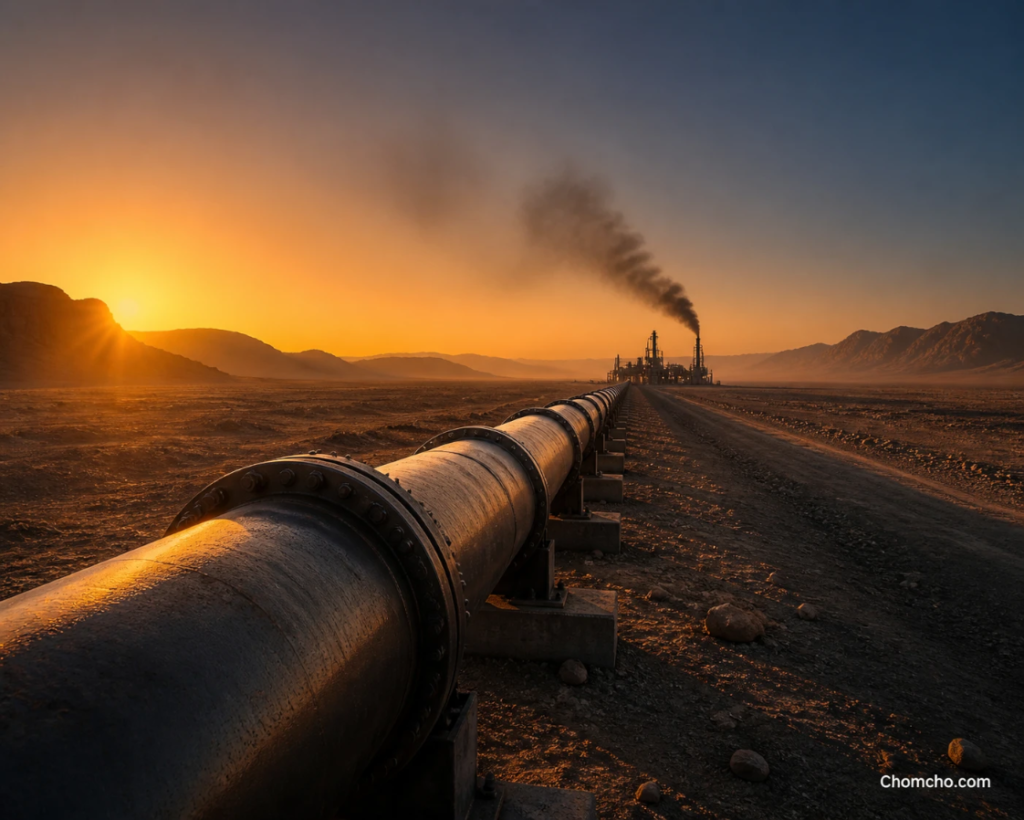
On September 15, on the sidelines of a G20 energy meeting in Houston, US Energy Secretary Chris Wright was asked how long Saudi Arabia’s wounded East-West Pipeline would stay shut. His answer was careful: “It’s still a detailed assessment, but I think it will be measured in days.”
The assessment he referred to is the Saudi engineering survey of the damage, which was still underway.
Wright was saying that oil should be flowing again within days, not that the pipeline would be fully repaired in days. The headlines did not preserve that distinction, and neither did the market: within a day Brent crude fell almost 3 percent to settle at 105.83 dollars, and West Texas Intermediate dropped to 102.43.
Others who examined the same pictures reached a different conclusion.
Andy Lipow, president of Lipow Oil Associates, told CNBC: “Judging from the on-line pictures, it will take months to repair.”
Sources speaking to Reuters split the difference, one estimating five to six weeks for full repairs, another saying partial pumping could resume sooner.
Riyadh’s own behavior suggests caution rather than confidence, because the kingdom has since told European customers that late-September cargoes are cancelled. The global fuel crisis now squeezing four continents turns on which estimate proves right.
What the drones hit
In the second week of September, drones launched from Iraqi territory struck the East-West Pipeline in a series of attacks.
Secretary Wright said plainly that Iran-backed proxy groups were responsible. No group has claimed the strikes and an investigation is underway.
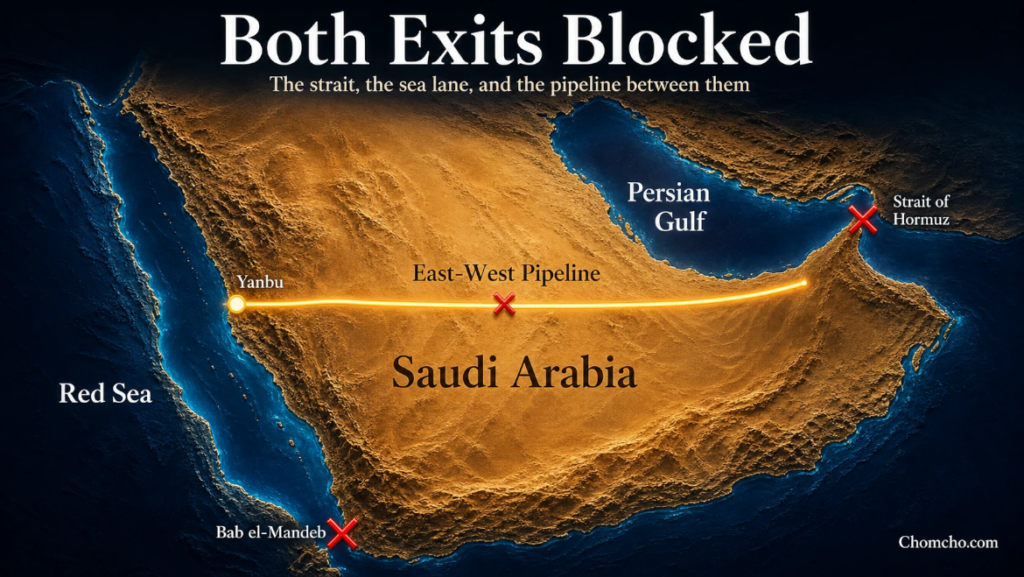
The line runs 1,200 kilometers, about 745 miles, across the Arabian Peninsula, and can carry roughly 7 million barrels a day.
For the past six months it has been the main route out for Middle Eastern oil, because it carries crude from the eastern oilfields to Yanbu, the Saudi port on the Red Sea, so tankers never enter the Strait of Hormuz.
With Hormuz largely closed since spring, that pipeline was how Saudi oil still reached the world. Riyadh shut it as a precaution, and the world lost its detour.
The kingdom with no exit
Now both doors are shut at once.
Yanbu held only five to seven days of crude for export when the line went down, according to industry sources cited by Reuters, which is why the cancellation of late-September cargoes speaks louder than any statement: it means Riyadh does not expect the pipeline back before those stocks run out.
At the southern end of the Red Sea the Houthis declared a maritime embargo against the kingdom in July and seized Mayun island in the Bab el-Mandeb strait, so even the tankers that do load at Yanbu must run a gauntlet.
Iran-aligned militants have also fired drones and ballistic missiles at Saudi cities, injuring more than seventy people.
Washington is not sitting still: Wright said the kingdom is taking steps to move more oil out of the Strait of Hormuz with assistance from the US military.
The war that began on February 28, when American and Israeli forces struck Iranian targets, strangled the Gulf’s main artery. By March, crude and product flows through Hormuz had fallen to less than a tenth of pre-conflict levels. In 2025 that waterway carried about 20 million barrels a day, roughly a quarter of the world’s seaborne oil trade. No route replaces it.
The price at the pump
Before the fighting started, crude sold for 60 to 70 dollars a barrel. Brent crossed 100 last week for the first time since July, touched 109 on Monday, and settled at 108.75 on Tuesday before Wright’s remarks pulled it back. Goldman Sachs now openly models an upside case above 120.
Americans feel it. Diesel set an all-time record of 5.85 dollars a gallon on September 4, passing the June 2022 high, and reached about 6.23 by September 14, according to AAA. Regular gasoline averaged about 4.31 that same day.
Diesel worldwide is up roughly 60 percent since late February, worse than crude itself, because refining is the real bottleneck and Russia’s refineries are being bombed by Ukraine.
Diesel moves food, freight, and farm equipment, which is why a pumping station in the Hejaz ends up in the price of bread in countries that have never heard of it.
The fuel riot belt
That is exactly what has happened.
In Syria the government raised diesel by about 40 percent, to 175 Syrian pounds a liter, and gasoline by more than a quarter, blaming world prices and maintenance at the Baniyas refinery.
The result was the largest protest wave since the fall of Assad two years ago: burning tires on the Aleppo highways, demonstrations in Idlib, Hama, Raqqa, Deir al-Zor and Hasakah, tanker trucks blocked, and crowds demanding the energy minister’s resignation.
Protesters told Reuters they did not want higher wages; they wanted cheaper fuel.
In Guatemala, organized truckers and other protesters blocked highways and caused damage in several parts of the country.
In Portugal, diesel passed 9 dollars a gallon and drivers answered on September 7 with a mass horn protest on Lisbon’s 25 de Abril bridge and a slow convoy crawling toward the Galp refinery at Sines.
Bangladesh shows what the squeeze does to a poor country.
It imports more than 90 percent of its petroleum, most of it from the Middle East, and the shortage of gas for power plants has forced rationing and the temporary closure of garment factories, the engine of its economy, with power cuts four or five times a day in the industrial hub of Gazipur.
On September 5 an eleven-party opposition alliance launched a long march from Dhaka to Chittagong; its leader, Shafiqur Rahman, told the crowd the movement aimed at “ensuring cooking gas and lighting up every household with electricity.”
In Libya the national oil company suspended two oilfields and a pumping station during protests of its own.
The pattern is older than this war.
Cheap fuel is the load-bearing wall of fragile states. Governments subsidize it because it keeps the buses running and the crowds home, and when the subsidy breaks, the street arrives.
That is the political face of the global fuel crisis.
The cost at home, honestly measured
An energy shock of this size reaches the American economy too, and there is no point pretending otherwise.
On September 16 the Federal Reserve raised interest rates for the first time in more than three years, a unanimous 12 to 0 vote lifting the range to 3.75 to 4 percent, to contain inflation driven by fuel.
Chairman Kevin Warsh named the cause without hesitation: “There is no hiding from hot spots around the world,” he told reporters. The Congressional Budget Office estimates the war will add about half a percentage point to inflation early next year, and headline inflation held at 3.4 percent in August.
Perspective matters, though, and the pump tells the story better than the headlines do.
The highest national average ever recorded for regular gasoline was 5.02 dollars a gallon, set in June 2022 under the Biden administration, with no Gulf war to blame and a domestic energy policy that treated production as a problem to be managed.
Today, with the world’s most important oil corridor effectively closed and a pipeline burning in the desert, Americans are paying about 4.31.
A war that has shut Hormuz for half a year has still not driven prices to where peacetime policy drove them four years ago. That difference is not luck.
Drill, baby, drill
It is policy. “We will drill, baby, drill,” President Trump said in his inaugural address, and the administration proceeded to act on it.
It declared a national energy emergency to speed permits, reversed the Biden administration’s designation of some 13 million acres on Alaska’s North Slope as off-limits special areas, and reopened the National Petroleum Reserve in Alaska to leasing.
The market answered: in March, ExxonMobil, Shell, Repsol, ConocoPhillips and Australia’s Santos bid a record 163 million dollars for Alaskan leases, and the Pikka project on the North Slope is coming online.
The rest of the program is equally concrete.
The Bureau of Land Management approved nearly 6,000 drilling permits on federal and tribal land, a 55 percent increase over the prior year.
Federal royalty rates were cut to 12.5 percent, the lowest allowed, to draw bidders.
Offshore, the first of thirty Gulf sales running through 2040 under the tax law signed in July 2025 put roughly 80 million acres up for lease in December, and about a million acres in Alaska’s Cook Inlet followed in March.
In 2025 the United States became the first country ever to export more than 100 million metric tons of liquefied natural gas in a single year.
None of that stops a drone over a Saudi pumping station. All of it determines how badly the drone hurts.
War without a return address
Consider what the attack accomplished.
A few drones, launched from Iraqi soil by men who will not sign their work, shut a pipeline in Saudi Arabia and moved the price of diesel in Lisbon, Guatemala City, and Dhaka.
No American base was touched. No flag was raised over the operation.
That is the architecture of proxy warfare: the militia fires, the sponsor shrugs, and the invoice is mailed to the world’s poor.
It is also the argument for deterrence that reaches the sponsor rather than the launcher, because a strategy that punishes only the trigger finger guarantees an endless supply of fingers.
What about Russian profits?
Moscow is the usual suspect, and the reality is more interesting than the slogan.
Higher prices would normally enrich the Kremlin, but Ukraine has spent this year destroying the machinery that turns crude into revenue.
Russian refining has fallen to a 24-year low, nearly a quarter of refining capacity has been halted or curtailed, Deputy Prime Minister Alexander Novak has publicly admitted output is down, and Moscow has banned gasoline exports since April and jet fuel through November to keep its own pumps supplied.
Russia has pushed more raw crude out to compensate, and it still collects a windfall, but a wounded refining system caps how much of this spike Putin can actually bank.
Beijing, as always, is positioned to buy from sellers who have nowhere else to go.
Europe’s self-inflicted exposure
Europe entered this crisis having spent two decades legislating against its own energy production while importing the difference.
Now Portuguese drivers blow their horns on a Lisbon bridge, European refiners lose Saudi cargoes, and the continent competes for the same tankers as everyone else.
A policy built on the assumption that supply would always arrive has met a month in which it did not.
Energy security is not an environmental question. It is a national security question, and Europe answered it wrong.
Reserves buy weeks, production buys decades
One of the first emergency answers was reserves.
On March 11 the 32 members of the International Energy Agency agreed to release 400 million barrels, the sixth and largest coordinated action in the agency’s history, which its director called an “emergency collective action of unprecedented size.”
The American share was 172 million barrels over roughly 120 days, authorized by President Trump.
It cushioned the blow, and it is finite.
The Strategic Petroleum Reserve held 285 million barrels in the week ending September 11, under 40 percent of its authorized capacity.
That level was not reached this year: the reserve fell from more than 638 million barrels in January 2021 to under 395 million by January 2025, before this war existed, and the emergency release this spring drew down what was left.
Hence the second half of the strategy, and the more durable half.
In late August the administration announced an agreement giving a US-backed venture control of 65 billion barrels of Venezuelan reserves across 17 fields, with an initial production target of 1.5 million barrels a day, and the president said the crude would refill the reserve, calling it “a Gift from Venezuela to the People of the United States.”
Honesty requires the caveats: much Venezuelan crude is extra-heavy and fails the reserve’s specifications, tankers wait up to a month at its ports, and Rystad estimates 180 billion dollars of investment over ten years to make those fields perform.
But the direction is right, and it is the only direction that ends this vulnerability.
Reserves buy weeks. Production buys decades.
A hemisphere that pumps, refines, and ships its own energy cannot be held hostage by a drone launched from Iraq or a militia sitting on an island in the Red Sea.
The countries burning tires this week are the ones that trusted somebody else to keep their tanks full.
Energy security is national security.