
This post is also available in:
 Português
  Español
  Français
  Deutsch
  Italiano
  Русский
Peru’s first elected woman president takes office
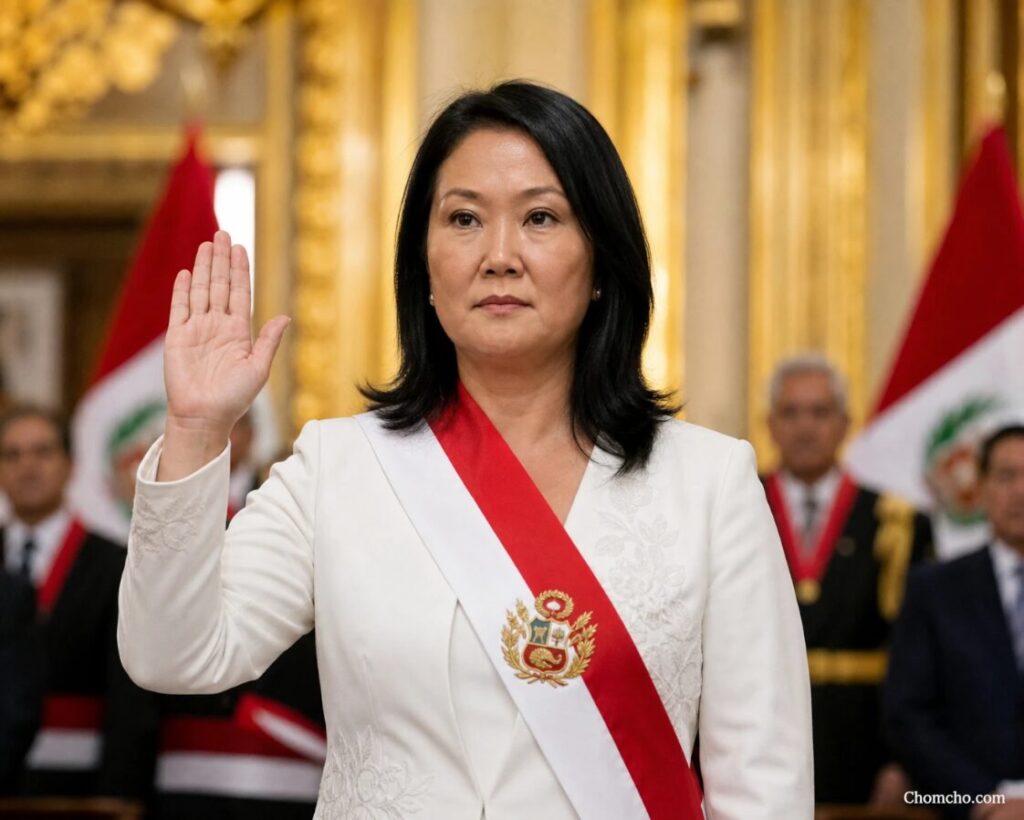
Peru has a new president. Keiko Fujimori was sworn in on July 28 before the Congress in Lima, on the same day Peru celebrated its independence.
She is the first woman elected president in the history of Peru. Her victory was extremely narrow: 50.135% against 49.865% for leftist congressman Roberto Sánchez, a difference of about 50,000 votes out of 18 million.
Only one result in modern Peruvian history was closer: her own defeat against Pedro Castillo in 2021.
The ceremony was not peaceful outside. Opposition lawmakers protested with photos of people who died during the riots of 2022 and 2023.
Sánchez has alleged fraud without evidence, and the electoral authorities dismissed his complaints.
He still refuses to recognize the new government. It does not matter. The new president took her oath, and the clock of the Fujimori first 100 days is already running.
She had set the tone on July 15, when she received her credentials.
“Peru does not need a government that explains its problems. It needs a government that solves them,” she said.
At the inauguration she added a promise: “My goal is not only to administer the state. My main objective is to narrow the enormous social deficit that affects millions of Peruvians.”
A cabinet named before the oath
On July 27, one day before the inauguration, Fujimori presented her cabinet.
Prime Minister Luis Galarreta leads it. In Peru the prime minister is known as the “premier,” and he is not a head of government like in Europe.
The official title is President of the Council of Ministers, a coordinator of the cabinet who answers to the president.
Galarreta is also the first vice president, and he presided over the Congress in 2017 and 2018.
Vice President Luis Galarreta said that technology will be central: “Artificial intelligence, technology, cameras, there is a lot to do on the security front in the first 100 days, but above all, it’s about leadership.”
Economy Minister Elmer Cuba is a serious choice. Cuba was a director of the Central Reserve Bank from 2016 to 2021 and worked with the World Bank and the Inter-American Development Bank.
Foreign Minister Carlos Espá worked 15 years at the U.S. Embassy in Lima. That detail matters: the new foreign minister knows Washington from the inside.
The Constitution now starts a countdown. Galarreta must present the government agenda to Congress within 30 days and win a vote of confidence.
Crime tops the agenda
Extortion cases increased about ten times between 2023 and 2025, according to government figures. Criminal gangs extort schools, small businesses and transportation workers.
A poll taken in early July found that 73% of Peruvians want the fight against insecurity to be the top priority.
“The most important thing on the agenda for the next 100 days is restoring order,” Fujimori told the Ecuadorian newspaper El Universo.
Her plan is the toughest Peru has seen in decades.
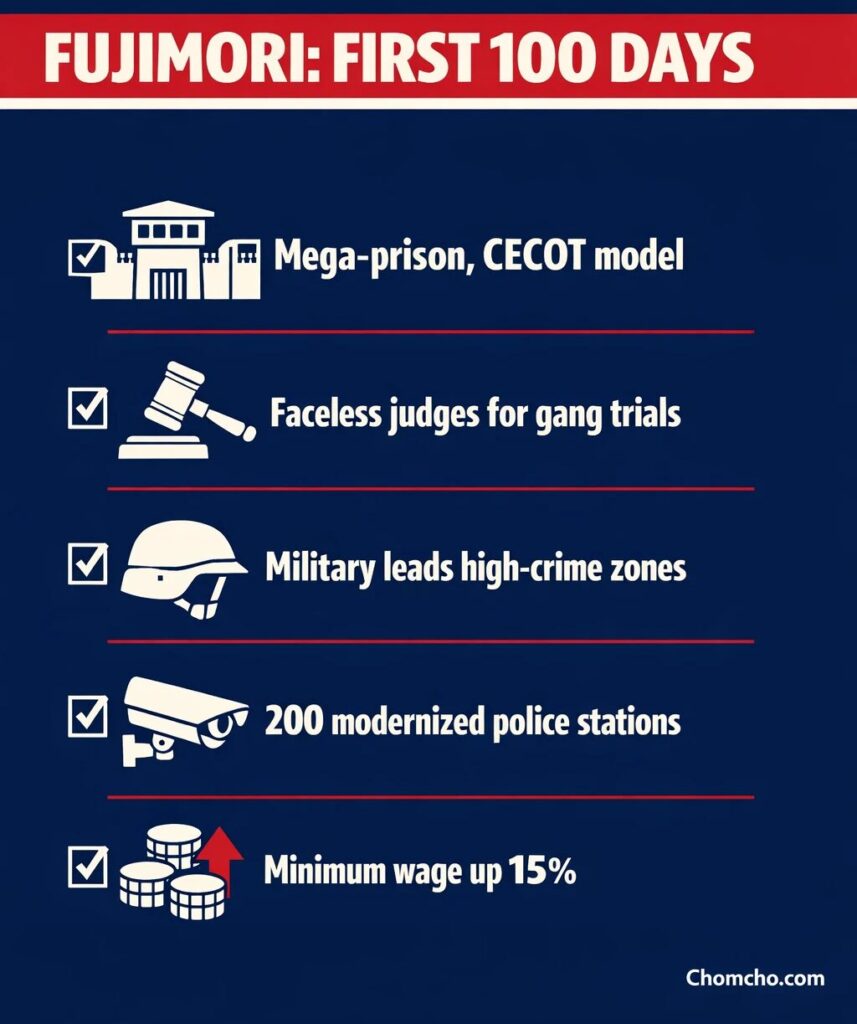
She promised a mega-prison modeled on the CECOT prison of President Nayib Bukele in El Salvador.
She promised “faceless judges” for organized crime trials, judges whose identities stay hidden so the gangs cannot threaten them.
Her father used the same method against terrorism in the 1990s. The armed forces will temporarily lead security operations in the most dangerous zones, and she will request special legislative powers from Congress.
There is also a technology front: smart patrol vehicles, connected surveillance camera networks, 200 modernized police stations, and a joint military and police operation in Tumbes, on the sensitive northern border.
One specialist estimated that the proposed command center alone could cost 500 million dollars. On the social side, she promised a 15% increase in the minimum wage.
Her victory continues a conservative wave built on public anger over crime, with Abelardo de la Espriella in Colombia and José Antonio Kast in Chile.
All of them point to El Salvador as the reference.
The socialists had their turn in Latin America, and the results were crime, poverty and migration. Now the voters are correcting the course.
One point deserves honesty.
Some politicians blame Peru’s 1.6 million Venezuelan migrants for the crime wave. The numbers tell a more balanced story.
Venezuelans are about 4.4% of Peru’s population. According to Peru’s prison agency, known as INPE, Peru held 5,530 foreign inmates in May 2025, about 5.9% of all prisoners, and 4,106 of them were Venezuelans.
That percentage is close to their percentage of the general population.
The real threat is imported criminal gangs like the Tren de Aragua, not the ordinary families.
Those families fled socialism. The enemy is the regime that expelled them, not the people who escaped it.
A super El Niño arrives
The weather will not wait for politics.
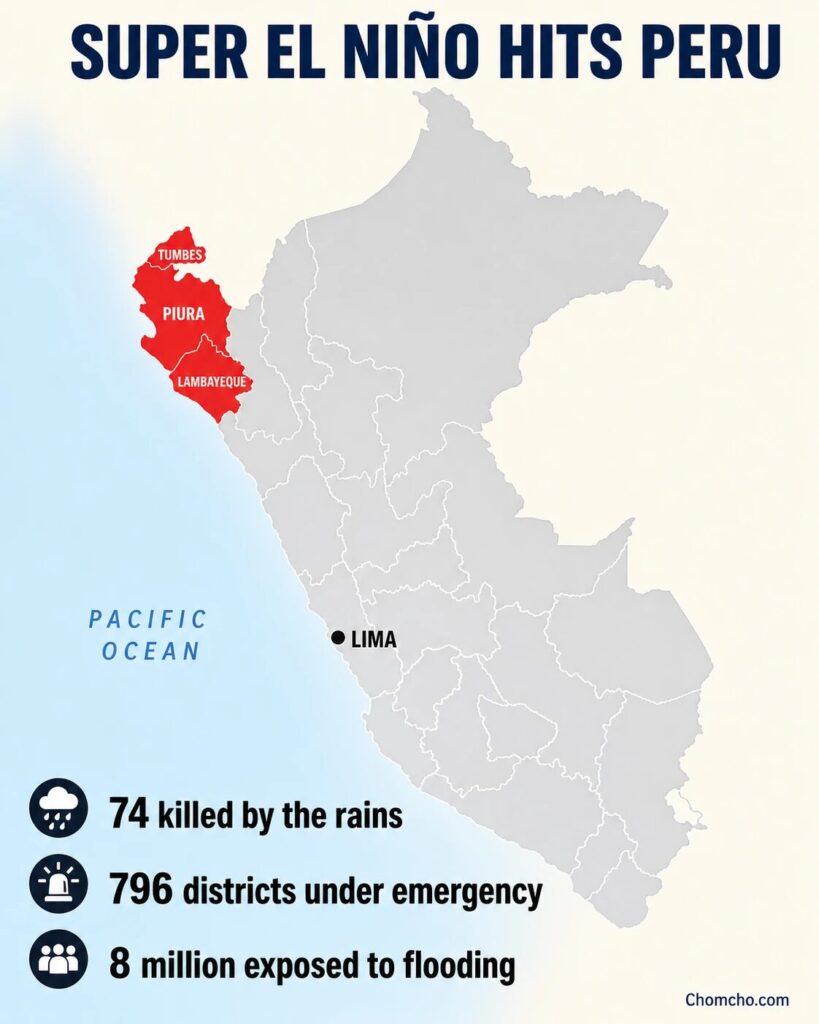
Peru is facing one of the strongest El Niño events on record, with ocean temperatures projected to peak about one degree above the previous record of 2015.
The government declared a 60-day state of emergency in 796 districts across 22 departments on July 2.
The rains have already killed at least 74 people this year, and the agency INDECI reported more than 1,257 homes destroyed by late March. According to the agency CENEPRED, almost 8 million Peruvians are exposed to flooding in the months ahead.
The worst damage is concentrated in Tumbes, Piura and Lambayeque, in the north.
Fuerza Popular senator Karla Schaefer warned that the drainage infrastructure of her region, Piura, is in “terrible” condition, worse than before the destructive El Niño of 2017.
The Lima Chamber of Commerce estimates that the seven most exposed regions produce close to a quarter of the national economy, and projects that the event will cut 2026 growth by almost one percentage point.
Behind the emergency there is a deeper gap.
About 3.3 million Peruvians still lack drinking water and 6.9 million lack basic sanitation. Water coverage rose only from 88.2% to 90.4% in a decade.
Fujimori promised that her government will be measured by “every family gaining access to drinking water for the first time.”
El Niño will test that promise immediately.
The country that removes presidents
Fujimori is now the ninth person to hold Peru’s presidency in ten years.
Former president Pedro Castillo tried to dissolve Congress and rule by decree in December 2022.
Lawmakers removed him within hours by a vote of 101 to 6, and he was later sentenced to more than eleven years in prison for attempted rebellion.
Some conservatives argue this pattern is institutional strength, not chaos.
The removal clause has worked as a safety valve that kept Peru from following Venezuela, Nicaragua or Bolivia into full authoritarian collapse.
This time the structure is also different.
Peru’s Congress is bicameral again for the first time since 1992.
Fuerza Popular holds 22 of the 60 Senate seats and 41 of the 130 seats in the Chamber of Deputies, the largest bloc in both chambers.
Together with the allied Renovación Popular party, the conservative bloc controls half of the Senate.
Any removal now needs both chambers, so President Fujimori is far better protected than her predecessors. Passing new laws will still require alliances.
Sánchez follows the example of outgoing Colombian president Gustavo Petro.
Petro also refuses to accept the defeat of his own candidate in Colombia.
The difference is that Sánchez holds no executive power. He is an opposition legislator, nothing more.
America First meets Peru
Washington welcomed the new government.
The U.S. Embassy in Lima (@USEMBASSYPERU) said that “the Trump Administration looks forward to deepening collaboration with the Fujimori Administration to advance security cooperation and to strengthen bilateral cooperation on investment and trade.”
The cooperation is already real.
The U.S. State Department approved this year a Foreign Military Sale of 1,500 million dollars to modernize Peru’s Callao naval base.
Peru pays for it with its own sovereign bonds, not with money from U.S. taxpayers, and the U.S. Army Corps of Engineers is the main contractor.
Washington also designated Peru a Major Non-NATO Ally.
This is the America First model working exactly as President Trump designed it: strong allies who pay their own costs, and America providing the technology and the trust.
Fujimori also wants Peru inside the Shield of the Americas, the regional security initiative backed by the Trump administration.
At the same time she promises a “strategically balanced” position between Washington and Beijing.
China is Peru’s largest trading partner, with about 30,000 million dollars in accumulated investment, including the Chancay megaport, only 80 kilometers from the same naval base that Washington is modernizing.
Balance sounds diplomatic. But only one of those two powers respects Peruvian sovereignty, and it is not the one that builds ports to control trade routes.
There is one more reason the United States watches closely.
Peru is the world’s second-largest producer of cocaine, responsible for an estimated 36% of global production, with roughly 90% of its coca crop feeding the illicit drug trade.
A Peru with order, prisons that work and a professional military is good for Peruvians and good for America.
The Fujimori first 100 days have begun, and Peru finally has a real chance. Let’s pray for Peru.