
This post is also available in:
 Português
  Español
  Français
  Deutsch
  Italiano
  Русский
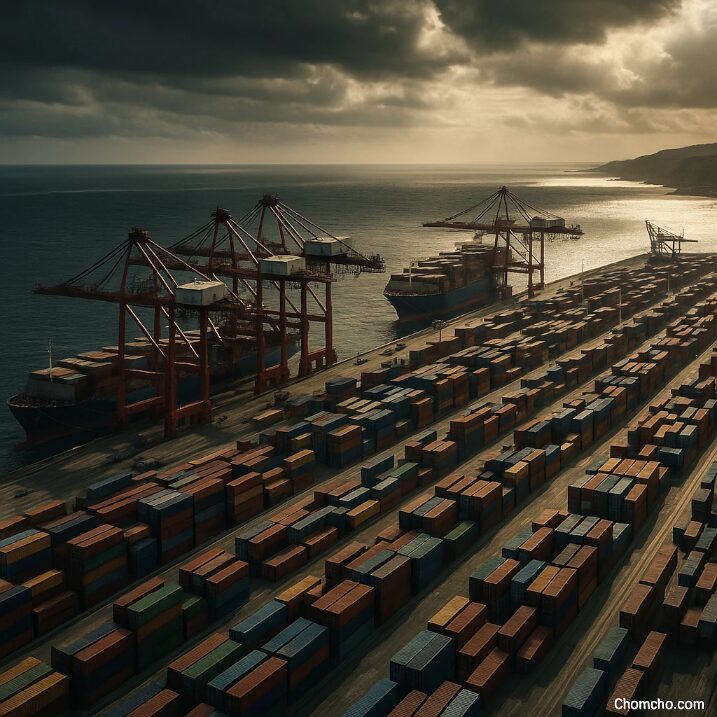
Peru asserts sovereignty over its most strategic port in this Chancay port ruling
China thought it had locked up Peru’s most important Pacific gateway without answering to anyone. It was wrong, at least for now, in this Chancay port ruling.
On June 19, 2026, judge Jacqueline Elsa Solís Arellano of Peru’s Juzgado Civil de Chancay declared “infundada” (unfounded) the legal challenge filed by COSCO Shipping Ports Chancay Perú against Indecopi.
Indecopi is Peru’s consumer and competition protection agency, formally a Peruvian government institution, which had launched a technical review of competitive conditions at the megaport.
The court ruled that Indecopi’s oversight is fully covered by the presumption of legality that protects public administrative acts, and that companies operating essential public infrastructure, as Chancay clearly does, have a legal duty to accept preliminary supervision and investigation by competent authorities.
In short: Peru’s own government has the right to regulate Peru’s own ports, even when China built and paid for them.
But the full story is far more complicated, and far more important, than a single court victory suggests.
What Indecopi found, and why COSCO tried to stop it
Indecopi is Peru’s Instituto Nacional de Defensa de la Competencia y de la Protección de la Propiedad Intelectual, the national agency responsible for defending competition and protecting consumer rights, a fully government-mandated institution operating under Peru’s constitutional framework.
In April 2025, Indecopi’s Competition Directorate published a technical study concluding that no competitive conditions exist in four key service markets at Chancay:
– Container loading and unloading
– Vessel services including mooring
– Integrated packages combining vessel attention and empty container handling
– A second integrated package covering vessel service with loaded container handling
In plain terms: COSCO was operating as an effective monopoly at every critical chokepoint in the port’s operations.
COSCO responded by filing an amparo, a constitutional protection action in Peru’s judiciary, arguing that Indecopi’s regulatory review violated its contractual rights, its right to free enterprise, and the legal stability guarantees it had been given as a private investor.
The company characterized the investigation as “premature,” arguing the port was still in a development phase and that Indecopi was overstepping its mandate.
Solís Arellano rejected every argument, ruling that for an amparo to succeed against a government administrative act, COSCO would have had to prove an arbitrariness “manifest, gross, and disproportionate,” which it failed to demonstrate.
COSCO has already announced it will appeal, and a separate, larger legal battle over the transport regulator Ositran’s general supervisory powers at the port is still on appeal from a February 2026 ruling that actually went the other way and ordered Ositran to stand down.
This Chancay port ruling is a first-instance win, not a final verdict.
To understand why, it helps to know that a separate and more serious legal battle is still ongoing.
Ositran, Peru’s transport infrastructure regulator and a different government agency with broader powers to regulate, supervise, and sanction port operations generally, actually lost its own case in February 2026, when a different court sided with COSCO and ordered Ositran to stop exercising its regulatory, supervisory, and sanctioning powers over Chancay entirely.
Peru’s government is currently appealing that ruling.
In other words, Peru just won the right to investigate COSCO’s port service charges and whether it is operating as a monopoly, but is still fighting in court to recover its broader right to regulate and sanction the port’s operations at all.
The bigger battle is far from over.
COSCO is not a private company: the military-civil fusion reality
COSCO presents itself in Peruvian courts as a private commercial investor entitled to the full protections of a private business.
This claim deserves scrutiny, and Washington has applied that scrutiny in detail.
On January 7, 2025, the US Department of Defense formally designated China COSCO Shipping Corporation Limited as a Chinese Military Company under Section 1260H of the National Defense Authorization Act.
The designation identifies COSCO as a key contributor to the People’s Liberation Army defense industrial base and an integral part of advancing China’s military-civil fusion strategy.
Military-civil fusion is not a theory or an allegation.
It is an official Chinese Communist Party state strategy, first referenced as a guiding principle in 2007 under Hu Jintao and elevated to an official military strategy in 2015 under Xi Jinping.
Under this strategy, civilian and commercial entities are legally required to serve military objectives when the Chinese state demands it.
COSCO, as a state-owned company, is mandated by law to submit to the will of the Chinese Communist Party and fulfill national objectives, including military ones.
According to the Australian Strategic Policy Institute, COSCO “operates its own militia, which is likely capable of conducting paramilitary activities such as maritime surveillance, counter-piracy missions, and search and rescue operations.”
The same institution notes that COSCO appears to be “developing the capability needed to comply with Chinese Communist Party requests to assist with intelligence operations, national defense mobilization, or grey-zone activities.”
Congressional testimony before the House Homeland Security Committee further revealed that COSCO vessels reportedly have Chinese Communist Party political commissars embedded among their crews.
When COSCO tells a Peruvian court it is simply a private shipping company entitled to operate free from state oversight, it is telling a story that the US Department of Defense, the Australian Strategic Policy Institute, and multiple Congressional committees have publicly and formally rejected.
Washington’s response: “cheap Chinese money costs sovereignty”
The Trump administration has been unusually blunt about what Chancay represents.
In February 2026, the US State Department’s Bureau of Western Hemisphere Affairs posted on X: “We are concerned about latest reports that Peru could be powerless to oversee Chancay, one of its largest ports, which is under the jurisdiction of predatory Chinese owners.”
The Bureau then added: “We support Peru’s sovereign right to oversee critical infrastructure in its own territory. Let this be a cautionary tale for the region and the world: cheap Chinese money costs sovereignty.”
In April 2026, Congresswoman Maria Elvira Salazar (@MaElvira_Salazar), chair of the House Foreign Affairs Subcommittee on the Western Hemisphere, told a Congressional hearing: “The new Peruvian government, which will be elected next June, must take it back, that port, take it back, and the United States will help them.”
She described Chancay as a dual-use facility capable of shifting from commercial to military operations, allowing Chinese submarines and battleships to operate from Peruvian territory.
China analyst Gordon Chang warned Fox News: “In times of war, China will not allow its port operations to load, unload, or service American ships or ships coming from or going to US ports.”
The United States formally designated Peru a Major Non-NATO Ally on January 14, 2026, through Presidential Determination No. 2026-04 signed by President Trump, deepening defense cooperation and expanding Peru’s access to US military equipment and programs.
Separately, Peru itself has committed 1,500 million dollars of its own funds, financed through Peruvian bonds with zero US taxpayer dollars, to modernize and relocate its naval base at Callao, just 80 kilometers from Chancay.
China’s Foreign Ministry has rejected Washington’s concerns as “false accusations and disinformation,” insisting the port remains under Peruvian jurisdiction and operates on purely commercial terms.
That claim sits uneasily alongside the Pentagon’s formal military designation of COSCO itself.
The Fujimori factor: who governs Peru next will decide everything
This Chancay port ruling lands in the middle of Peru’s still-uncalled presidential election.
As of this writing, conservative Keiko Fujimori (@KeikoFujimori) leads leftist Roberto Sánchez with approximately 40,700 votes with 99.69 percent of ballots counted.
The entire Chancay sovereignty dispute has become perhaps the most consequential foreign policy issue facing whoever forms Peru’s next government.
US Ambassador Brandon Navarro made Washington’s preference clear when he stated publicly after the first round: “Meanwhile, China is more concerned about operating Chancay without Peruvian oversight,” tying the electoral outcome explicitly to the port dispute.
A Fujimori government would inherit the Ositran appeal still working through the courts, the Indecopi competition investigation, and Washington’s offer to help Peru ‘take back’ the port.
It would also inherit a sobering legal reality: COSCO’s core argument is that Chancay was built entirely with private capital without a state concession contract, and therefore standard public port regulation does not apply.
Peru’s courts have not yet fully resolved that question.
What the June 19 Chancay port ruling does confirm is that Indecopi, a Peruvian government institution, has the constitutional authority to review competitive conditions at the port.
That is a foundation.
What Peru’s next president builds on that foundation will define the country’s relationship with both Washington and Beijing for a generation.
The bigger picture: a Cold War of influence on South America’s Pacific coast
Chancay is not merely a legal dispute or an infrastructure project.
It is the sharpest, most concrete front line in a broader Cold War of influence between the United States and China playing out across Latin America.
China is Peru’s largest trading partner and has been for over a decade.
Chancay was designed to deepen that relationship by dramatically reducing the cost and time of shipping Peruvian copper, lithium, and agricultural products to Chinese factories, while simultaneously giving Beijing a strategic foothold on South America’s Pacific coast.
Brazil, Chile, and Ecuador are all watching Chancay as a potential gateway for their own Pacific exports to Asia, which is exactly why the rules governing it carry weight far beyond Peru’s borders.
We covered this dynamic in our Chile China corridor article: Chile’s proposed energy corridor to Argentina is partly a defensive response to Chancay’s rise threatening Chile’s own Pacific ports.
Under China’s military-civil fusion strategy, a commercial port majority-owned by a Pentagon-designated Chinese military company is never purely commercial.
The State Department said it plainly: cheap Chinese money costs sovereignty.
The June 19 Chancay port ruling is one small but symbolically important step in the right direction, a Peruvian government institution asserting its constitutional authority over infrastructure that China built on Peruvian soil.
COSCO will appeal. The larger Ositran case is still alive. The election result is not yet official. And Washington has made clear it is watching.
In the new Cold War for Latin America’s Pacific coast, this battle is just beginning.