
This post is also available in:
 Português
 Español
 Français
 Deutsch
 Italiano
 Русский
Summary
Trade Representative Jamieson Greer said Washington would hold its position: "When the Canadians want to get to yes, obviously we'll be there ready to talk."
This is the US-Canada trade war.
In August, 50 percent U.S. tariffs hit about 20,000 million dollars of Canadian goods, and Carney promised to match them "dollar for dollar."
"You're at war when you get attacked.
We got attacked," he said.
Trump wrote: "Canada wants the benefits of being a State, without being one!!!"
Carney calls his answer diversification.
He said the international order "will be rebuilt out of Europe," and Europe offered Canada the chance to be the EU's first associate member.
Ottawa agreed to let in 49,000 Chinese electric cars, and about 300 Canadian business delegates are in India this week.
"They treat Chinese goods more fairly than they do the goods that come from the people of Maine: It's insanity," Vice President JD Vance said.
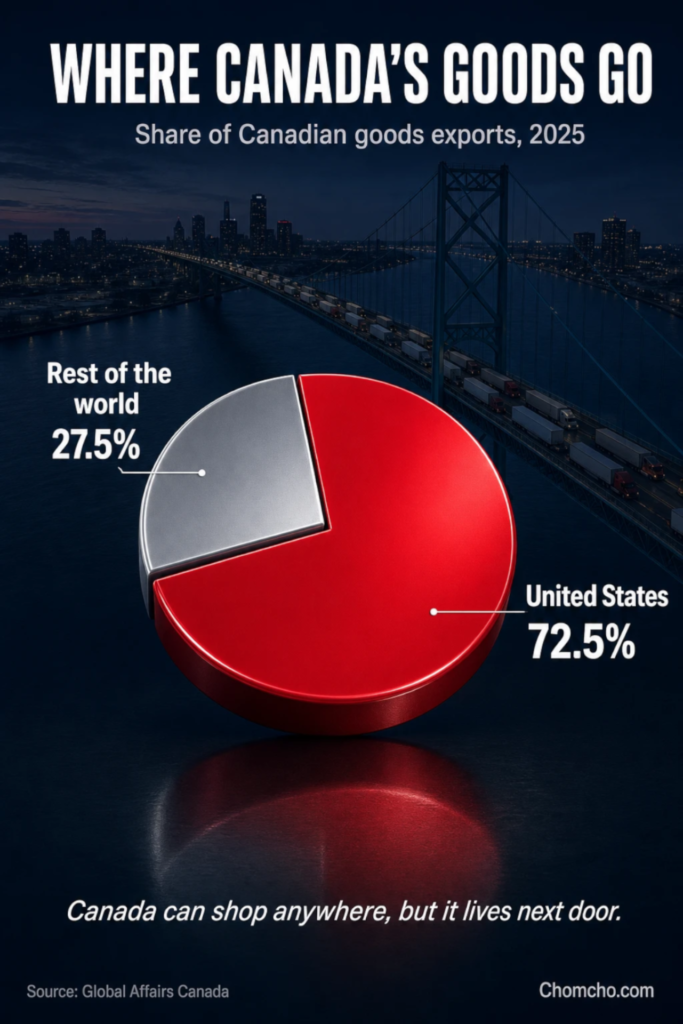
Yet about 72 percent of Canada's goods exports still went to the United States in 2025, and Carney promised to keep maximizing oil and diesel sales to the U.S.
At home, Quebec elected the separatist Parti Québécois on October 5, and on October 19 Albertans vote on whether to begin the legal process toward a binding referendum on separation.
Canada's dairy wall remains the clearest barrier: over-quota tariffs reach 298.5 percent on butter, and a 2025 law bars Ottawa from offering more access.
Even Adam Smith accepted retaliation when it can open a foreign market.
As Scripture says, "better is a neighbour that is near than a brother far off" (Proverbs 27:10, KJV).
Canada can shop anywhere, but it lives next door.
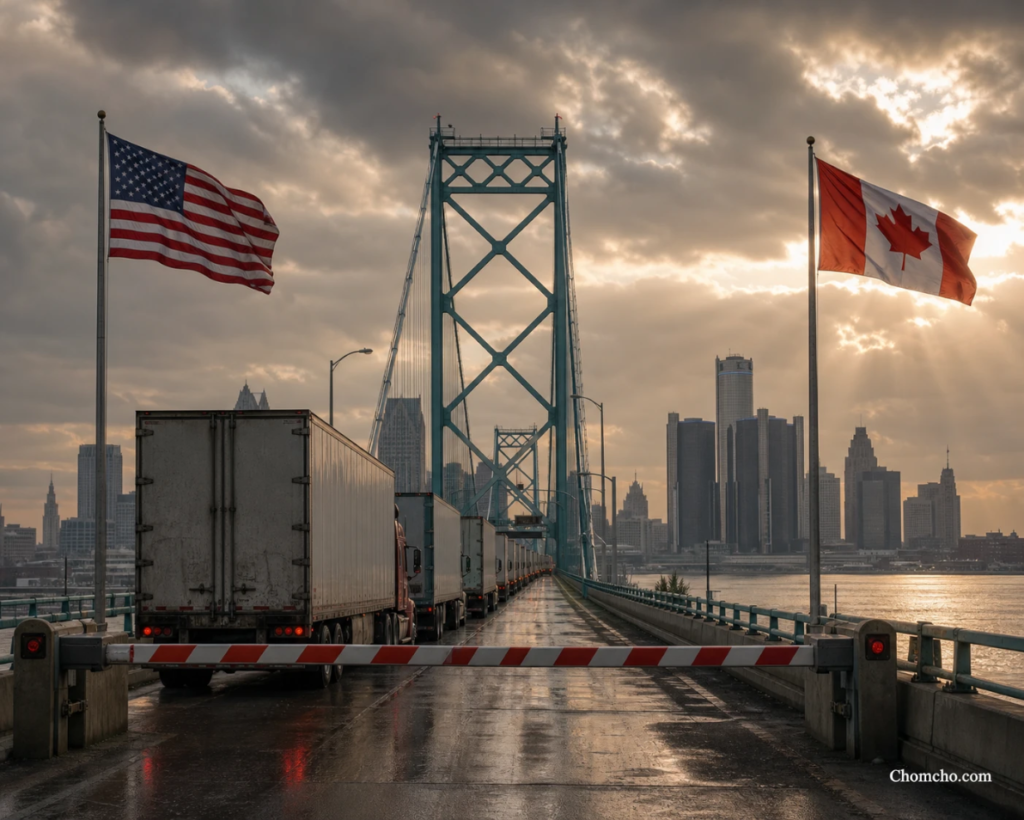
Washington holds its position
Asked on October 5 whether trade talks with Canada would resume before the midterm elections, President Trump answered: “I’m in no rush.” He also said: “Canada behaves very badly with the United States.”
Three days later, Trade Representative Jamieson Greer said Washington would hold its position. “When the Canadians want to get to yes, obviously we’ll be there ready to talk,” he told CNBC.
On October 11, Trump and Prime Minister Mark Carney spoke by phone, but Ottawa’s official summary mentioned Ukraine and Canadian oil and diesel sales, not the trade talks.
No new meeting has been announced.
The tone was set in late July. “Mexico and Canada need us. We don’t need them,” Trump said, four weeks after Washington declined to extend the USMCA, the trade pact among the three North American countries, at its July 1 review.
Yes, this is a trade war
Some call it just a dispute. The facts say otherwise.
In July, Trump used Section 338 of the Tariff Act of 1930, a law that lets a president answer countries that discriminate against American trade with duties of up to 50 percent.
According to Congress’s research service, it was the first time a president had used it to impose tariffs.
On August 21, Carney walked away from the talks, blaming “last-minute changes in the U.S. proposed terms.”
The next day, 50 percent tariffs hit about 20,000 million dollars of Canadian goods, from dairy and alcohol to cement and hockey sticks.
Carney then promised that Canada “will match those tariffs dollar for dollar,” and it did on September 8. On September 29, Washington banned Canadian beer, wine, spirits, some dairy products and large motorcycles.
Carney himself used the word. “You’re at war when you get attacked. We got attacked,” he said on August 22.
Trump wrote on social media: “Canada wants the benefits of being a State, without being one!!!”
Tariffs on both sides and frozen talks: this is the US-Canada trade war, and CNBC, Al Jazeera, AFP and Wikipedia all call it that.
Carney calls it diversification
When Carney talks strategy, though, his favorite word is diversification. “We have to take care of ourselves because we can’t rely on one foreign partner,” he said last October, setting a goal to double Canada’s exports outside the United States within ten years.
In January, he boasted of “12 new deals, four continents, in six months.”
When the talks collapsed, he said in a statement: “We have recognized from the beginning that America has changed, and that we will not return to our old relationship.”
At Davos, he warned that “middle powers must act together because if you are not at the table, you are on the menu.”
An essay published this week on Modern Diplomacy, a European foreign-affairs site, makes the same case: Canada is diversifying, not breaking with Washington.
The real question is where Carney is now shopping.
Looking to Europe
In May, at a summit in Yerevan, Armenia, Carney said: “It is my strong personal view that the international order will be rebuilt, but it will be rebuilt out of Europe.”
Chomcho answered at the time that Europe cannot lead what it cannot fund.
Europe is answering the call anyway.
On September 16, European Commission President Ursula von der Leyen told Carney she wanted to work “on opening the door for Canada to be the first associate member of the EU,” a status the EU treaties do not even contain.
Canada has already joined the EU’s defense loan program, SAFE, and Ottawa may reportedly buy about 60 Swedish Gripen fighters and keep only 30 of its 88 American F-35s.
Later this month, leaders meet in Montreal for an EU-Canada summit, where a draft statement seen by AFP lists deals on digital trade, critical minerals and 50 firefighting planes.
Brussels does not hide its target.
Its defense commissioner, Andrius Kubilius, said buying European “will gradually mean less for American products.”
And on October 6, a naked golden statue of Trump called “The Orange Plague” stood outside the European Parliament in Strasbourg, with the approval of the Parliament’s administrators, though a spokesperson said that was no endorsement.
Mocking a president elected by about 77 million Americans is not foreign policy. It is contempt, and Washington will remember it the next time Europe asks for help.
Looking east: China and India
In January, Carney visited Beijing, the first visit by a Canadian prime minister since Justin Trudeau’s in 2017.
He agreed to let in 49,000 Chinese electric cars at a 6.1 percent tariff, down from the 100 percent imposed by Trudeau, and China agreed to cut its tariff on Canadian canola from 84 percent to about 15.
Look at the exchange: Canada sends farm crops, and China sends finished cars. That is how a supplier of raw materials trades with an industrial power, not how a G7 economy trades with an equal.
Carney called relations with China “more predictable.” Ontario Premier Doug Ford warned of “a flood of cheap made-in-China electric vehicles.”
Washington noticed. “They treat Chinese goods more fairly than they do the goods that come from the people of Maine: It’s insanity,” Vice President JD Vance said in August. “And what we’ve said to Canada is stop it.”
Even David Cohen, Joe Biden’s ambassador to Canada, said Ottawa had tentatively tried to get closer to China.
Then came India. The fifth round of free-trade talks ran in Ottawa from October 5 to 9, and this week Trade Minister Maninder Sidhu leads about 300 Canadian business delegates to Mumbai and Bengaluru.
It is Canada’s largest trade mission to India in more than 30 years, according to Ottawa.
The goal is 70,000 million Canadian dollars in trade by 2030, up from 30,400 million in 2025, only two years after relations collapsed over the killing of Sikh activist Hardeep Singh Nijjar.
Geography still wins
Diversification has limits. About 72 percent of Canada’s goods exports went to the United States in 2025, according to Canadian government figures.
No market in Europe or Asia can replace a neighbor of 340 million consumers.
Even in the middle of the US-Canada trade war, Carney told Trump on October 11 that Canada will “continue to maximize our exports of oil and diesel to the United States.”
Canada’s skies are defended together with the United States through NORAD.
Yet Carney told The New York Times in September that he had studied the “extreme tail risk” of American military action against Canada. “That’s not a base case, but it would be irresponsible not to,” he said.
Diversification is a hedge, not an exit.
Two provinces question Canada
While Carney courts Brussels, Beijing and New Delhi, two provinces are questioning Canada itself.
On October 5, Quebec elected the separatist Parti Québécois, which won nearly 60 of 127 seats, short of a majority.
Its leader, Paul St-Pierre Plamondon, promises a third independence referendum, but only after Trump leaves office in 2029. Greer noticed: Ottawa, he said, has “a little bit of preoccupation up there.”
On October 19, Albertans will vote on whether to remain a province of Canada or begin the legal process toward a binding referendum on separation.
A late-August poll found fewer than a quarter support leaving. But one separatist leader, Jeffrey Rath, said in February that “the Trump administration shows Albertans far more respect than is shown to Albertans by the government in Ottawa.”
Free trade needs fair rules
Free trade is one of the great engines of capitalism, but it works fairly only when both sides play by comparable rules.
When a government shields its producers behind quotas, subsidies or closed markets, then targeted tariffs can be defended as a tool to open those markets, rebuild domestic industry and protect strategic sectors.
Even Adam Smith, the father of free trade, agreed.
“There may be good policy in retaliations of this kind, when there is a probability that they will procure the repeal of the high duties or prohibitions complained of,” he wrote in The Wealth of Nations in 1776.
“The recovery of a great foreign market will generally more than compensate the transitory inconveniency of paying dearer during a short time for some sorts of goods.”
He also warned that judging when retaliation will work depends on “the skill of that insidious and crafty animal, vulgarly called a statesman or politician.” Retaliation, in other words, is justified when it can win.
The costs are real. Tariffs can raise prices for consumers and businesses in the short term, and the long-term gains, stronger domestic production and more secure supply chains, are not guaranteed.
The key line runs between targeted tariffs against unfair practices and broad tariffs that protect industries forever. The first has a strategic logic. The second weakens the competition that makes capitalism work.
Conservatives sometimes disagree on where that line falls.
The Cato Institute, a free-market think tank, warns that protectionism “has repeatedly proven to impose high costs for minimal benefits,” working through “hidden taxes on all other Americans.”
That warning deserves respect. But Smith’s test fits Canada: the goal is not to close America’s market, but to open Canada’s.
When Canada wants to get to yes
Dairy is where the wall is clearest.
Canada lets a set amount of American milk, cheese and butter in tariff-free. Above that quota, tariffs jump to 241 percent on milk, 245.5 percent on cheese and 298.5 percent on butter.
“If a Maine farmer sends dairy products into Canada, they could be paying as much as a 250% tariff,” Vance said.
Canadians answer that the quotas are rarely filled, so in practice “these tariffs are not actually paid by anyone,” as Canadian farm analyst Al Mussell put it.
But the quota itself is the barrier. Canada hands 85 to 100 percent of it to its own dairy processors, the very companies that compete with American producers.
A USMCA panel sided with Washington in 2021, before a second panel accepted Canada’s revised rules in 2023.
Then, in June 2025, Canada passed Bill C-202, a law that bars Ottawa from offering more tariff-free quota or lower over-quota tariffs on dairy, poultry and eggs in any trade deal.
Even Cohen called the dairy system a legitimate grievance that hurts American dairy farmers.
Dairy is not alone.
The Trade Representative’s 2026 report lists provinces that pulled American liquor from their shelves, “Buy Canadian” procurement rules in Ontario, Quebec and British Columbia, and a digital services tax still not repealed at the end of 2025.
Earlier presidents complained about these barriers for decades and settled for small concessions. Trump is the first to answer them with tariffs.
Washington’s door remains open. As Greer put it, “When the Canadians want to get to yes, obviously we’ll be there ready to talk.”
The United States and Canada are stronger together, but a good neighbor cannot keep the benefits of a state, as Trump put it, while keeping walls against its partner.
Scripture says it plainly: “better is a neighbour that is near than a brother far off” (Proverbs 27:10, KJV).
Brussels is far away. Washington is next door.
Canada can shop anywhere, but it lives next door.