
This post is also available in:
 Português
 Español
 Français
 Deutsch
 Italiano
 Русский
 Nederlands
 日本語
 Polski
Summary
Trump congratulated them and then reminded everyone that he still signs the laws: "I have the ultimate power, it's called veto."
Two facts are certain. Trump is president until January 2029, with diplomacy, the military and the trade weapons in his hands, and Democrats will obstruct. That's what they do best.
Trump keeps the wheel, Congress gets the brakes. The new Congress is sworn in on January 3, 2027.
Iran is where the brakes bite. With both chambers, Democrats can pass a binding war-powers resolution and attach conditions to war funding; Trump can veto, but every dollar now has to be argued in public.
The Iranian government heard the message it wanted, yet Trump is not in a forgiving mood: U.S. forces hit Qeshm Island the day before the vote, and he says the U.S. is "locked and loaded" and that he will act "if Iran doesn't behave."
Our best assessment: Iran will try to wait the two months until the new Congress sits, but it cannot wait two years. The likeliest path is a deal with Trump early in the new year.
Israel: Trump announced that the roughly 4,000 million dollars a year in military aid ends in 2026.
It was Netanyahu's idea, proposed in January, and much of that money paid American workers to build American weapons.
The timing is politics. Trump removed that issue before a hostile Democratic committee could use it against Israel next spring.
Ukraine: here the brakes work in reverse. Congress will push for more money for Ukraine and more sanctions on Russia, so any sanctions relief in a peace deal now has to pass through committees that want the opposite.
Europe celebrated in private and stayed careful in public. Pedro Sánchez was the exception, and he is campaigning for a November 29 election the polls say he loses.
China was the least affected: The Chinese government called the midterms "a domestic affair" and made clear it deals with Trump, not with Congress.
Being tough on China is one of the few policies both parties in Congress support, and the tariff and chip tools are presidential. Where Congress does matter is Taiwan.
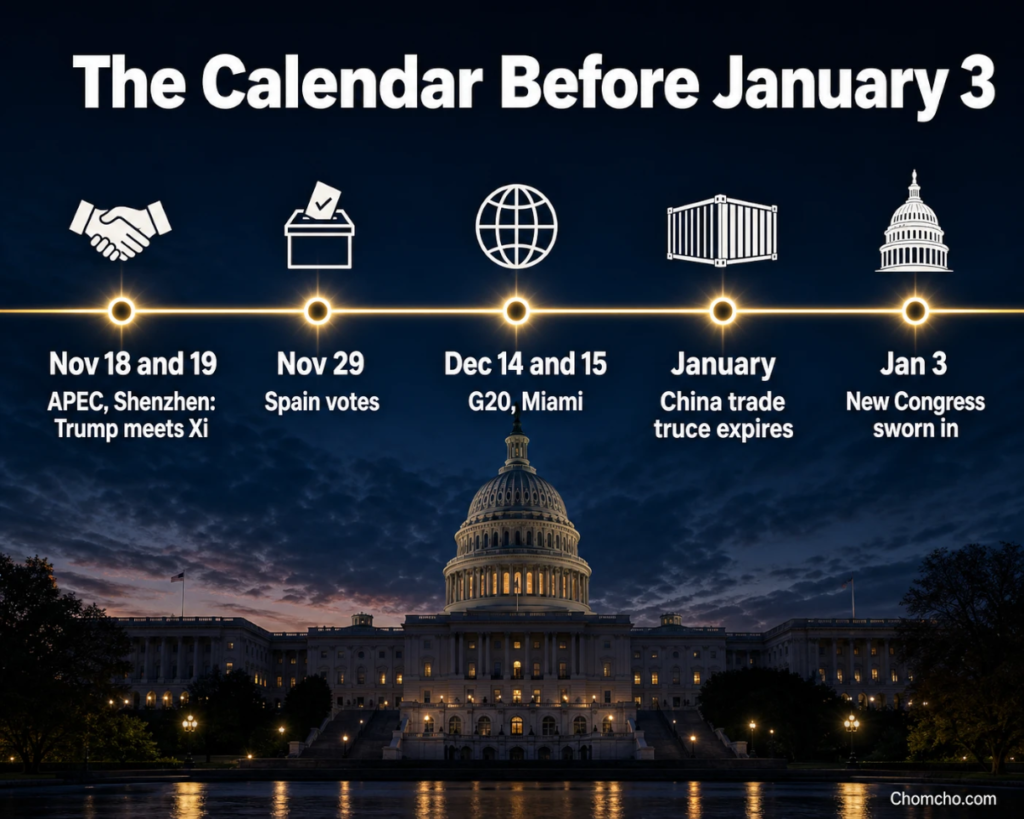
The next ten weeks are the test: APEC in Shenzhen on November 18 and 19, Spain's vote on November 29, the G20 in Miami on December 14 and 15, and the new Congress on January 3, 2027.
Democrats have no foreign policy of their own; they have an opponent. Obstruction is not foreign policy, not even a plan.
"If a kingdom be divided against itself, that kingdom cannot stand" (Mark 3:24, KJV).
Still, the wheel is Trump's. The America First course holds; his room to act shrinks.
Democrats take Congress, Trump keeps the veto
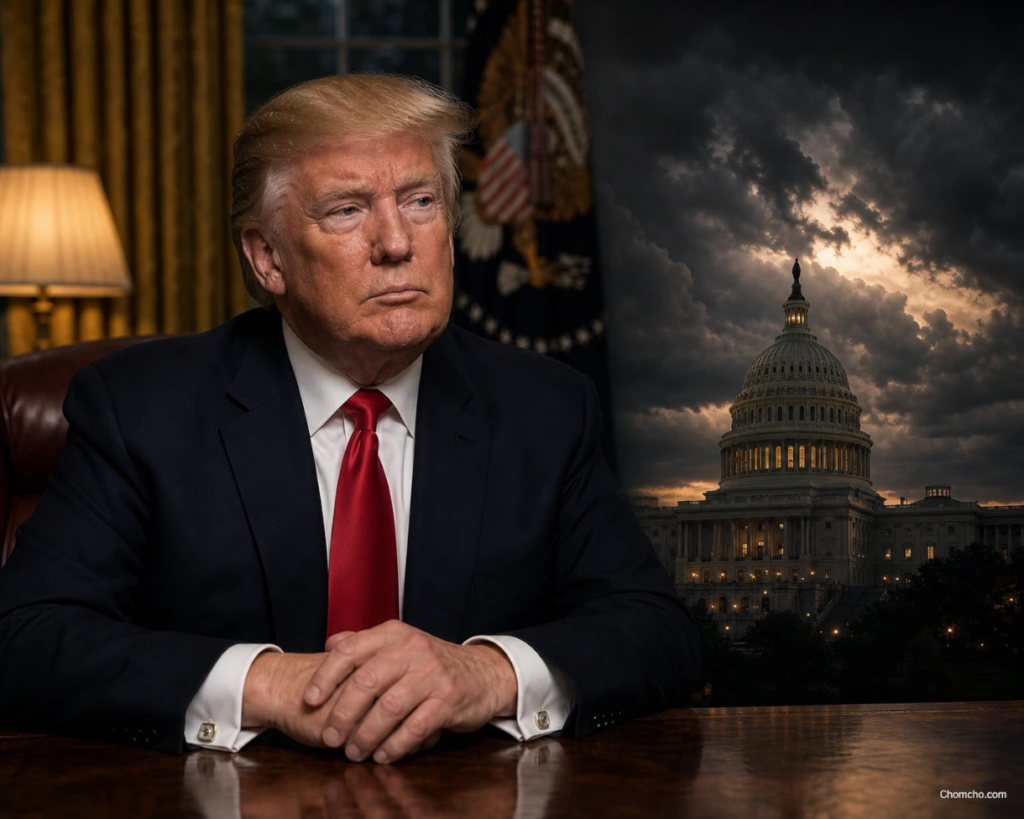
On November 3 the Democrats took both the House and the Senate. Trump congratulated them, said he would work with them, and then reminded everyone that he still signs the laws.
“I have the ultimate power, it’s called veto,” he told CBS News on election day. “Historically, you veto for a couple of months and then they come and say, we’ve got to make a deal.”
To Fox News he put it more bluntly: Democrats are “in control, but they’re really not in control.”
Two facts are certain. First, Trump is still in charge. He is president until January 2029, and the Constitution gives him diplomacy and the military, while Congress long ago gave the president broad trade powers.
Second, Democrats will obstruct, on foreign policy and on everything else. Trump still keeps the wheel, Congress gets the brakes.
The new Congress is sworn in on January 3, 2027; until then the old Republican majorities remain.
The main reason for these election results was the price of gasoline.
Trump told the Wall Street Journal that fuel prices were the biggest factor and that “Iran was a piece of it,” then added: “I did the right thing. I would have done it again.”
Even in foreign policy, the economy decides how people vote. A war that raises prices at home becomes a domestic issue on Election Day, November 3.
The question is how hard the brakes can press on U.S. foreign policy, and that depends on the road.
Iran, Israel, Ukraine, Europe, China and the rest of the world each get a different answer.
One warning first: a divided United States government is weaker abroad, and every government on this list has already noticed.
Iran: two months, not two years
This is where the brakes bite.
The war with Iran began on February 28, 2026, when the United States and Israel launched joint strikes. In September a Senate war-powers resolution failed by a single vote, with four Republicans voting with the Democrats; the House passed its own version 220 to 204.
With both chambers in January, Democrats can pass a binding resolution and attach conditions to war funding. Trump can veto, and they do not have two thirds to override, but every dollar for the war now has to be argued in public.
The Iranian government heard the message it wanted.
Ghalibaf, the speaker of parliament and Iran’s lead negotiator, wrote on X: “Conscience or the cost of living, Americans said NO TO WAR, and we endorse this message.” Ghalibaf also threatened a “nightmare” if strikes resume.
Supreme Leader Mojtaba Khamenei reportedly said anyone expecting a change in U.S. foreign policy was “very much mistaken.” Iranian leaders understand the veto too.
Trump is not in a forgiving mood.
Iran stalled through the summer and fall and never closed a deal before the election, and that helped cost him Congress. The day before the vote, U.S. forces hit Qeshm Island near the Strait of Hormuz.
The Wall Street Journal reported on October 28 that Gulf governments had been told to prepare for a “short, intense military campaign” after the midterms.
On election day Trump told the Financial Times: “We’re locked and loaded if we need to go, but there may be no reason for it.” On Wednesday, November 4, Trump added: “Certainly if Iran doesn’t behave, I will.” Qatar-led mediators are trying to restart talks.
What follows is an educated assessment, not a fact.
Iran will probably try to wait the two months until the new Congress sits, because waiting costs it nothing and the hope of a friendlier Congress costs nothing.
But at the same time, Iran will probably not wait two years. Its economy cannot take it, and Hormuz cannot stay a war zone until 2029.
The likeliest path is a deal with Trump early in the new year, the best deal the Iranian government can get, with the quiet plan to reopen it in 2029 if a Democrat wins the White House.
Trump, for his part, wants an agreement he can call victory before the Democrats chair the congressional committees, which is why the pressure, and the strikes, come now.
Both sides have reasons to close. The strikes in between are the price of the delay.
Israel: the aid that ends
On the morning of November 3, Trump told Fox and Friends that the United States will stop its roughly 4,000 million dollars a year in military aid to Israel at the end of 2026.
“We’ve already agreed that by the end of this year, we won’t be paying Israel,” he said, adding that Israel is a good ally and “they don’t need it.”
He also said Netanyahu “brought it up,” and he openly gave the political reason: the aid had become a Democratic talking point, used against Republicans in Michigan by Abdul El-Sayed, who ran for the Senate on it.
The history matters, because the political left will describe it incorrectly.
In 1996 Netanyahu told Congress he wanted to end American economic aid, and it was phased out over the following decade.
The military aid is the part he first proposed to end this year: he told The Economist in January that he wanted to “taper off” American military aid within ten years.
The late Senator Lindsey Graham, one of Israel’s strongest friends in the Senate, answered the same month that “we need not wait ten years.”
In June Netanyahu wrote to Representative Marlin Stutzman, backing his resolution to end the aid: “The time has now arrived for us to move from aid recipient to partner.”
The current memorandum, signed in 2016, was meant to run to 2028, with 38,000 million dollars over ten years, and it required that almost all of the money be spent on American-made weapons, 92 percent this year and next, 100 percent in 2028.
Trump is ending it two years early.
Much of that money never left the American economy. It paid American workers to build American systems that Israel then tested in combat.
So the direction is right, and it was Israel’s idea. The timing is politics.
Thomas Warrick of the Atlantic Council doubts the aid can stop by December, since Congress appropriates it and missile-defense programs cannot be stopped immediately; he expects a phase-out during 2027.
Israeli officials learned of the announcement from the news.
Why did the military aid to Israel become toxic?
Because the Democratic Party has moved. Its progressive wing, with a growing Muslim-American political base in states like Michigan, now treats support for Israel as a liability. Even on the far right, a few commentators have expressed the same view; Tucker Carlson called the Iran campaign Israel’s war.
That explains Trump’s timing.
In January the new majority takes the committees that write the foreign-aid bills, and aid to Israel was going to be their favorite weapon: conditions attached, transfers held up, hearings on every shipment, all of it just as the Iran talks begin.
Trump saw it coming and removed the issue before the polls closed.
Announced by the president, agreed with Netanyahu, framed as a move from aid to partnership, the end of the aid is a decision between friends.
Cut by a hostile committee next spring, it would have been a punishment, and a precedent.
Trump chose the first version so the Democrats could not write the second. Netanyahu, who proposed this in January, understood the difference.
Ukraine and Russia: the brakes work in reverse
Here the new Congress will not slow Trump down. It will push the accelerator.
Democrats, with part of the Republican caucus, want more money for Ukraine, through NATO’s mechanism where allies buy American weapons for Ukraine, and more sanctions on Russia.
Congress has already approved about 175,000 million dollars for Ukraine since 2022, all of it under Biden, who asked nothing in return and added it to the national debt.
Many conservatives see the war as a globalist project kept alive by people who never pay for it. Whether or not one agrees, the money is real.
Moscow read the result the same way.
Russian Deputy Foreign Minister Sergei Ryabkov said Democratic leaders have, in his words, a “sharply negative” view of Russia. Kremlin spokesman Dmitry Peskov said the Kremlin hopes the result will not affect Trump’s “efforts toward peace.”
Translation: Russia liked talking to Trump and now expects Congress to make talking harder. Any sanctions relief Trump might offer as part of a peace deal now has to pass through committees that really want the opposite.
Europe: celebrating in private, careful in public
Europe’s leaders remember the generous American spending of the Obama and Biden years, when American taxpayers carried the continent’s defense while European budgets went to generous welfare systems, including for migrants who entered Europe illegally.
That is why the quiet joy among European Union officials was hard to hide, and why most of them tried to hide it anyway. They know who is still in charge.
France’s economy minister, Roland Lescure, called it “an indisputable victory for the Democrats” and in the same breath he said Trump will still lead U.S. foreign policy.
Foreign Minister Jean-Noël Barrot, for his part, called the result “very good news” for American democracy.
Britain’s prime minister, Andy Burnham, said the world now has a chance to unite around the cost of living, which he cannot bring down “until the conflict in the Middle East is resolved.”
European Parliament vice president Christel Schaldemose said she was “cautiously optimistic on Europe’s behalf.”
Careful words, every one of them.
Pedro Sánchez was the exception.
Spain’s prime minister wrote that Americans voted “against policies that only impoverish. Against hatred. Against sexism,” and that the far-right wave “is no longer growing, it is crumbling. It happened in Brazil. It just happened in the US. And it will happen soon in Spain.”
Sánchez faces a snap election on November 29 that the polls say he loses, and Trump said in July that “Spain is a wasted cause.”
The man is campaigning, not analyzing. Trump already excluded Spain from the G20 preparatory meetings for Miami. Whether Sánchez is still the one eating ropa vieja there in December depends on Spanish voters first.
Sánchez is only the loud version of a pattern older than Trump.
For decades European governments were antagonistic toward America while America financed their security; now they present the quarrel as a quarrel with Trump and MAGA only.
Four days before the election, at the G20 foreign ministers’ meeting in Atlanta, European ministers and the EU’s Kaja Kallas refused to pose for the family photo with Russia’s Lavrov, and Rubio had to cancel the photo for everyone. German Foreign Minister Johann Wadephul said there could be no normality with Russia.
Nobody was trying to end a war that afternoon; they were making a symbolic gesture.
In our view that reflex, showing off virtue before getting results, is part of what keeps many conservatives convinced that the Ukraine war is a globalist project, just like the 2020 Covid-19 pandemic.
Washington’s Democrats and Western Europe’s governments speak with one single voice when the subject is Trump, Putin or Netanyahu. A divided Washington suits them; it is the arrangement they are used to.
China: the least affected, and why
Beijing’s answer came within hours and it was the calmest of the day.
Asked by the New York Times, foreign ministry spokeswoman Mao Ning said the midterms “are a domestic affair,” and that China “stands ready to continue working with the U.S. to uphold and deliver on the important common understandings reached by the two heads of state.”
The goal, in her words: “a constructive relationship of strategic stability on the basis of respect, fairness, and reciprocity.” Bloomberg’s headline said the rest: “China Keeps Faith in Trump.”
Behind the polite words there is a message. When Beijing calls the election “a domestic affair,” it is saying that it deals with Trump, not with Congress.
The “understandings reached by the two heads of state” are the agreements Trump and Xi made at the May summit in Beijing and the September state visit in Washington, and China wants those agreements protected from the new Democratic majority.
In the same briefing, Mao Ning confirmed that Beijing is in contact about a Trump, Xi and Putin meeting at the APEC summit in Shenzhen on November 18 and 19, and that Wang Yi had just met Saudi and Iranian security officials.
In other words, China is offering itself as the mediator in both the Ukraine war and the Iran war, while assuring the United States government that nothing between the two countries has changed.
Why is China the least affected?
First, being tough on China is one of the few policies both parties in Congress support; no Democratic committee will vote to go easier on China.
Second, the tools are presidential. The Supreme Court struck down Trump’s emergency tariffs in February and the administration simply switched to other legal authorities; Goldman Sachs expects new tariffs after the midterms, and the chip controls never passed through Congress.
Third, the trade truce expires in January, and Beijing’s side of it was to postpone its rare-earth export controls, which it can revive at will.
None of that is in the hands of the Senate.
Where Congress does matter is Taiwan. Trump has held back a 14,000 million dollar arms package for Taipei to protect the truce, and both parties want it delivered.
Chen Dongxiao of the Shanghai Institutes for International Studies expects Taiwan arms sales to become the new variable; Taiwan’s foreign ministry said it enjoys bipartisan support and will work with both parties.
Natixis economist Alicia Garcia-Herrero said “Democrats are unlikely to give Trump free rein on deals with Beijing,” and she is right. The Democrats will try to undermine Trump’s moves on China even if their chances of success are low.
Shi Yinhong of Renmin University told the New York Times that the May understanding would break down “because Trump suddenly becomes far from all-powerful.”
Saul Eslake, an Australian economist, told Reuters he expects Xi to look for ways to exploit Trump’s weakened position.
Put it together: the Chinese government’s leverage rises on trade and falls on Taiwan. Xi himself told Trump at the May summit that “the Taiwan question is the most important issue in China-U.S. relations,” so the ground Beijing loses is the ground it values most.
Congress cannot soften Trump’s China policy, but it can block a soft deal.
The rest of the world hedges
Everyone else is doing the same arithmetic.
Japan’s chief cabinet secretary, Minoru Kihara, said the U.S.-Japan alliance “remains the cornerstone of Japan’s foreign and security policy,” and he said it while the Japanese government checked its tariff exposure.
Kazuhiro Maeshima, a professor at Sophia University in Tokyo, warned that if Japan’s investment pledges slow, “calls for additional tariffs could resurface,” as he put it.
Reuters found trading partners across Asia weighing whether to delay the investment promises they made to avoid tariffs. India is waiting to see what happens.
Latin America answered by ideology, as expected.
Mexican President Claudia Sheinbaum, who is expected at APEC in Shenzhen, said only “we must wait and see”; she pointed instead to the Mexican-origin governors elected in Texas and California.
Lula, fresh from a narrow reelection in Brazil, had already declared that “Brazil is no one’s backyard,” and Sánchez’s “it happened in Brazil” shows the Left counting Lula’s survival as the first wave of a tide.
In Canada, Ontario Premier Doug Ford said he was overjoyed by the result and that his country gained “a little more leverage.”
South Africa’s president, Cyril Ramaphosa, excluded from the Miami G20 and from the trade preferences of the African Growth and Opportunity Act (AGOA), called it “a new era in world relations.”
The temptation everywhere is the same: wait for Trump to leave.
We believe that for allies this is a mistake, because the tariffs and the troop decisions are his alone and he has until January 2029.
For rivals it is a gamble, because a president with nothing left to lose at home has every reason to act abroad.
When Trump’s decisions undermine the policies of other governments, they call him “unpredictable.” If pursuing a policy that finally benefits America is unpredictable, then yes, under that new definition, Trump is indeed unpredictable.
The calendar: what happens before January
The next ten weeks are the test.
November 18 and 19, APEC in Shenzhen, Trump’s third meeting with Xi this year and possibly a three-way table with Putin; Ukraine and Iran would be the subjects, and the picture alone would be historic.
November 29, Spain votes.
December 14 and 15, the G20 at Trump National Doral in Miami, with Xi expected and South Africa off the guest list.
January, the trade truce with China expires.
January 3, as noted above, the new Congress is sworn in and the Democrats take the committee chairs.
Somewhere in between comes the Iran decision: deal or strikes. We believe Iran is more inclined to wait two months for a friendlier Congress.
Remember the analogy: Trump keeps the wheel, Congress gets the brakes.
These ten weeks are Trump driving before the new brakes are even installed. He will act where Congress cannot reach, in summits, strikes, tariffs and executive agreements, and he will try to secure what outlasts him.
Expect a deal with Iran he can name, a Shenzhen communique he can wave, and tariff decisions announced from the Oval Office rather than negotiated on Capitol Hill.
Expect Democrats to answer with hearings.
Some have already suggested impeaching Hegseth or Trump over the war; House Democratic leader Hakeem Jeffries says nothing is ruled in or out, Representative Jamie Raskin promises to move “very quickly,” and Trump dismisses it as “impeachment for no reason.” It would not be his first.
A house divided, and Trump’s wheel
Democrats have no foreign policy of their own for the next two years. They clearly have an opponent.
Their “strategic” goal is to make Trump’s life difficult, and if the world burns while they draft subpoenas, the hearings will go on anyway.
Obstruction is not foreign policy, not even a plan, and the countries on this list, friend and rival, can read the difference.
Scripture put the risk in one sentence. “And if a kingdom be divided against itself, that kingdom cannot stand” (Mark 3:24, KJV).
A nation that fights itself in public invites its rivals to test it, and that is the real cost of November 3: not a change in U.S. foreign policy, but a louder argument about it, heard in Tehran, Moscow and Beijing.
Still, the wheel is Trump’s. Veto, commander in chief, trade authority, the summit calendar, and the plain fact, in his own words, that the other side eventually comes to make a deal.
The America First course holds. The margins shrink. The fights move to Capitol Hill, where they belong, and the strength of the United States abroad will depend on how quickly Americans remember that the enemy is not across the aisle.
A divided house cannot stand. A united one cannot be moved.