
This post is also available in:
 Português
  Español
  Français
  Deutsch
  Italiano
  Русский
Summary
Nothing on Iran, nothing on Taiwan, nothing on chips, no new rare earth guarantee.
Xi came for three things. A permanent end to U.S. arms sales to Taiwan, starting with the 14,000 million dollar package Trump is holding as a negotiating chip. Looser chip export controls. And a return to the June interim agreement with Iran so China keeps buying Tehran's oil. He got none of them.
China buys about 90 percent of Iran's oil exports. Trump wanted China to use that leverage to reopen the Strait of Hormuz. He wanted delivery on the Busan promises: soybeans are on track, but farm goods and rare earth magnets are lagging, with shipments down to 512 tons in August. He wanted imprisoned Americans released and guardrails on AI.
Saxo Bank called the result "stability, not a breakthrough." CSIS's Scott Kennedy read the short extension as a sign Washington is unsatisfied and wants to keep the heat on.
Stability is better than escalation, and that is worth saying plainly.
On a Voz News panel in Spanish, Orlando Avendaño called China the roommate you sleep next to with one eye open.
That is the right foreign policy: keep trading, sign the deals, verify every delivery, and keep the next deadline sixty days out.
The roommate needs the house more than the house needs him.
On a Voz News panel in Spanish this week, anchor Karina Yapor asked, among other things, whether China is the uncomfortable partner you must never turn your back on.
Her guest Orlando Avendaño answered with a picture: China is the roommate you can share a house with, “but when you go to sleep, you have to sleep with one eye open.”
You can sign trade agreements, he said, you can understand the dynamic, “but you cannot stop distrusting,” because China intends to overtake the United States and become the predominant power.
That is the best short description of the Trump-Xi summit that ended in Washington on Friday. The roommate came to dinner. Nobody handed him the keys.
Xi’s first Washington visit in over a decade
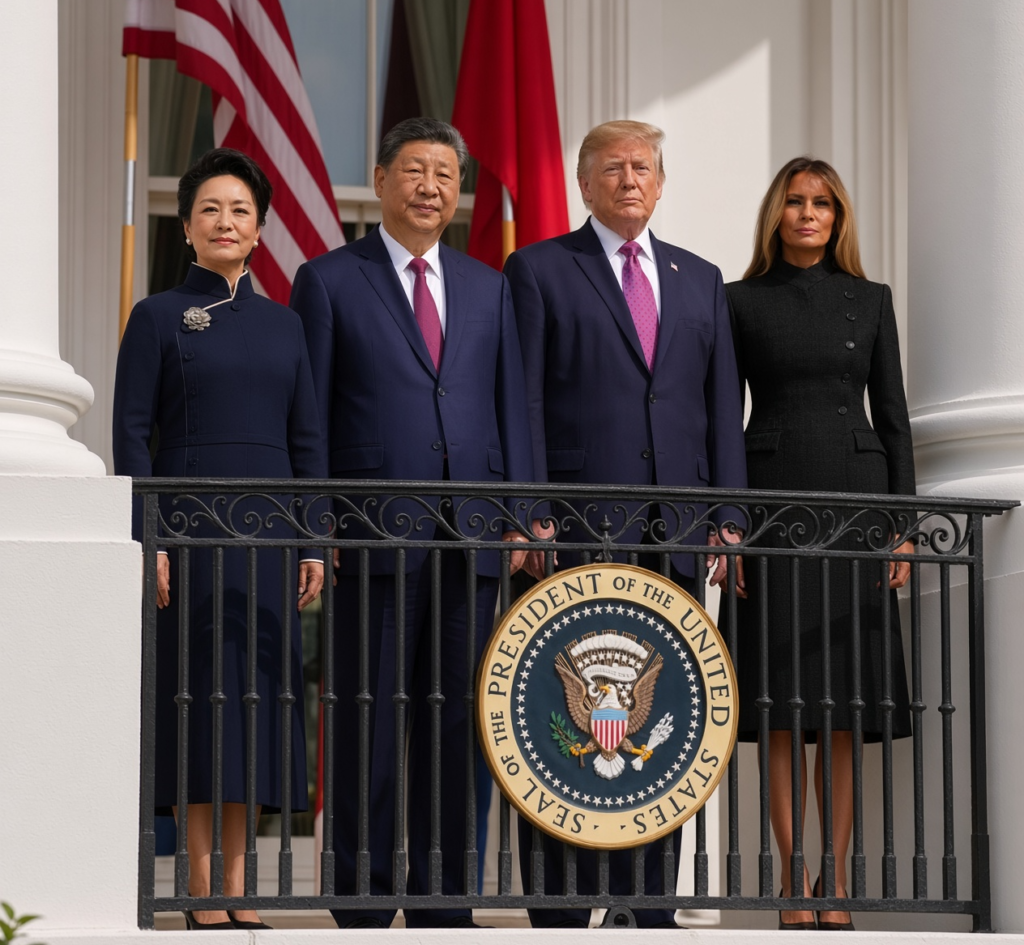
Xi Jinping landed at Joint Base Andrews on Wednesday evening, and President Trump met him on the tarmac, the first time since 1962, papal visits aside, that a president welcomed a foreign leader there.
Thursday brought a full state arrival ceremony, about three hours of talks, and a state dinner. Friday was tea in the Red Room, a visit to the National Archives, where Xi pointed at the U.S. Constitution in the rotunda, and the farewell.
By early afternoon he was on his plane back to Beijing, with no signed deal in his luggage and no new promise from Washington on Taiwan or chips.
It was the third meeting between the two men in a little less than a year: Busan, South Korea, in October 2025, where the trade truce was born; Beijing in May; and now Washington.
Two more may come, at the APEC meeting in Shenzhen in November and the G20 in Miami in December.
Trump called it “a great meeting” and said the two countries “have made tremendous strides.”
On Friday morning he added on Truth Social that it had been “very productive” for both countries and that “tremendous things will be happening.”
Xi reached for an old Greek historian. Thucydides wrote that the rise of Athens, and the fear it caused in Sparta, made war inevitable. Harvard’s Graham Allison turned that into the “Thucydides Trap”: when a rising power challenges the ruling one, war usually follows.
Xi named the trap at the White House and then turned it into something gentler, a competition instead of a war.
“It should be a race of catching up with one another, not a wrestle in which one either wins or loses,” he said.
The context: a bad year for China abroad
The Hill ran an opinion piece in February under the headline “China’s worst year in Latin America is just getting started.”
The list was already long: Panama out of the Belt and Road, the Panamanian Supreme Court voiding the port concessions of a Hong Kong company, the CIA back in Venezuela, and the Cuban dictatorship beginning to crumble.
Beijing’s partnerships in the region are built on money, not on shared conviction, and they hold only until they are tested.
Then there is Iran. The war is in its seventh month. A U.S. naval blockade sits on Iran’s ports, and the Strait of Hormuz, through which most of China’s Gulf crude arrives, is a war zone. Beijing needs that strait open more than Washington does.
Then rare earths, the roommate’s one real weapon. China refines about 85 percent of the world’s supply and makes more than 90 percent of the magnets.
The Trump administration has answered with mines, plants and checks: more than 7,000 million dollars committed since April 2025, a Pentagon stake in MP Materials, grants and loans for USA Rare Earth in Texas and Oklahoma, and an 8,500 million dollar minerals deal with Australia.
Gracelin Baskaran of CSIS, who directs its critical minerals program, said Washington has “rolled out the entire industrial policy toolkit,” and she added: “That’s exactly what China did.”
Five weeks after the Beijing summit, China blacklisted both American companies. That is the roommate’s promise record in one sentence.
And artificial intelligence. The first U.S.-China AI dialogue took place on September 20 in New York, and Treasury Secretary Scott Bessent proposed an alert system for AI incidents.
At the dinner table sat Elon Musk, Jeff Bezos, Sam Altman, Sundar Pichai, Jensen Huang and Tim Cook. Each of them has a China problem: chips, iPhones, supply chains, market access. Not one Chinese CEO came.
Trump told the UN this week that “whoever wins superintelligence wins,” and that the United States is “leading now over China by a lot.”
What Xi wanted
Taiwan first. Xinhua reported that Xi urged Trump to “oppose” Taiwanese independence, and Beijing wants the 14,000 million dollar arms package that Trump is holding as a “very good negotiating chip” to disappear for good.
That is not going to happen. U.S. law requires arms for Taiwan’s defense, and Congress would revolt.
Xi also wanted looser chip export controls. Nothing changed.
On Iran, he wanted the opposite of what Trump wants: a return to the June interim agreement and no interruption of Chinese oil purchases from Tehran.
What he brought was soft: two pandas for Zoo Atlanta, an invitation for 100,000 young Americans to visit China, and the slogan “constructive strategic stability.”

What Trump wanted
Iran, above everything. China buys about 90 percent of Iran’s oil exports. That is leverage, and Washington wants it used to push Tehran to accept U.S. terms and reopen Hormuz.
In April, Pete Hegseth said Beijing had assured Washington it would not arm Iran: “Trump has a strong and direct relationship with Xi. They communicated on that, and China said that is not going to happen.” An assurance is not a delivery, but it is a start.
Second, compliance rather than a new deal. Bessent said China has been “very good thus far” on the 25 million tons of soybeans it promised in Busan, but “lagging” on the 17,000 million dollar pledge for other farm goods and on rare earths.
Magnet shipments to the U.S. fell to 512 tons in August, and some American companies have waited more than six months for export licenses.
Third, the release of Americans held in Chinese prisons, some of them detained in the 2025 crackdown on churches.
Fourth, guardrails on AI, meaning agreed limits so that an accident or a rogue system on one side does not start a war on the other.
What was actually accomplished
One thing: the trade truce that was to expire on November 10 now runs to January 10, 2027.
The 12.5 percent forced-labor tariff stays. Nothing on Iran, nothing on Taiwan, nothing on chips, no new rare earth guarantee.
The legacy press had written the verdict before the plane landed.
CNN told its readers that deep mistrust on both sides would likely block any significant breakthrough. CBC called the summit “heavy on symbolism but light on substance.”
The market verdict, from Saxo Bank, was the most honest: “stability, not a breakthrough,” a result “better than an escalation but weaker than markets had hoped for.”
Chinese and Hong Kong stocks rose on truce hopes early in the week and slipped on Thursday.
Still, stability is better than escalation.
When the two largest economies on earth spend three days talking instead of raising tariffs and blacklisting each other’s companies, the world is safer, and that is worth saying plainly before the criticism.
Scott Kennedy of the Center for Strategic and International Studies (CSIS) read the two months correctly. The short extension “suggests to me the U.S. is unsatisfied with China’s offers and wants to keep the heat on.”
Eric Xiao of CMC Markets put it in one line: “The truce is moving fastest where it costs least.” Soybeans are cheap for Beijing. Rare earths and Taiwan are not.
The parallel table
The real trade work happened in a smaller room. Bessent and Vice Premier He Lifeng held the eighth round of trade talks in New York on September 20, met again in Washington, and produced the extension.
On their table: taking tariffs off 30,000 million dollars in non-critical goods, financial services, farm purchases. Bessent would not promise a bigger deal by January.
The numbers explain why Trump can wait.
The U.S. goods deficit with China fell nearly 32 percent in 2025, to 202,000 million dollars, the lowest since the early 2000s, according to Commerce Department data. Much of that trade moved to Vietnam and Taiwan rather than disappearing, but the point stands: the leverage runs in Washington’s direction.
What Trump should do with the roommate
Keep trading. Sign the deals. Verify every delivery, then verify it again, and put the next deadline sixty days out, not a year. A short leash is the right foreign policy for a partner who blacklists your companies five weeks after a state banquet.
Scripture already said it: “A false balance is abomination to the LORD: but a just weight is his delight.” Beijing keeps a false balance; the answer is a just weight, checked at every shipment.
Miles Yu of the Hudson Institute wrote after the May summit that “cooperation detached from moral reality becomes appeasement.” The moral reality here is simple: a partner who promises rare earths in Busan and blacklists your producers in June has not earned trust, only a shorter leash.
The good news is that America’s mines and magnet plants are real, and the Hormuz pain belongs to China, not to the United States.
The roommate needs the house more than the house needs him. Sleep with one eye open, and keep the door to trade open too.