
This post is also available in:
 Português
 Español
 Français
 Deutsch
 Italiano
 Русский
 Nederlands
 日本語
 Polski
Summary
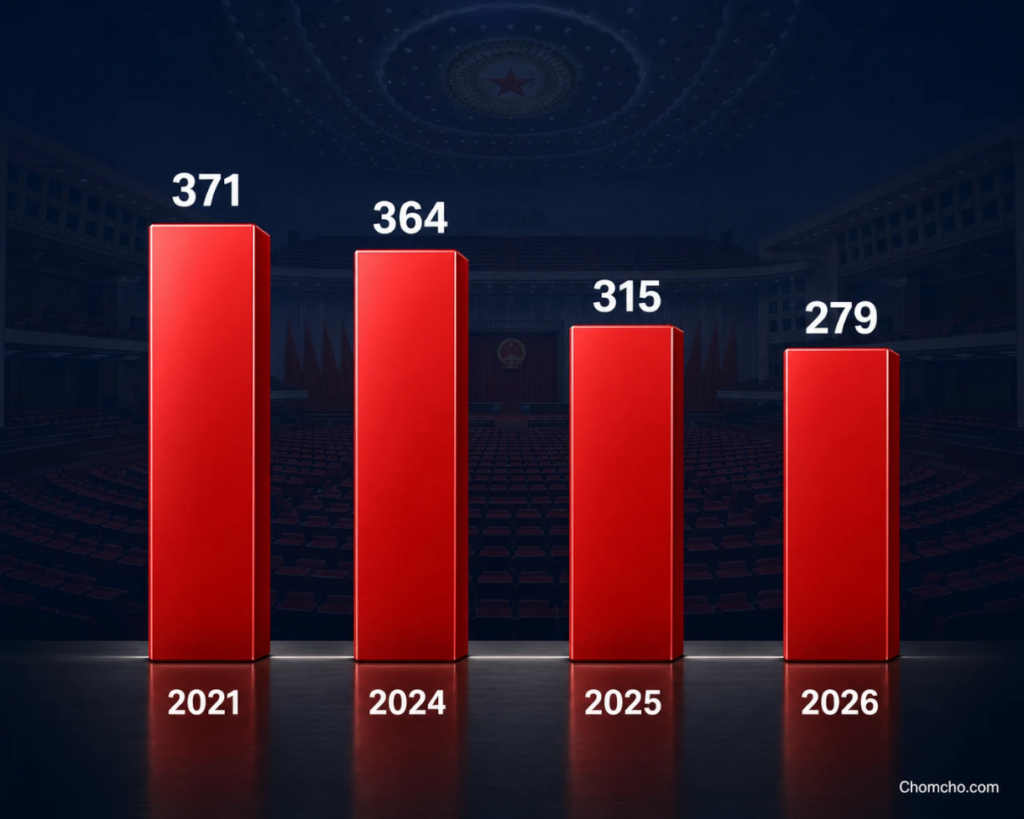
Only 279 of the 376 Central Committee members named in 2022 showed up, the first time under 300 in Xi Jinping's 14 years.
On October 30 the PLA Daily, the newspaper of the People's Liberation Army (PLA), told the troops they must resolutely obey the Party Central Committee, the Central Military Commission and Chairman Xi.
A leader who purged his own generals now demands loyalty from the survivors.
The numbers are not in dispute. The Center for Strategic and International Studies counts over 100 generals purged or missing since 2022. Of 47 three-star generals, 41 are purged or missing, 87 percent.
Also, five of the six generals Xi placed on the Central Military Commission (CMC) in 2022 have been removed. Two men remain on a seven-seat body: Xi and Zhang Shengmin, the officer who ran the purges.
The removal of Zhang Youxia was the biggest surprise. A princeling whose father served beside Xi's father, the closest thing Xi had to a brother in uniform, he disappeared from public view in December 2025, was investigated in January 2026 and expelled in September 2026 for "forming cliques" and disloyalty.
The pattern is almost always the same: silence, then a charge, then expulsion, then a closed trial.
Corruption in the PLA is real. The Rocket Force procurement scandal is not in dispute, and the "watered-down" combat capability and the "fakery" in training come from the Chinese government's own newspaper.
But in an authoritarian system where nearly every official breaks some rule to get by, corruption charges can be selectively weaponized. Graft is the legal reason. Loss of political alignment at the top is the real one.
Xi wants two things: a military able to challenge the United States and a military unable to challenge Xi. The second goal is undermining the first.
Experience, initiative and honesty are the casualties. A general who fears the chairman will not tell him the missiles are not ready.
For Taiwan, the purge complicates and probably delays the Chinese government's ambitions, but a weaker PLA is not a safer PLA. A ruler who hears only good news can miscalculate.
President Donald Trump is due to meet Xi in Shenzhen on November 18 and 19, sitting across from a man who cannot trust his own army.
That is a position of strength, and the United States government should use it: keep American power visible, watch who fills the empty seats, and do not pause arms sales to Taiwan for a photo opportunity.
The contrast is the point. Pete Hegseth, head of the Pentagon, cut 10 percent of its generals and admirals and said so in public, to the troops. Xi makes his generals disappear.
Deterrence is built in daylight. Keep it strong.
A record purge, an order to obey
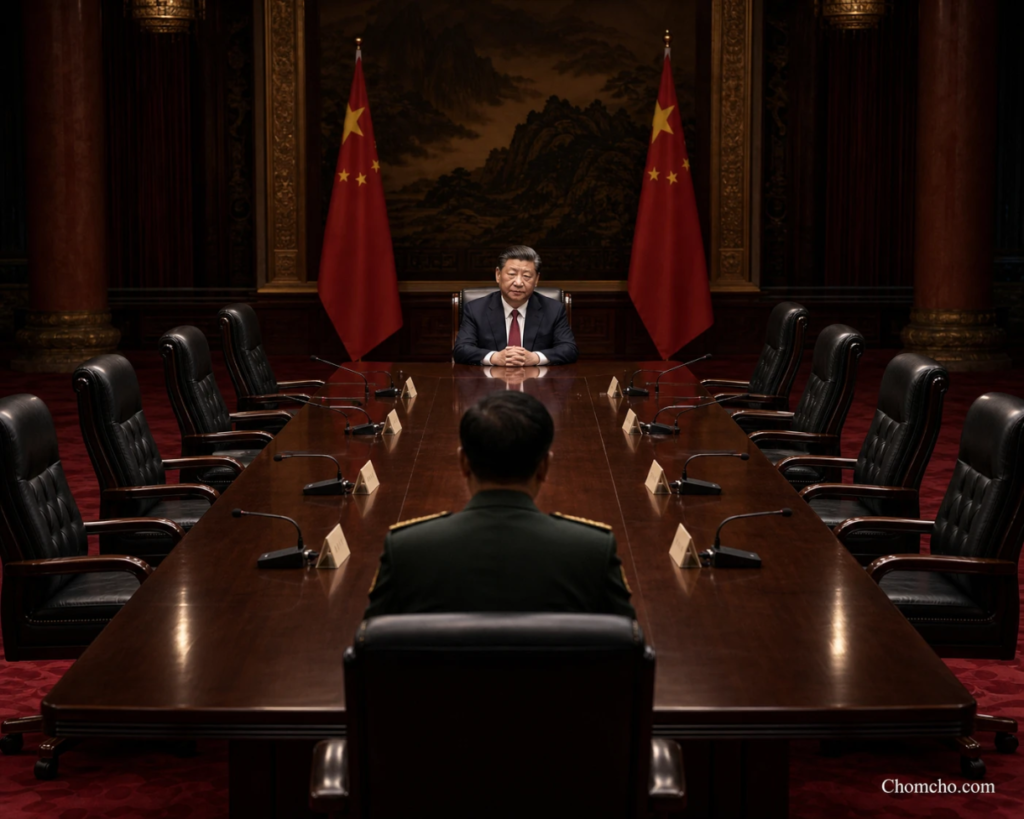
From October 26 to 29, the Chinese Communist Party held its fifth plenum behind closed doors in Beijing.
The communique confirmed the expulsion of 33 members, the most at any plenum since 1978. Sixteen of them were military men. Only 279 of the 376 Central Committee members named in 2022 showed up, about 74 percent, and the first time in Xi Jinping’s 14 years in power that attendance fell below 300.
The empty seats were the most important news.
The plenum ratified what everyone already knew: former Politburo member Ma Xingrui, former top general Zhang Youxia, former Joint Staff chief Liu Zhenli and former diplomat Liu Jianchao, all men who once sat near the center of power, are out.
It also did something unusual. It promoted General Zhang Shengmin, the man who ran the army’s internal police for nine years, to the 24-member Politburo, one level below the seven-member Politburo Standing Committee, the first such promotion outside a party congress since 1994.
The party set its 21st Congress for the second half of 2027. Xi, 73, is expected to take a fourth term there.
Days before the meeting, Xi published an article in Qiushi, the party’s theory journal, attacking “two-faced” officials who praise the leadership in public and resist it in private.
After the plenum, Zhang Fuhai, deputy secretary of the party’s Central Commission for Discipline Inspection, told reporters that the Central Committee, with Xi at its core, had “eliminated serious hidden dangers within the party, the state and the military.”
Zhang Fuhai then added that the party would rather offend thousands than let down China’s 1,400 million people.
The army received its orders on October 30.
On October 30 the PLA Daily, the official newspaper of the People’s Liberation Army (PLA), wrote that troops “must resolutely obey the command of the Party Central Committee, the Central Military Commission, and Chairman Xi.”
On November 1 the PLA Daily reported that units across the armed forces had studied the plenum and firmly supported the expulsions, and it called the Zhang and Liu cases a major victory in the war on military corruption.
A leader who purged his own generals is now demanding loyalty from the survivors. The plenum only ratified what had been happening for three years.
The purge by the numbers
Numbers first, because they are not in dispute.
The Center for Strategic and International Studies (CSIS) in Washington published a database in February 2026 covering generals and lieutenant generals only.
The CSIS database counted 101 senior officers purged or potentially purged since 2022: 36 officially removed, 65 more missing from meetings they should have attended.
Of 47 officers who held three-star rank in 2022 or reached it after, 41 have been purged or potentially purged. That is 87 percent. Also, of 35 three-star generals promoted since 2020, 32 appear to have been investigated. Xi had approved every one of those promotions himself.
CSIS estimates that purged and potentially purged men held about 52 percent of senior PLA leadership positions.
Eleven were purged even after retirement, seven of them retired before 2022.
Five of the six generals named to the Central Military Commission (CMC) in 2022 are gone, and former defense minister Wei Fenghe, from the previous commission, fell as well.
All four past commanders of the Rocket Force, the branch that holds China’s nuclear missiles, have been officially purged.
The pace also matters.
CSIS counts 19 official purges in 2023 and 2024 together, 15 in 2025, and at least 46 generals who went missing in 2025 alone.
The BBC’s count of Central Committee members removed tells the same acceleration story: 35 in Xi’s first term, 5 in his second, 51 so far in his third.
This is the China military purge in numbers, and it is not an anti-corruption campaign that got large. The purge is the replacement of an entire officer corps.
Corruption in the PLA is real and serious, as the next sections show, but the numbers say it is not Xi’s main concern. His main concern appears to be his own job.
Numbers do not show the individual people. Three names explain the rest.
Three generals, and how a purge unfolds
He Weidong was removed first. A CMC vice chairman and Politburo member, he had served in Fujian in the 1990s when Xi was a rising official there, and Xi lifted him straight into the CMC in 2022.
He Weidong was expelled in October 2025, the first sitting vice chairman of the commission removed since the Cultural Revolution.
Zhang Youxia was the bigger shock. Born in 1950, the first-ranked vice chairman, he was the closest thing Xi had to a brother in uniform. Their fathers, Zhang Zongxun and Xi Zhongxun, served side by side in the communist northwest during the civil war, and the two sons grew up in Beijing in the same circle of revolutionary families.
Zhang Youxia was last seen in public on December 22, 2025. On January 24, 2026, the defense ministry announced an investigation.
Then by September 21 the Politburo expelled him from the party and the army for “forming cliques” and being disloyal and dishonest to the party. On October 29 the plenum ratified it.
Liu Zhenli was removed together with Zhang Youxia. Born in 1964, chief of the CMC Joint Staff Department, the office that writes the war plans, he was one of the very few PLA leaders with combat experience, earned in the border fighting with Vietnam in 1986.
Removing him reached past politics into the operational heart of the military.
Even the officers closest to Xi personally were removed.
Fang Yongxiang, director of the CMC General Office, in effect Xi’s own military secretariat, and Zhong Shaojun, Xi’s long-time aide and Fang’s predecessor in that office, were both expelled in 2026. Both men worked at Xi’s side.
The pattern is always the same, and the pattern is the message.
First, silence. A general stops appearing at events where his presence is routine, and nobody explains why.
Zhang Youxia missed a study session chaired by Xi in January 2026, and the rumors started that same day. Weeks or months later, the party announces an investigation for “serious violations of discipline and law,” the standard phrase that everyone understands to mean corruption.
Then comes expulsion from the party and the army, and the case goes to military prosecutors.
Trials are closed. Sentences are rarely published. A few officers reappear in lesser posts, demoted but alive, which is why absence alone does not prove arrest.
CSIS keeps two lists for exactly that reason: confirmed, and missing.
What the Chinese government confirms is the charge. What independent researchers establish is the count. What nobody outside the system can see is the evidence.
The Chinese government calls every case corruption. Part of that is true.
Real corruption: the problem is not invented
The Rocket Force is the proof.
In the summer of 2023 its commander, Li Yuchao, and his deputies were removed, and CSIS traces the trouble to procurement contracts dating to the force’s founding in 2015.
In January 2024, Bloomberg reported that U.S. intelligence had found missiles filled with water instead of fuel and silo fields in western China with lids that would not open properly.
To be fair, some analysts dispute the fuel detail, since liquid-fueled missiles are normally stored empty. But the procurement scandal itself is not in dispute.
The Chinese government itself has admitted the damage.
When the investigation into Zhang Youxia and Liu Zhenli was announced in January 2026, the PLA Daily said the two men had caused “tremendous damage” to the military’s political ecosystem and combat capability, and promised that in the fight against corruption “no place is out of bounds, no ground is left unturned, and no tolerance is allowed.”
Days later the paper said the investigations would end a “watered-down” combat capability, and the army announced a crackdown on “fakery” in training, the habit of reporting exercises and results that did not happen as described.
That is the party confessing, in its own newspaper, that procurement was rotten, equipment did not work and training reports were fiction.
A system with no independent courts, no free press and no opposition breeds exactly this. The party investigates the party.
And that is the point. In a top-down, sprawling authoritarian system, financial misconduct, bribery and nepotism run through the entire bureaucracy.
Because nearly every official operates inside that gray system, corruption charges can be selectively weaponized.
When a high-ranking official or a fellow princeling is suddenly arrested, corruption is simply the standard, legally convenient vehicle that state media use to justify the removal to the public.
But corruption alone does not explain a princeling’s fall.
The real reason: loyalty, networks, succession
Start with the calendar. Xi became general secretary in 2012. In 2018 the party removed the two-term limit on the presidency. In 2022 he took a third term.
And in 2027, he will almost certainly take a fourth, something no leader has done since Mao, and he has named no successor.
The PLA is not the army of the Chinese state. It is the armed wing of the Communist Party, and the party is Xi.
CSIS put it plainly: “charges of corruption do not explain the full extent of the purges and political dynamics played a key role,” and “political factors will be paramount for Xi” in choosing replacements.
Chong Ja Ian of Carnegie China told the BBC the purge of senior party and military officials has become “an effort to consolidate and maintain authority,” and that it “will continue and expand depending on how secure Xi feels rather than any real issue with corruption.”
He then added: “Xi has few qualms about removing people he promoted.”
Zhang Youxia was not an enemy. He was the ally. If a princeling whose father fought beside Xi’s father can be expelled for “forming cliques,” the definition of acceptable loyalty has no limit.
Nobody in the Chinese leadership is safe, and everyone in it now knows that.
Independent observers read it the same way.
Dennis Wilder, a former senior CIA analyst now at Georgetown University, told the Guardian in January that, in his view, a power struggle was the likelier explanation: the purge “is about a general that became too powerful.”
Neil Thomas of the Asia Society called it the most significant PLA purge of the post-Mao era and said no one in the Chinese leadership is safe, because Xi puts the party above any individual.
The Swedish Institute of International Affairs, reviewing the published explanations, counted 29 that pointed to a power struggle, 10 to corruption and 7 to policy disagreement.
Saying that corruption does not explain the fall means this: graft provides the legal reason for the downfall, but the true cause is an existential loss of political alignment, or of power, at the very top.
Even the plenum’s own paperwork hinted at discomfort.
Willy Lam of the Jamestown Foundation told the Taipei Times that, in his reading, the communique’s discussion of inner-party democracy and of regulating how “top leaders” exercise power was “unexpectedly detailed,” amounting to veiled criticism of one-man rule.
Willy Lam also noted that the communique did not mention the “Two Establishes,” the loyalty slogan that enshrines Xi as the party’s core. The army’s newspaper put the slogan back the next morning.
Whether that was dissent or stagecraft, outsiders cannot know. The party clearly felt the need to answer it.
History offers a warning, stated here as a possibility, not a prediction.
Mao’s closest military ally and named successor, Lin Biao, died in 1971 fleeing the country after falling out of favor. Stalin shot most of his senior commanders in 1937 and paid for it in 1941.
Xi’s purge is not at Stalin’s level, and it may never get there. But the direction since 2025 is toward more fear, not less, and a 73-year-old ruler with no heir tends to fear his own generals most.
That fear is now built into the chain of command.
Two goals that fight each other
Xi wants two things. A military able to challenge the United States, and a military unable to challenge Xi. The second goal is undermining the first.
Experience is the first casualty of the purge. CSIS notes that 80 percent of the purged CMC members held operational roles, and that the one general left, Zhang Shengmin, “has little operational experience.” He spent his career in missiles and then nine years running the army’s discipline commission.
The CMC today has no operational commander at all. Of 52 key leadership posts, CSIS found only 11 properly filled, 23 held by acting or interim officers and 12 apparently vacant.
Initiative is the second casualty. An officer who has watched 87 percent of his peers vanish will make the decision that is safe for him, not the one that is best for his force.
Honesty is the third. A general who fears the chairman will not tell the chairman that the missiles are not ready.
The Chinese government’s own complaint about “fakery” in training is the symptom: when the truth is dangerous, people report fiction.
The Asia Society Policy Institute called the culling of the top brass “in a category of its own” and said it “raises serious questions about organisational leadership and combat readiness.”
Scripture saw this long before CSIS did. “The fear of man bringeth a snare: but whoso putteth his trust in the LORD shall be safe” (Proverbs 29:25, KJV).
Rule by fear produces obedience and blindness at the same time. When men serve a master they are afraid of, they stop telling him the truth; and a ruler who hears no truth walks into the snare himself.
So is the PLA becoming stronger or institutionally weaker?
Stronger in hardware, every year. Weaker in the thing hardware cannot buy: commanders who are trusted, experienced and free to speak.
Nowhere does that matter more than across the Taiwan Strait.
The Taiwan clock
Xi gave the PLA until 2027 to be ready to take Taiwan.
In late December 2025 the Eastern Theater Command ran the “Justice Mission” drills, rehearsing the sealing of Keelung and Kaohsiung, Taiwan’s main ports, and for the first time said openly that the exercise was meant to deter outside intervention.
In March 2026, commanders linked to the 73rd Group Army in Fujian, the province directly across the strait from Taiwan, were removed.
Shen Yu-chung, deputy minister of Taiwan’s Mainland Affairs Council, said in March that Xi had escalated what began in the Rocket Force into an unprecedented purge of the entire military leadership; he was describing the army that is supposed to carry out the 2027 mission.
Does the China military purge accelerate, delay or complicate the Chinese government’s ambitions?
The honest answer is that nobody outside Beijing knows for sure, so what follows is Chomcho’s own reading of the facts. It complicates, and it probably delays.
CSIS found that routine operations continued but that larger exercises were affected: the 2025 Taiwan drills were delayed, and joint exercises with Russia fell from 14 in 2024 to six in 2025.
A joint operation against Taiwan needs navy, air force, missile forces and ground troops to work as one, and the men who were building that joint command are the men who were removed.
Two cautions.
Purging generals may signal dissatisfaction with readiness rather than confidence in it, so the purge is not evidence of an imminent attack.
Wilder argues it buys the U.S. military more time to prepare for a Taiwan conflict.
Lyle Goldstein of Defense Priorities warns the other way; he says it would be a mistake to assume the PLA now lacks capable senior officers or is less likely to move on Taiwan, and the men who replace the purged could be younger, more aggressive and less willing to question their leader.
The second caution: a weaker PLA is not a safer PLA. An army of frightened officers is less capable, but it is also less predictable, and a ruler who hears only good news can miscalculate. Taiwan is simply the place where that conclusion would be tested.
This is exactly what the United States government has to read before November 18.
What the United States government should watch in Shenzhen
On November 18 and 19, Trump is due in Shenzhen for the APEC summit, the first sitting U.S. president to visit the city, and his third meeting with Xi this year, after Beijing on May 15 and the state visit to Washington on September 23 to 25, with the G20 in Miami still to come in December.
“We will be meeting again in November, in China, and then at the G20 in December, in Miami, Florida. Much has been, and will be, accomplished,” Trump wrote after Xi left Washington.
The Kremlin says a three-way meeting with Putin there is possible. Treasury Secretary Scott Bessent says the trade truce has been extended to January 10.
Trump sits across from a man who cannot trust his own army. That is a position of strength, and it should be used as one.
What does the purge mean for American deterrence in the Indo-Pacific?
An opportunity, not a reason to relax. For a few years the Chinese military high command is half empty, and that is the moment to make American strength in the region plain. It is not a reason to relax, because Xi will refill those seats with men who owe him everything, and the hardware keeps coming either way.
The watch list for the United States government:
- Who stands behind Xi. The empty CMC seats, whether they get filled before the 2027 Congress, and with whom. Loyalists with no operational record would confirm the pattern.
- Who gets the military seats on the Politburo. Since 1997 the norm has been two generals; today there is one, Zhang Shengmin, the inquisitor, the man who ran the purges.
- Taiwan arms sales. Reports say new sales may stay on hold around the summit. Deterrence that pauses for a photo is not deterrence.
- Signals of blindness. A PLA that cannot give Xi honest readiness reports is a PLA that could be ordered into something it cannot finish. The United States government should plan for miscalculation, not only for intent.
Beyond the list, how should the United States government interpret Xi’s internal consolidation? As weakness dressed as strength, and as a reason to keep American power visible, not to relax it. Strength at the table starts with the force behind it.
America First: a military built to fight
Compare the two systems of the two rival powers.
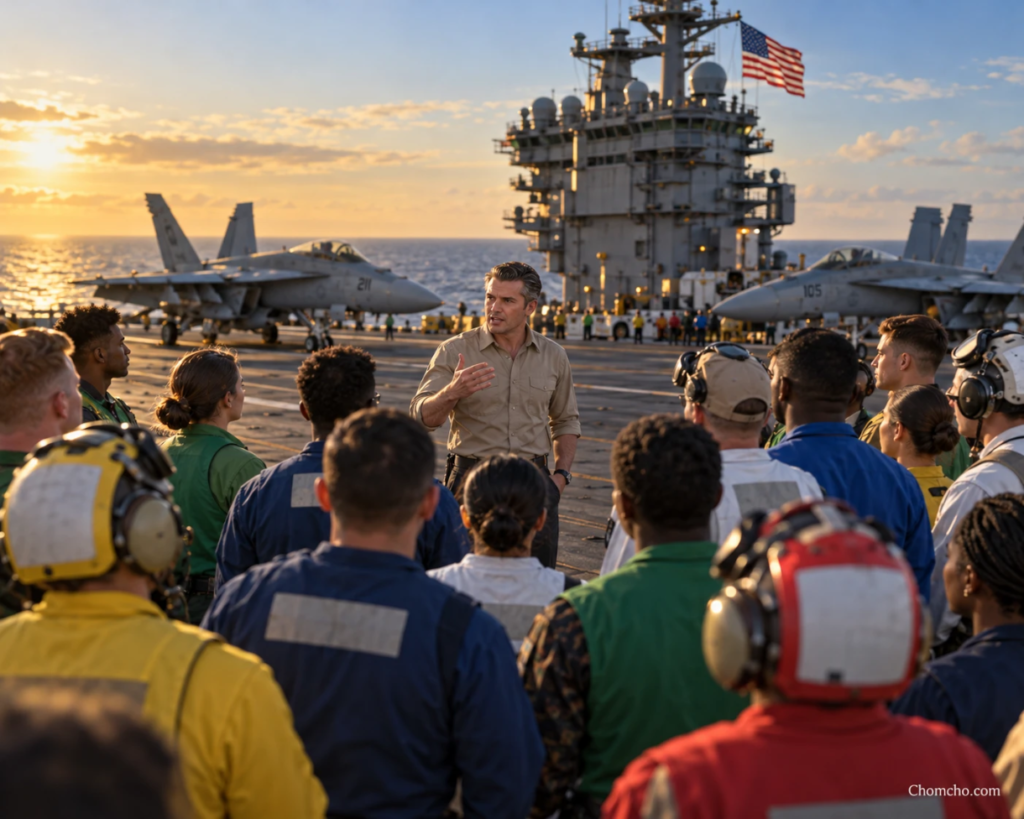
On September 30 at Quantico, Defense Secretary Pete Hegseth told junior officers and sergeants that the Pentagon had fired 10 percent of its generals and admirals and had cut the number of general and admiral positions by another 10 percent, a 20 percent reduction in total.
“The number crunchers say we fired 10 percent of the generals and admirals across the force, and that number sounds about right,” he said.
Hegseth mentioned this in public, to the troops, and the reason is no secret: a leaner command and a force built for lethality, not for diversity goals. Nobody vanished. Nobody’s family waited nine months for a charge.
That is the contrast, and it is an indirect verdict on the communist system.
One country trims its brass in daylight and argues about it on television. The other makes its generals disappear and then prints an editorial ordering the survivors to obey.
Xi warns against two-faced officials. The real two-faced men are the ones who swore loyalty to the nation and now, for all practical purposes, swear loyalty to one man.
The Trump foreign policy carries its own logic abroad: real strength, built in the open, and allies who pay for their own defense.
NATO allies committed at The Hague in June 2025 to spend 5 percent of GDP on defense. Tokyo, Taipei and Seoul are being pressed to carry more of their own load.
Also, the Space Force and artificial intelligence are the new high ground, and the United States intends to hold it.
Geopolitics rewards the side whose generals can let their yes be yes and their no be no. The truth still sets men free, armies included.
Deterrence is built in daylight. Keep it strong.