
This post is also available in:
 Português
 Español
 Français
 Deutsch
 Italiano
 Русский
 Nederlands
 日本語
 Polski
Summary
Putin promised no "neo-colonial exploitation" and declared the era of a few states deciding "the fate of entire continents" over.
What he wanted: Africa's 54 UN votes, military reach through the Africa Corps, minerals, and a trade system beyond sanctions. Grain is Russia's main tool of influence: 13 million tonnes of farm products in the first nine months of 2026.
The political return appeared in February 2026, when six African states voted against a UN peace resolution on Ukraine and 17 abstained.
What Africa wanted: weapons, cheap grain, power plants, a bigger UN voice, and the freedom to deal with everyone. Mali's leader, General Assimi Goïta, asked for "partnerships based on sovereignty, equality and non-interference."
Trade figures show that Russia is a much smaller partner.
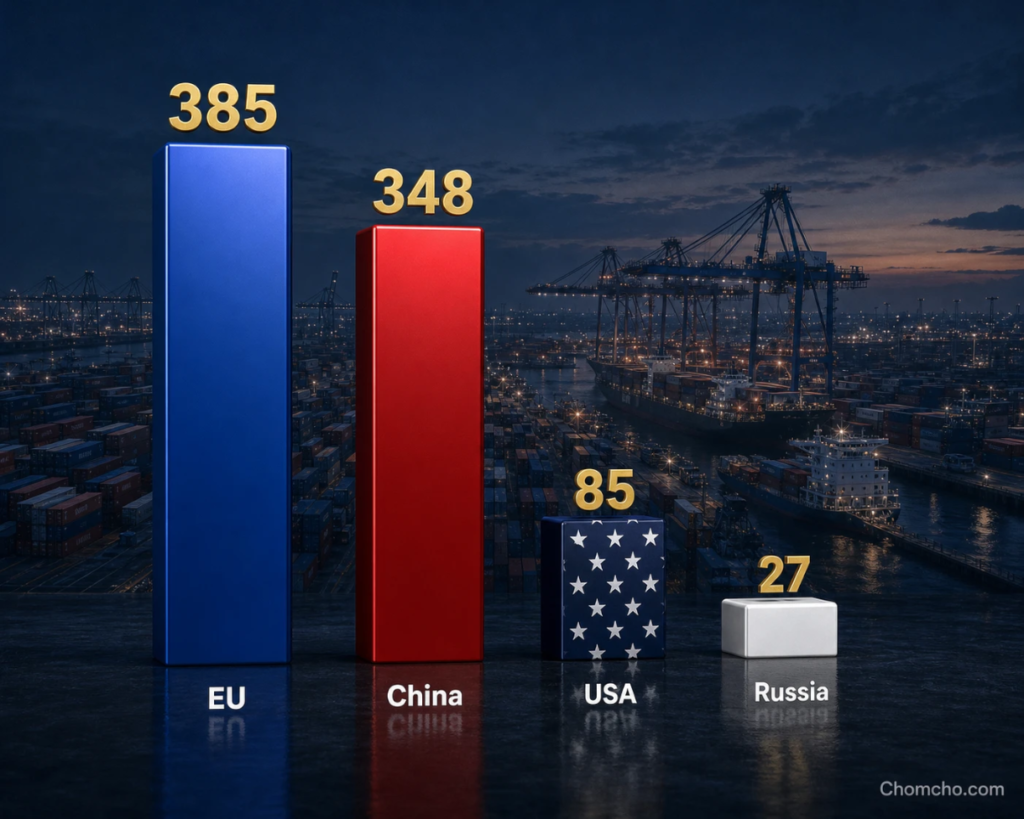
Trade with Africa in 2025: Europe 385,000 million dollars, China 348,000 million dollars, the United States about 85,000 million dollars, Russia 27,000 million dollars.
The United States total is less than half its trade with Vietnam alone. Russia's real weight is the Africa Corps, about 2,000 men in the Sahel.
No leader mentioned the African recruits: 3,066 Africans lured into Russia's army with job offers, 502 confirmed dead. Two days before the summit, a UN commission called it trafficking.
In the Sahel, the Africa Corps saved Niger's junta from a mutiny but cannot lift the jihadist fuel blockade on Bamako, the capital of Mali. Egypt, an ally of the United States, is building a 25,000 million dollar nuclear plant with Russia.
The answer of the United States government is "commercial diplomacy" and minerals deals. This is the right approach, but the Russian government brought together 22 presidents, and the United States has not.
Trade beats mercenaries. The United States must be present in Africa, or other countries will take its place.
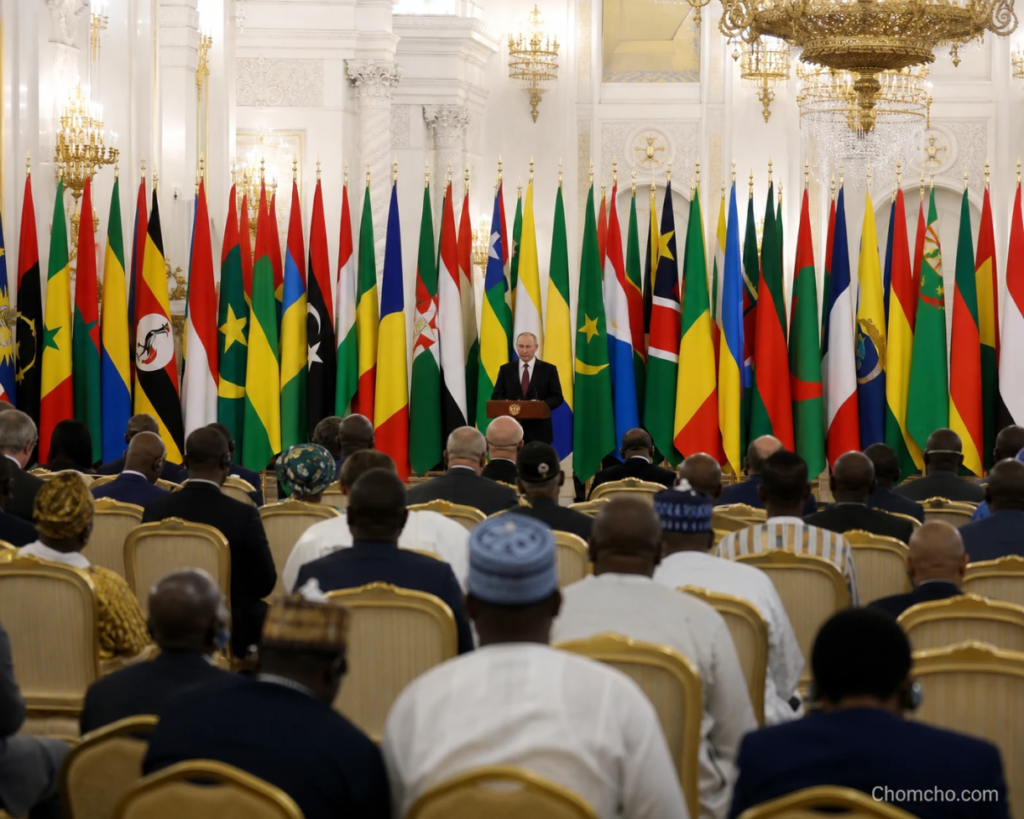
The largest African gathering ever hosted by the Russian government
The third Russia Africa Summit closed in Moscow on October 29 with 48 of Africa’s 54 countries taking part and 22 of them represented by their heads of state, up from 17 in 2023.
Vladimir Putin co-chaired it with Burundi’s President Évariste Ndayishimiye, the current chair of the African Union.
The final declaration calls for “a more multipolar world order,” more African seats at the United Nations Security Council, and an end to sanctions and “the unlawful seizure of sovereign assets.” It adds an action plan for 2027 to 2029 and a separate declaration on artificial intelligence.
The Kremlin said 33 agreements would be signed.
Putin defined the main message: “Our business does not engage in the predatory, neo-colonial exploitation of natural and human resources.” And: “The era when the fate of entire continents was determined by a narrow bloc of states is irrevocably gone.”
What Putin wanted
Four things. First, votes. Africa holds 54 seats at the UN General Assembly, where resolutions on Ukraine pass or fail, and every abstention weakens the position of Western countries.
Second, military reach: arms sales, training, and the Africa Corps, which gives the Russian government bases and influence from the Sahel to the Red Sea.
Third, gold, uranium, minerals and energy, often paid for in security rather than cash.
Fourth, a trade system beyond the reach of sanctions. Putin said 85 percent of payments between Russia and Africa are now settled in rubles and local currencies instead of dollars, so the United States government cannot freeze them.
Russia’s main argument is the Soviet past. The Soviet Union armed African independence movements, and Putin reminds every visitor of it.
Yuri Ushakov, foreign policy adviser to Putin, said it directly: “We are natural allies in building a multipolar world order.”
Grain is Russia’s main tool of influence. Russia was a grain importer in the early 2000s and is now the world’s largest wheat exporter.
Putin said Russia supplies grain and fertilizer to more than 40 African countries, 13 million tonnes of farm products in the first nine months of this year, and “stands ready to expand supplies.”
The political return on that wheat appears at the United Nations in New York.
On February 24, 2026, the General Assembly backed a resolution for a lasting peace in Ukraine by 107 votes to 12, with 51 abstentions.
Six African states voted no, among them Burundi, whose president co-chaired this summit, and the Sahel juntas of Mali, Burkina Faso and Niger. Seventeen abstained, including South Africa, Ethiopia and Algeria.
Wheat rarely buys a vote in favor of Russia. It buys abstentions that protect the Russian government from criticism.
What Africa wanted
Weapons and training against jihadists. Cheap grain and fertilizer. Roads, power plants and nuclear reactors.
Also, a bigger voice at the UN. And above all, the freedom to deal with Russia, China, Europe and America at the same time without being told to choose.
Mali’s leader, General Assimi Goïta, said it from the podium: Mali wants “partnerships based on sovereignty, equality and non-interference,” and African countries should be free to choose their partners.
That is the real story of this summit. Africa is not joining a Russian bloc. Africa is comparing offers, and Russia was one of several partners.
Money versus muscle
Trade figures show that Russia is a much smaller partner.
In 2025, the European Union traded about 385,000 million dollars with Africa and China traded a record 348,000 million dollars. The United States was on pace for about 85,000 million. Russia traded about 27,000 million dollars, and 39 percent of that was with a single country, Egypt.
The United States trade figure deserves a closer look, because the United States has the largest economy on earth.
The gap is not about size. Europe is close to Africa and was the main colonial power, so its trade is old and deep.
China buys African raw materials and sells cheap manufactured goods, which Africa needs.
America stopped buying African oil after the shale boom, and most of what Africa makes does not compete with goods the United States produces.
Still, 85,000 million dollars a year with 54 countries is less than half of what the United States trades with Vietnam alone. Africa is a missed market of 1,600 million people with the youngest population on earth.
Russia’s real weight is not trade. It is the Africa Corps, the Defense Ministry unit that replaced the Wagner mercenaries: an estimated 1,700 to 2,000 men across Mali, Burkina Faso and Niger, and about 1,000 contractors in the Central African Republic.
Vladimir Putin needs Africa more than Africa needs him. What he offers is not trade but protection: Russian weapons for the leaders in power, and in return, votes, minerals, and even recruits for his own war.
The African recruits that no leader mentioned
One subject never reached the podium. Journalists for Justice, a human rights organization, counts 3,066 Africans from 40 countries recruited into Russia’s army and 502 confirmed dead by June 2026, 76 of them Kenyans.
Ghana says 55 of 272 recruited Ghanaians have died. Cameroon counts 94 dead among 335 identified recruits, Egypt 52 among 361.
They were lured with job offers, good wages and talk of citizenship, then handed Defense Ministry contracts in Russian they could not read and sent to the front.
On October 26, two days before the summit opened, a United Nations commission found that Russian authorities had trafficked men from 29 countries through deception and coercion.
Amnesty International wrote an open letter to the attending leaders voicing “deep concern regarding Russia’s forced and deceptive recruitment” of Africans and asking them to demand that Russia “cease any ongoing and future recruitment of people from Africa.”
Kenya has charged a recruiter with trafficking. Nigeria and South Africa have protested.
But in Moscow, no leader raised it, and Putin did not mention it. Russia denies recruiting Africans illegally.
The Sahel test
Between 2022 and 2024, Mali, Burkina Faso and Niger expelled French and then American forces and hired Russian forces. The Africa Corps has proved that it can protect a government: in August 2026, when mutineers seized the air base in Niamey, the capital of Niger, the Africa Corps helped Niger’s military government crush them within a day.
Protecting a country is another matter. Since late 2025, the al-Qaeda affiliate JNIM (Jama’at Nusrat al-Islam wal-Muslimin) has imposed a fuel blockade on Bamako, the capital of Mali, attacking convoys from Senegal, Guinea, Ivory Coast and Mauritania. At its worst it cut deliveries by about 80 percent, closed schools and left the capital in queues.
The Africa Corps now escorts fuel convoys with attack helicopters, yet in May 2026 jihadists burned dozens of vehicles 45 kilometers from the capital, and more than 100 fuel trucks have been torched since 2025.
General Assimi Goïta of Mali came to Moscow anyway. On October 7, Mali bought 350 trucks from the Russian manufacturer KAMAZ for more than 50 million dollars, and in his speech he named defense, food, energy, mining and a solar plant planned with Russia as proof of progress.
The Sahel is the clearest test of whether Russia’s security model delivers for a nation, or only for the men in charge.
Egypt, the quiet anchor
President Abdel Fattah el-Sisi met Putin on October 28, the summit’s opening day. Egypt is Russia’s biggest African customer, and Rosatom is building the 25,000 million dollar El Dabaa nuclear plant, four reactors financed mostly by a Russian state loan.
Egypt also receives about 1,300 million dollars a year in American military aid. Even the closest Arab partner of the United States in Africa hedges with Moscow, and sees no contradiction in it.
What Washington should do
The Trump administration calls its approach “commercial diplomacy.”
Secretary of State Marco Rubio hosted a Critical Minerals Ministerial in Washington on February 4 with about 50 countries, Angola, Congo, Gabon, Guinea and Nigeria among them.
Vice President JD Vance proposed a trading bloc against China’s rare earth controls, backed by “Project Vault,” a 12,000 million dollar minerals stockpile. The Congo-Rwanda peace deal gives American companies preferential access to Congolese minerals.
That is the right instinct. Gabon supplies 63 percent of America’s manganese imports; South Africa holds about 80 percent of the world’s known manganese reserves; Chinese firms own more than 80 percent of Congo’s copper mines.
Minerals, liquefied gas, nuclear reactors and farm exports are markets America can win. But Moscow just put 22 heads of state in one room, and Washington has not.
Mali’s U.S. travel advisory still tells Americans to avoid the country “for any reason,” while Mali’s president was being welcomed at the Kremlin.
That is the gap. America does not need to compete with Russia in mercenaries. It needs to show up with trade, minerals deals and a summit of its own, because every African government that the United States ignores accepts offers from Putin.
That is the foreign policy lesson of this Russia Africa Summit.
Trade beats mercenaries. The United States must be present in Africa, or other countries will take its place.