
This post is also available in:
 Português
  Español
  Français
  Deutsch
  Italiano
  Русский
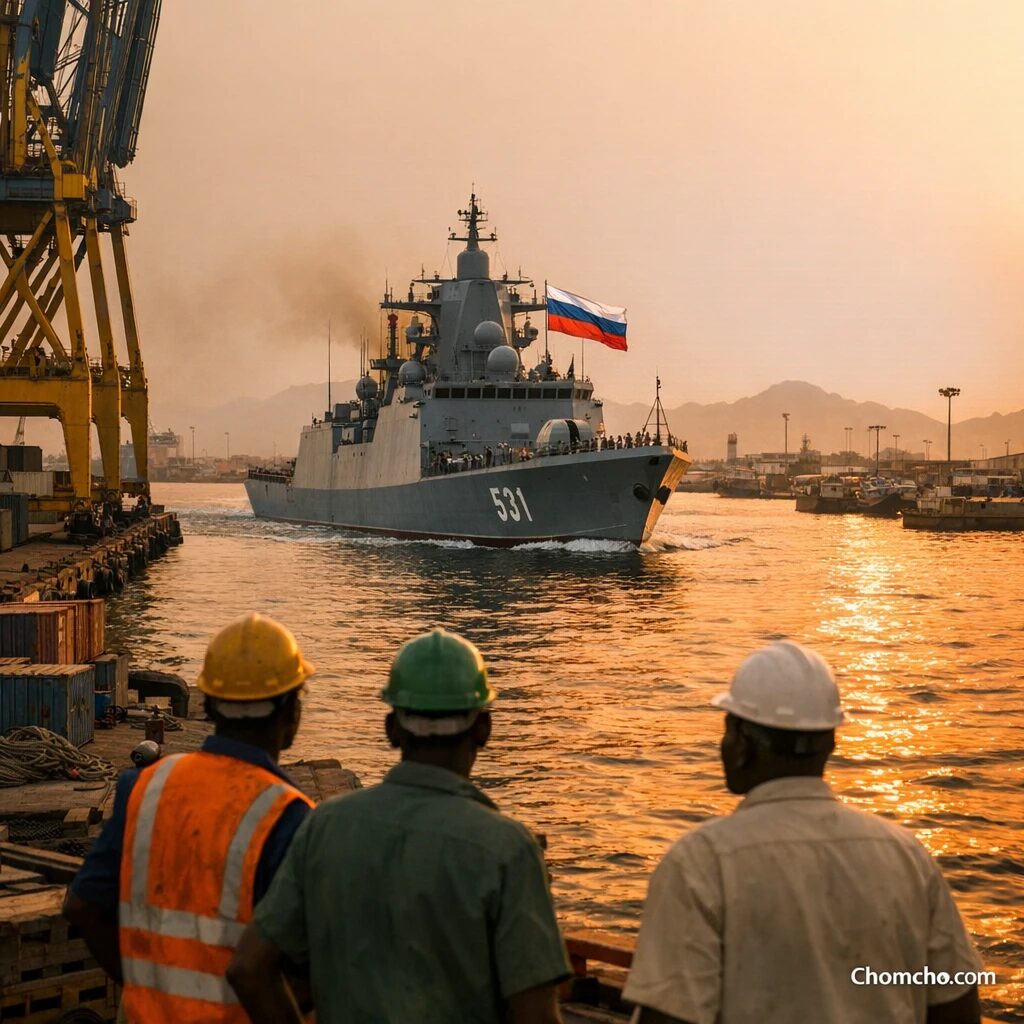
Big promises from Moscow before the October Russia-Africa Summit
The Russia Sudan alliance is quietly growing between the Kremlin and one of the poorest nations on earth.
The Kremlin offers weapons and promises. In exchange, it wants gold, a naval base, and power over one of the most important sea routes on the planet.
Sudan’s Ambassador to Russia Mohammed Eltigani Sirrag gave a friendly interview to the pro-Kremlin outlet New Eastern Outlook in July 2026.
He praised Russia’s contribution to Sudan’s sovereignty. He celebrated the training and education that Moscow provided during the Soviet era.
He also announced hopes for new agreements on energy, trade, investment, food security, and military cooperation.
Sudan’s leader General Abdel Fattah al-Burhan confirmed he will attend the third Russia-Africa Summit in Moscow this October. New agreements are expected to be signed there.
Everything sounds beautiful in the speeches. The reality behind those words is much darker.
This is one of the least known stories on this side of the Atlantic, so let us present the characters first.
Who is who in Sudan
Sudan is a nation of about 50 million people in northeast Africa, with a long coast on the Red Sea.
Its official capital is Khartoum. However, the government actually operates from Port Sudan, because the war destroyed much of Khartoum.
Port Sudan is exactly where Russia wants its naval base. Remember that detail.
Sudan is one of the poorest countries on earth. In February 2024, the World Food Programme reported that more than 95 percent of Sudan’s population could not afford one meal per day.
Yet Sudan is rich in gold, oil, copper, and farmland.
Poor people, rich land. That combination attracts predators.
The dictator who started it all
Every story needs a villain, and this one has several. The original villain is Omar al-Bashir. He ruled Sudan as a dictator for 30 years, from 1989 to 2019.
The International Criminal Court wants al-Bashir for war crimes and genocide in Darfur, where his Arab militias, known as the Janjaweed, massacred entire communities.
In 2017, isolated by the West, al-Bashir traveled to Russia and offered Vladimir Putin a gift: a naval base on the Red Sea in exchange for protection.
That offer started everything we are watching today.
Al-Bashir fell in 2019 after a popular uprising. The generals who removed him inherited his agreement with Moscow, and they also inherited his militias.
The leader of those generals is Abdel Fattah al-Burhan.
He rules Sudan today as president of the Transitional Sovereignty Council, which is the military government of the country. Remember his name, because he is the central juggler of this story.
And no, Sudan’s Burhan has no relation to Burnham, the new British Prime Minister. The similar names are pure coincidence.
A civil war financed by foreigners
In April 2023, the militias that al-Bashir created turned against the army.
The Rapid Support Forces, known as the RSF, are the direct descendants of the Janjaweed. Their leader is General Mohamed Hamdan Dagalo, better known as Hemedti.
The RSF has no connection to ISIS or the Taliban. It is an Arab supremacist militia accused of genocide against non-Arab communities.
This is not a religious conflict, since both sides are Muslim. It is an ethnic conflict between Arab tribes and non-Arab African tribes.
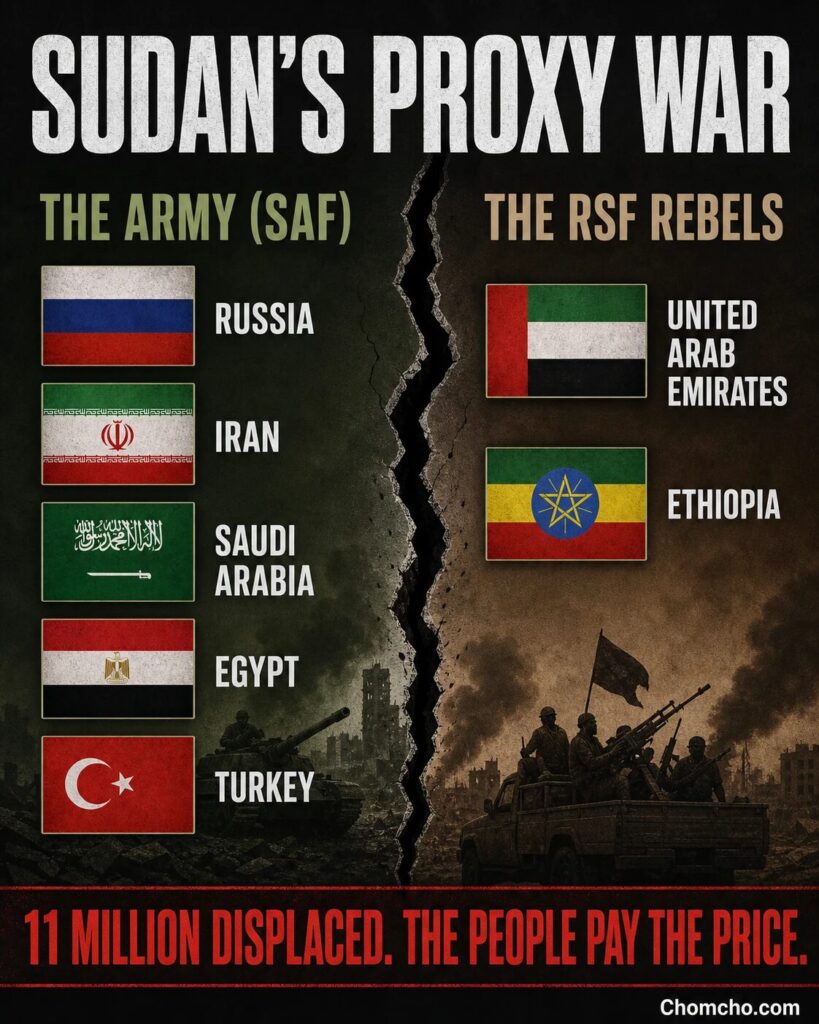
The main sponsor of the RSF is the United Arab Emirates.
Human rights groups have documented Emirati weapons, drones, and even Colombian mercenaries supporting RSF atrocities. Sudan cut diplomatic relations with the UAE in May 2025 and declared it an aggressor state.
The government side has serious problems of its own.
In March 2026, the U.S. State Department designated the Sudanese Muslim Brotherhood and the pro-army al-Bara Bin Malik Brigade as global terrorists, citing support from Iran’s Revolutionary Guard.
The Brotherhood is an Islamist movement from the al-Bashir era, and the brigade is its armed militia. Both are now fighting for the government.
Iran’s Revolutionary Guard supports the brigade. You read that correctly. Iran now supplies attack drones to Sudan’s army. Saudi Arabia, Egypt, and Turkey also support the army.
The result of this proxy war is the largest displacement crisis in the world.
More than 11 million Sudanese have been forced from their homes, and hundreds of thousands have been killed.
War toys everywhere, food nowhere.
The naval base Russia dreams about
Now back to the base, in chronological order.
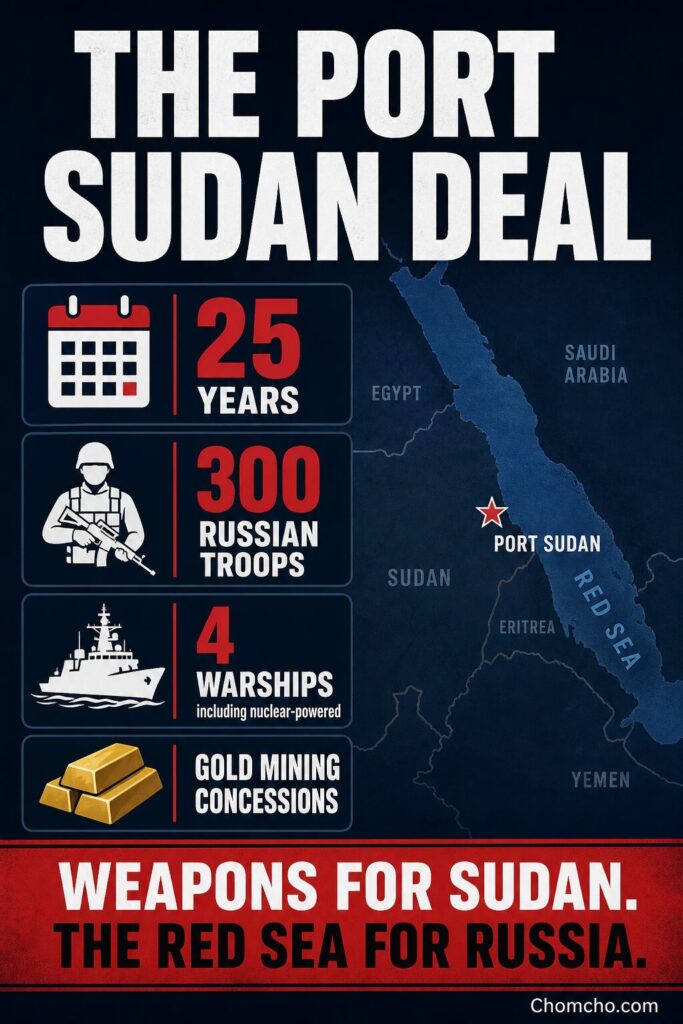
Al-Bashir made the original offer in 2017. The agreement allowed Russia to keep up to 300 troops and four warships, including nuclear-powered vessels, at Port Sudan for 25 years.
After al-Bashir fell, Sudan’s military reviewed the agreement and suspended it in 2021, under pressure from Washington.
Then the civil war changed everything.
Desperate for weapons, Sudan’s generals reopened the conversation.
In late 2025, Sudanese officials confirmed to the Wall Street Journal that the 25-year proposal was active again. This time it included mining concessions for Russia and preferential prices on air defense systems for Sudan.
Then came the double game. In December 2025, Burhan privately assured Saudi Arabia that the plans for the base were frozen.
Two months later, in February 2026, Sudan’s Foreign Minister Ali Youssef Sharif declared in Moscow that there were no obstacles and that both sides were in complete agreement.
One message for the Saudis, another message for the Russians.
Burhan tells each friend exactly what that friend wants to hear.
The Kremlin’s double game in the Red Sea
Why does Russia want Port Sudan so badly?
After losing access to its naval facilities in Syria, Moscow needs a new home for its fleet in the region.
Port Sudan sits near the entrance to the Suez Canal, one of the most important routes of world trade.
A Russian base there would give the Kremlin influence over global shipping and an entrance into Africa and the Indian Ocean.
Now comes the cynical part.
While Russia asks Sudan for a Red Sea base, it has been helping the Houthis, the terrorists attacking Red Sea shipping.
Verified reports show that Russia provided satellite targeting data for Houthi attacks, sent military intelligence advisors to Yemen, and used the arms dealer Viktor Bout for weapons negotiations.
If the name Viktor Bout sounds familiar, it should. He is the Merchant of Death, the man who inspired the Hollywood movie Lord of War.
The United States sentenced him to 25 years in prison and then exchanged him with Russia in 2022 for a basketball player.
He clearly has a better publicity manager than any general in this story.
Now think about what this means for Sudan. The country sent up to 10,000 soldiers to Yemen to fight the Houthis as part of the Saudi coalition, and Sudanese soldiers died in that fight.
Today Sudan’s government accepts drones from Iran, the sponsor of the Houthis, and negotiates a base with Russia, the helper of the Houthis. Burhan is shaking hands with the friends of the enemies who killed his own men. The irony is painful.
Moscow has no loyalties in Sudan either.
Early in the civil war, Russia supported the RSF rebels through the Wagner Group mercenaries, who exchanged weapons for Sudanese gold.
When the RSF made contact with Ukraine, Moscow changed sides and embraced the army.
No loyalties or principles, only interests.
China waits in the shadows
Beijing already has its only foreign military base in Djibouti, a small country near Sudan at the southern entrance of the Red Sea.
With regard to Sudan, China does not need a second base. It prefers to buy the whole country.
Sudan owes China around 5,000 million dollars. In June 2026, Beijing generously canceled 50 million of that debt, about one percent of the total.
In July 2026, Sudan’s state ports company signed an agreement with China Harbour Engineering to repair ports and possibly build new ones.
Chinese companies are also buying positions in Sudan’s copper, gold, and oil sectors.
Oil, weapons, ports, gold, debt. China is positioning itself to own whatever remains of Sudan when the war ends.
Our evaluation
So far, this has been factual reporting. What follows is our opinion.
First, a necessary clarification. Our criticism is aimed at the policies of the Kremlin, never at the Russian people.
Russians are a conservative, faithful, and well-mannered people, and we appreciate them. Governments are not their citizens.
Second, the saddest part of this story.
Sudan’s ambassador praises Russia’s contribution to sovereignty while his country cannot feed its own children.
Beautiful words while Russia gets the gold and the people starve.
Energy agreements, trade agreements, military agreements: none of them have put one meal on the table of a hungry Sudanese family.
Third, why should Americans care? Because the Red Sea connects directly to the Suez Canal, and whoever controls that corridor influences the price of everything you buy.
A Russian naval base at Port Sudan would place Kremlin warships, possibly nuclear-powered, next to one of the most sensitive corridors on earth.
And Russia would do this while helping the terrorists closing that same corridor.
The good news is that American pressure works.
Warnings from Washington are the main reason the base remains frozen after nine years of negotiations.
The Trump administration should keep applying that pressure, and it should compete seriously for Africa’s minerals before China buys the entire continent.
We pray for the suffering people of Sudan, the forgotten victims of this giant geopolitical game. May God bring them peace, bread, and freedom.
The world is finally paying attention to the Russia Sudan alliance, and international attention is exactly what the Kremlin’s plans cannot survive.