
This post is also available in:
 Português
  Español
  Français
  Deutsch
  Italiano
  Русский
The 2026 World Cup Is a geopolitics tournament, not just a soccer one
The biggest sporting event in history kicked off on June 11, 2026.
Mexico beat South Africa 2-0 in Mexico City, with Shakira, Andrea Bocelli, and J Balvin performing at the opening ceremony.
The 2026 World Cup, co-hosted by the United States, Canada, and Mexico, features 48 teams, the most ever.
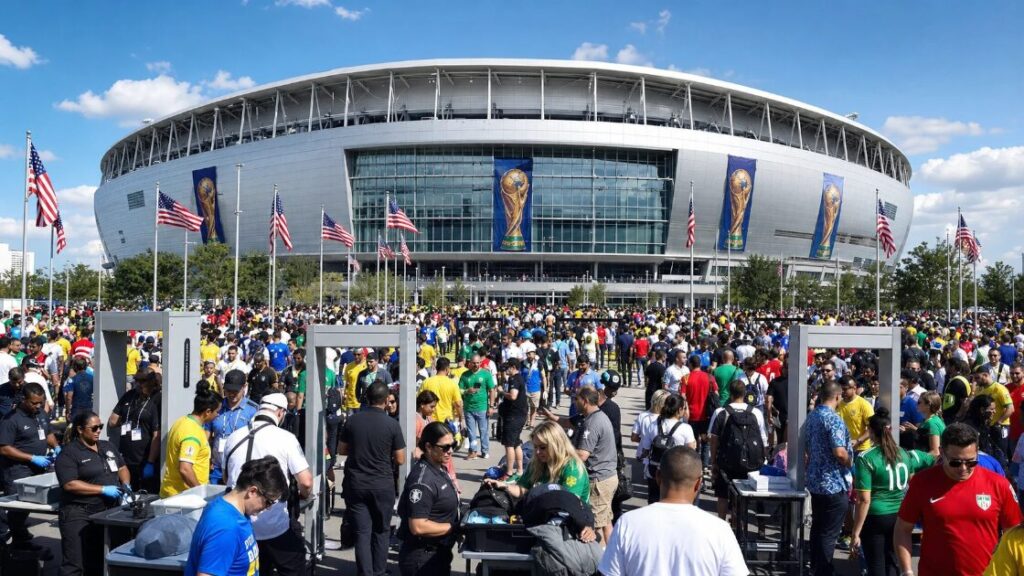
But the headlines dominating the lead-up to kickoff were not about goals. They were about visas.
Somali referee Omar Artan, one of FIFA’s 52 selected officials and set to make history as the first Somali referee at a World Cup, was denied entry at Miami airport and sent home.
FIFA President Gianni Infantino told reporters to “chill and relax” about the Artan case and about Iran’s participation.
Iran’s national team received player visas just 10 days before their opener, though several support staff including managerial personnel were denied.
An Iraqi player was reportedly questioned for seven hours at a U.S. airport. An Iraqi team photographer was denied entry after his phone was searched.
A coalition of more than 120 civil rights organizations, including the ACLU, issued a travel advisory warning visitors about possible detention, searches, and what they called “cruel or degrading treatment.”
World Cup geopolitics, it turns out, started before the first whistle blew.
Soccer, soft power, and what most countries really want
Hosting a World Cup has always been about more than sport.
Political scientists call this soft power, the ability to shape global perception through attraction rather than coercion.
Germany 2006 projected a modern, reunified nation.
South Africa 2010 showcased post-apartheid progress.
Qatar 2022 used the tournament as the centerpiece of a decades-long strategy to transform a small Gulf state into a global player.
Critics call the darker version of this “sportswashing,” using a major event to distract from human rights criticism.
Qatar 2022 became the most prominent modern example. And football diplomacy has a real track record.
Ping-Pong Diplomacy helped thaw U.S.-China relations in the 1970s. Major tournaments have eased tensions and opened diplomatic doors before.
The 2026 World Cup flips that script. For most host nations, the World Cup is a prestige project.
For the Trump administration, it appears to be treated primarily as a security and sovereignty issue, not a branding opportunity.
That is a notable difference worth highlighting.
Trump cares more about defending Americans from terrorism and the spread of disease from unstable regions than about national image-building.
Soft power is nice. Protecting your own citizens comes first.
The America First case for the visa policies
Roughly 20% of the world’s nations, 39 out of 195, currently face U.S. travel restrictions, expanded in two waves since June 2025.
The reasons cited are not arbitrary: high visa overstay rates, countries that refuse to take back their own deported nationals, and documented security vetting failures.
JD Vance and Transportation Secretary Sean Duffy both publicly told visitors: come, celebrate, watch the games, but go home when your visa expires, or you will be dealing with DHS Secretary Kristi Noem.
The Lawfare Project’s senior counsel Gerard Filitti made the security case directly. “The World Cup is a national-security event, and the system is being tested in real time.”
He pointed to the Iraqi photographer, the Iraqi player questioned for hours, the Somali referee, and the Iranian staff denials, all under terrorism-related screening provisions that already exist in U.S. immigration law.
In Toronto, a Canadian host city, an Islamic terrorist attack was reportedly thwarted after Canada’s looser visa policies let in individuals who had glorified Hamas and Hezbollah on sports media platforms.
More than 700 Iranian agents have allegedly been identified in Canada as security threats, and U.S. Border Patrol has arrested more than 300 Iranians attempting illegal entry in the past year.
DHS is investing 115 million dollars in counter-drone technology alone, part of more than 1,000 million dollars in combined U.S.-FIFA security spending.
The administration also suspended a visa bond program, up to 15,000 dollars per traveler, for World Cup attendees from high-risk countries, while keeping visa processing prioritized for athletes and teams.
That is balance, not a blanket ban.
Large, dense crowds across dozens of cities for 39 days also raise public health concerns.
With the ongoing Ebola outbreak in the Democratic Republic of Congo, screening at this scale is basic public health management, not paranoia.
A World Cup that mirrors a multipolar, distrustful world
Iran’s Foreign Ministry called the visa issue “non-sporting” and “political.”
After the February 2026 conflict that killed Iran’s Supreme Leader, Iran’s sports minister initially said the team could not participate.
Tehran reversed course, and the team is playing.
Human Rights Watch and other groups warn the tournament could be used for immigration enforcement operations.
FIFA wants a celebration of global unity. The reality is a tournament unfolding against the backdrop of an active U.S.-Iran war, travel restrictions affecting one in five nations on earth, and a documented terrorism threat environment.
A “World Cup Geopolitics” headline is not hyperbole.
Hosting the World Cup is an honor and an economic opportunity, but it does not override a government’s first duty: protecting its own citizens.
A country at war with Iran does not owe blanket entry to Iranian officials or security personnel who fail legitimate vetting, World Cup or not.
Trump’s “let them play” stance toward Iran’s team shows the policy is not blanket hostility. It is selective, security-based screening.
Exactly as it should be.