
This post is also available in:
 Português
  Español
  Français
  Deutsch
  Italiano
  Русский

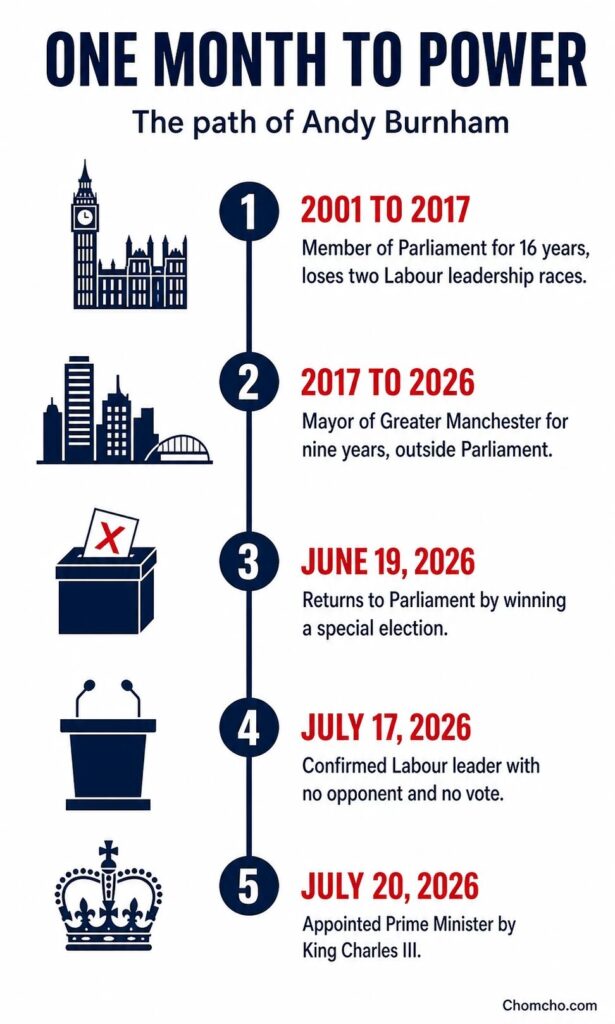
One month back in Parliament was all it took for Britain to get Prime Minister Burnham.
On July 20, 2026, Andy Burnham met King Charles III at Buckingham Palace and became the new Prime Minister of the United Kingdom. He is Britain’s seventh Prime Minister in roughly a decade.
Read his chronology carefully, because the timeline is the story.
Burnham served 16 years in the House of Commons, from 2001 to 2017, and ran twice for the Labour Party leadership, losing both times.
He then left Parliament completely and spent nine years as mayor of Greater Manchester, winning that regional office three times.
On June 19 of this year, he returned to Parliament by winning a special election in Makerfield with 54.8 percent of the vote, defeating the Reform UK candidate.
It was friendly territory: Makerfield sits inside Greater Manchester, the region he had just governed for nine years, next to the district he represented for 16.
One month later, he was Prime Minister.
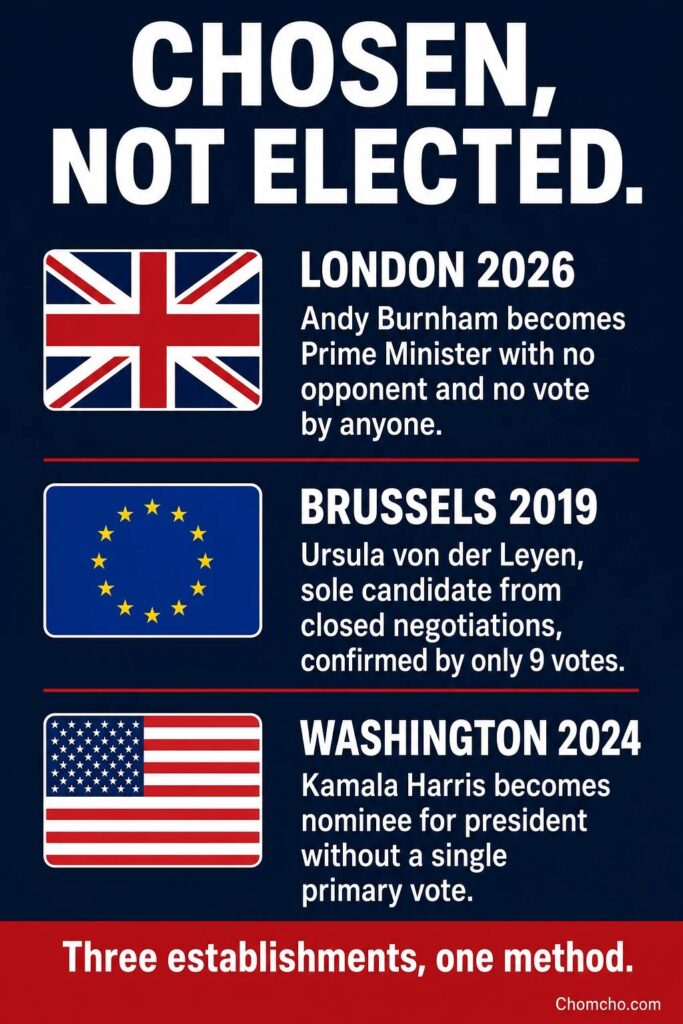
No general election. No leadership contest. No opponent.
For readers less familiar with British politics
A quick explanation, because the system matters here.
Britons never vote directly for a Prime Minister. They vote for Members of Parliament, who sit in the House of Commons, the elected chamber that holds the real power.
The House of Lords, whose members are appointed rather than elected, can only delay or revise laws.
The party that wins a majority of the Commons governs the country, and its leader automatically becomes Prime Minister.
Labour won a large majority in July 2024 under Keir Starmer, valid until 2029. So when a governing party changes its leader, the country changes its Prime Minister, with no new election required.
When a leadership change happens, the system still expects a contest: candidates gather nominations from fellow Labour members of Parliament, and then hundreds of thousands of ordinary party members vote to choose the winner.
This time, none of that happened. And almost nobody asked why.
It is not unprecedented (Gordon Brown rose unopposed in 2007 and Rishi Sunak in 2022), but it is not how the process was designed to work.
The contest that never was
To understand how strange this is, go back to June.
Starmer’s government was collapsing. Ministers were resigning. His attempted relaunch in May was described even by his own party as painful to watch.
Deputy Prime Minister David Lammy admitted during the crisis that “no-one seems to have the names to stand up.”
Think about that sentence. In a governing party with more than 400 members of Parliament, nobody had the courage to challenge the establishment’s arrangements, first to confront Starmer, and then, when Starmer resigned, to compete against Burnham.
Not one Labour politician entered the leadership race. With no rival, there was no vote at all. Not by the public. Not by Labour’s own party members. Not even by its members of Parliament.
Burnham was simply confirmed as leader at a party conference on July 17, and the King appointed him Prime Minister three days later.
Alan Mendoza, director of the conservative Henry Jackson Society in London, put it plainly: Burnham is “the least scrutinized incoming U.K. Prime Minister of recent times.”
He entered office without ever explaining his program to the country, because nobody forced him to. Nobody needed to vote for him. The top of the establishment simply selected him.
Reform UK party leader Nigel Farage said the public is “tired of the game of musical chairs” at 10 Downing Street.
The comparison is exact. In that children’s game, when the music stops, the quickest player grabs the last chair, and everyone else can only watch.
British voters have been watching from outside the circle for a decade.
Farage demands a general election for the whole country, and he is backing his words with a personal gamble: he resigned his own parliamentary seat, forcing a special election in his district on August 13, which he plans to win and return with a fresh mandate directly from the voters.
The contrast with Burnham writes itself.
And let us say what everyone in the UK already knows: Reform UK, in practical terms, is Nigel Farage.
If Reform UK wins power one day, it will be the closest thing Britain has ever had to the public directly choosing its own leader.
A fairly recent Western pattern, not a British accident
Now widen the lens, because Britain is not alone.
In the European Union, Ursula von der Leyen was not a candidate in any European election in 2019.
Her name emerged from closed-door negotiations among member state leaders, and the European Parliament confirmed her as the only candidate on the ballot, by a margin of just nine votes.
In 2024, she was once again the sole name put forward.
Elon Musk asked her the question directly on X, under her own post about defending democracy: if democracy is the foundation of freedom, why is her position not “elected directly by the people”?
His reply was seen more than 15 million times. She never answered.
In the United States, the two big parties normally choose their candidates through primaries, where millions of ordinary voters decide.
Yet in 2024, Kamala Harris became the Democratic nominee for president without receiving a single primary vote.
The party leadership decided, and the voters were informed afterward.
Brussels. Washington. Now London. Three establishments, one method: the leader is selected at the top, and the public’s role is reduced to applause.
Abraham Lincoln described democracy as government of the people, by the people, for the people. What we are probably watching is government of the establishment, by the establishment, for the establishment.
The British Labour Party’s own tradition once produced the best test for this.
Tony Benn, one of Labour’s most famous figures of the last century, taught that the final question to ask any powerful person is: “How can we get rid of you?”
Democracy is the only system that answers that question peacefully, through elections.
A system where leaders are installed without opponents cannot answer it at all. Benn was Labour. His own party should listen.
What stays the same under Burnham
On the issues that matter most to the establishment, expect continuity.
On immigration, Burnham’s parliamentary record places him in Labour’s more liberal tradition.
His recent language is tougher, with talk of border enforcement and removals, and he voted this month for Labour’s Immigration and Asylum Bill.
But professional legal analysis published this week concludes a Burnham government is unlikely to produce any fundamental break from current immigration policy.
In short: the same rhetoric of control, and the unchanged reality of open doors.
On foreign policy, he has pledged continuity on NATO, on Britain’s nuclear weapons, on support for Ukraine, and on the relationship with the United States.
One difference in tone deserves mention: he has declared that rebuilding Britain’s military strength will be his first priority, an area where Starmer was widely accused of neglect.
We will see if his rhetoric matches reality.
Where Burnham moves to the left
Domestically, Burnham stands clearly to the left of Starmer.
He rejects the free market legacy of Margaret Thatcher and speaks of taking his Manchester model nationwide.
His ideas include wealth taxes, and analysts calculate that one of his property tax plans could cost London homeowners about 7,500 million pounds.
For our readers who stand with Israel, a warning is required.
Mendoza predicts Burnham will pressure traditional allies of Britain, including Israel.
Burnham has already suggested sanctions and trade restrictions on goods linked to Israeli settlements, although he did condemn the Hamas terrorist attack of October 7.
This topic deserves close attention in the months ahead.
Credit where it is due
Honesty requires recognizing his first major act, because it was a good one.
Burnham killed the digital ID program known as BritCard, the mandatory digital identity scheme designed under Starmer.
A parliamentary petition against that scheme had gathered almost three million signatures, one of the largest in British history.
Defenders of liberty fought it for months, and it died at the hands of a Labour leftist.
Good policy is good policy, whoever signs it.
Our evaluation: Starmer 2.0, or something stranger?
These are the facts. What follows is our evaluation of what they mean.
Is Burnham simply Starmer 2.0?
On immigration and foreign alignment, yes. On economics, he is Starmer with the brakes removed, further left, more taxes, more state. On the digital ID, he is genuinely better.
But the deepest story is not his policies. It is his selection.
A man who spent nine years outside Parliament returned for a single month and received the highest office in Britain without one vote being cast anywhere, by anyone.
We believe the facts speak for themselves: this is how the Globalist political class replaces its managers, and the public is expected to accept the result.
America and the Burnham question
President Trump and the new Prime Minister did not begin as friends.
Burnham compared Trump’s return to office to the chaos of Liz Truss, called his decisions on Ukraine unacceptable, and back in 2021, after the January 6 riot, declared that British politicians who had supported Trump should be ashamed.
More recently, Trump, asked about Burnham, said he only knew he had been “the mayor of a town,” added that he heard Burnham was extremely liberal, and concluded that “the U.K. is dying.”
Then came a curious episode.
Trump celebrated on social media that Burnham would fully open North Sea oil drilling.
The problem: Burnham never confirmed any such policy, and his team says Labour will approve no new drilling licenses.
Either the President misread the reports, or he was offering a gesture of goodwill to an old critic. We honestly do not know which, and if it was a misreading, it deserves correction, not applause.
The famous special relationship between America and Britain survives, but for now only theoretically and institutionally: the alliance, the intelligence sharing, the nuclear cooperation.
We see no sign that Britain is helping America in the current conflict with Iran, and nothing suggests Prime Minister Burnham will change that.
America’s interest is simple: a Britain that pays its fair share in NATO, stands firmly with Israel, controls its borders, and acts like a real ally instead of a lecturing one.
Whether Prime Minister Burnham delivers any of that, nobody can say. He reached office without a campaign, without debates, and without a single vote, so the world received no answers, and no clues.
Freedom grows where citizens choose their leaders, and America still does!