
This post is also available in:
 Português
  Español
  Français
  Deutsch
  Italiano
  Русский
Summary
The Reaper is an eye that does not blink: cameras, infrared sensors and radar, hours of loiter time over the same jungle, and Hellfire missiles if needed. It is the Donroe Doctrine in hardware.
The move belongs to a larger pattern. American forces are being drawn out of Europe, where wealthy allies can defend themselves, and attention is concentrated on the Indo-Pacific, where China is the serious rival.
Latin America is the smaller version of the same reordering: the fentanyl and gang violence that kill Americans do not come from the Sahel.
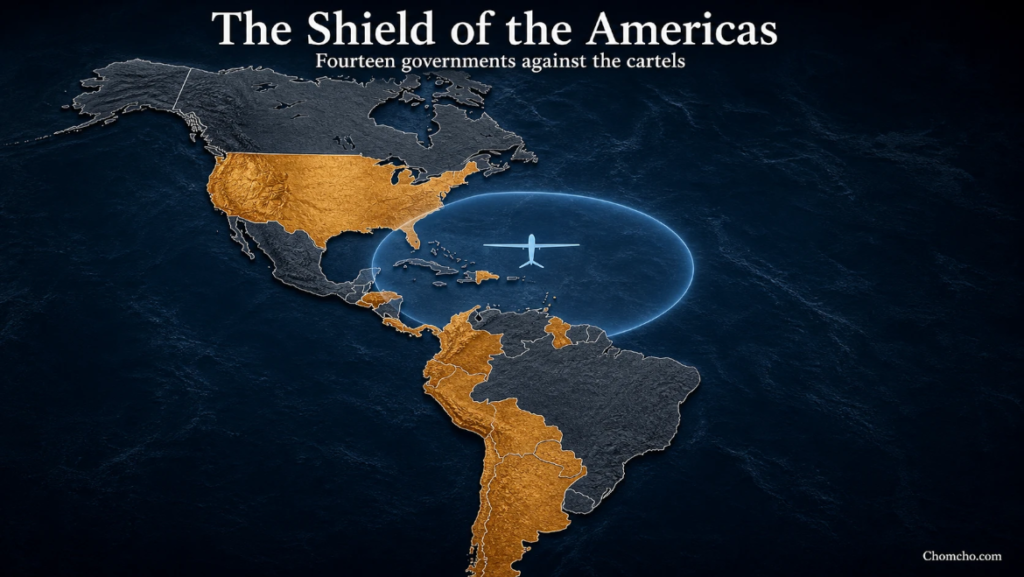
The drones would arrive into a structure that already exists. The Shield of the Americas, launched in March at a summit in Doral, Florida, now unites Washington with thirteen governments across the region, most of them conservative.
Peru joined this month during a tour by Secretary of State Marco Rubio, who called it a golden era in relations with Lima.
Ecuador shows how it works. In a joint operation on September 8, a vessel linked to Los Choneros was intercepted and its crew handed to Ecuadorian authorities, not killed from the sky. Rubio called Ecuador the best ally in the region and announced a ship and five interceptor boats.
In Colombia, President Abelardo de la Espriella has ended the peace tables and gone after the cartels directly, closing his messages with a phrase the legacy press there cannot stand: long live Colombia, long live Christ the King.
The cost is honest: pulling surveillance out of the Sahel leaves jihadists advancing there. But governing means choosing, and no American city is being poisoned from Mali. Watch the neighborhood. Defend the border. That is real America First foreign policy.
A fleet moves to the neighborhood
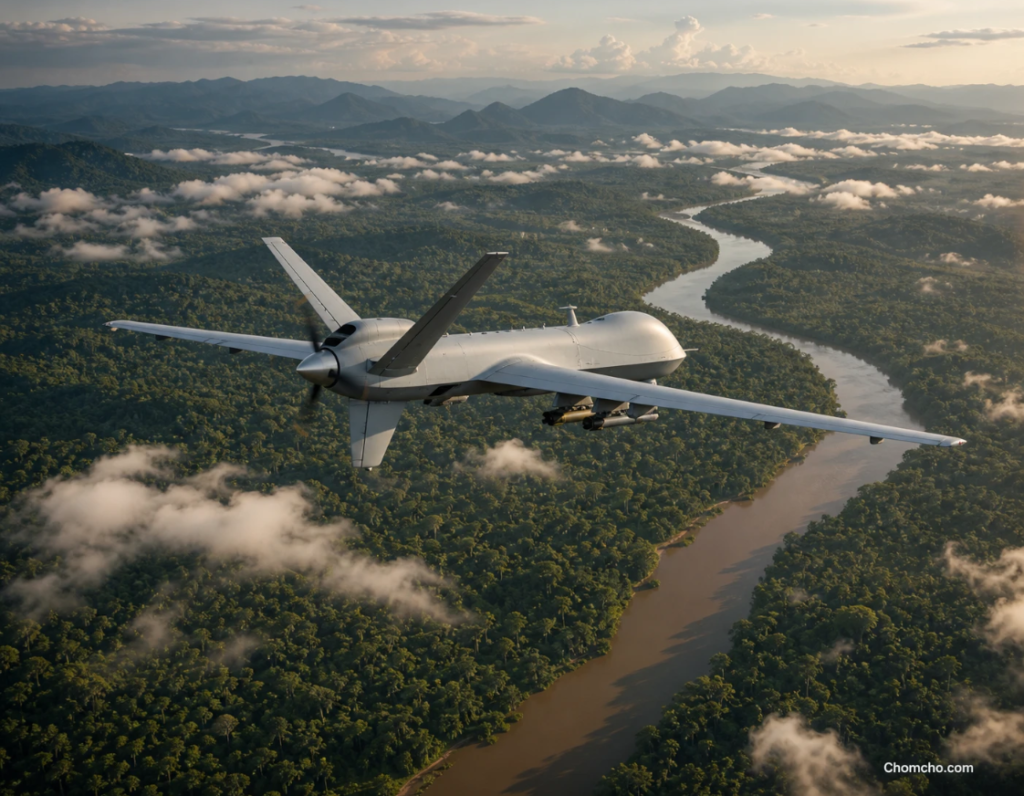
The United States is preparing to move most of the MQ-9 Reaper drones now deployed in Africa to South America, for counter-drug operations.
The report, published this week by Infobae and analyzed on air by the regional security specialist Andrei Serbin Pont, points to a focus on northern South America, Central America and the Caribbean. It is the Donroe Doctrine in hardware.
Serbin Pont put the shift in one sentence: everything used in Africa to kill terrorists is being sent to Latin America, where the word is narcoterrorists.
What a Reaper actually does
The MQ-9 is not primarily a weapon. It is an eye that does not blink.
It carries cameras, infrared sensors, laser designators and radar, it can loiter over the same patch of jungle or coastline for many hours, and it feeds what it sees to command centers in real time. It can also strike, with AGM-114 Hellfire missiles and guided bombs, but the intelligence is the point.
Cost matters too. As the analyst noted, flying a Reaper is cheap “compared with flying an F-16 or an early warning aircraft.”
And a small fleet goes a long way. Washington has agreed to loan MQ-9As to Colombia, and Serbin Pont observed that four such aircraft in rotation would keep significant areas of a country under almost constant watch.
Coca fields, clandestine airstrips, river routes and go-fast boats are exactly the kind of targets that reveal themselves only to something patient.
Washington rearranges the map
This geographical movement of assets belongs to a larger pattern.
It’s what Trump foreign policy looks like in practice: American forces drawn out of Europe, where wealthy allies with a 20 trillion dollar economy can defend themselves, and attention concentrated on the Indo-Pacific, where China has built military installations on artificial islands and presses against the claims of Vietnam, the Philippines and its other neighbors.
Latin America is the smaller version of the same reordering of priorities, and the adversary is different: not a superpower, but criminal armies operating mostly north of the equator.
The principle is still identical. American resources should sit where American interests actually are, and the fentanyl, cocaine and gang violence that kill Americans do not come from the Sahel. They come from the neighborhood.
The Shield of the Americas
The drones would arrive into a structure that already exists.
The Shield of the Americas, known in US documents as the Americas Counter Cartel Coalition, was launched on March 7 at a summit in Doral, Florida.
It now unites Washington with thirteen governments across Latin America and the Caribbean: Argentina, Bolivia, Chile, Costa Rica, the Dominican Republic, Ecuador, El Salvador, Guyana, Honduras, Panama, Paraguay, Trinidad and Tobago, and, since this month, Peru. Most of them are led by conservatives.
Peru’s accession was not improvised. Its Foreign Ministry had signaled the intention weeks earlier, as part of a broader plan to reinforce border security against a wave of criminality. What sealed it was a September tour by Secretary of State Marco Rubio through Colombia, Ecuador and Peru.
On September 10, after meeting President Keiko Fujimori at the Government Palace in Lima, Rubio said the two countries “are entering a new era in US-Peru relations, a golden era in many ways.”
Fujimori, confirming the accession, made a point worth underlining for anyone who still calls this imperialism: what matters to Peru, she said, is that the United States today has a political eye on Latin America.
For decades the complaint in this region was American neglect. Now the complaint is American attention.
Ecuador, the working model
Ecuador shows how the arrangement functions in practice.
Joint operations between American and Ecuadorian forces began on March 3, announced by Southern Command, in a country whose government had already declared its criminal gangs internal enemies.
On September 8, a joint operation intercepted a vessel linked to Los Choneros, designated a terrorist organization by the United States, which was serving as a refueling point for traffickers in the eastern Pacific.
The detail that matters most is what happened to the men aboard: before the boat was destroyed, the crew was handed over to Ecuadorian authorities, and the Ecuadorian Navy confirmed receiving six of them while ten others escaped.
Not summary execution from the sky. Surveillance and interception, feeding prisoners into a national justice system.
The following day Rubio called Ecuador the “best ally” of the United States in the region for fighting criminals, and announced the delivery of a ship and five interceptor boats. President Daniel Noboa awarded him Ecuador’s National Order of Merit.
Not everything is frictionless, and honesty requires saying so. In a 2025 referendum, Ecuadorians rejected the installation of foreign military bases. Cooperation has limits that Ecuadorian voters themselves set, which is precisely how sovereign partnership is supposed to work.
Colombia turns the page
The biggest change is in Bogotá, and it came from the ballot box rather than from Washington.
Abelardo de la Espriella won the presidency promising to be merciless with crime. He took office on August 7, suspended every stalled peace negotiation, and declared war on the FARC dissidents, the ELN and the criminal bands serving the drug trade.
He refused, in his words, to let peace serve as “an excuse for impunity.”
He has ordered repeated bombings, especially in Guaviare, against the front commanded by alias Iván Mordisco, for whom the Defense Ministry offers a reward worth 1.5 million dollars. Twenty-six fighters died in his first weeks.
He published the results himself, walking among the body bags after Operación Azarías and standing before the bodies of four criminals killed in Riohacha. “I promised to confront terrorism and I am doing it,” he said.
He also ends his messages with a phrase that infuriates the legacy press: “Long live Colombia, long live Christ the King.”
Colombia is a Christian country, where more than eight in ten people identify with a Christian church, yet the state has been formally secular since the 1991 Constitution stripped Catholicism of its official status.
A president who closes official messages by invoking Christ is doing something his critics find intolerable and yet his voters recognize the phrase immediately.
On the bombing of the terrorist camps, the criticism arrived on schedule as well.
Human rights organizations called the images a glorification of violence, the national forensic institute objected to the display of bodies, a court ordered the videos taken down, and another briefly suspended bombings in areas where recruited minors may be present, after the forensic institute confirmed that four minors died in the first two strikes.
Those deaths are real and worth grieving. So is the reason they were there: armed groups that recruit children and place them in combat camps bear the guilt for what happens in those camps.
And the outrage is selective in its intensity. Under Gustavo Petro, the same institutions documented more than sixty minors killed in the same kind of bombings.
What changed in Colombia is not only a president. It is the posture of a state that spent years negotiating with the people it is supposed to defeat.
This is not a shooting gallery
The serious objection deserves a serious answer.
Serbin Pont asked which legal framework in Latin America allows a government to label a man a narcoterrorist and fire a missile at him, and the question is fair. Intelligence cooperation is not the same as an American strike inside a sovereign country.
But that is the point of the architecture now being built.
The MQ-9 Reaper drones watch, identify routes and logistics, and pass the information to governments that then act under their own law, as Ecuador did with the crew of that boat.
What made this possible was not new technology; it was new governments.
With Maduro gone from Caracas and Petro gone from Bogotá, Washington is dealing with partners who ask for the help instead of denouncing it at the United Nations.
Critics warn that destroying vessels can complicate later prosecutions, which is a reason to keep handing crews to local courts, not a reason to leave the routes unwatched.
Colombia shows the other edge of that argument. After a bombing in Guaviare in which three of the dead were minors, a single family court judge in Bogotá, Marggy Viviana Arciniegas, ordered the armed forces to halt bombings nationwide, and judges in Guaviare and Cúcuta added their own restrictions.
De la Espriella drew the line himself: judicial review is one thing, substituting for the government is another. On September 16 she lifted her own suspension.
What Africa loses
The other half of the ledger is honest too.
The Sahel is collapsing. The jihadists of JNIM have blockaded fuel into Bamako since September of last year, destroying hundreds of tankers, and their April offensive struck the Malian capital and four other cities, killed the defense minister, and forced Russia’s Africa Corps to withdraw from the north.
The tri-border area of Mali, Burkina Faso and Niger now accounts for more than half of the world’s terrorism deaths, and Bamako is shopping for military help in Türkiye, China and Iran.
Pulling surveillance out of that theater has a cost, and pretending otherwise would be dishonest. But governing means choosing, and no American city is being poisoned from Mali. Washington cannot help everybody everywhere.
Trump foreign policy sets its priorities in plain order, and Americans sit in the first row.
The neighborhood first
The threat closer to home keeps evolving.
In August, Northern Command reported using a laser system for the first time to shoot down drones on the Mexican border that were allegedly flown by cartels. The criminal organizations already contest the sky over that frontier in small ways.
A Reaper orbit over the transit routes is the answer to that, not an escalation of it.
Strip away the acronyms and the Donroe Doctrine comes down to something the Founders would have recognized: a great power looks after its own hemisphere, defends its own borders, and helps neighbors who want the help.
Rubio’s September tour did not invent those neighbors. It found them: a Peru that had already decided to join the Shield, an Ecuador that awarded him its highest honor and received patrol vessels for the fight, and a Colombia whose voters had already elected a president who treats the cartels as enemies rather than as a negotiating counterpart.
The MQ-9 Reapers would simply give all of it eyes.
Watch the neighborhood. Defend the border. That is real America First foreign policy.