
This post is also available in:
 Português
  Español
  Français
  Deutsch
  Italiano
  Русский
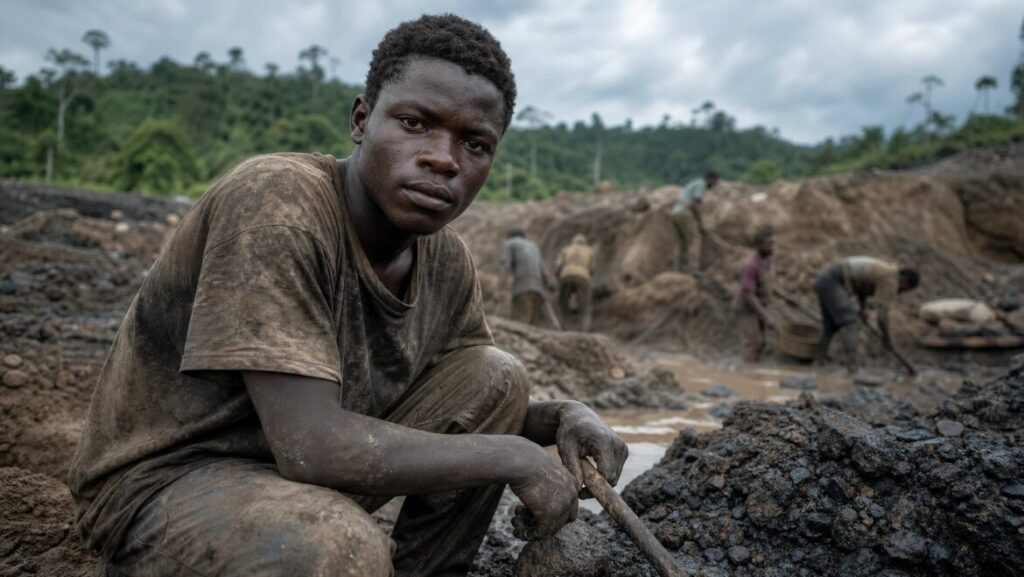
The hidden war behind your smartphone
The phone in your pocket most likely contains tantalum derived from coltan.
Your electric vehicle battery almost certainly runs on cobalt.
The AI infrastructure powering the apps you use daily depends on semiconductors built with minerals from one of the most violent conflict zones on earth.
That place is the Democratic Republic of Congo (DRC), and right now it is at the center of a war that affects every person on the planet.
Two developments this week make the story impossible to ignore.
A major investigation published this week alleges that coltan from mines controlled by the M23 rebel group is entering global technology supply chains through Rwanda.
The investigation focuses on the Rubaya mining area in eastern Congo, which holds roughly 15% of the world’s coltan output.
That coltan eventually ends up in your phone, your laptop, and in precision-guided missiles used by modern militaries.
Separately, military buildups near the Rwanda-Congo frontier have been reported this week despite ongoing peace talks.
Diplomats talk peace. Troops keep moving. The mineral trade continues.
The U.S. sanctioned senior M23 and Rwanda Defence Force commanders in June 2026 for violations of the Washington Peace Accords signed just six months earlier.
The Congolese army conducted drone strikes on M23 positions north of Goma on June 2. The peace, such as it was, is fragile at best.
The DRC produces roughly 70% of the world’s cobalt supply. It holds 60% of global coltan reserves. It is the world’s second largest copper producer.
It sits on an estimated $24,000,000 million worth of minerals beneath its surface.
Those minerals power batteries, smartphones, computers, missiles, satellites, and AI infrastructure.
The Congo is not just an African story. It is the story of who controls the foundations of the modern world.
Who is fighting and why
The Democratic Republic of Congo is Africa’s second largest country by area, with a population of roughly 100,000,000 people.
It should be one of the wealthiest nations on earth.
Instead it is one of the poorest, a country that has never fully recovered from Belgian colonial brutality, decades of dictatorship, and endless cycles of war.
President Felix Tshisekedi leads the internationally recognized government from Kinshasa, the capital.
Born in 1963, Tshisekedi is the son of Etienne Tshisekedi, one of the DRC’s most celebrated pro-democracy figures.
Felix was first elected in 2019 under disputed circumstances — a contested election that even the Catholic Church of Congo challenged.
He was re-elected in December 2023 with 73% of the vote in an election opposition candidates also called fraudulent.
He has faced ongoing accusations of corruption and weak governance.
In May 2026 he raised eyebrows by suggesting he might seek a third term if the people wanted it. That is not normally a sign of a healthy democracy.
His enemy in the east is the M23 movement, formally the March 23 Movement, a powerful rebel group that has seized the major cities of Goma and Bukavu.
M23 is neither Marxist nor a religious movement. It draws primarily on ethnic Tutsi community grievances, personal political ambition, and mineral wealth.
It is as much a criminal enterprise as a rebel organization.
The face of M23 is Corneille Nangaa, one of the most extraordinary characters in modern African politics.
Born in 1970, he studied economics at the University of Kinshasa and later worked with the United Nations Development Programme.
He went on to serve as director of the DRC’s own Electoral Commission from 2015 to 2021, where he personally certified Tshisekedi’s contested 2018 election victory.
After a bitter falling out with Tshisekedi, Nangaa went into exile and in 2023 launched the Congo River Alliance, a coalition of rebel groups including M23.
He has been sentenced to death in absentia by a Congolese military court.
His stated objective is explicit: “Our objective is neither Goma nor Bukavu but Kinshasa, the source of all the problems.” He wants to march on the capital and overthrow the government he once helped install.
The role of Rwanda in all of this is the story’s most uncomfortable dimension.
The DRC accuses Rwanda of directly backing M23 with troops and weapons. Rwanda denies it.
The UN, the U.S., the EU, and numerous international reports have all documented Rwandan military support for M23.
The U.S. Treasury sanctioned the Rwanda Defence Force in March 2026 for “blatant violations” of the Washington Peace Accords.
At least 120 tonnes of coltan are reportedly smuggled monthly from the Rubaya mines to Rwanda, laundering conflict minerals into legitimate supply chains.
Rwanda’s mineral exports grew from $772 million in 2022 to $1,100 million in 2023.
Most of that growth came from minerals it does not actually mine on its own soil.
Congo conflict minerals and the great power struggle
This is where the story stops being about Africa and starts being about all of us.
China has dominated the DRC’s mineral sector for over a decade.
Chinese companies control most of Congo’s cobalt and copper output, routing it through Chinese refineries and into Chinese-controlled supply chains.
Beijing’s strategy is simple and effective: control the raw materials, control the technology, control the future.
The Trump administration is now pushing back directly.
In January 2026, the DRC handed Washington a vetted list of mining and processing projects open to American investment.
The list included cobalt, copper, coltan, lithium, gold, and germanium deposits.
The U.S. has pledged over $1,000 million for the Congo critical minerals supply chain.
KoBold Metals, backed by Bill Gates and Jeff Bezos, is competing with Chinese firm Zijin for the Manono lithium deposit, one of the largest undeveloped lithium reserves on earth.
A U.S. consortium including firms led by former military executives has bid for the Etoile copper-cobalt mine.
In one of the most remarkable developments of 2026, M23 rebels themselves reached out to Washington, offering to sell minerals directly to the United States.
The rebels are hoping that Trump’s push for non-Chinese mineral sources could translate into political legitimacy for their movement.
It is a cynical play, but it reflects just how central the mineral question has become to every actor in this conflict.
The coltan in the Rubaya mines alone is worth understanding.
Tantalum, processed from coltan ore, is used in semiconductors, aerospace components, mobile phones, gas turbines, and precision-guided missiles.
America’s defense industry depends on it. America’s AI industry depends on it. And right now, a rebel group backed by Rwanda controls a significant portion of the global supply.
America First: the right approach for the right reasons
The Washington Peace Accords of December 2025, brokered by the Trump administration, were a genuine attempt to link mineral access to peace and security in the region.
The idea was sound. Minerals for security. American investment in exchange for stability.
That is exactly the kind of deal-making that serves American interests without committing American troops. But M23 violated the accords almost immediately.
The U.S. sanctioned Rwanda, but did not cut off American aid to Kigali.
Critics argue that inconsistency sends the wrong message: that Washington will punish bad behavior with words but not with real consequences.
China is watching all of this carefully.
Beijing has invested heavily in Congolese relationships, infrastructure, and mining contracts for years.
Every month of instability in eastern Congo is a month that American mineral deals are delayed and Chinese supply chains continue to function.
The Second Congo War, which lasted from 1998 to 2003, is considered the deadliest conflict since World War II, with an estimated 5,400,000 people killed.
Nobody wants a repeat. But the underlying conditions that produced that catastrophe, weak governance, ethnic grievances, foreign interference, and mineral competition, are all present in June 2026.
America does not need to send troops to Congo. It does not need to pick sides in a civil war. But it does need to understand what is at stake.
Whoever controls Congo’s minerals has a strategic advantage in electric vehicles, semiconductors, AI infrastructure, and defense manufacturing.
That is not a distant geopolitical abstraction.
That is the phone in your pocket, the battery in your car, and the missile that may one day defend your country.
Congo conflict minerals are not just Africa’s problem. They are ours.