
This post is also available in:
 Português
  Español
  Français
  Deutsch
  Italiano
  Русский
The Pentagon has real plans on the table for the Cuba military threat.
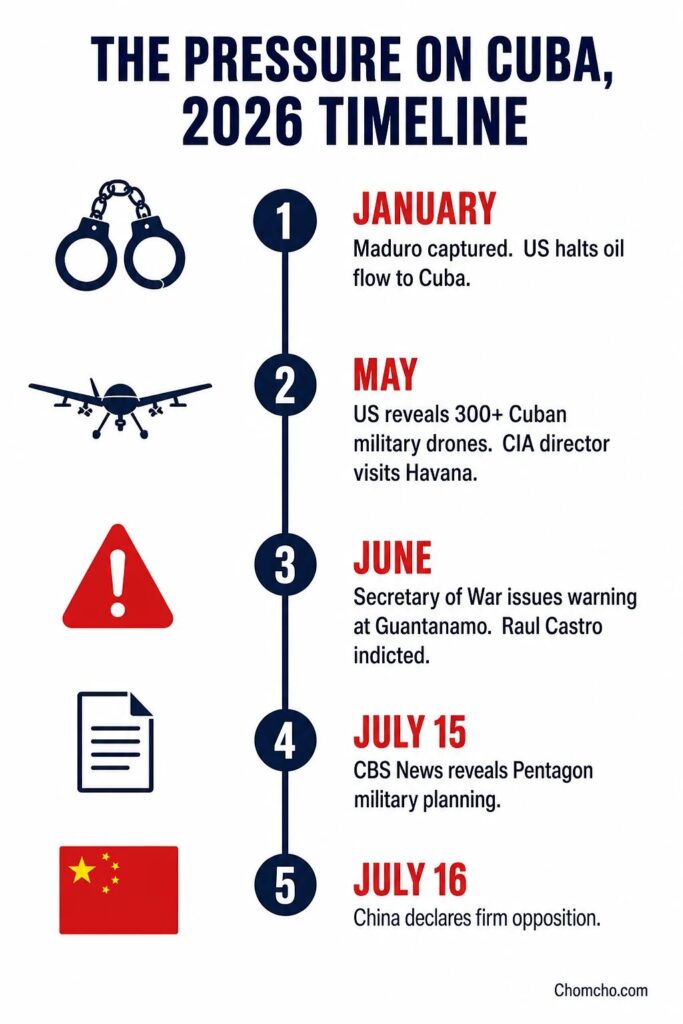
On July 15, 2026, CBS News reported that Pentagon planners have spent recent weeks studying military options against Cuba.
One option is an air assault by thousands of soldiers from the 101st Airborne Division, the only unit trained for that mission.
CBS News was clear on two points. First, President Trump has not yet decided to launch any operation.
Second, US officials consider action unlikely in the short term because major military resources are committed to the operations against Iran.
Unlikely in the short term. Notice those words. Nobody in Washington said the option is off the table.
The 300 drones that changed everything
Why is the Pentagon even studying this? The answer came two months earlier.
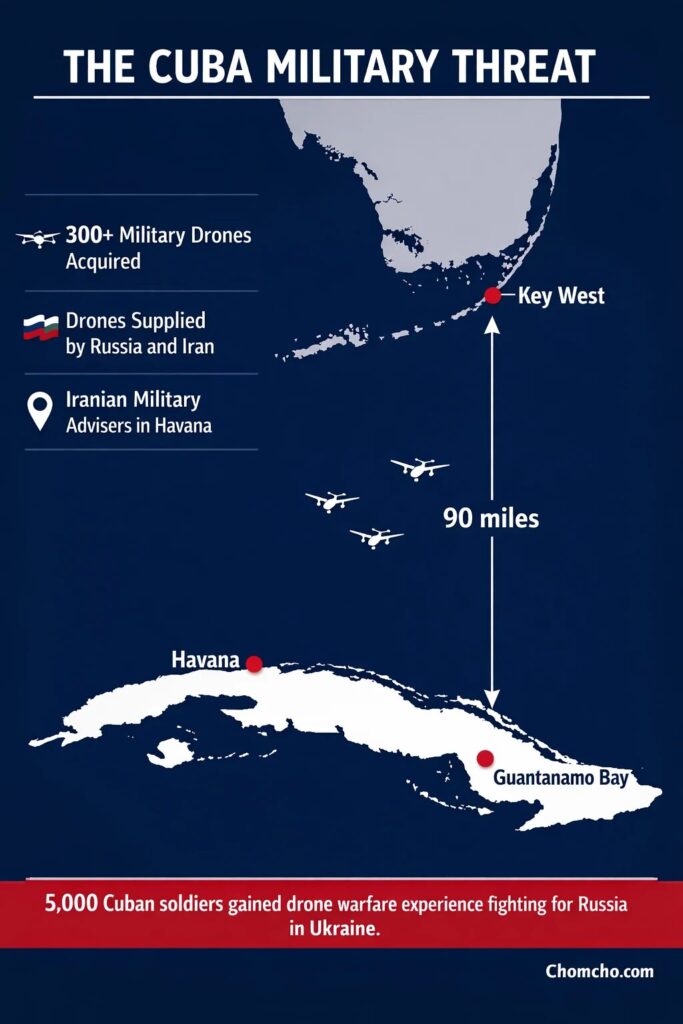
On May 17, Axios revealed classified US intelligence showing that Cuba has acquired more than 300 military drones, supplied by Russia and Iran.
According to that intelligence, Cuban military officials have discussed using them against the US naval base at Guantanamo Bay, against US ships, and possibly against Key West, Florida.
The details get worse. Iranian military advisers are present in Havana.
US officials also report that around 5,000 Cuban soldiers fought for Russia in Ukraine, and those veterans returned home with modern drone warfare experience.
Secretary of War Pete Hegseth traveled to Guantanamo on June 10 and warned Havana directly against acquiring weapons that could reach the base or the US homeland.
He reminded the regime that “no country on Earth can match the military capabilities of the United States of America.”
This is not a poor island asking to be left alone.
This is a hostile regime, 90 miles from Florida, arming itself with the same drone technology that Iran and Russia use in their wars.
China reacts exactly as expected
On July 16, China’s Foreign Ministry declared that Beijing “firmly opposes” any US military action against Cuba.
Spokesman Lin Jian accused Washington of violating the UN Charter and promised continued Chinese support for Cuban sovereignty.
Here is the interesting part. If US officials themselves call an operation unlikely, why did Beijing respond within 24 hours?
Because China believes it can happen.
Their fast reaction tells us they are watching the Maduro precedent closely.
In January, US forces captured the Venezuelan dictator, and he now faces drug trafficking charges in New York. Beijing lost a client in Caracas. It does not want to lose another one in Havana.
The pressure campaign has already started
The military planning is only one track of a much wider strategy.
Secretary of State Marco Rubio has described the Cuban government as guided by a “morally bankrupt Marxist ideology.”
CIA Director John Ratcliffe visited Havana in May and reminded Cuban leaders of what happened to Maduro.
Former Cuban leader Raul Castro has been indicted in the US, in a case connected to the 1996 shootdown of four small planes flown by the exile group Brothers to the Rescue.
The economic pressure is even stronger.
In January, President Trump announced on social media that the flow of oil and money to Cuba was over.
Washington has squeezed the island’s fuel supply, and Cuba’s broken electrical system now suffers constant blackouts after decades of communist mismanagement.
Mike Gonzalez, senior fellow at the conservative Heritage Foundation, wrote in March that it is time for the US to intervene and save the island.
He described the rulers in Havana as “the miserable clique that has all the guns and all the prisons.”
His proposal: apply maximum pressure until they accept the same offer Maduro rejected. Leave the country, or face the consequences.
So far in this Chomcho article, this has been factual reporting. What follows now is our evaluation: how and why these circumstances developed, and what we believe would be the consequences of a US military action in Cuba.
The real reasons for acting
Let us be honest about motives. Cuba is a poor country with almost no natural resources. Unlike Greenland, there are no vast mineral deposits waiting under the ground. Nobody would invade Cuba for profit.
We believe there is a democratic reason.
Millions of Cuban Americans are US citizens and voters, and many of them have waited decades for a free Cuba. They supported President Trump strongly, and he might want to return the favor.
But the main cause is national security, and the safety of Americans is a core America First goal. Protecting the homeland has been a crucial point in Trump’s foreign policy from the beginning.
Cuba has aligned itself with every single enemy of the United States. Russian drones. Iranian advisers. Chinese diplomatic protection. It is like having a little China and a little Iran sitting 90 miles from our coast.
Here at Chomcho, we believe that America should have solved this a long time ago, instead of sending our troops thousands of miles away to fight in distant lands. The most serious threats are not always the farthest ones.
The consequences of a free Cuba
What would happen after a successful US operation?
Honesty requires starting with the cost.
Yes, US taxpayers would carry an initial burden. That is why reconstruction must come through loans, not gifts.
A free Cuba could sell reconstruction bonds and repay its debts as its economy opens.
Rebuilding a democratic neighbor 90 miles away matters far more to America than rebuilding Gaza or other distant territories, as we have done in the past.
After the cost come the benefits, and they are large.
Regional stability would improve for a generation. No more military threats launched from the island. No more safe harbor for the enemies of America in the Caribbean.
The US would win a strong permanent ally, just as it did with Panama. A democratic Cuba would trade with us, host American investment, and stand with us in the region.
For the Cuban people, the change would mean democracy and prosperity for the first time in almost 70 years. Free elections. Private property. Food on the table. Electric lights that stay on.
And the world reaction?
Expect loud condemnation at first, from our enemies and even from some lukewarm partners.
But then the videos would arrive. Cubans dancing in the streets of Havana. Political prisoners walking free. Families reunited with relatives from Miami.
The world would see this event for what it truly is: a liberation.
Our first priority is US security. But this is also about the Cuban people, and both goals point in the same direction.
Answering the critics
Some isolationists on the right will say that American troops should never set foot on foreign soil.
We respect the instinct, but 90 miles is not exactly a foreign adventure. It is homeland defense.
A drone launched from Cuba can reach Florida in minutes. Refusing to act against a threat this close is not restraint. It is negligence.
Budget conservatives will ask about the cost. The answer is again loans, bonds, and a future trading partner, not another blank check.
The cries for help and a Biblical precedent
The cries for help are real, and they are not new.
For generations, Cuban exiles have asked one US government after another to help free the island.
The cries also come from inside Cuba, even though the communist government controls all communications and punishes any protest with prison.
In July 2021, thousands of Cubans marched in the streets shouting for freedom, until the regime shut down the internet to silence them.
This year, Cubans on the island raised signs reading “God Save Cuba, SOS Trump,” knowing the risk of arrest and beatings.
More than 1,000 political prisoners sit in Cuban jails today for asking what Americans take for granted.
Christians can detect a Biblical precedent here.
In Joshua 10, the city of Gibeon, an ally of Israel, was attacked by a coalition of five hostile kings.
The Gibeonites sent an urgent message: “Do not abandon your servants. Come up to us quickly and save us!” (Joshua 10:6). It was the SOS message of its day, and God saw it. Joshua did not hesitate.
He marched his army through the night, and God confirmed the mission on the way: “Do not be afraid of them; I have given them into your hand” (Joshua 10:8). He defeated the coalition that had formed near his borders.
The lesson travels well across the centuries: when allies cry out for rescue, and a coalition of enemies gathers close to your land, answering that cry is not aggression. It is faithfulness.
Today, the cries come from 90 miles away, and America is finally listening.
America is strong, Cuba’s people are ready, and freedom is closer than ever!