
This post is also available in:
 Português
  Español
  Français
  Deutsch
  Italiano
  Русский
  Nederlands
  日本語
日本語  Polski
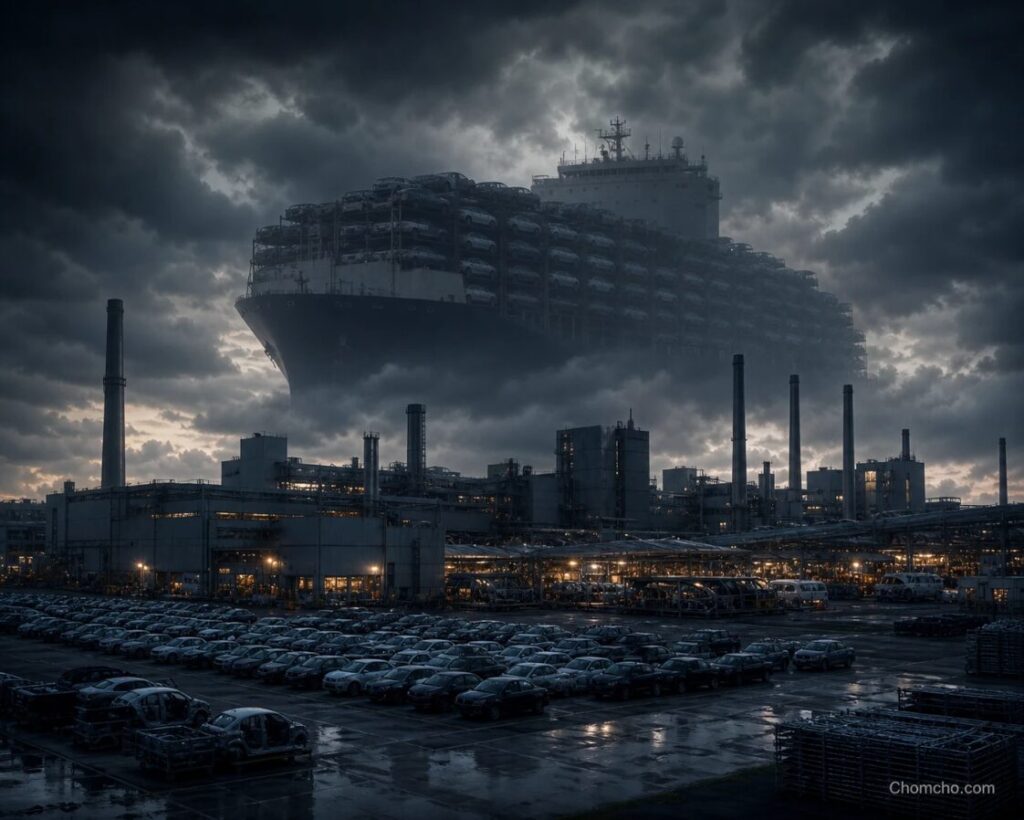
Cheap Chinese cars created the German auto crisis
The German auto crisis reached a turning point this week, and it sounded like a surrender.
On Wednesday, July 8, Hildegard Müller, president of the German Association of the Automotive Industry (VDA), the lobby that represents Volkswagen, Mercedes-Benz, and BMW, admitted that reality has overtaken political goals and that jobs are in growing danger.
Germany, she said, will not be able to keep all of its factories and suppliers open.
Her proposed solution should chill every European: open those factories to foreign manufacturers.
In plain language, sell the crown jewels of German industry to whoever will buy them. And everyone knows who is shopping.
The timing is no accident.
Volkswagen, Europe’s largest automaker, is preparing a plan for up to 100,000 job cuts by 2030, double what was previously announced, along with possible plant closures.
The plan goes before the supervisory board in Wolfsburg this week, and the IG Metall union has called protests at the plants of Emden, Zwickau, Hanover, and Kassel.
Around 3 million German jobs depend on this industry.
Müller even warned her countrymen to prepare for the end of habits and entitlements that Germany can no longer afford. This is not a restructuring memo. This is a white flag.
Green mandates and expensive energy created this disaster
Did this Western industrial decimation start with green policies?
In large part, yes. Brussels ordered the death of the combustion engine by 2035.
That forced automakers to abandon the technology they dominated for a century and compete in electric vehicles, the exact field where China spent two decades preparing.
At the same time, Germany shut down its nuclear plants and bet its energy future on windmills and Russian gas.
When that gamble collapsed, European energy prices exploded. Heavy industry cannot survive expensive energy.
The numbers tell the story. According to the European Automobile Manufacturers’ Association (ACEA), the organization of Europe’s carmakers, the European Union produced around 14 million cars in 2019.
By 2025, production had stagnated under 11.5 million.
Almost 3 million cars of annual production simply vanished.
The Draghi Report found that producing a vehicle in the EU costs about 30 percent more than in China. Add high taxes, high labor costs, and suffocating bureaucracy, and the green utopia did China’s work for it.
It gutted Europe’s greatest industry before Beijing fired a single economic shot.
The Chinese invasion by the numbers
While Europe legislated itself into weakness, China moved in.
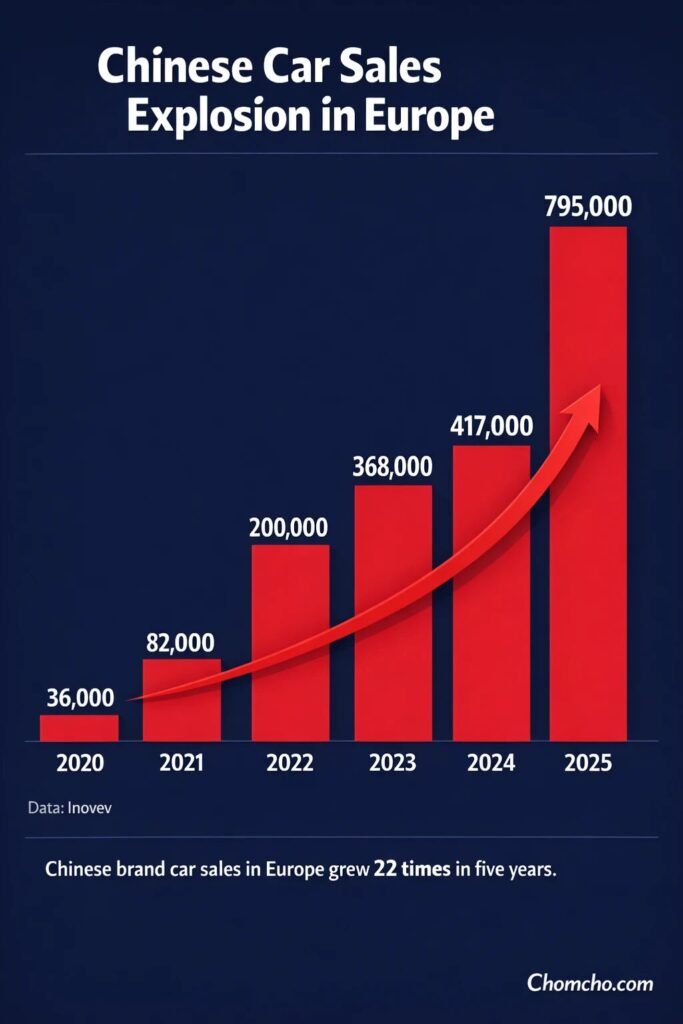
Chinese brand car sales in Europe, according to the French auto analysis firm Inovev, went from 36,000 units in 2020 to 82,000 in 2021, then 200,000 in 2022, then 368,000 in 2023, then 417,000 in 2024, and a staggering 795,000 in 2025.
That is a 22-fold explosion in five years.
By December 2025, Chinese makers captured 9.5 percent of Europe’s entire car market in a single month.
China’s global car exports jumped from 1.2 million vehicles in 2019 to 8.3 million in 2025.
This was never fair competition. Analyses based on OECD data found that Chinese automakers received three to eight times more government subsidies than their Western competitors.
Beijing built a state-funded battering ram and aimed it at Europe’s gates.
Now comes the second phase: building inside the walls.
This is brand new.
In 2025, more than 99 percent of Chinese brand cars sold in Europe were still shipped from China.
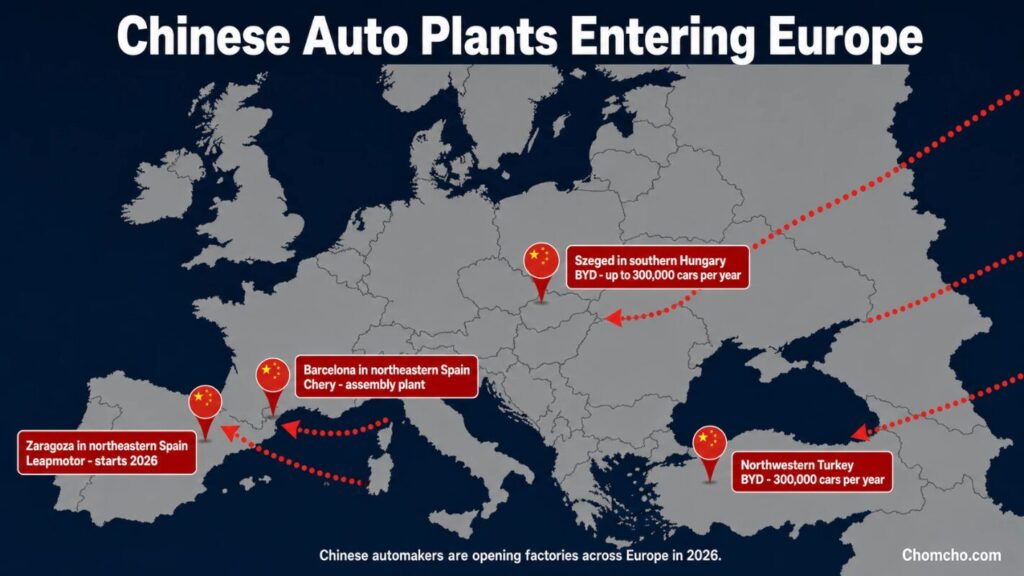
But BYD’s massive plant in Szeged, Hungary, an investment of some 4,000 million euros with capacity for up to 300,000 cars per year, began production in early 2026.
Chery is already assembling cars from Chinese kits at a former Nissan plant in Barcelona.
Leapmotor starts production in Zaragoza later this year. MG’s owner SAIC is planning its own factory in Spain. BYD is openly hunting to buy an existing European plant, with another factory in Turkey on the way.
The invasion arrived by ship. Now it is buying the port.
Brussels blinked with the minimum price giveaway
Compare the two Western responses.
The United States hit Chinese electric vehicles with tariffs that exceed 100 percent, and Chinese cars are essentially absent from American roads.
The European Union imposed tariffs of only 7.8 to 35.3 percent on top of its 10 percent base duty, and Chinese sales kept growing anyway.
Then Brussels did something worse than weakness.
In January 2026, the European Commission agreed to replace the tariffs with a “minimum price” system. Chinese automakers simply promise not to sell below a set price floor.
Here is the scandal in the fine print.
Under the former tariffs, the extra money went to European treasuries, roughly 2,000 million euros a year.
But under the new minimum price system, the Chinese manufacturers keep that difference as pure profit.
European consumers pay the same, Europe collects nothing, and Beijing’s champions get fatter margins to fund their expansion.
Economists warned the scheme transfers income straight from European consumers to Chinese producers.
Brussels didn’t negotiate a defense. It negotiated the terms of occupation.
The Trojan horse of selling factories to survive
Müller’s proposal is presented as pragmatism. It is actually the final stage of defeat.
First, who owns the factory controls the factory.
Under China’s national security laws, Chinese companies must cooperate with the Communist Party’s intelligence and strategic demands.
A “German” factory owned by a Chinese corporation answers, in the end, to Beijing.
Second, the jobs saved are crumbs.
Chery’s operation in Barcelona assembles knocked-down kits, prefabricated components engineered and built in China.
Spaniards get the screwdriver work while the engineering, the batteries, the software, and the profits stay in China.
That is not an auto industry. That is an assembly colony.
Third, we must be honest: from Beijing’s perspective, this is a brilliantly planned global strategy.
China is taking over car and machinery production in Europe while securing ports, mines, and infrastructure projects across poor nations in Africa and Latin America to lock up minerals and raw materials.
One hand controls the resources, the other controls the manufacturing.
Europe is voluntarily handing over the middle of the chain. Saving the job while surrendering the owner is feeding the horse the Greeks left at your gate.
Industrial sovereignty is the concept Europe forgot
Industrial sovereignty is a simple idea.
It is a nation’s ability to produce the essential goods of its own survival, such as vehicles, machines, steel, chips, and energy equipment, without depending on a foreign power, above all a hostile one.
A country can be rich on paper and still be a servant if someone else makes everything it needs.
Europe just rediscovered the concept, on paper.
In March 2026, the European Commission unveiled the Industrial Accelerator Act, a “Made in EU” law requiring that public money favor European-made products.
An electric vehicle must contain at least 70 percent European parts by cost to qualify for subsidies.
Any foreign investment above 100 million euros in strategic sectors faces special screening when a single country controls more than 40 percent of global capacity.
That clause was written with China in mind.
Commissioner Stéphane Séjourné asked the obvious question: how do you tell citizens the green transition is an opportunity if 100 percent of the batteries end up made in China?
But the law is still a draft.
And even if passed, it only controls public spending and subsidies.
Private consumers remain free to buy Chinese cars with their own money, and millions of Europeans are doing exactly that.
Germany led a group of member states trying to water it down, because German automakers sell a quarter of their cars in China and fear Beijing’s revenge.
Europe wrote the correct diagnosis and refuses to take the medicine.
The war question nobody asks
If war comes, who builds the tanks?
Many military historians argue that the United States won World War II, at least in part, because it converted civilian industry into military mass production almost overnight.
Ford’s Willow Run plant, built by an automaker, produced a B-24 Liberator bomber roughly every hour.
Chrysler’s Detroit Tank Arsenal rolled out thousands of tanks from automotive capacity.
Germany’s own Panzers came from its car industry. The side with the factories won.
Now imagine Europe in a future conflict. Its vehicle plants closed, or owned by companies legally bound to the Chinese Communist Party. NATO’s European members would need Beijing’s permission to rearm.
That is not an economic problem. That is a national survival problem.
Trump understands what Brussels refuses to learn
Secretary of State Marco Rubio (@marcorubio) told the Senate that “The 21st century will be defined by what happens between the United States and China.”
He also warned that within a decade nearly everything Americans need could depend on whether China allows them to have it.
Slowing Chinese economic, political, and military influence runs through almost every part of U.S. foreign policy under President Trump (@realDonaldTrump).
Even Elon Musk (@elonmusk) warned in 2024 that without trade barriers, Chinese automakers will “pretty much demolish most other car companies in the world.”
He was right, and Europe is the proof.
Trump acted on that warning.
America keeps tariffs above 100 percent on Chinese electric vehicles, added a 25 percent tariff on imported vehicles, and made energy dominance a national mission with drilling, nuclear power, and pipelines that keep American factories running on cheap energy.
His administration is also securing critical minerals through deals with allies instead of adversaries.
There is no scenario in which Trump allows Chinese state-backed companies to buy American auto plants. The idea is unthinkable in Washington and official policy in Berlin.
Here is a joke that is only half a joke: if Europe’s politicians change nothing, perhaps the only way the European auto industry will survive is by relocating to America, where energy is cheap and the government actually defends its industry.
When companies must flee their own continent to survive, the continent has failed them.
The European Union forgot why it was created
There is a bitter irony in all this.
The European Union began as an economic project.
The 1957 Treaty of Rome created a common market with a clear vision: European industries would enjoy economies of scale, selling to hundreds of millions of consumers across the continent instead of being trapped inside small national markets.
That size would let them compete with giants like the United States and, later, China. That was the promise, and for decades it worked.
But in the last decade, Brussels has drifted into political integration, endless regulation, climate mandates, and even restrictions on freedom of expression.
The economic union became a political project that its founders never approved.
The union that was created to make European industry strong now watches that industry die under its own rules.
Europe has the market size.
Europe has the engineering talent.
What Europe lacks is leadership that remembers the original mission. It did not fail for lack of size. It failed for lack of purpose and for failed ideologies.
And that failure has a price.
If the trend continues, Chinese companies will own the factories, and Europeans will work in them as employees.
The engineers who once designed the world’s finest cars will assemble Chinese kits under Chinese managers, on the same soil where their grandfathers built an industrial empire.
The owner commands and the worker obeys. That is the future Europe is negotiating for itself, one factory sale at a time.
Scripture says “the borrower is servant to the lender” (Proverbs 22:7), and the principle extends beyond money.
A nation that depends on a rival for the work of its own hands has made itself that rival’s servant, whatever its flags and parliaments pretend.
Europe still has a choice: defend its industrial sovereignty like America does, or keep selling the family farm one factory at a time.
The buyers are already inside the gates.
Nations that defend their industries defend their future.