
This post is also available in:
 Português
  Español
  Français
  Deutsch
  Italiano
  Русский
  Nederlands
  日本語
日本語  Polski
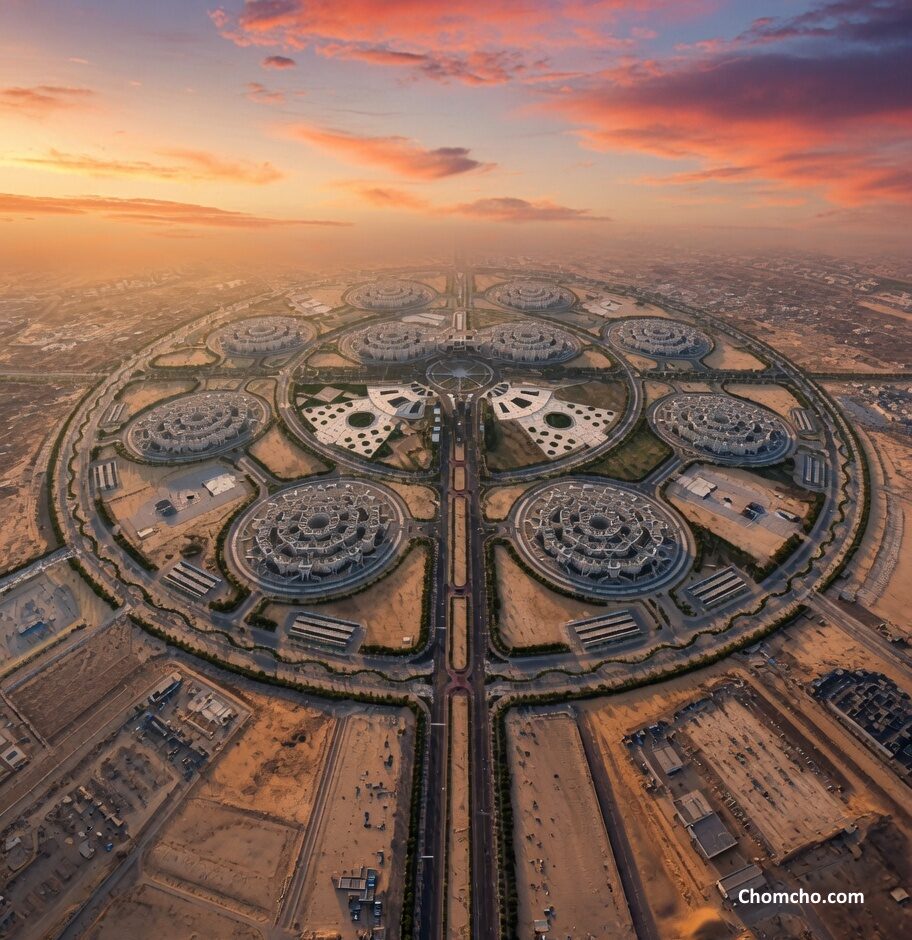
New headquarters of Egypt is the size of Lisbon
On Saturday, July 4, 2026, President Abdel Fattah el-Sisi, dressed in full military uniform, inaugurated the Octagon, the new State Strategic Command Headquarters of Egypt, in the New Administrative Capital east of Cairo.
The ceremony included an artillery salute, a motorcycle procession, and flyovers of Apache attack helicopters.
Sisi signed the founding charter, raised the Armed Forces flag, and called the complex “a towering national edifice.”
The numbers are hard to believe.
The site covers 22,000 acres, roughly 90 square kilometers. That is the size of Lisbon, the capital of Portugal. Eight octagonal buildings represent the branches of the armed forces and the sovereign institutions of the state.
They surround two central command structures, and everything is connected by fortified underground networks.
The Octagon is now the largest military headquarters in the world.
Who is the man behind it?
Sisi took power in a 2013 military coup, banned the Muslim Brotherhood, and has ruled ever since through elections about as credible as the ones in Venezuela.
This is a regime, not a democracy. In our opinion, Sisi is a moderate dictator by regional standards, and he has kept the peace with Israel.
But moderation has limits, and we will get to his treatment of Christian Copts later.
A fortress built while Egyptians struggle for bread
For a school teacher in Cairo or a fruit vendor in a local market, people who fight every day to put bread on the table, this project is probably one of the greatest wastes of money in the history of Egypt.
No speech about national security will ever change their minds, and honestly, who can blame them?
Roughly one in three Egyptians lives in poverty. Youth unemployment is high, inflation devours salaries, and the country carries a heavy debt to the IMF and to foreign lenders.
The government has never published the real cost of the Octagon, but nobody builds the largest military complex on Earth with pocket change.
There is a deeper problem. The Egyptian military already controls a large share of the national economy, from construction companies to food production.
Critics see the Octagon as one more monument that the military class built for itself, with money that could have funded jobs programs for the young, food security for the elderly, and support for the handicapped.
It is the oldest debate in economics: weapons or bread. In Egypt, the weapons won by a landslide.
Why Sisi built his strategic brain
The regime’s case deserves a fair hearing.
Egypt’s old defense facilities in crowded Cairo were designed for another century.
The Octagon integrates the army, the navy, the air force, air defense, the intelligence services and civilian ministries under one unified command system.
It houses AI-enabled data centers, encrypted communications, independent power and water supplies, and underground bunkers built to survive direct aerial bombardment.
Egyptian officials call it the strategic brain of the state.
The second reason is the dangerous region around this country. Egypt borders a civil war in Sudan, chaos in Libya, the ruins of Gaza, and it faces a water dispute with Ethiopia over the Nile. We will expand on this below.
The third reason is prestige and deterrence.
Sisi wanted the biggest, and he said so with pyramids in mind: the design invokes the eight faces of the Great Pyramid.
The size itself is the message. Egypt wants friends and rivals alike to see its power in concrete form.
Bigger than the Pentagon, poorer than Vietnam
Let us be precise with the numbers, because they are often confused.
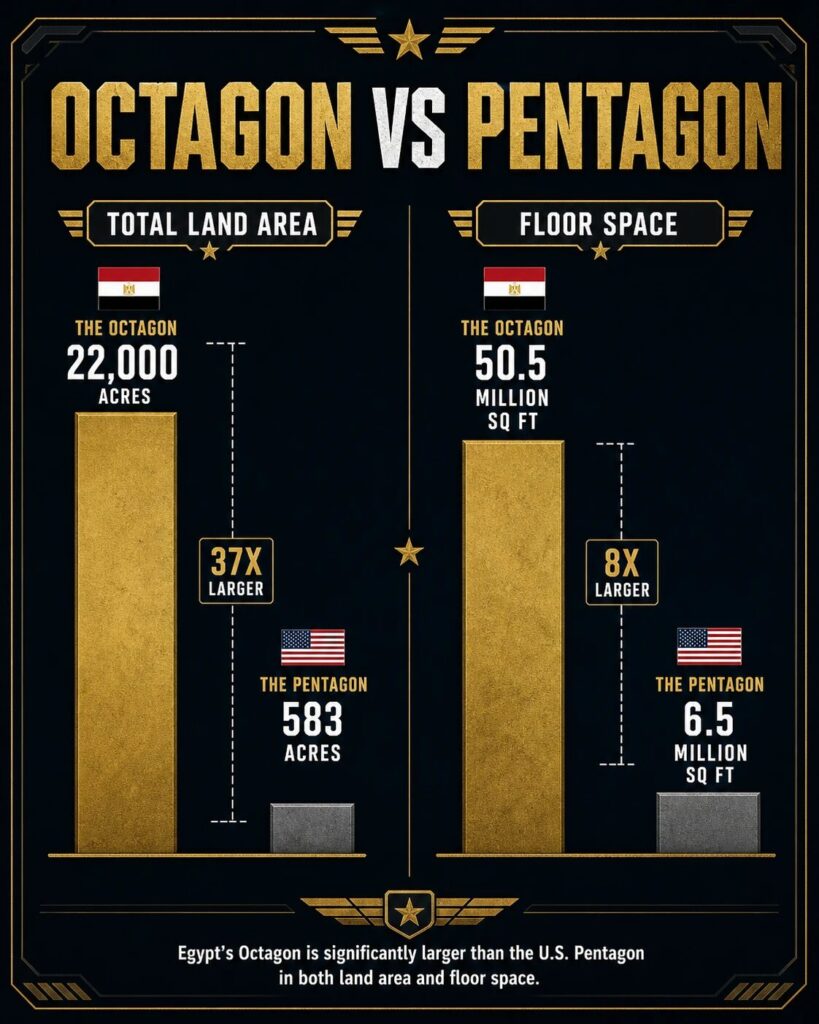
In total land area, the U.S. Pentagon complex sits on 583 acres, while Egypt’s Octagon covers 22,000 acres. That is roughly 37 times more land, and most of it is open ground, security perimeters, parking lots and space for expansion.
In actual building space, the U.S. Pentagon has about 6.5 million square feet of floors, while Egypt’s Octagon has about 50.5 million square feet. That is roughly eight times more built interior space.
Now compare the wallets. The United States spends close to 900,000 million dollars a year on defense. Egypt spends now about 2,600 million.
The inevitable conclusion, without any political bias, is that the new headquarters of Egypt is physically larger than the U.S. Pentagon in every measure, built by a country spending a tiny fraction of the American defense budget.
The comparison with Vietnam, a country of similar population and wealth, is even more revealing.
Egypt has around 110 million people, while Vietnam has about 100 million, with a similar level of wealth per person, actually slightly higher than Egypt’s.
Vietnam spends more on defense, between 8,000 and 10,000 million dollars a year, and faces a genuine giant next door in China.
Yet Vietnam built no mega headquarters.
To be fair to Egypt, Vietnam does not have a single, large, centralized military command or main headquarters. Its military buildings are distributed across many regional centers, which makes a direct building-size comparison difficult.
Vietnam’s lack of one central command reflects a lesson learned from its guerrilla past: what is dispersed is hard to destroy.
Egypt chose the opposite philosophy, building one enormous, visible, centralized fortress instead.
As we stated previously, Egypt probably needed a new central command building to face the realities of 21st century warfare and its position in a rough neighborhood. What is hard to justify is its size.
Israel, Turkey and a possible double game
Let’s now examine Egypt’s shifting alliances to understand the tensions behind its foreign policy.
Egypt was the first Arab country to sign peace with Israel, back in 1979, and that treaty has survived every regional storm since.
There is quiet security coordination in Sinai and along Gaza.
At the Octagon inauguration itself, Sisi said that lasting peace with Israel depends on an independent Palestinian state with East Jerusalem as its capital.
The treaty stands, but the warmth is limited. Now comes the uncomfortable part.
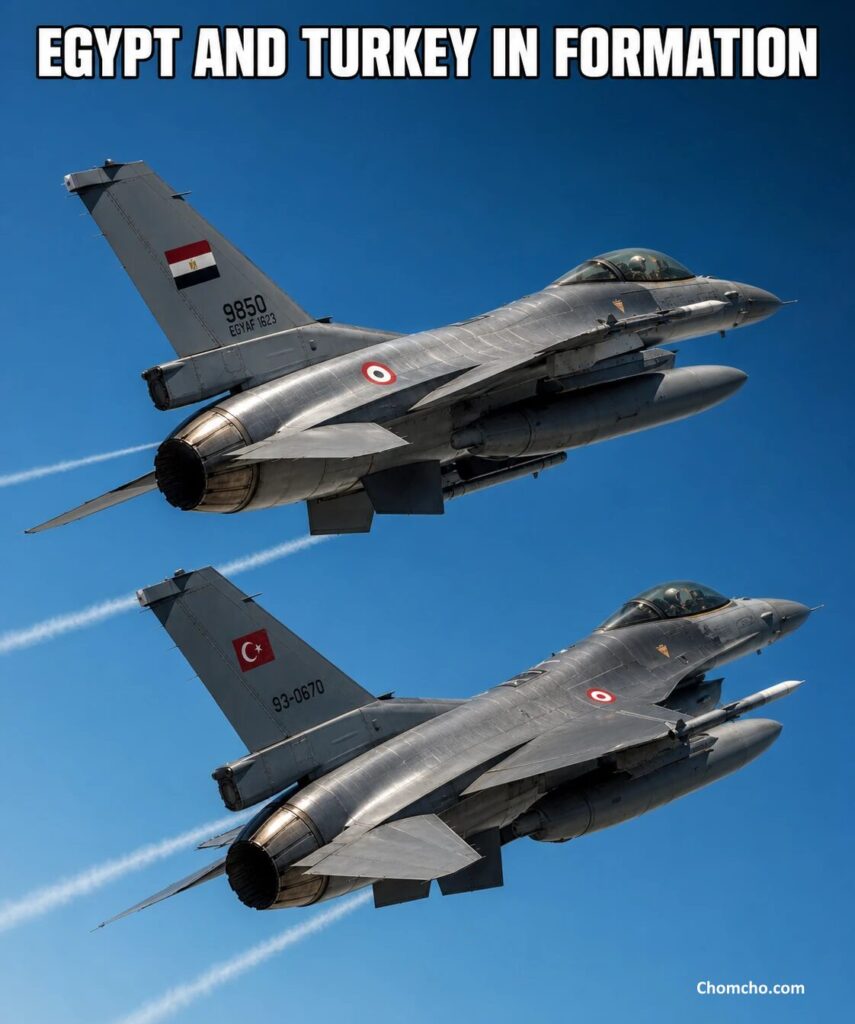
As we reported before in Chomcho.com, in June 2026 Egyptian and Turkish F-16 fighters trained together at Egyptian air bases, the first joint air exercise between the two countries in about two decades.
Days later, Egyptian pilots flew to Turkey for the Anatolian Eagle 2026 exercise, alongside Azerbaijan and a NATO early warning aircraft.
On June 27, the two chiefs of staff signed a military cooperation pact in Cairo. Also, Egypt and Turkey are even producing Turkish drones on Egyptian soil.
All of this with Turkey’s president Erdogan (@RTErdogan), a leader in open verbal confrontation with Israel.
In March 2025, Erdogan prayed for Allah to “destroy and devastate Zionist Israel,” a statement Netanyahu said he takes “very seriously.”
Turkish officials have gone further, with the interior minister calling for the “liberation” of Jerusalem and a Turkish court issuing war crimes arrest warrants for Netanyahu himself.
Due to Egypt’s recent alliances and military exercises with Turkey, Israeli Prime Minister Benjamin Netanyahu (@netanyahu) warned in February that “the Egyptian army is getting stronger, and we need to monitor it.”
When the man responsible for Israel’s survival says that in public, the concern in Jerusalem is real.
On Iran, Egypt stayed out of this year’s war and played the cautious mediator, while Houthi attacks in the Red Sea cut deeply into its Suez Canal revenue.
So is Cairo running a balancing act or a double game?
Probably both.
Egypt takes American aid, buys Russian weapons, trains with Turkey, hosts Chinese fighter jets for exercises, and keeps a cold peace with Israel.
That is not a neutral or non-aligned foreign policy, as foreign observers often describe it. That is a country playing every side, and hoping none of them notice.
A rough neighborhood from Gaza to the Nile
To be fair to Cairo, the threats around it are not imaginary.
To the south, Sudan is destroyed by civil war, and refugees pour across the border. To the west, Libya remains fractured between rival armed factions. To the east, Gaza lies in ruins after two years of war.
Also, upstream on the Nile, Ethiopia’s giant dam threatens the water supply of 110 million Egyptians, which Cairo treats as an existential issue.
In the Red Sea, Houthi attacks on shipping slashed Suez Canal income, one of Egypt’s main sources of foreign currency.
And there is one position that deserves respect from American conservatives: Egypt has refused, firmly and repeatedly, any mass Palestinian immigration from Gaza into Sinai.
When the idea of relocating Gaza’s population to Egypt and Jordan was floated in Washington early in Trump’s term, Sisi rejected it outright and mobilized the whole Arab world against it.
Whatever we think of his regime, Sisi understands something many Western leaders have forgotten: no nation is obligated to absorb a population that would destabilize it.
American aid and the protection of Egypt’s Christian Copts
Here is the section that matters most to us, and we suspect it is also of interest to the public on this side of the Atlantic.
Egypt’s Coptic Christians number roughly 10 percent of the population, the largest Christian community in the entire Middle East.
Copts are not simply a religious minority, they are the native population of Egypt, descendants of the ancient Egyptians who built the pyramids, long before the Arab conquest brought Islam to the region.
They have endured church attacks, mob violence, discrimination in public life, and the quiet humiliation of second-class citizenship.
We have written about this persecution before, and nothing fundamental has changed.
Scripture commands us to “remember those who are in prison, as though in prison with them, and those who are mistreated, as though you yourselves were suffering” (Hebrews 13:3).
Some Copts sit in Egyptian prisons today on blasphemy or apostasy-related charges for nothing more than their faith, and many more endure the mistreatment the same verse describes, church attacks, mob violence, and second-class treatment under the law.
American Christians cannot look away while their brothers in the faith live under pressure in a country partly financed by American taxpayers.
This is our opinion, plainly stated: American aid to Egypt, about 1,300 million dollars a year, mostly delivered in US-made military equipment, should be conditional on one thing.
Not that the money should go to Christian Copts, but that Sisi’s regime stops mistreating them and protects them as full citizens.
Trump, Egypt and the price of American aid
To be clear, all this is not to say, even implicitly, that U.S. aid money was used to build the Octagon.
Egyptian companies built it, and apparently Chinese money did not build it either, although Chinese loans, which are debts to be repaid and not grants, financed much of the New Administrative Capital around it.
Russia is in the picture too: at the inauguration, Egypt proudly displayed its Russian-made S-300VM air defense missile systems.
That single image says everything about Cairo’s multi-alignment strategy.
The good news is that, despite it all, U.S.-Egypt relations remain relatively strong.
For instance, in October 2025, President Trump (@realDonaldTrump) traveled to Sharm el-Sheikh and co-chaired the peace summit with Sisi that sealed the Gaza ceasefire, one of the genuine diplomatic achievements of his presidency.
“Everybody said it’s not possible to do,” Trump said there, and he proved them wrong.
Egypt was essential to that deal, and Trump now has more influence in Cairo than any American president in decades.
He should spend part of that influence for the benefit and security of Egypt’s Christian Copts.
A fortress the size of Lisbon can protect a regime. Only justice can protect a nation.
Nations are measured by how they treat the least of these, not by the size of their fortresses.