
This post is also available in:
 Português
  Español
  Français
  Deutsch
  Italiano
  Русский
Two strongmen, one new Egypt Turkey axis
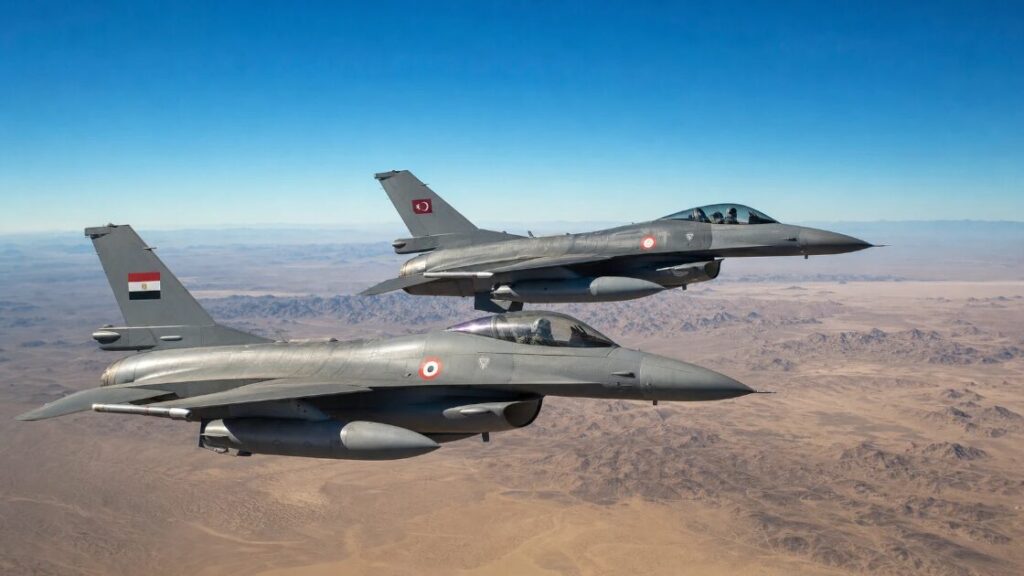
Egypt launched two joint military exercises this week, one with Turkey, one with Oman, in a sign of just how far the Egypt Turkey alliance has come.
According to Egypt’s Ministry of Defense, the Egyptian-Turkish exercise involves multi-role combat aircraft conducting joint air training across several Egyptian air bases, including conferences to “harmonize combat concepts” and live training sorties.
Simultaneously, the Egyptian-Omani exercise “Qalaat al-Jabal-2” brings together Egyptian Paratrooper Forces and Omani Special Forces at training camps over several days.
This is part of what the spokesperson called deepening cooperation “between the armed forces of the two brotherly countries.”
To put the stakes in perspective, Israel spent roughly $48,300 million on defense in 2025.
Turkey spent $30,000 million. Egypt’s entire official defense budget was just $2,500 million, despite Egypt having nearly five times Israel’s population and more than four times the active military personnel.
That gap tells you something important: Turkey, not Egypt, is the real military heavyweight in this new partnership, and Turkey has also been by far the louder and more aggressive critic of Israel throughout the recent conflicts.
From bitter enemies to battlefield partners
This rapprochement looked impossible a decade ago.
In 2013, then-General Abdel Fattah el-Sisi overthrew Muslim Brotherhood President Mohamed Morsi.
Turkey’s Erdogan, himself rooted in political Islam, had hoped Morsi’s election would let Turkey lead the Sunni world.
Ankara became a safe haven for exiled Brotherhood members, and anti-Sisi television broadcast freely from Istanbul for years.
Egypt designated the Brotherhood a terrorist organization, viewing it as an existential threat, and aligned with Saudi Arabia and the UAE, who shared that fear, against Turkey and Qatar.
Neither Sisi nor Erdogan runs anything resembling a liberal democracy.
Sisi rules Egypt through the military and has crushed virtually all political opposition. Erdogan has steadily dismantled judicial independence and jailed journalists and rivals for two decades.
Two strongmen who once despised each other are now training armies together, a reminder that in this region, ideology bends quickly when interests align.
The thaw began around 2021 and became full reconciliation by 2024.
By February 2026, Turkey had stripped citizenship from senior Brotherhood exiles as a goodwill gesture.
Sisi and Erdogan then signed a formal military framework agreement plus a $350,000,000 arms and joint-production deal, including a new artillery ammunition factory inside Egypt.
Bilateral trade is targeted to grow from $9,000 million to $15,000 million annually by 2029.
The real driver: a resurgent Israel and a vanishing resistance axis
Here is the analysis that matters most.
Hezbollah was devastated in 2024. Bashar al-Assad’s regime in Syria collapsed shortly after. The 2026 Iran war then wiped out much of Iran’s senior military leadership, as we covered in our Iran War Lessons series.
The old “Axis of Resistance” that used to check Israeli power is effectively gone.
At the same time, the Abraham Accords framework keeps deepening Israel’s ties with the UAE, Bahrain, and quietly Saudi Arabia.
Turkey has positioned itself as Hamas’s loudest defender on the world stage, hosting its political leadership for years even as Gulf states cooled toward the group.
Egypt, by contrast, has played mediator, controlling the Rafah crossing and maintaining careful, often tense relations with Hamas given its own Brotherhood ban.
Turkey has also been the primary backer of Syria’s new post-Assad government, while Egypt views that Islamist-leaning government with considerable suspicion.
Despite their differences on Hamas and Syria, Egypt and Turkey appear to share one underlying concern: a Middle East where Israel is the unchallenged dominant military power, and where Gulf states are increasingly aligned with Tel Aviv and Washington.
This is not necessarily an anti-Israel pact in any formal sense.
It looks like classic balance-of-power behavior, when one power wins decisively, others quietly coordinate so they are not left out entirely.
Turkey’s wider web, and India’s countermove
Turkey’s reach extends well beyond Egypt.
Ankara remains closely aligned with Pakistan and Azerbaijan, a partnership that openly supported Pakistan during its 2025 conflict with India.
In response, India has dramatically expanded ties with Greece and Armenia, Turkey and Azerbaijan’s traditional rivals.
India signed a $3,000 million fighter jet deal with Armenia in late 2025, its first-ever export of front-line combat aircraft.
Armenian forces also showcased Indian Akash air defense systems and Pinaka rocket launchers at a May 2026 military parade, a direct message to Baku and Ankara.
Analysts now describe an emerging “India-Greece-Armenia triangle” as a counterweight to the Turkey-Azerbaijan-Pakistan axis.
No formal statements have been exchanged, but the trend lines speak for themselves.
What Washington, Moscow, and Beijing are watching
Russia and China have every reason to watch these Egyptian exercises closely.
Egypt has deepened defense cooperation with Russia for years, and a friendlier Egypt-Turkey relationship that reduces Cairo’s dependence on Gulf and Western patrons only helps Moscow’s broader push for influence across the Middle East and Africa.
China, for its part, benefits any time traditional U.S. allies diversify away from American suppliers, since it positions Chinese arms and infrastructure as the next logical alternative.
Here is the part that should concern Washington most. Egypt receives roughly $1,300 million per year in U.S. Foreign Military Financing, money that exists specifically so Egypt buys American weapons.
That single American program equals roughly half of Egypt’s entire official defense budget.
And yet Egypt has previously pursued Russian Su-35 fighter jets, only backing off after the U.S. threatened sanctions under CAATSA, and has reportedly explored Chinese fighter jets as well, with Chinese aircraft already flying over Egypt during a joint exercise.
Washington pays for roughly half of Egypt’s defense budget, and Cairo still shops for alternatives to American hardware. That is not a healthy alliance dynamic.
Turkey, despite being a NATO member, was expelled from the F-35 program in 2019 over its purchase of Russian S-400 air defenses, and friction with Washington over Syria, Libya, and the Eastern Mediterranean has never fully healed.
The Egypt-Turkey alliance, by itself, is not necessarily hostile to American interests.
Reduced tension between Cairo and Ankara lowers the risk of regional miscalculation.
But the broader pattern, a major aid recipient diversifying away from U.S. arms suppliers, combined with Turkey’s expanding footprint from Libya to the Caucasus to the Horn of Africa, deserves serious attention from Washington.
America is simultaneously managing an Iran-Israel conflict, the war in Ukraine, and a rising China.
An emboldened Turkey, now on better terms with both Egypt and the Gulf, is positioning itself as an indispensable power broker across multiple theaters at once, exactly the kind of leverage Washington cannot afford to ignore.
The Egypt Turkey alliance deserves a seat at America’s strategic planning table, not a footnote.