
This post is also available in:
 Português
  Español
  Français
  Deutsch
  Italiano
  Русский
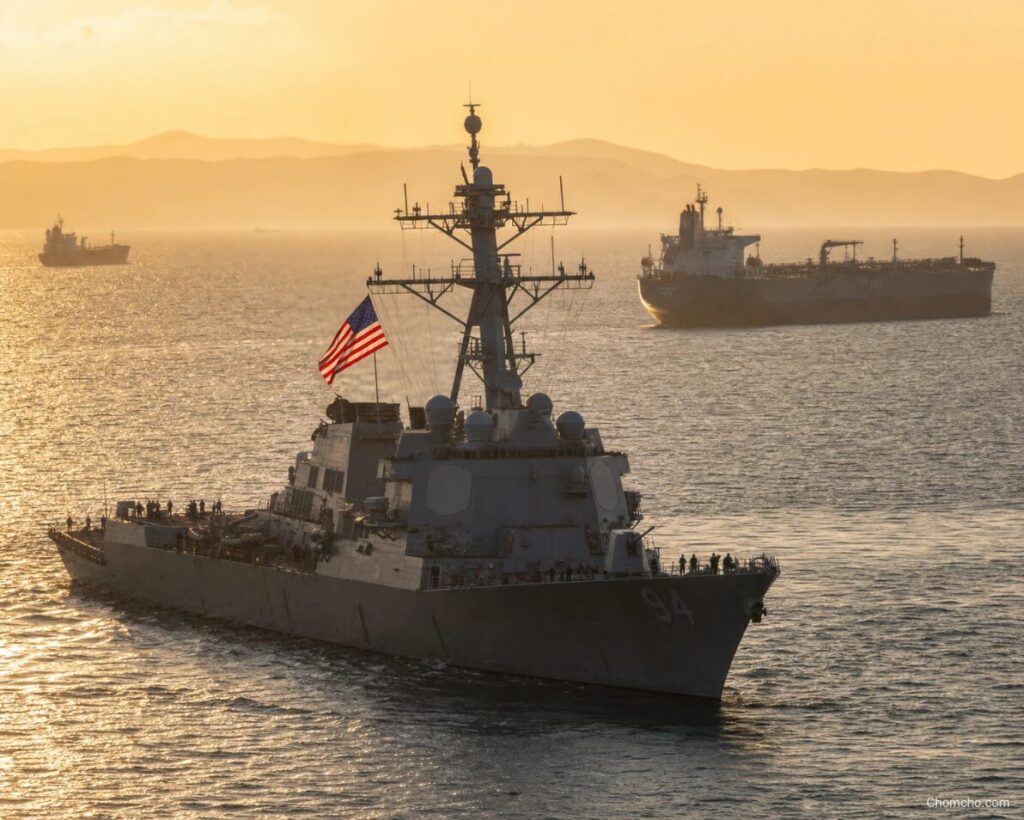
Trump just put a price tag on the world’s oil lifeline, and the fight over who pays could outlast the US Hormuz toll.
President Trump reinstated the naval blockade on Iran Monday and declared that the United States will collect 20 percent on all other cargo shipped through the Strait of Hormuz, branding America “THE GUARDIAN OF THE HORMUZ STRAIT.”
The blockade resumes Tuesday at 4 p.m. Eastern Time.
Three things remain unclear: how the 20 percent fee would actually be collected, whether it survives a challenge under international maritime law, and how far oil prices will climb.
Brent crude already jumped more than 7 percent on the news, its biggest one day gain since April. That is just for now; we do not know how far it will go.
What exactly did Trump announce?
The blockade only targets Iranian ships and buyers.
Everyone else pays the toll.
“We guarded the strait for 50 years, more, and we never got paid for it,” Trump told Fox News, adding that the process “will begin immediately.”
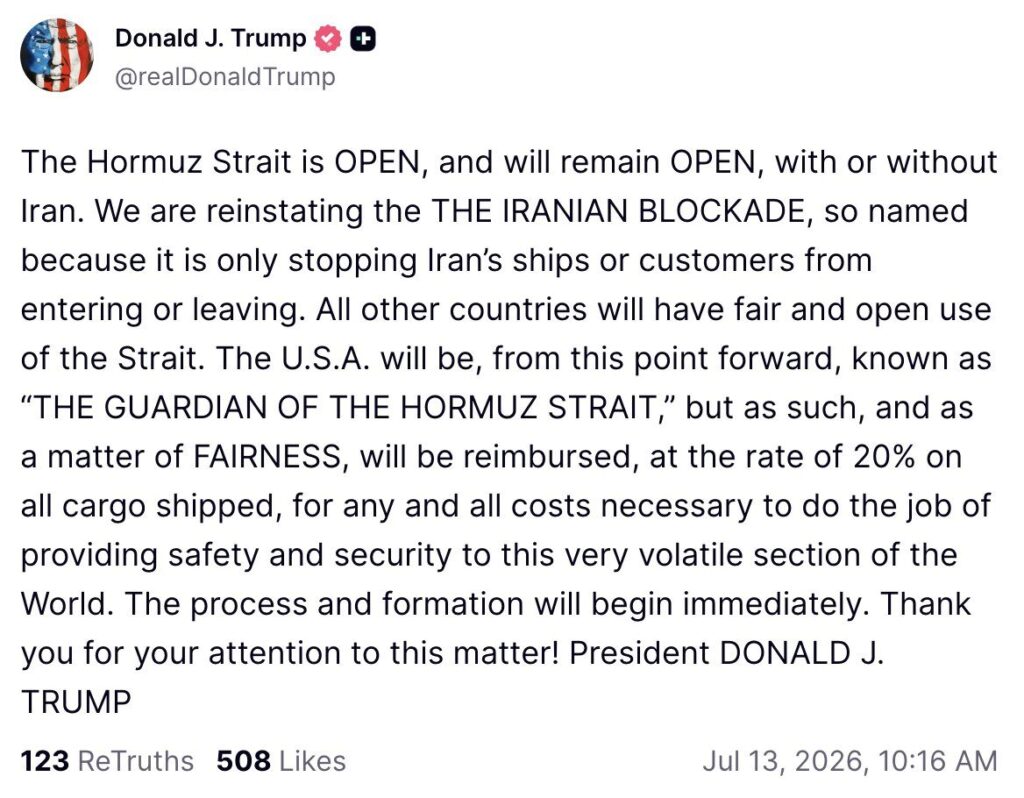
Who should pay to guard the world’s most dangerous chokepoint?
The legal objection is short and clear.
James Kraska, a maritime law expert at the U.S. Naval War College, said tolls to transit Hormuz are against international law and that the world has an unimpeded right to pass through it.
The United Nations’ International Maritime Organization agrees, insisting there is no legal basis for mandatory fees on an international strait.
But step back and look at who actually does the work.
Nineteen U.S. Navy ships, including two aircraft carriers, patrol these waters right now.
American sailors take the risk.
American taxpayers cover a war that economist Mark Zandi estimates has already cost the average household about 1,000 dollars.
China, India, Japan, and much of Europe import enormous volumes of oil through this exact strait while contributing almost nothing to keep it open.
Even Tehran cannot deny the basic logic.
Iran’s own foreign minister, Abbas Araghchi, posted on X that “whoever provides secure and safe passage of commercial vessels through the Strait of Hormuz should be compensated for this service,” insisting only that Iran deserves the title and a fairer rate.
When your adversary agrees with your premise and only argues about who should collect the money and how much, you have already won the argument.
Not everyone in the market is convinced the number makes sense.
Bob McNally of Rapidan Energy Group called the 20 percent figure a distraction, and Nordic American Tankers CEO Herbjorn Hansson put it plainly: “Iran is suffering, America is suffering, 192 countries outside the Hormuz Strait are suffering.”
Fair points.
But confusion over the mechanics does not erase the underlying question of who has earned the right to be paid for real protection.
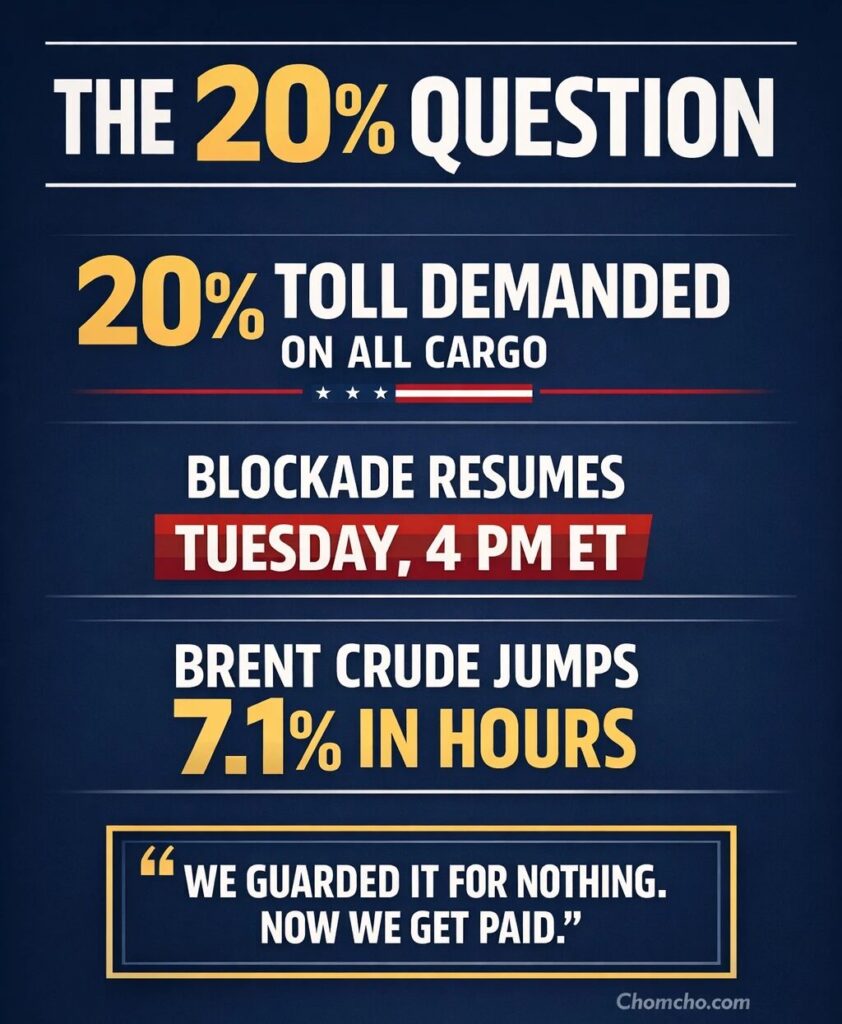
Is this toll temporary, or here to stay?
Trump has not said. Three readings are possible.
It could be temporary leverage, pressure meant to force Iran to permanently abandon interference with shipping.
It could be temporary cost recovery, a charge that fades once the crisis does.
Or it could become a lasting America First principle: if the United States secures a critical global chokepoint, everyone who benefits should help pay for it, crisis or no crisis.
Which one Trump intends is still an open question.
How are the great powers reacting?
Quietly, so far.
As of this writing, no major statement has come from Beijing, New Delhi, Tokyo, or Seoul, the very capitals with the most oil riding on this decision.
Iran’s Araghchi has been the loudest voice, and even his response reads more like haggling than outright refusal.
Would a European alternative work?
France and the United Kingdom have assembled a naval coalition meant to protect shipping through Hormuz.
But it only deploys “as soon as conditions permit following a sustainable ceasefire agreement,” in their own words.
In practice, that means Europe waits for the fighting to stop before lifting a finger.
Oman has quietly offered to help mediate between Tehran and Washington, which is more than most European capitals have done so far.
Trump and Defense Secretary Pete Hegseth have made their frustration public.
“The United States has been informed by most of our NATO Allies that they don’t want to get involved with our Military Operation,” Trump wrote.
“We will protect them, but they will do nothing for us, in particular, in a time of need.”
To his credit, Trump has also pushed NATO to take a bigger role and spend more on defense overall, so the criticism comes with an open door attached, not just a closed fist.
Even Canadian Prime Minister Mark Carney has said the defense burden is shifting away from the United States.
If Europe truly wants a bigger voice in shaping global order, as some of its own leaders now suggest it should have, it might start by showing up in the waters that keep its own economy running, rather than waiting for someone else to make it safe first.
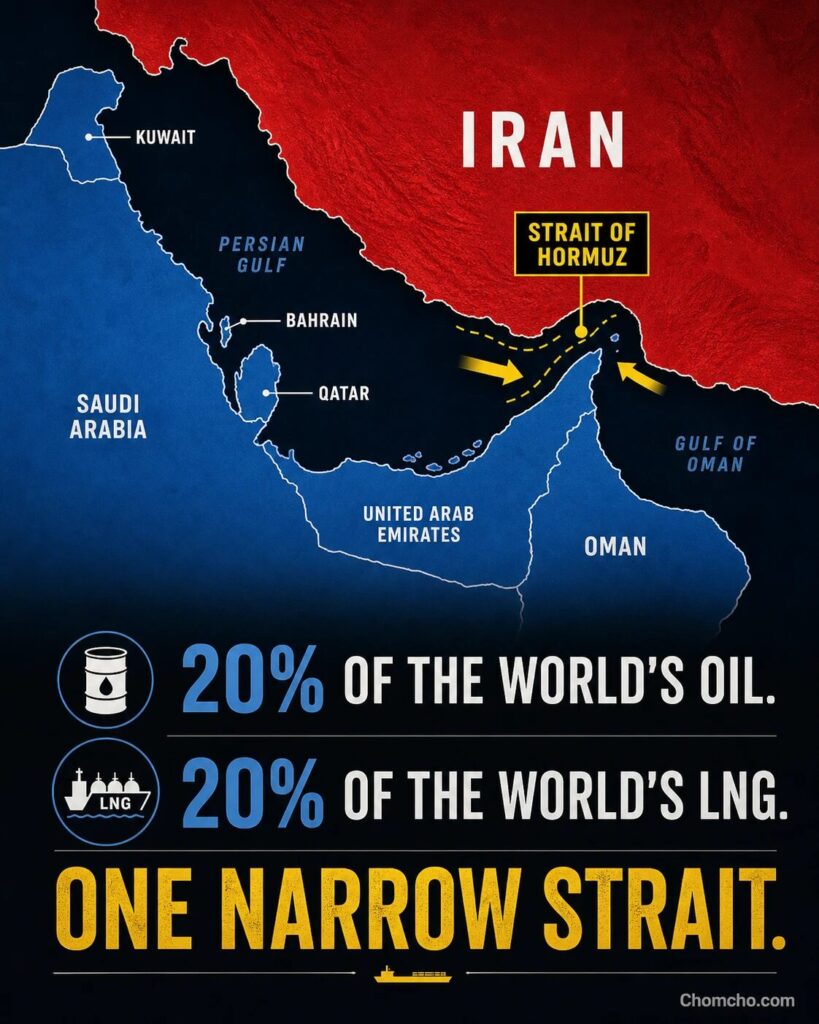
Who really protects the world’s shipping lanes?
Hormuz is not the only chokepoint at risk.
Houthi rebels have spent years attacking ships in the Red Sea and the Bab el Mandeb strait.
There is no true international police force for the open ocean, only whichever fleet shows up. For decades, that fleet has almost always been American.
If Iran backs down today, another regime, somewhere else, will eventually test the same waters tomorrow.
The case for paying America’s bill
Call it law enforcement, not warfare.
A police officer who walks a dangerous beat expects a paycheck, not gratitude alone, and there is an old and simple principle, older than any naval force, that whoever does the labor deserves the reward.
Guarding the world’s busiest oil route for half a century without asking for a dime was generous. It was never required.
Much of this policy remains undefined.
Trump has not explained how the fee would be calculated, collected, or enforced, and reactions from the world’s major powers are still emerging.
Would the “guardian angel” role be sustainable for years to come?
Could Europe overcome its hesitation and share the burden without waiting for permission?
Could a deal ever be struck with a rival like China, and could a toll like this one instead risk a new confrontation with Beijing down the road?
Some of these scenarios are unlikely, others far more plausible, but Trump’s decision has the potential to reshape the geopolitics of the world’s oil routes.
We do not know what happens next, how these plans will actually work, or how the rest of the world will ultimately respond.
This story is still being written in real time.
Whatever comes next, one thing is certain. America still commands the seas, and the days of guarding them for free may be over.
The US Hormuz toll may be the opening move in a much bigger story about who pays to keep the world safe.