
This post is also available in:
 Português
  Español
  Français
  Deutsch
  Italiano
  Русский
  Nederlands
  日本語
日本語  Polski
Rubio India Quad: America draws the line in the Indo-Pacific
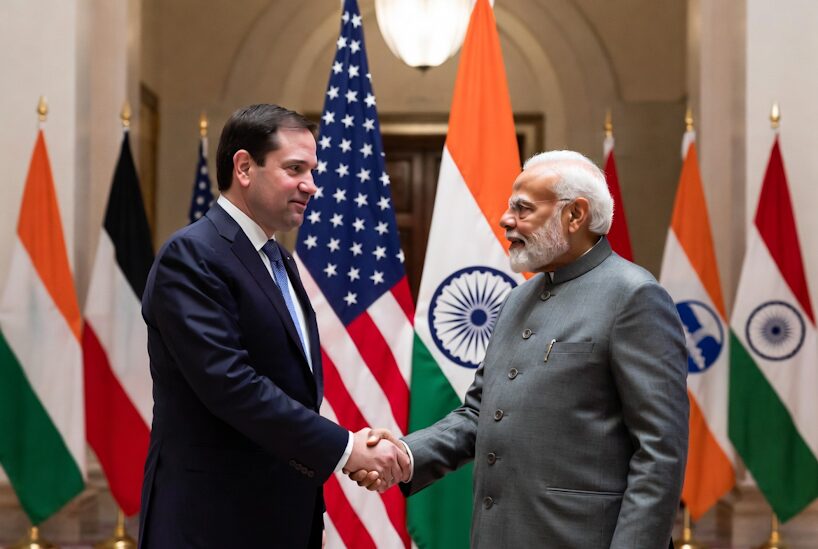
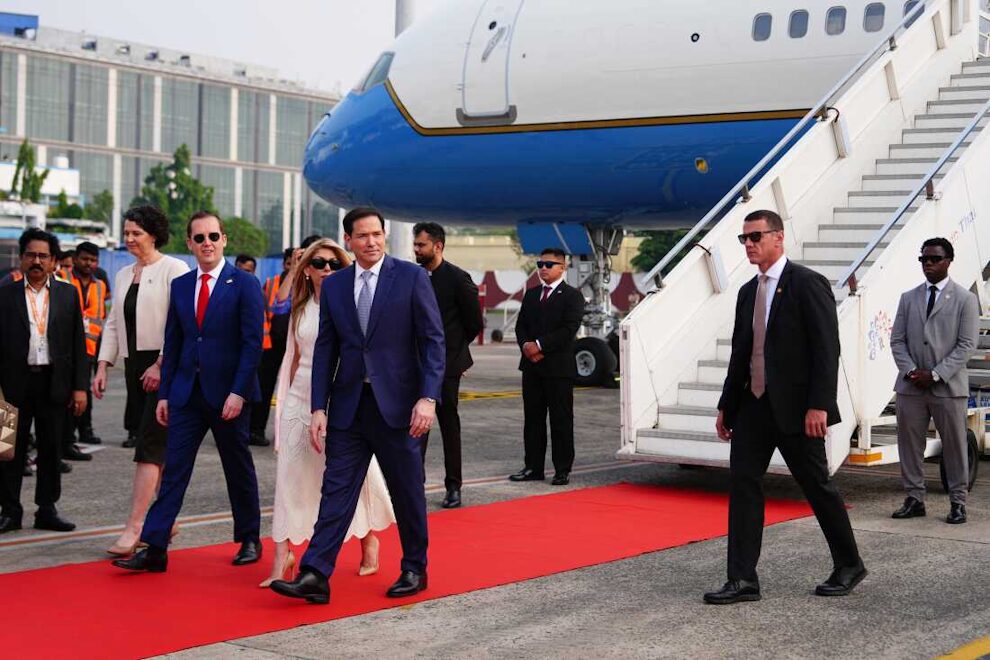
Secretary of State Marco Rubio (@MarcoRubio) arrived in India on May 23, 2026 for his first official visit as America’s top diplomat — a four-day trip covering Kolkata, New Delhi, Agra, and Jaipur.
This is not a courtesy visit. The timing is deliberate and the agenda is urgent.
Relations between Washington and New Delhi were strained after Trump’s 2025 tariff offensive hit India hard — many of those tariffs have since been rolled back, but the trust deficit remained.
Rubio’s mission is clear: reset the relationship, deepen the strategic partnership, and make sure India knows where it stands in America’s global vision.
He met Prime Minister Narendra Modi (@narendramodi) on May 23 for about an hour of bilateral talks at Sewa Teerth in New Delhi.
Modi posted on X afterward: “India and the United States will continue to work closely for the global good.”
That is diplomatically measured language — but the subtext is significant.
Rubio extended a White House invitation from President Trump for Modi to visit “in the near future.”
Rubio described India plainly as one of “a handful of really important strategic alliances” the US maintains worldwide.
That is not boilerplate. That is Washington telling New Delhi: we need you, and we know it.
Energy, trade, and the Hormuz factor — what the US wants from India
The Rubio India Quad visit has a very specific economic agenda — and the Strait of Hormuz crisis is driving all of it.
India is the world’s third largest energy consumer. With the Hormuz closure cutting 20% of global oil supply and pushing Brent crude above $105 per barrel, Washington sees a critical opportunity.
Rubio was direct: “We want to sell them as much energy as they’ll buy” — pushing US LNG exports and even Venezuelan oil to help India diversify away from Russian and Iranian supplies.
He added that Washington “will not let Iran hold the global energy market hostage.”
Beyond energy, the visit aims to revive talks on an interim bilateral trade agreement — stalled since the 2025 tariff disputes.
The agenda also includes critical technology transfers, defense cooperation, and supply chain security.
Here is where it gets complicated.
India practices what it calls “strategic autonomy” — meaning it buys Russian weapons, purchases Iranian and Russian oil, and is a founding member of BRICS alongside China, Russia, Brazil, and South Africa.
Just ten days before Rubio landed in New Delhi, India hosted the BRICS foreign ministers’ meeting — attended by Russia, China, Iran, and others.
Washington is not naive about this.
But the calculation is simple: a partially aligned India is vastly better than a fully non-aligned one — and far better than an India that drifts toward Beijing.
That is why Rubio is here.
The Quad meeting — Australia, Japan, India, and the US draw the line on China
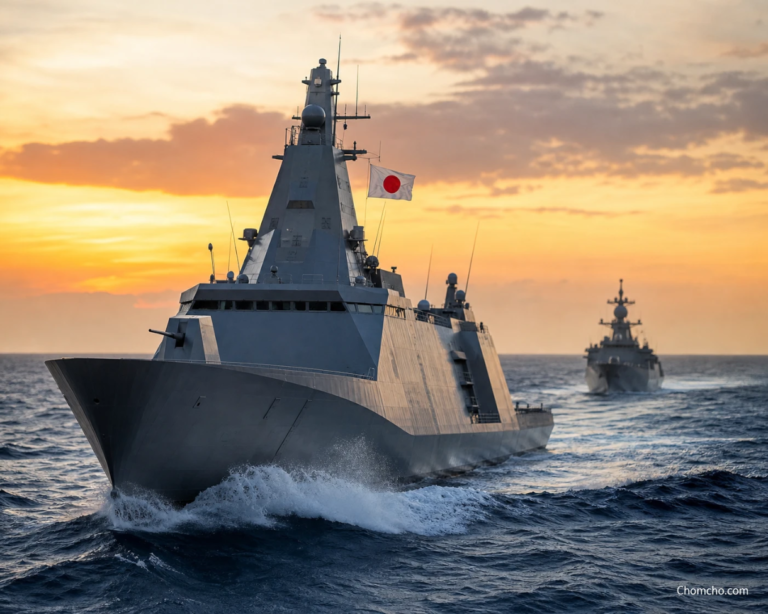
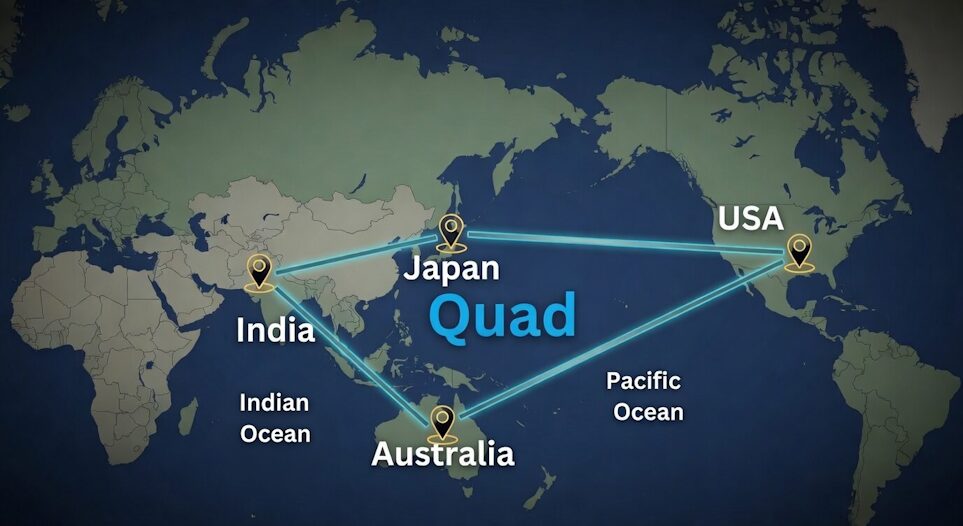
The centerpiece of the Rubio India Quad visit is the May 26 Quad Foreign Ministers meeting in New Delhi — bringing together the US, India, Australia, and Japan to advance what all four nations call a “Free and Open Indo-Pacific.”
The Quad has become a key platform for cooperation on maritime security, supply chains, and regional strategy as China expands its military and economic influence across the region.
The meeting builds on the July 2025 Washington gathering and sets the stage for a full Quad Leaders Summit to be hosted by India.
Australia’s Penny Wong, Japan’s Toshimitsu Motegi, and India’s S. Jaishankar are all at the table on May 26.
Nobody is saying “anti-China” out loud. But everybody in that room knows that is exactly what this is. The Quad has repeatedly condemned China’s actions in the South China Sea.
Beijing calls the Quad an attempt to contain its rise.
Beijing is right — and that is not a criticism. From an America First perspective, containing Chinese expansion is the entire point.
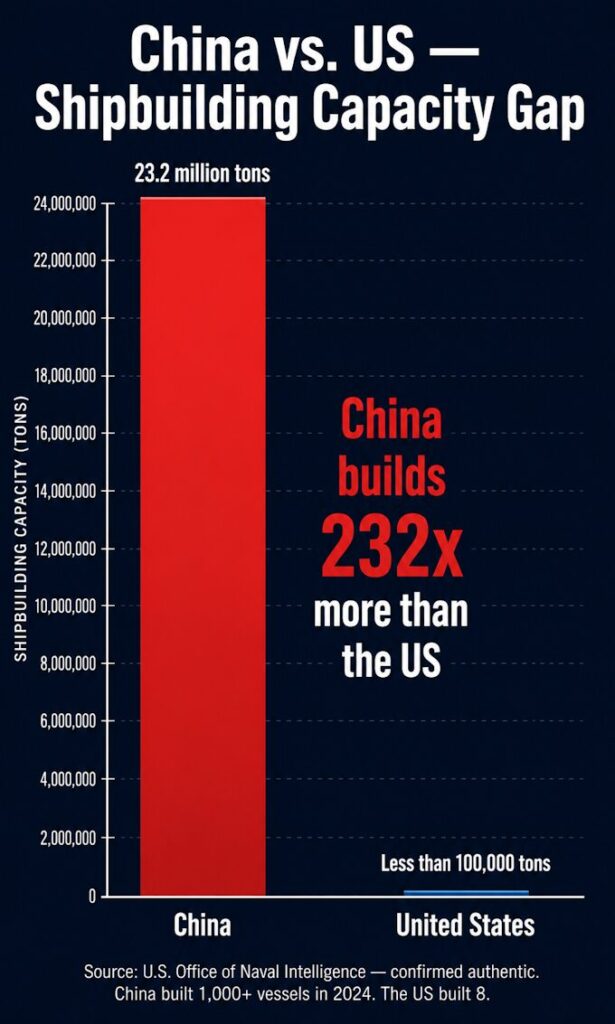
Here is the hard number that explains why alliances matter right now: according to a leaked US Navy Office of Naval Intelligence briefing slide — confirmed as authentic — China has 232 times the shipbuilding capacity of the United States.
In 2024, China built over 1,000 commercial vessels. The US built eight.
The US Navy is shrinking to 287 ships while China’s fleet surpasses 370.
America cannot out-build China alone. Japan, South Korea, and Australia can help close that gap. That is not optional. That is survival arithmetic.
Squad vs Quad — and why India and South Korea are the next piece of the puzzle
While the Rubio India Quad meeting dominates the May 26 headlines, a broader and more urgent strategic conversation is accelerating quietly beneath it.
Readers should understand the distinction between two key groupings.
The Quad — US, Japan, Australia, India — is a broad diplomatic, economic, and security framework for the entire Indo-Pacific.
The Squad — US, Japan, Australia, Philippines — is narrower, more tactical, and explicitly military: real-time maritime deterrence in the South China Sea.
Philippines Armed Forces Chief Gen. Romeo Brawner Jr. proposed expanding the Squad to include India and South Korea at the Raisina Dialogue in March 2025 — saying without apology: “We find commonality with India because we have a common enemy. And I’m not afraid to say that China is our common enemy.”
South Korean President Lee Jae Myung visited India this very week — signing new defense agreements covering AI, cyber security, autonomous weapons systems, and joint production.
India already operates 100 South Korean K9 Vajra-T howitzers deployed in Ladakh — directly on the Chinese border — with 100 more planned.
No formal Squad expansion has been announced yet. But the building blocks are being assembled one defense agreement at a time.
CSIS analysts warn plainly that if China continues expanding its fleet at the current pace and the US does not rebuild its alliances, Beijing will grow increasingly likely to win a prolonged great power war.
America First does not mean America Alone.
It means America leading a coalition strong enough to deter the greatest military build-up the world has seen since the Second World War.
The May 26 Quad meeting in New Delhi is part of that coalition. And Beijing is watching every handshake.