
This post is also available in:
 Português
  Español
  Français
  Deutsch
  Italiano
  Русский
Summary
Brazilian pollsters Datafolha, Quaest and AtlasIntel all had Lula ahead. They were all wrong.
The runoff is October 25, and the Bovespa, Brazil's main stock index, jumped more than 8 percent on Monday, October 5.
Flávio, 45, campaigned on crime and the cost of living and would declare Brazil's two largest criminal gangs, the PCC and the Comando Vermelho, narco-terrorist organizations.
Congress also shifted in Flávio's favor: his Liberal Party (PL) elected 19 senators and 121 federal deputies, the largest bloc in both chambers.
The context is the case against his father, former president Jair Bolsonaro: a 27-year prison sentence for a supposed coup plot, a social media ban, prison and now house arrest, under Supreme Court Justice Alexandre de Moraes, who shut down the social network X across Brazil and whose wife's law firm held a 131 million reais contract with a collapsed bank.
In our view, the same left and globalist allies that tried to jail Trump succeeded in imprisoning Trump's ally Jair Bolsonaro in Brazil.
U.S. President Donald Trump called the result a "great victory." Argentina's President Javier Milei and Colombia's President Abelardo de la Espriella celebrated; De la Espriella prayed that God have mercy on Brazil as He did with Colombia.
On Monday, October 5, Spain's Prime Minister Pedro Sánchez called early elections for November 29.
For Washington, Flávio offers membership in the "Shield of the Americas," Trump's regional security alliance, a free trade agreement and Brazil's rare earths, the world's second-largest reserves.
BRICS, the bloc of emerging economies, is absent from his platform, but China will likely remain Brazil's largest trading partner, even though Brazil would choose Washington as its main ally.
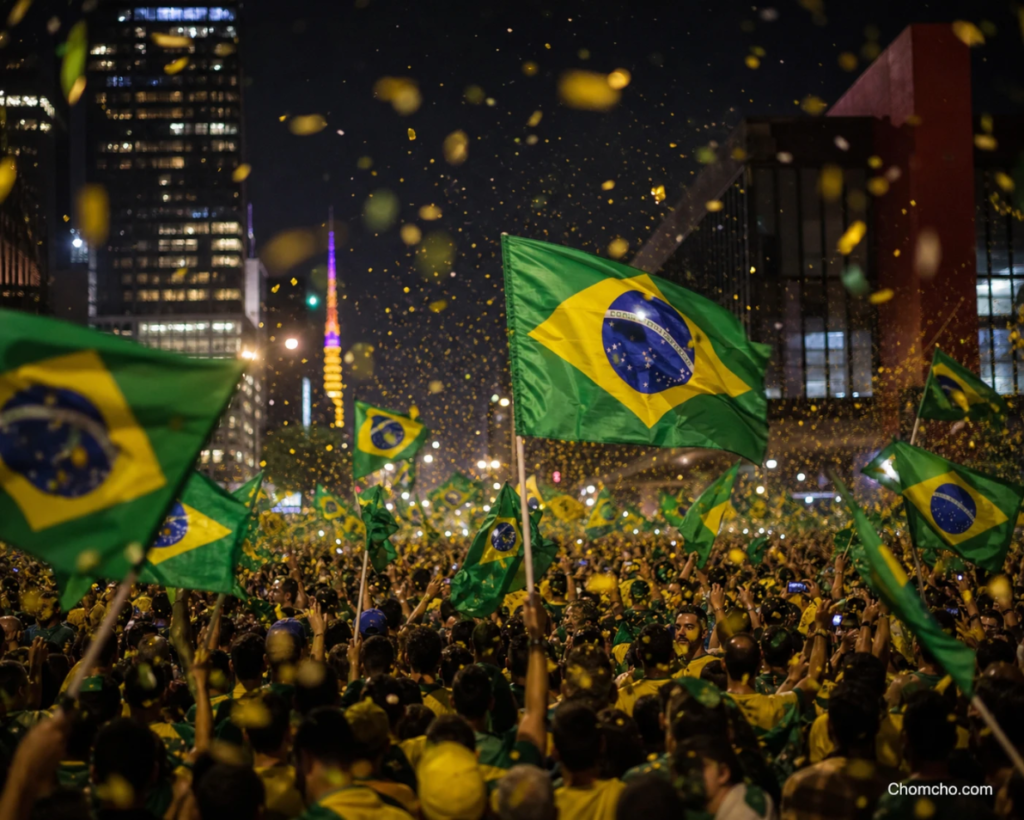
The polls said Lula; the voters said Flávio
The first round of the Brazil elections on October 4 produced two clear facts.
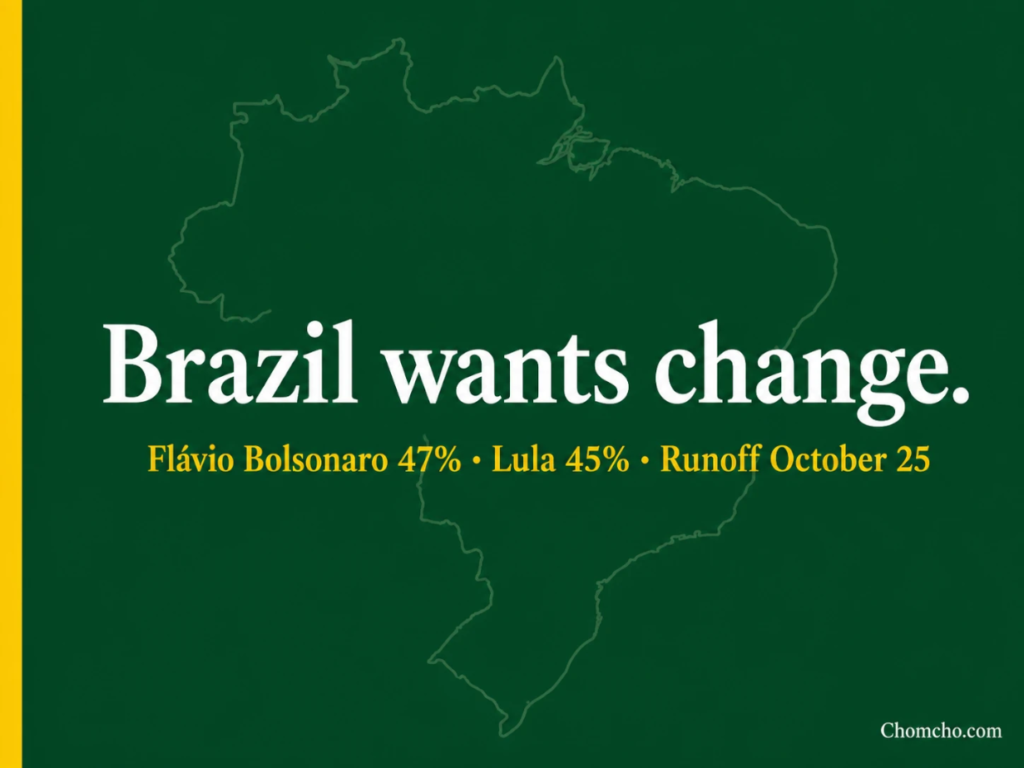
Senator Flávio Bolsonaro finished first with about 47 percent of the valid votes against 45 percent for President Luiz Inácio Lula da Silva, 56.1 million votes to 53.9 million. And the pollsters, once again, got it wrong.
Neither man reached 50 percent, so the runoff is set for October 25.
The three most watched polling houses all had Lula ahead in their final surveys: Datafolha by three points, Quaest by one, and AtlasIntel by about three.
“Brazil wants change,” Flávio told his supporters. Lula, 80, admitted he had expected to win outright.
The markets voted too.
On Monday morning, October 5, the Bovespa, Brazil’s main stock index, jumped more than 8 percent and passed 205,000 points, while the Brazilian real, the national currency, gained more than 4 percent against the dollar.
Investors see in Flávio a promise of fiscal discipline in a country whose nominal deficit reached almost 10 percent of GDP in June.
Brazilians abroad split. Overall, Lula won the overseas vote, 47.6 percent to 43.5, and led in 64 countries to Flávio’s 36.
But in the United States, Flávio took 61.1 percent against 31.7 for Lula, and in Japan 71.8 percent against 15.3. Perhaps that also says something about the conservative political mood in those two countries. We certainly hope so.
Who is Flávio
In Brazil he is simply “Flávio,” to tell him apart from his father, former president Jair Bolsonaro. He is only 45, a senator from Rio de Janeiro and the eldest son.
Like Abelardo de la Espriella in Colombia and Keiko Fujimori in Peru, Flávio campaigned strongly on crime, alongside the cost of living.
His platform would declare Brazil’s two largest criminal gangs, the PCC (First Command of the Capital) and the Comando Vermelho (Red Command), narco-terrorist organizations.
“We will designate them terrorist groups,” he has promised.
Flávio will not be alone in the runoff. Romeu Zema, the former governor of Minas Gerais who finished sixth, endorsed Flávio on Monday, October 5, against Lula’s Workers’ Party (PT): “A vote against the PT is a vote for Flávio Bolsonaro.” Ronaldo Caiado, former governor of Goiás and also a first-round candidate, had long told Flávio that the two men would support each other in a runoff.
Congress also shifted in Flávio’s favor: his Liberal Party (PL) elected 19 senators and 121 federal deputies, the largest bloc in both chambers.
No president can change Brazil without Congress, and Flávio would start with a friendly Congress.
The first runoff poll, by AtlasIntel, gives Lula a slight edge: 50.1 percent to 49.9. Readers should treat it with caution.
The same houses favored Lula before the October 4 vote, AtlasIntel’s own final survey had him ahead by three points, and the voters said otherwise. Polls that miss the first round have little credibility left for the second.
The judge, the father and the censors
To understand why this result matters, look at what happened to the Bolsonaro family.
Jair Bolsonaro was sentenced to 27 years for supposedly plotting a coup after his 2022 defeat; Donald Trump called the trial a “witch hunt.”
The case was run by Supreme Court Justice Alexandre de Moraes, who placed the former president under house arrest with an electronic ankle monitor.
In July 2025 Moraes also barred Jair Bolsonaro from social media, directly or through third parties, including his interviews, under threat of prison.
Jair Bolsonaro went to prison in November 2025 and has been under humanitarian house arrest since March 2026, for health reasons.
The pressure reached the rest of the family.
In June 2026, the Supreme Court sentenced Jair Bolsonaro’s son Eduardo, a former federal deputy, to more than four years in prison for seeking American support for his father.
The pressure also reached the press and social media platforms.
Moraes ordered the suspension of accounts belonging to Bolsonaro supporters, and in 2024 he shut down X across Brazil after the company said he had threatened its legal representative with arrest.
Elon Musk, the owner of X, called Moraes “a criminal cosplaying a judge.” In 2025 Moraes also blocked the video platform Rumble, which denounced “unprecedented censorship.”
Now Moraes faces questions of his own.
The law firm of Moraes’s wife, Viviane Barci de Moraes, held a three-year contract worth 131 million reais, about 25 million dollars, with Banco Master, the bank at the center of Brazil’s biggest financial scandal.
Moraes denies wrongdoing, and in September 2026 the Supreme Court postponed a decision on whether to open a formal investigation of Moraes.
In our view, the same left and the same globalist allies that tried to put Trump in prison in the United States succeeded in imprisoning Trump’s ally Jair Bolsonaro in Brazil.
That is why a Flávio victory would mean more than just a change of government: it would mean that political persecution does not pay. He has said he would pardon his father.
In fairness to our readers, Flávio is also under investigation, over money that jailed banker Daniel Vorcaro, the former owner of Banco Master, provided for “Dark Horse,” a film about Jair Bolsonaro.
That case is now part of the campaign. The Brazilian public will decide whether this accusation is legitimate.
Washington watches closely
The White House never formally endorsed Flávio, and Lula’s campaign still accuses the Trump administration of interfering.
But the signals are clear. On Monday, October 5, Trump called the first round a “great victory” and predicted a very close runoff. He met Flávio in May 2026 and described him as a smart young man who loves his country.
U.S. Secretary of State Marco Rubio thanked Flávio in June 2026 for a “generous offer” to put a transition team at Washington’s disposal.
And in May, at Flávio’s request, Washington designated the PCC and the Comando Vermelho as foreign terrorist organizations.
“May God have mercy on our brother country”
Latin America’s new right celebrated before the count was over.
Argentina’s President Javier Milei called it a historic election against the communist Lula.
Colombia’s president Abelardo de la Espriella wrote: “Today my heart is with Brazil; may God have mercy on our brother country as He did with Colombia. The real change is defeating the left.” He ended his post with: “Long live Christ the King!”
Venezuela’s María Corina Machado, Colombia’s former president Iván Duque and Colombian right-wing politician María Fernanda Cabal also celebrated.
Argentina, Chile, Colombia and Peru have already turned to the right. Brazil, with more than 200 million people, is the prize that would make the new majority complete.
Spain: the same test across the Atlantic
On Monday, October 5, Spain’s socialist prime minister Pedro Sánchez called early elections for November 29, after Congress rejected his two housing decrees.
Sánchez expects the housing crisis to help him. But he is weakened by corruption cases involving people close to his Socialist party and by the Ceuta crisis: about 60,000 people crossed from Morocco into the Spanish enclave in late July 2026.
Before that, Sánchez opened an amnesty for undocumented migrants that drew 1,174,978 applications against a forecast of 500,000.
Europe pushed back. “Italy will not stand idly by,” said Italian Prime Minister Giorgia Meloni, who called for Spain’s suspension from the Schengen free-travel area and reimposed checks on arrivals from Spain, while France added controls on its border.
Sánchez called the reaction “selfish, polarising and unlawful.”
Two left-wing governments, in Brasília and Madrid, now face voters within eight weeks.
What a Flávio presidency means for Washington
For American foreign policy, the October 25 runoff is the most important election in the hemisphere in 2026.
Under Lula, relations with Washington came close to breaking. After Brazil put Jair Bolsonaro on trial, Trump imposed several rounds of tariffs that reached 50 percent on many Brazilian goods.
Rubio also placed visa restrictions on Moraes and his judicial allies.
Lula answered with defiance: he called Rubio a “frustrated Latin American,” a Cuban descendant from Miami who hates Brazil, and built his campaign on opposing Trump.
Rubio replied that Lula had put his ego ahead of a deal for the Brazilian people.
A meeting between Lula and Trump at the White House in May 2026 briefly improved relations, but in June the U.S. government proposed new 25 percent tariffs on Brazilian goods and Lula said Brazil could “not accept the treatment.” That dispute is still open.
Flávio offers the opposite.
He has promised to join the “Shield of the Americas,” Trump’s regional security alliance against drug cartels, to seek a free trade agreement with the United States right away, and to cooperate against the PCC and the Comando Vermelho.
His platform names the United States, Israel and Argentina as Brazil’s priority partners and seeks membership in the OECD, the Paris-based club of 38 market democracies.
From an American foreign policy perspective, the key issue is rare earths.
Brazil holds the world’s second-largest rare earth reserves, after China, and Washington also wants its graphite, nickel and niobium as it tries to reduce its dependence on Chinese supply chains.
In March, Flávio told CPAC that Brazil could help end America’s dependence on China for rare earths.
That offer could become Flávio’s main bargaining tool to obtain lower U.S. tariffs, and a Brazil that supplies the minerals of the future would turn a quarrel into a partnership.
BRICS, the bloc of emerging economies that includes China and Russia, is the unresolved question. His platform does not mention the bloc at all. He has criticized plans to trade outside the dollar and has suggested leaving the bloc, but he has not committed to it, and some experts expect Brazil to stay in both BRICS and Mercosur.
Realism matters here. China has been Brazil’s largest trading partner since 2009, and Brazil will keep selling China soybeans and iron ore.
Experts expect Flávio to align with Washington on security while keeping his economic ties with Beijing. That is the line Peru and Argentina have chosen: trade with China, trust the United States.
Lula tried to balance between Washington and Beijing. Flávio would choose a side on security, and that alone would change the hemisphere. Brazil will keep selling to China, but it would choose Washington as its main ally.
On October 25, the Brazil elections could turn South America’s largest country into Washington’s largest partner.
That is a change worth praying for.