
This post is also available in:
 Português
  Español
  Français
  Deutsch
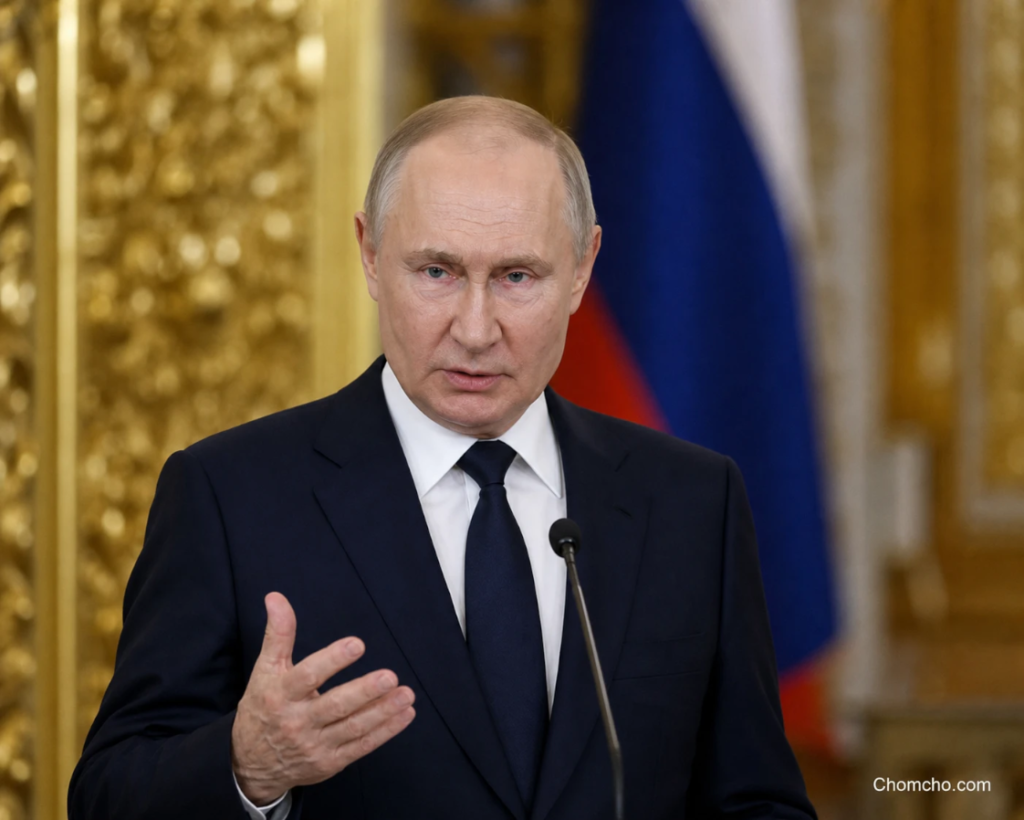
Putin speaks on the 25th anniversary of 9/11
On September 11, of all dates, Vladimir Putin issued a war warning. Any deployment of European troops to Ukraine, he said, “means a war against Russia.”
In the same breath he assured the world that Moscow threatens nobody: European leaders “are frightening their populations with an imaginary threat coming from Russia,” a threat that “does not exist and has never existed.”
Both halves of that statement deserve scrutiny, because both halves serve him.
A year-old pledge and its fine print
The troop plan Putin denounced is real, but older than the headlines suggest.
On September 4 of last year, at a Paris summit co-chaired by Emmanuel Macron and then-Prime Minister Keir Starmer, 26 countries of the so-called coalition of the willing “formally committed” to deploy a reassurance force in Ukraine, on the ground, at sea, or in the air, once a ceasefire or peace is signed.
Read the fine print. Macron never published the list of the 26. Poland, the country with the most at stake, publicly ruled out sending ground troops.
And Zelensky himself confessed the quiet part: “We are counting on a US backstop.”
A year later, Starmer is gone, replaced by Andy Burnham, and the plan’s first test is only now arriving.
Macron announced in August that the coalition will hold its first large-scale joint exercises in October and November, expected in Poland, to demonstrate what he called its operational readiness.
Italy, a coalition member, refused to participate at all, repeating its no to Italian soldiers in Ukraine. Europe plans; America is expected to underwrite.
The numbers behind the Russia threat to Europe
Now the arithmetic the fear-mongers skip.
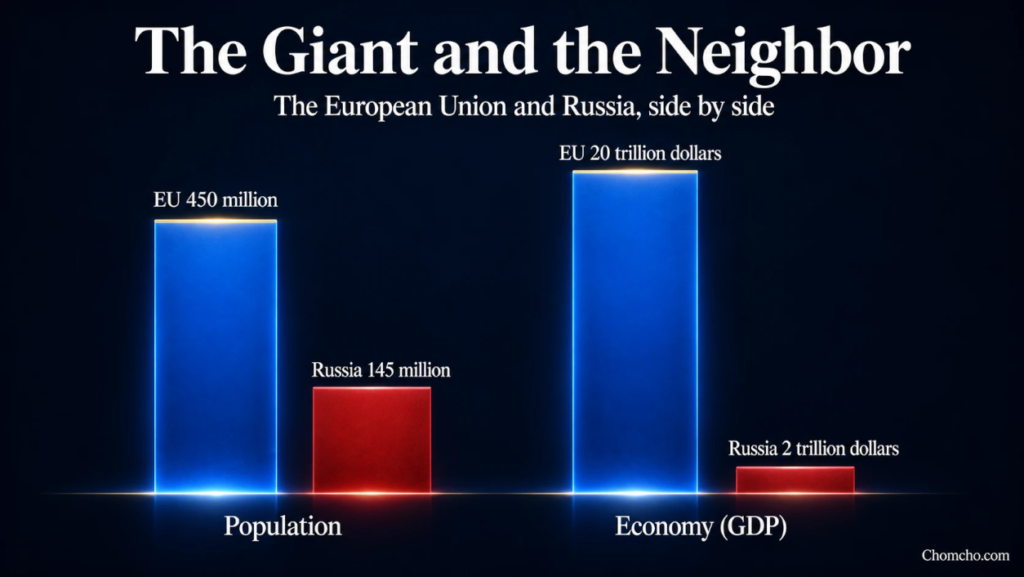
The European Union holds about 450 million people; Russia holds about 145 million. The EU economy produces close to 20 trillion dollars a year; Russia’s produces roughly 2 trillion.
Three to one in people, nearly ten to one in money, before counting Britain or the United States. This is the giant that trembles.
Let it be said plainly, because honesty is the difference between analysis and propaganda: Putin is an aggressor whose word is worthless.
He launched the largest land war in Europe since 1945, his drones have violated NATO airspace, and for Poland and the Baltic states the Russia threat to Europe is not a theory but a neighbor.
Yet a Russia that after years of grinding war struggles to conquer the Donbas is not marching on Paris or Madrid.
The probability of a Russian attack on Western Europe is near zero, and every serious planner knows it.
Fear as a business model
Why, then, the sirens? Because the globalist establishment thrives on fear.
Fear built the pandemic bureaucracies; fear now builds the war budgets, the common debt, and the emergency powers.
A frightened population asks few questions.
The elites also have their private quarrel with Putin: he is a useful monster for leaders whose own economies stagnate and whose own voters drift toward national conservatism.
There is a second, unspoken engine of the panic: Donald Trump is withdrawing American troops and resources from the continent, including 5,000 from Germany after Chancellor Friedrich Merz sneered that the United States was being “humiliated” in the Iran conflict.
Europe’s free security guard is going home.
The leaders do not like it. Too bad.
Where are the soldiers?
Fear needs armies, and armies need men.
Europe is short roughly 100,000 soldiers, and most of its armies miss their recruitment or retention targets, from Britain, whose army has missed them for over a decade, to Greece, Portugal, and the smaller states, which struggle worst of all.
Germany, after an all-out push, finally grew the Bundeswehr to about 186,700 this summer, its best figure in 13 years and still barely a third of the way to its own 2035 goal.
France fills its ranks, but by its army’s own deputy chief’s admission, lacks the equipment to give them.
Behind the recruiting posters sits demography.
Europe’s youth pool is shrinking, and war consumes exactly the young men a shrinking nation cannot spare.
Ukraine is the warning. Its working-age population has fallen by about 40 percent since 2022, and the country that held 41 million people in 2021 holds perhaps 33 million today.
With its own men at the front or abroad, Kyiv now imports laborers from India and Bangladesh: cleaning crews in Ivano-Frankivsk, factory shifts in Zakarpattia.
Meanwhile migration into Europe runs disproportionately male and from the Third World.
A continent that sends its sons to die while importing other nations’ sons to replace them is not defending its civilization; it is exchanging it.
Stating this is not hatred; it is arithmetic.
Planes, carriers, and closing factories
The hardware tells the same story.
France and Germany could not even agree on building a fighter jet together: the FCAS program collapsed, and Spain, which had bet its air force on it, learned of the burial without being consulted, as we reported at the time.
Britain’s attack submarines went through an availability crisis we also covered. France’s single aircraft carrier spends long stretches of its life in maintenance, with no sister ship to fill the gap.
Beneath the weapons lies the industrial base, and it is thinning.
German assembly lines fall quiet while Chinese carmakers open plants on European soil; overregulation strangles what remains, and Europe is a spectator in the AI race between America and China.
In a real war, factories must convert to war production. Fewer factories, less conversion.
The United States shares a milder case of the same disease, which is precisely why Trump keeps forcing industry home.
The voters nobody asked
And the citizens? No European electorate has ever been asked at the ballot box whether to send troops to Ukraine.
When pollsters ask instead, the answer is clear: in the European Council on Foreign Relations’ May 2026 survey of 19,481 people across 15 countries, majorities opposed sending their own soldiers even after a peace deal, with support at 28 percent in Germany, 23 percent in France, and 30 percent in Poland.
The war consensus is an elite consensus. The people never enlisted in it.
The threat from within
JD Vance told the Munich Security Conference the truth to its face: the threat that worries him most for Europe is not Russia and not China, but “the threat from within,” a civilization retreating from its own values while unvetted mass migration transforms its cities.
On that point, the numbers above are his witnesses.
A Europe that cannot recruit its own sons, keep its own factories, or consult its own voters has problems no Russian did to it.
Peace through strength, not through babysitting
America’s interest is a Europe that is secure, armed, and off the American payroll: peace through strength replaces peace through American babysitting.
What America is not obliged to underwrite is contempt.
Merz tells German youth he would not recommend they study or work in the United States.
France’s own UN mission in Geneva tweeted that America is no longer “a beacon of human rights” and “stands alongside North Korea,” language so poisonous that US diplomats walked out of a Security Council meeting in response.
These are the governments planning a tripwire force in Ukraine on the assumption that American power will rescue it if Putin calls the bluff.
So let the matter be stated as the numbers state it.
The Russia threat to Europe is theoretically possible, as almost anything is, but it is real only where Russia has borders and near zero where the globalists need it most.
A civilization of 450 million with a 20 trillion dollar economy does not need American sons or manufactured fear to handle a neighbor one-tenth its size.
It needs soldiers, factories, honest leaders, and the consent of its own people.
Strength, not fear, keeps the peace.
Fear is the globalists’ currency. Don’t buy it.