
This post is also available in:
 Português
  Español
  Français
  Deutsch
  Italiano
  Русский
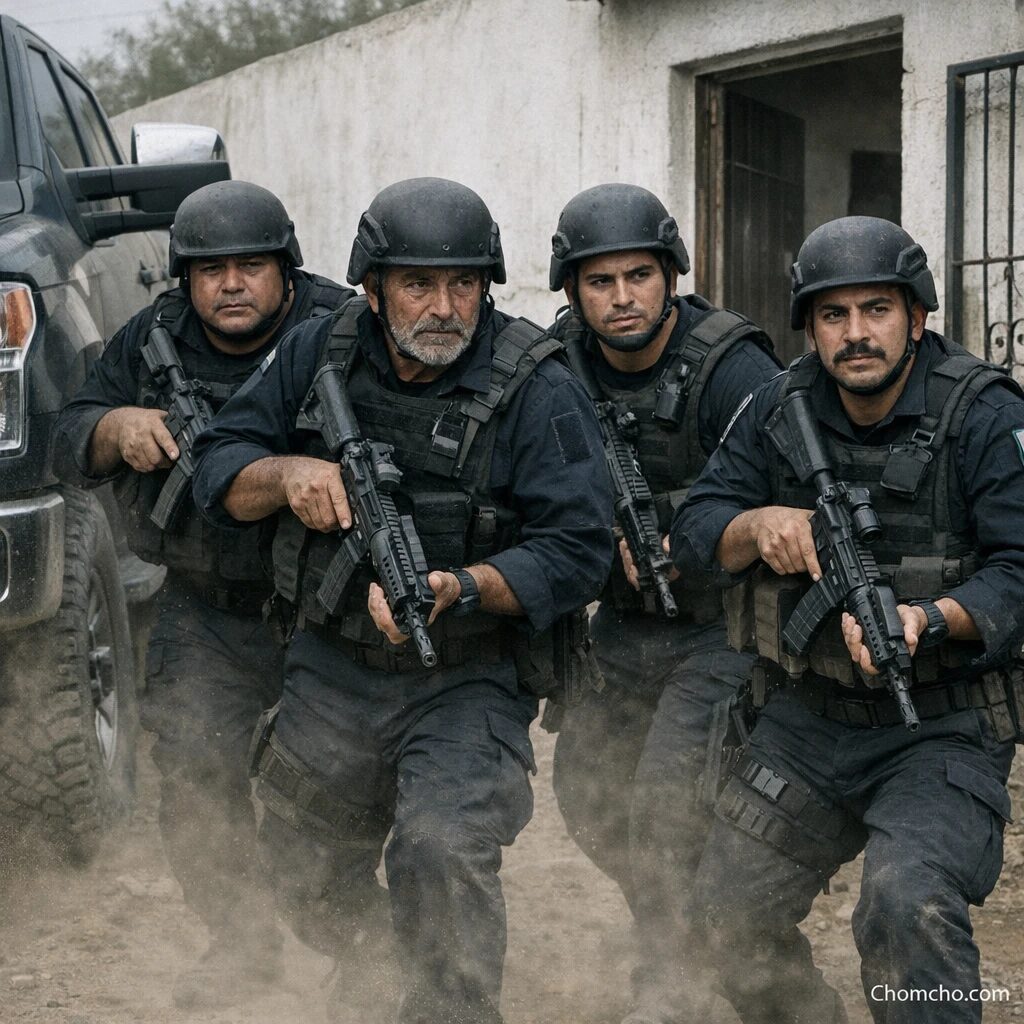
Police officers raiding homes under cartel orders reveal the true depth of Mexico cartel corruption.
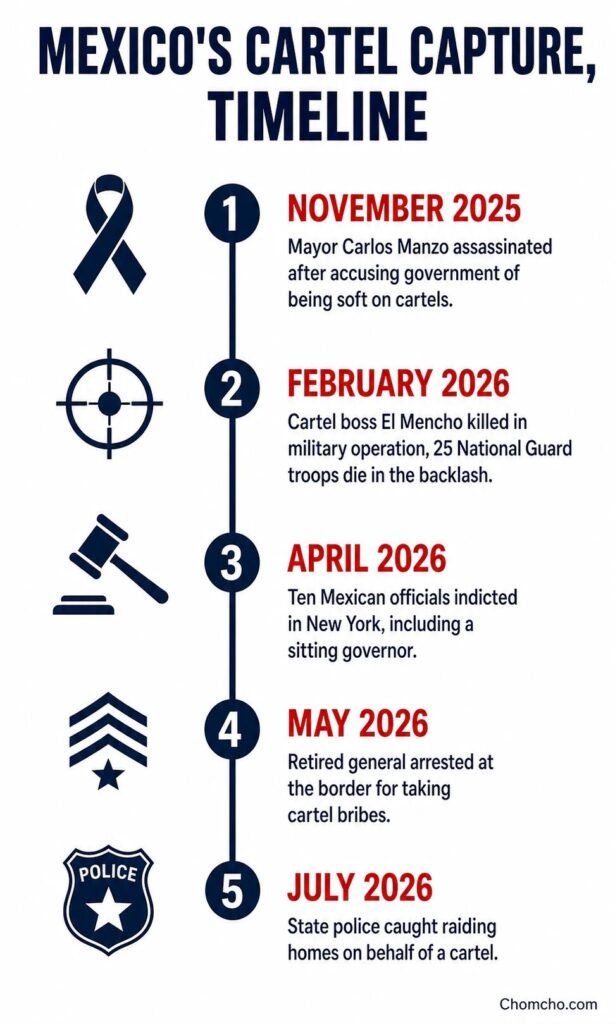
On July 18, Breitbart News Foundation published photographs that appear to show Michoacan state police carrying out raids on behalf of the criminal organization United Cartels.
According to the report, two high-ranking commanders, Marco Tulio Vertiz Rodriguez and Romualdo Albiter Rebollar, lead these operations, taking orders from cartel figure Carmelo Alvarez Espinoza, and use police power to attack the cartel’s rivals.
The people of Apatzingan responded the only way they safely can. Banners appeared across the city, addressed to Michoacan Governor Alfredo Ramirez Bedolla, begging him to act against his own police commanders.
That plea faces a problem.
Breitbart previously reported that the same governor is related to two cartel bosses currently serving sentences in US prisons.
When the police wear the uniform of the state but serve the cartel, there is a name for that: a captured state.
A mayor, a general, a governor, and a cartel boss
The Michoacan raids are not an isolated scandal. They are the newest chapter in a story that has accelerated over the past year.
In November 2025, Carlos Manzo, the mayor of Uruapan, Michoacan, was assassinated after publicly accusing the federal government of being soft on the cartels.
His murder sparked mass protests across Mexico demanding a real fight against organized crime.
In April, prosecutors in New York indicted ten Mexican officials and politicians on drug trafficking charges, including the sitting governor of Sinaloa, Ruben Rocha Moya.
In May, US Marshals arrested retired General Gerardo Merida Sanchez at the Arizona border.
The general, once director of Mexico’s Military Intelligence School, allegedly received 100,000 dollars per month from Los Chapitos to warn the cartel about police raids.
He now sits in a Brooklyn federal prison, in the same block as El Mayo Zambada and Nicolas Maduro.
And in February, Mexican forces, supported by US intelligence, killed Nemesio Oseguera, El Mencho, the leader of the Jalisco New Generation Cartel and one of the most wanted criminals on the planet.
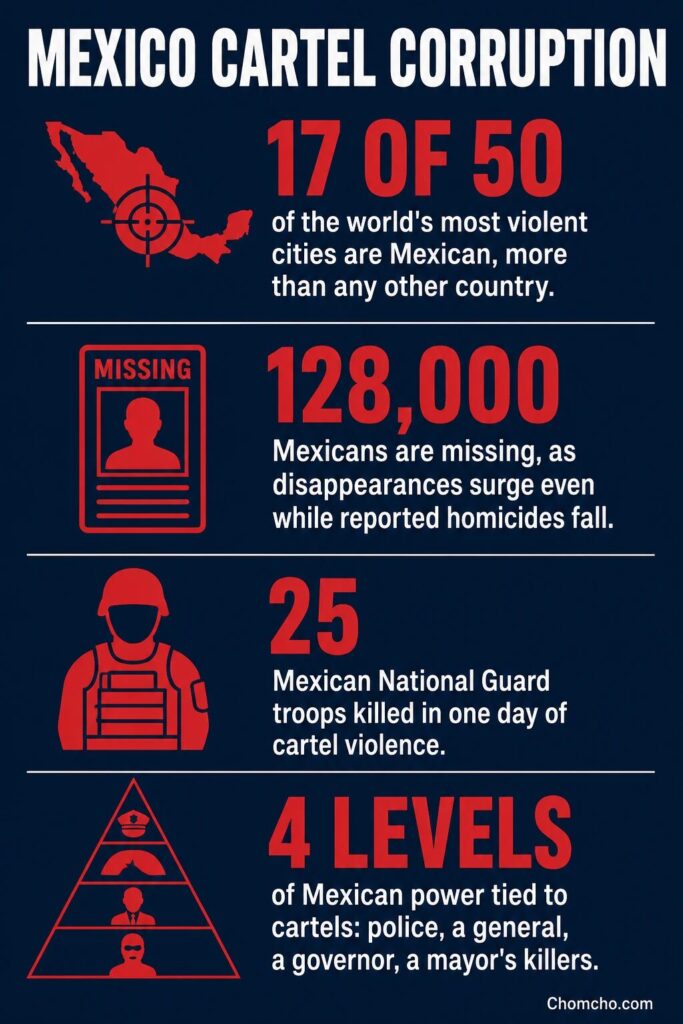
The cartels answered with roadblocks and burning vehicles across several states. Twenty-five members of Mexico’s National Guard died in the violence, the worst single day for Mexican security forces in many years.
A murdered mayor. An indicted governor. A bribed general. Police commanders raiding for the cartel. These are not separate stories. They are one story.
The numbers that cannot be denied
If the cases sound like exceptions, the statistics remove all doubt.
According to Seguridad Justicia y Paz, the Mexican civil organization that has tracked this data for years, 17 of the world’s 50 most violent cities are Mexican, more than any other country on Earth.
Mexican cities dropped out of the world’s top 10 most violent list this year, and the government points to falling homicide numbers as proof its strategy works.
But critics note something troubling: as homicides fall, disappearances have surged roughly 200 percent over the past decade, with an estimated 128,000 people now missing.
A body that is never found cannot be counted as a homicide.
Six of this year’s ten most violent cities are in Ecuador, driven largely by criminal factions tied to Mexican cartels.
Two Michoacan cities, Zamora and Jacona, made the full list of 50. The same state where the police now raid homes for the cartel.
What does no war against the narco really mean?
Now we arrive at the words of Mexican President Claudia Sheinbaum, spoken in 2025 and repeated in spirit ever since:
“Returning to the war against the narco is not an option. First, because it is outside the framework of the law.”
We have an honest question. What exactly does she mean by no “war against the narco”?
War is a military term. But Mexico already uses its military for daily law enforcement.
The army patrols the streets. The National Guard runs checkpoints. The navy marines have captured cartel bosses for years, including El Chapo himself. And it was a military operation, under her own government, that killed El Mencho in February.
So the line the president draws between war and law enforcement does not exist in Mexican practice.
Her military can patrol, guard, and even eliminate one cartel leader. But confronting the cartels as organizations is, in her words, not an option.
Mexicans are asking the obvious question. If not war, and not full law enforcement, then what remains? Coexistence?
The world’s richest man asked the question out loud
In January 2025, Elon Musk reposted an accusation on X claiming that billionaire Carlos Slim has ties to Mexican organized crime, adding only an emoji suggesting the matter deserved a closer look.
Musk wrote no accusation himself.
Reports spread that Slim responded by canceling billions of dollars in Starlink contracts, though those reports were never confirmed by Slim, América Móvil, or Starlink directly, and no major financial news outlet verified them.
True or not, the story itself reveals something. A single social media post was enough to make people believe a Mexican billionaire had cartel ties.
Then, in February 2026, one day after El Mencho’s death, Musk went further and wrote his own words about President Sheinbaum: “She’s just saying what her cartel bosses tell her to say.”
Her response: “We are considering whether to take legal action.”
Let us be clear about our position.
Nobody has proven these accusations, and we do not present them as facts.
But notice what the responses were: an unverified but widely believed business fallout, and a legal threat.
Not one piece of evidence was offered to refute the underlying reality that cartels penetrate Mexican power at every level.
Trump’s pressure produces what speeches never did
Compare that record with Washington’s.
President Trump designated eight cartels and transnational gangs as Foreign Terrorist Organizations. He later designated illicit fentanyl and its core precursor chemicals as weapons of mass destruction.
When he tied trade agreements to results in early 2025, Mexico sent 10,000 National Guard troops to the border within days.
Under his pressure, Mexico has transferred dozens of high-value cartel figures into US custody, and the CIA has operated against cartel targets on Mexican soil.
Even the fall of El Mencho carries Washington’s signature. The operation used US intelligence, and it came after months of escalating American pressure.
Trump claimed the victory in his State of the Union address: “We’ve also taken down one of the most sinister kingpins.”
Fairness requires the full picture: Mexican soldiers carried out the operation, and 25 of them paid with their own lives.
Both things are true. The pressure came from Washington, and the blood was Mexican.
Melissa Ford Maldonado of the America First Policy Institute explained the dynamic in one sentence: “Pressure is the only thing that compels the Mexican state to act.”
Trump himself has described Sheinbaum with two phrases that seem to contradict each other: a “brave lady” who is “so afraid of the cartels she can’t even think straight.”
Perhaps both are accurate. Personal courage is not the same thing as freedom to act when criminal organizations can reach anyone in the country.
Sovereignty is earned, not declared
Here at Chomcho, we believe the deepest irony is the word Mexico’s government uses most: sovereignty.
President Sheinbaum invokes sovereignty every time Washington offers help. But sovereignty is not a speech. It is control of your own territory.
A country where 17 of the world’s 50 most violent cities exist, where mayors are murdered for speaking, where governors are indicted and generals are bribed, and where police raid homes for the cartel, has already surrendered large parts of its sovereignty.
Not to America. To the cartels.
A stable Mexico is a direct American interest, and the reasons are simple. Mexico is our neighbor. It is one of our largest trade partners.
Also, a Mexico governed by law means less illegal immigration, less fentanyl crossing the border, and fewer American deaths.
America does not want to rule Mexico.
America wants a strong neighbor that rules itself.
With Mexico’s cooperation if possible. Without it if necessary.
The good guys are still stronger than the bad guys, and the pressure is working!