
This post is also available in:
 Português
  Español
  Français
  Deutsch
  Italiano
  Русский
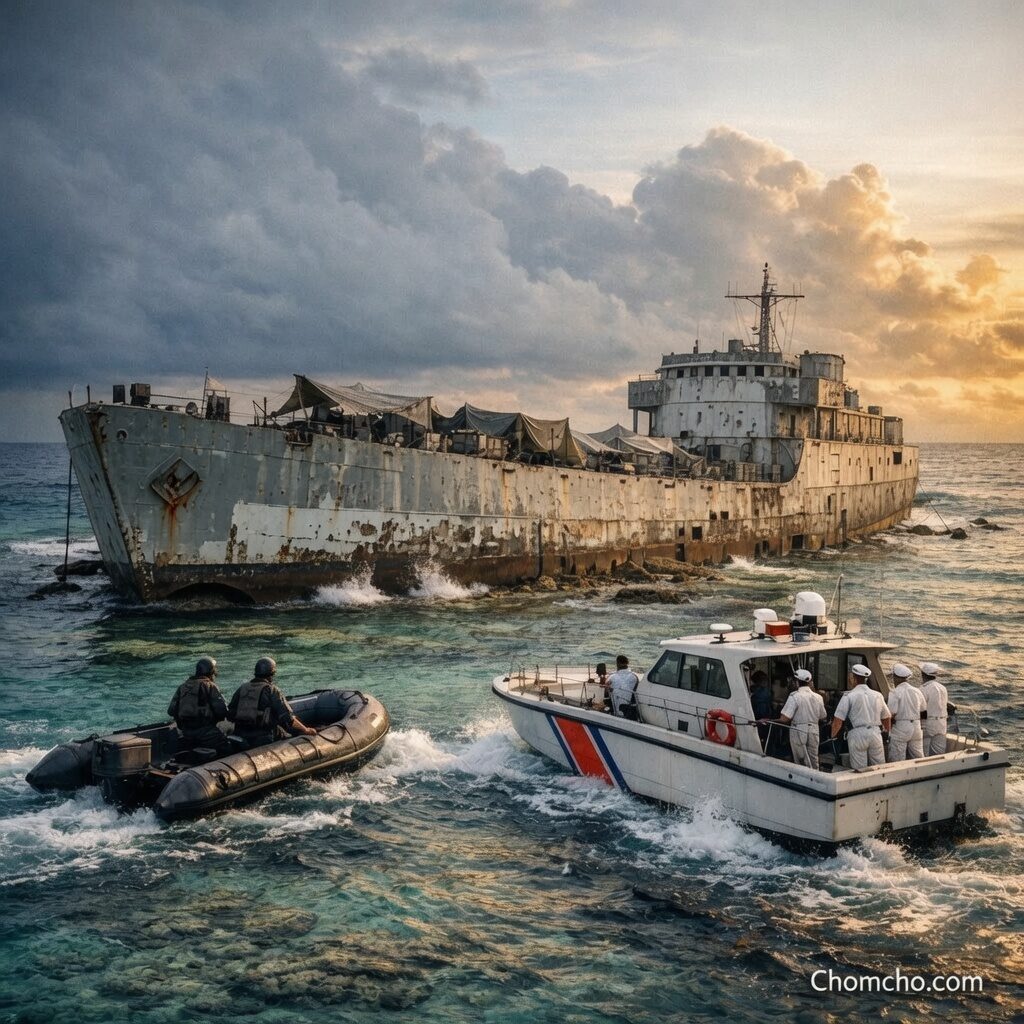
Filipino sailor injured at Second Thomas Shoal
On Monday, July 20, a Chinese coast guard officer repeatedly struck a Filipino sailor on the head with a wooden baton.
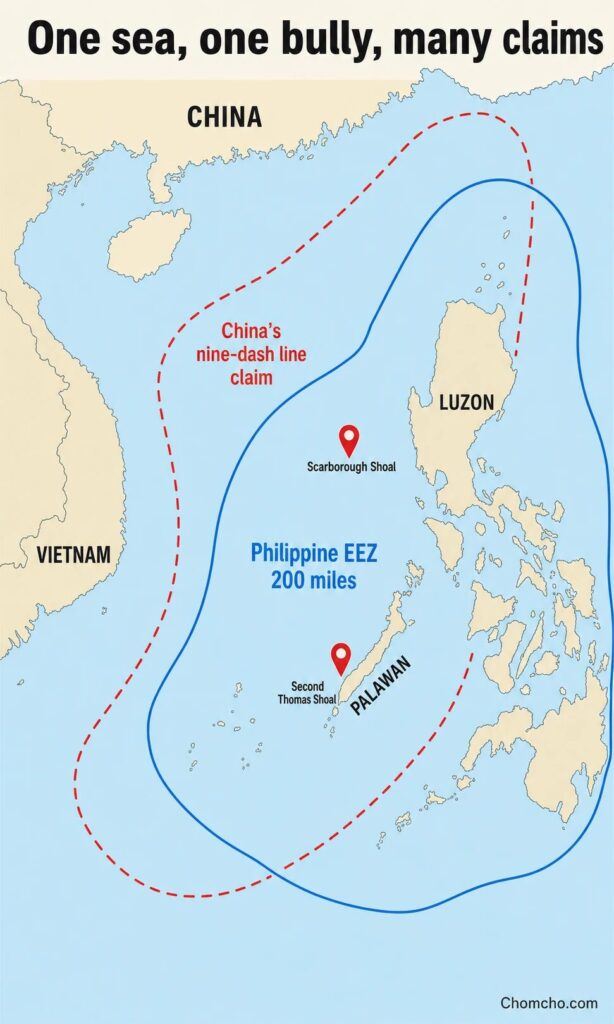
The attack happened at Second Thomas Shoal, a submerged reef that Filipinos call Ayungin, about 194 kilometers from the Philippine island of Palawan. The sailor suffered a gash on his head. His small navy boat was damaged.
The clash took place next to the BRP Sierra Madre, an old warship the Philippines deliberately grounded on the reef in 1999. A small detachment of marines lives aboard that rusting hull to defend the Philippine claim.
China calls the reef Ren’ai and claims it anyway, even though a 2016 international ruling in The Hague confirmed the shoal sits inside the Philippine exclusive economic zone.
Beijing simply rejects the ruling. For the Chinese Communist Party, international law only exists when it serves Beijing.
The diplomatic reaction was immediate.
President Ferdinand Marcos Jr. summoned Chinese Ambassador Jing Quan for the first time. Beijing summoned the Philippine ambassador in return.
The U.S. State Department condemned China’s “dangerous and aggressive actions” and demanded that Beijing “immediately cease its destabilizing conduct.”
The timing could not be worse for China. Two days later, its top diplomat arrived in Manila to talk about peace.
Inside the ASEAN summit in Manila
The attack happened on the opening day of the 59th ASEAN Foreign Ministers’ Meeting, hosted by the Philippines in Manila from July 20 to 24.
ASEAN, the Association of Southeast Asian Nations, now has 11 members: Brunei, Cambodia, Indonesia, Laos, Malaysia, Myanmar, the Philippines, Singapore, Thailand, Vietnam, and Timor-Leste, which joined in October 2025.
China is not a member. Neither is the United States.
Both attend as “dialogue partners” in the meetings that follow the main summit, together with India, Japan, South Korea, Russia, Australia, and others.
That is why Chinese Foreign Minister Wang Yi, U.S. Secretary of State Marco Rubio, and Indian External Affairs Minister S. Jaishankar are all in the same city this week.
The East Asia Summit closes the program on Thursday.
Two closed sea straits dominate the agenda
The ministers opened with a joint statement demanding an immediate halt to the renewed U.S.-Iran fighting and the full reopening of the Strait of Hormuz.
This confirms what we argued weeks ago: for Asia, the energy crisis matters as much as the Chinese threat.
Japan, South Korea, and most ASEAN economies depend heavily on imported Middle East oil. With Hormuz effectively closed by the war, every tanker matters.
Then the crisis doubled.
On the same day as the baton attack, the Iranian-backed Houthis declared a naval blockade of Saudi Arabia at the Bab el-Mandeb Strait, the narrow exit of the Red Sea.
That strait is only 29 kilometers wide at its narrowest point. Saudi Arabia had been using the Red Sea route as a relief valve while Hormuz stays blocked.
During the previous Houthi campaign, oil shipments through that corridor fell from 9.3 million barrels per day in 2023 to 4.1 million in 2024.
Two chokepoints under threat at the same time is a nightmare for Asian countries that depend on imported energy.
The ministers also discussed trade. In 2025, commerce between ASEAN and China reached one trillion dollars, a million millions, and both sides promised deeper economic integration.
Money keeps the smiles in place.
China talks peace but hits with wooden batons
Here is where the story becomes weird.
Speaking at the ASEAN-China conference in Manila, Wang Yi used a nautical metaphor: he promised that Beijing would be a source of stability for regional and global peace and development.
As we mentioned before, he said this two days after his coast guard clubbed a Filipino sailor on the head. He even blamed “certain forces within the Philippine military” for provoking the incidents.
The records tell a different story.
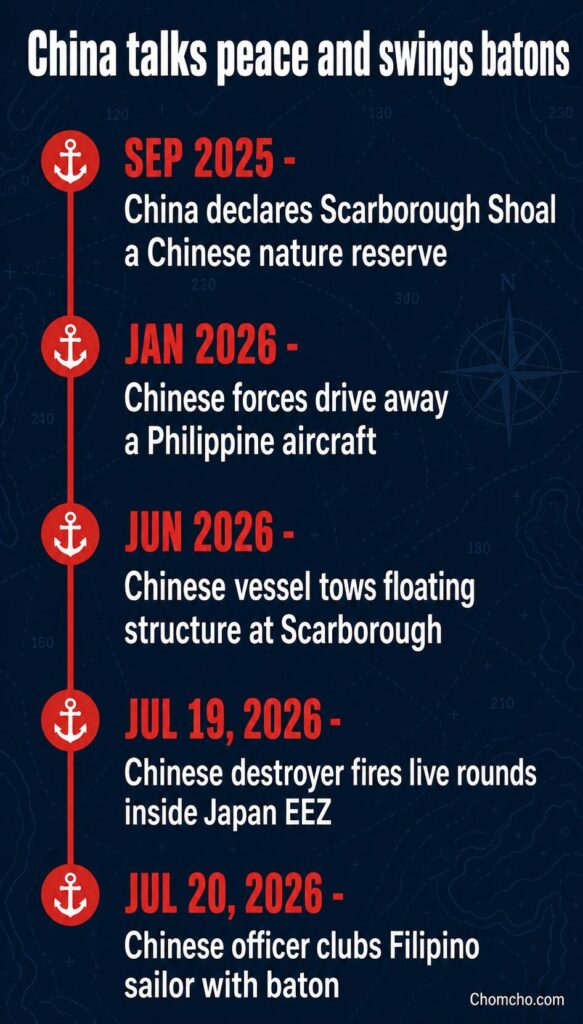
In September 2025, China unilaterally declared Scarborough Shoal, inside the Philippine economic zone, a Chinese “national nature reserve,” then fired water cannons at Philippine boats a week later.
In January 2026, Chinese forces drove away a Philippine government aircraft over the same shoal.
In June, a Chinese vessel was filmed towing a floating structure there.
And on July 19, one day before the baton attack, a Chinese destroyer fired live rounds inside Japan’s exclusive economic zone during a joint exercise with Russia, the first time Beijing has ever done so.
A source of stability does not hit sailors with wooden batons.
Beijing’s words and Beijing’s actions have never matched.
Soft words hide a quiet arms race
ASEAN’s answer to all of this will likely be another carefully worded communiqué.
The bloc has been negotiating a South China Sea Code of Conduct with China for about two decades. Officials again promise to finish it this year.
Nobody should hold their breath.
This is ASEAN weak diplomacy in its purest form: strong concern, zero consequences.
But watch what these countries do, not what they say.
The Philippines has expanded U.S. base access, signed new training deals, and bought BrahMos supersonic missiles from India.
Japan is selling military equipment to Manila and Hanoi to improve their maritime security.
Tokyo has good reasons: the same Chinese fleet that bullies the Philippines just fired live rounds inside Japanese economic waters. Japan is also rearming itself at a pace not seen since World War II, a subject we have covered before.
India presses its own claims: Indian External Affairs Minister S. Jaishankar met Wang in Manila and warned that peace along their border remains a “pre-requisite” for normal relations with China.
That warning has history behind it. In June 2020, Chinese and Indian soldiers fought hand to hand in the Galwan Valley, high in the Himalaya mountains. They used fists, stones, and iron bars. Twenty Indian soldiers died, and China admitted losing four. No shots were fired.
The pattern is the same from the Himalaya to the Philippine sea: Beijing pushes with physical force and calls itself peaceful.
Even Timor-Leste understands that joining the bloc means picking a side eventually.
Going back to the summit story, ASEAN countries will not challenge Beijing in public. The trade money is too big, or perhaps they fear provoking a powerful nation even more.
But these countries and some of their neighbors are quietly arming themselves because none of them trusts the Chinese Communist Party.
Weak in words, active in weapons.
Rubio brings strength to Manila
In our view, the United States is the only power in that room that backs its words with force.
Secretary of State Marco Rubio (@marcorubio) is meeting Wang Yi and President Marcos this week, carrying a simple message: the U.S.-Philippines Mutual Defense Treaty covers Philippine vessels and personnel in the South China Sea.
Touch them and you answer to America.
That is the difference President Trump (@realDonaldTrump) understands.
Communiqués did not stop the wooden baton. Deterrence is the only language that Beijing respects. While ASEAN drafts its paragraphs, Washington positions its forces. Peace Through Strength is not a slogan; it is the only policy with a track record.
The lesson from Manila is clear. ASEAN weak diplomacy produces documents, American strength produces deterrence, and small nations are quietly betting on strength.
Pray for the wounded Filipino sailor and for a free Indo-Pacific.