
This post is also available in:
 Português
  Español
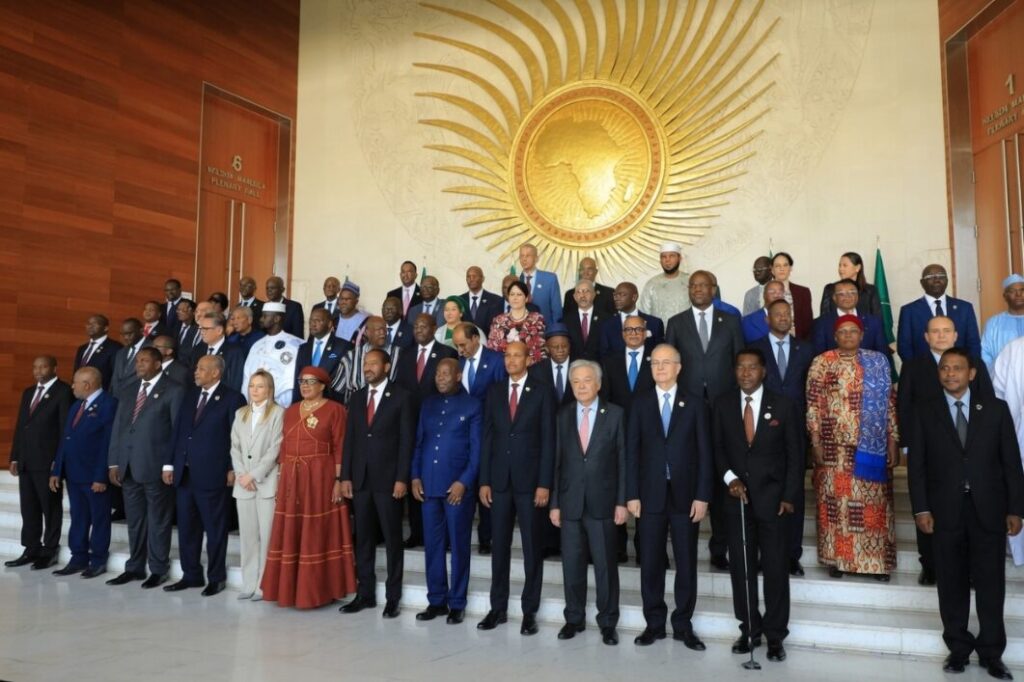
A new race for minerals has exposed the depth of the Africa integration crisis.
This week, officials in the Democratic Republic of the Congo praised their growing partnership with the United States as the global race for African minerals intensifies.
The American company Virtus Minerals now operates two cobalt and copper mines in the Congo, the first US-owned mining operation there in more than a decade.
The foundation was signed in December, when President Trump sealed a minerals-for-security agreement with the Congolese government known as the Washington Accord.
Trump called it “a great day for Africa, a great day for the world.”
This month, KoBold Metals, a mining company backed by investors including Jeff Bezos, also signed a preliminary agreement to explore Manono, one of the largest undeveloped lithium deposits on the planet.
Beijing is not standing still.
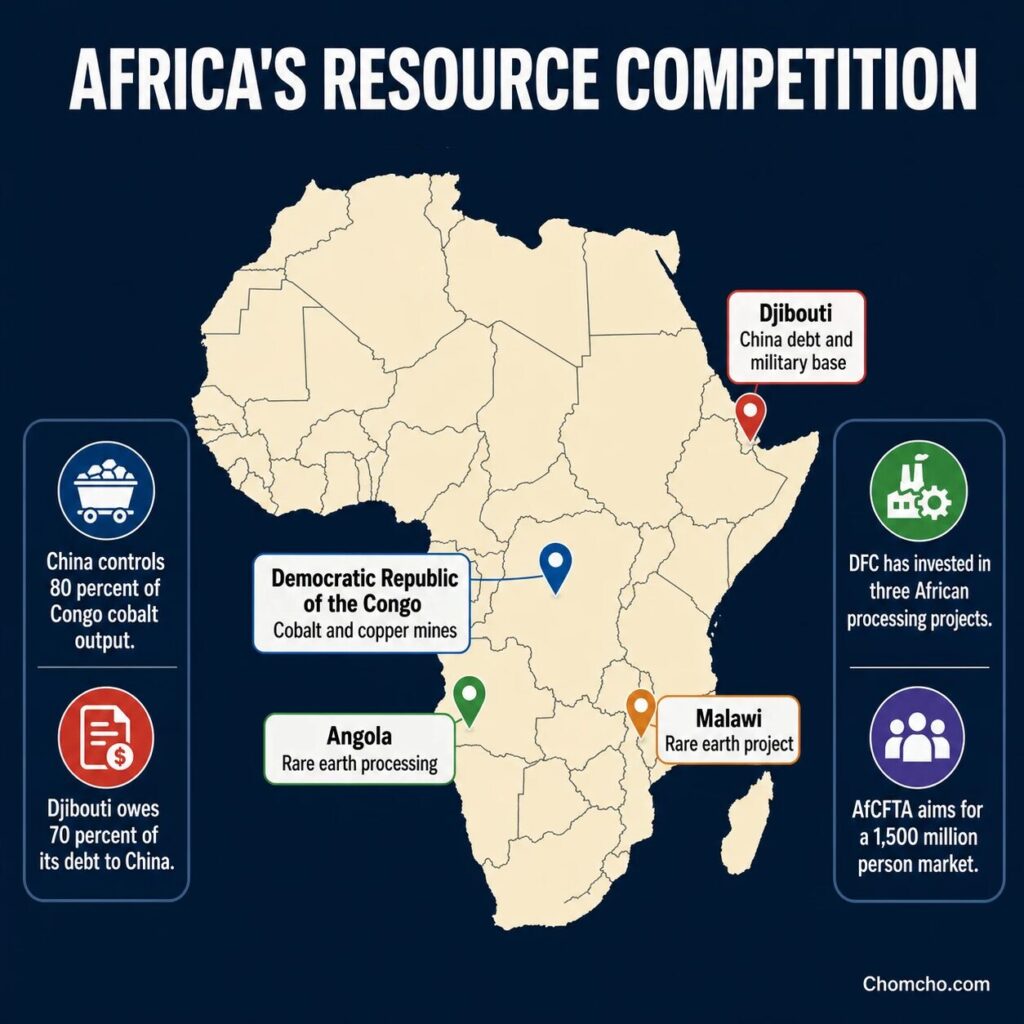
In March, China deepened its own mining agreement with the Congo, and Chinese companies still control roughly 80 percent of Congolese cobalt production through 15 of the 19 major mines.
All of this raises the question that frames this article.
Should the great powers look at Africa only as a warehouse of minerals to extract?
Or should they treat Africa as a future partner in real economic development?
The answer will decide whether history repeats itself.
A continent of 2,500 million people
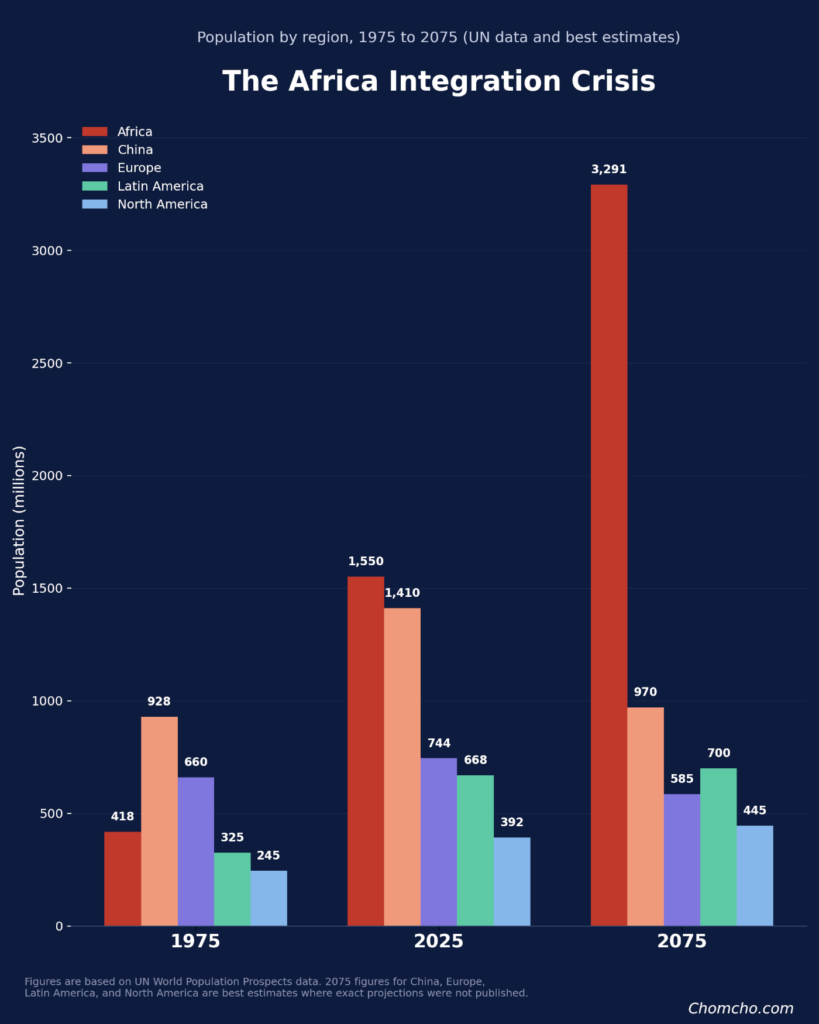
Africa is the youngest and fastest-growing region on Earth. Its population is projected to reach about 2,500 million people by 2050, roughly one out of every four human beings.
The contrast with the rest of the world is dramatic. Europe is aging and shrinking. East Asia, including China, has already started its decline. Africa keeps growing for the rest of the century.
The continent also holds enormous natural wealth: cobalt, copper, lithium, rare earth minerals, gold, oil, and some of the greatest untapped hydroelectric potential in the world.
What it lacks is infrastructure.
Weak transport networks, unreliable electricity, and almost no industrial processing capacity mean the wealth leaves Africa raw and returns as expensive imported products.
This demographic explosion also explains something we have covered many times: the growing migration pressure on Europe and, to a lesser extent, the United States.
A young continent without jobs will send its youth somewhere else.
A continent at war with itself
The security picture is equally serious.
According to the French geopolitical institute IRIS, 21 African states currently face a major crisis or armed conflict. Nearly 78 percent of all United Nations peacekeeping troops in the world are deployed in Africa.
The old European security presence is gone. France, the former colonial power in West Africa, was expelled from Mali, Burkina Faso, and Niger by military juntas.
It was a symbolic end to the colonial era, but honesty requires saying it clearly: whatever their colonial past, until recently, French troops were a positive force in the region. They had contained the jihadist expansion in the Sahel for years.
Their departure left a vacuum. Russia filled it.
The Africa Corps, the Kremlin’s rebranded version of the Wagner mercenary group, now protects the juntas in Mali and the Central African Republic.
The price is paid in gold and mining concessions.
Mali’s junta pays roughly 10 million dollars per month for about 2,000 Russian fighters, while jihadist violence has grown worse, not better.
Faith as a battlefield
There is another dimension of African stability that Washington is finally taking seriously: religion.
This week, the US military command for Africa, known as AFRICOM, held its West Africa Religious Affairs Symposium in Accra, Ghana.
Military chaplains from West African nations gathered to discuss what AFRICOM calls the decisive role of faith in regional stability.
One American chaplain described a Catholic priest and a Muslim chaplain working together to support a military unit, saying “that isn’t just religious tolerance, it’s operational strength.”
We respect the intention, and peace is always the objective. But history invites caution.
Cardinal Robert Sarah, the Guinean prelate and one of Africa’s most respected Catholic voices, warned the European Parliament just days ago that radical Islam is one of the “apocalyptic beasts” threatening both Africa and Europe.
Bishop John Niyiring of Kano, Nigeria, put it more simply: “There is always that fear between Christianity and Islam.”
The fear has reasons.
In Nigeria and across the Sahel, jihadist groups persecute and murder Christians with regularity, a tragedy that receives far too little attention in Western media.
The same religious tension shapes conflicts from the Middle East to the streets of Europe. Africa is not an exception. It is the front line.
The African Union’s uneven rise
Who speaks for Africa in all of this? In theory, the African Union.
The AU has made real progress. It holds a permanent seat at the G20 since 2023, and it is courted by Washington, Beijing, Brussels, and Tokyo. Its long-term plan, called Agenda 2063, dreams of an Africa that is “influential, united and strong.”
The reality is more modest.
About 60 percent of the AU budget comes from external partners, including the European Union, China, and the United States.
An organization that cannot pay for itself cannot fully speak for itself.
The French professor Patrick Ferras captures the problem in the title of his new book: Africa = African Union + 55 States.
His argument is simple and correct. Africa cannot be understood as one actor. It is 55 separate states, plus a union still learning to speak with one voice.
One continent, eight unions, a thousand divisions
The dream of African economic integration has a flagship: the African Continental Free Trade Area, signed by 54 states, a potential single market of 1,500 million consumers.
Implementation, however, moves slowly.
One reason is structural. Africa has eight overlapping regional economic communities, and many countries belong to several at once, with conflicting rules and competing bureaucracies.
But the fragmentation runs deeper than geography. It is ideological: pro-Western governments, pro-Russian juntas, and non-aligned states pull in different directions.
It is ethnic: colonial borders cut across peoples and tribes, so many states contain rival nations inside one flag.
And it is also a linguistic matter: a continent of an estimated 2,000 languages, divided into English-speaking, French-speaking, Portuguese-speaking, and Arabic-speaking blocs that often fail to understand each other.
Unity is Africa’s dream. Division is still Africa’s reality.
China’s Belt and Road: builder or trap?
To be fair to Beijing, China has built real things in Africa.
Through the Belt and Road Initiative, its global infrastructure program, Chinese companies have delivered railways, highways, ports, and power dams that Africa genuinely needed. Roughly 40 African states signed on voluntarily.
The problem is the fine print. The loans behind those projects have buried small countries in debt, and when the debt cannot be paid, Beijing collects in other ways.
Djibouti is the clearest example.
China holds roughly three quarters of the debt of this small nation, a burden close to 80 percent of its entire economy.
Chinese money built its ports and railways, and China now operates port facilities there and installed its first overseas military base on Djiboutian soil.
That base sits directly on the Bab-el-Mandeb strait, the gateway between the Red Sea and the Suez Canal, one of the most strategic waterways on Earth.
Zambia is the second warning.
Loaded with Belt and Road loans, it became the first African nation to default on its sovereign debt, owing roughly 6,400 million dollars to Chinese lenders, with credit agencies warning that its copper mines could end up as bargaining chips.
The pattern has a famous template outside Africa: Sri Lanka, which surrendered its Hambantota port to a Chinese company on a 99-year lease when the money ran out.
These are the facts and the relevant context.
What follows is our evaluation of what this rivalry means, for Africa and for America.
Our evaluation: the new Global Cold War
For a century, European colonial powers dictated the politics and economics of Africa. Today the contest is Washington versus Beijing, with Moscow as a smaller, disruptive third player.
The players changed. The prize did not.
America’s record in Africa has not always been the best.
In Ghana, the US company Newmont built the Ahafo gold mine, displacing many local farmers, and a 2009 cyanide spill drew criticism from Ghanaian regulators and a multimillion dollar fine.
Responsible investment requires more than good intentions. It requires transparency and real accountability to the communities involved.
But the current American approach looks different, and better.
The American model emerging in Africa is not extraction alone. It is processing and industry on African soil.
The US International Development Finance Corporation (DFC), not to be confused with USAID, now closed, committed 50 million dollars in 2023 to a rare earth processing plant in Phalaborwa, South Africa, funding the current administration has kept moving forward.
DFC also backs Pensana’s rare earth project in Angola, and Mkango’s Songwe Hill project in Malawi, both with technical funding agreements signed in 2024 and 2025.
Processing on African soil means long-term African jobs, growing African industry, and African value that stays in Africa.
That is the real difference between the two models. China builds roads to carry minerals out. America, at its best, builds factories that keep value in.
Africa’s development is America’s interest
Here at Chomcho, we believe a stable and prosperous Africa is not charity. It is American self-interest, and the two objectives strengthen each other.
Morally, American Christians have every reason to stand with Africa: a young, believing continent whose churches are full while Europe’s churches sit empty, and where Christians suffer persecution that deserves our voice and our solidarity.
Practically, the benefits are concrete.
A prospering Africa means less migration pressure on Europe and the West.
It means secure shipping lanes in East Africa, the Red Sea, and the Mediterranean, instead of Chinese military bases guarding the chokepoints.
And it also means a continent of 2,500 million people, rich in the minerals the whole world needs, that does not fall to Beijing and Moscow by default.
Africa’s rise and America’s security are not rivals.
They are partners waiting to happen, and this time, Washington seems to understand it!