

This post is also available in:
 Português
  Español
  Français
  Deutsch
  Italiano
  Русский
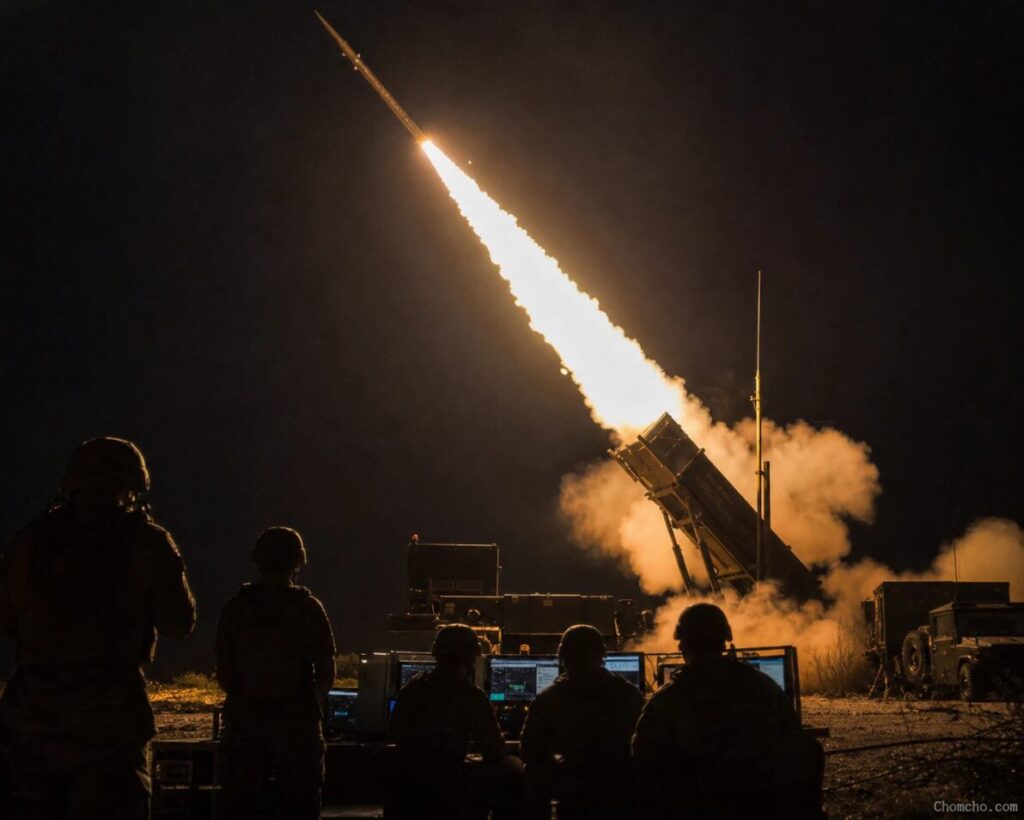
America is firing missiles faster than it can build them, and the numbers reveal a dangerous US missile shortage
America won the opening battles of Operation Epic Fury. Iranian targets were destroyed, and the ceasefire that followed proved the power of American arms.
But this week, as President Trump declared that the ceasefire is “over,” CNN published a wake up call.
The war exposed a problem that nobody in Washington wants to say out loud. The arsenal of the free world is running low.
The US missile shortage in numbers nobody can ignore
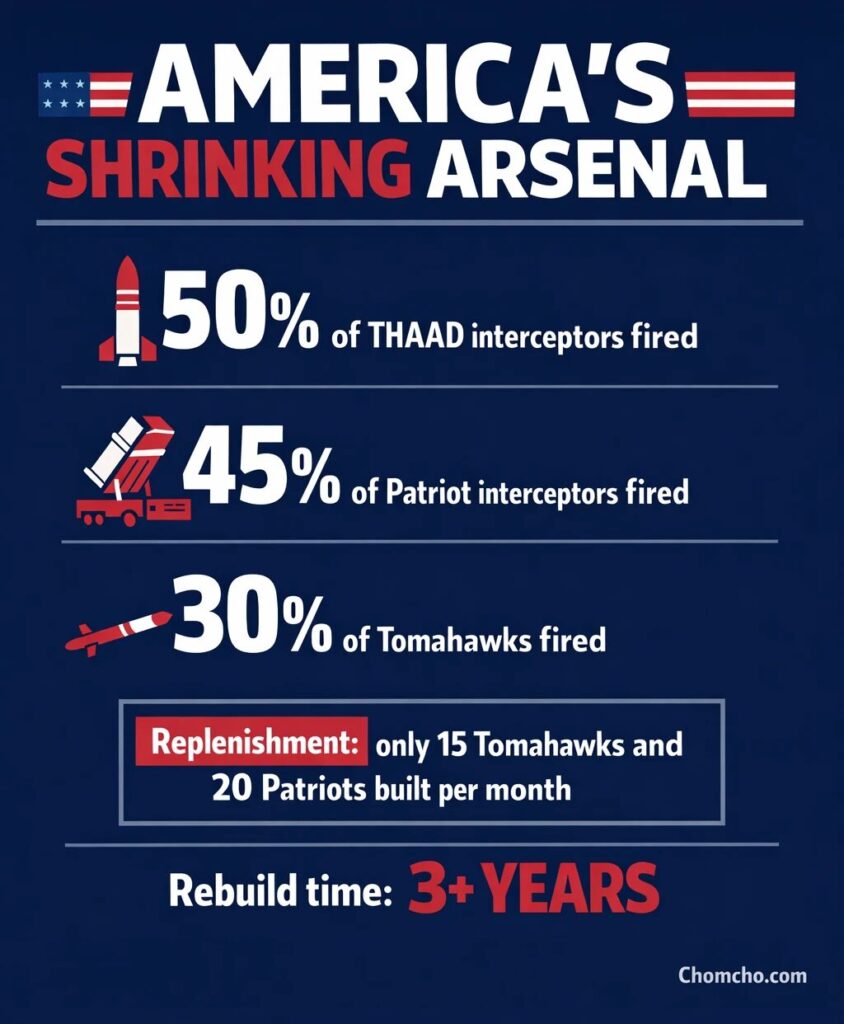
By the time full scale fighting stopped in April, the Pentagon had fired at least half of its THAAD interceptors, nearly half of its Patriot interceptors, and around 30 percent of its Tomahawk missiles.
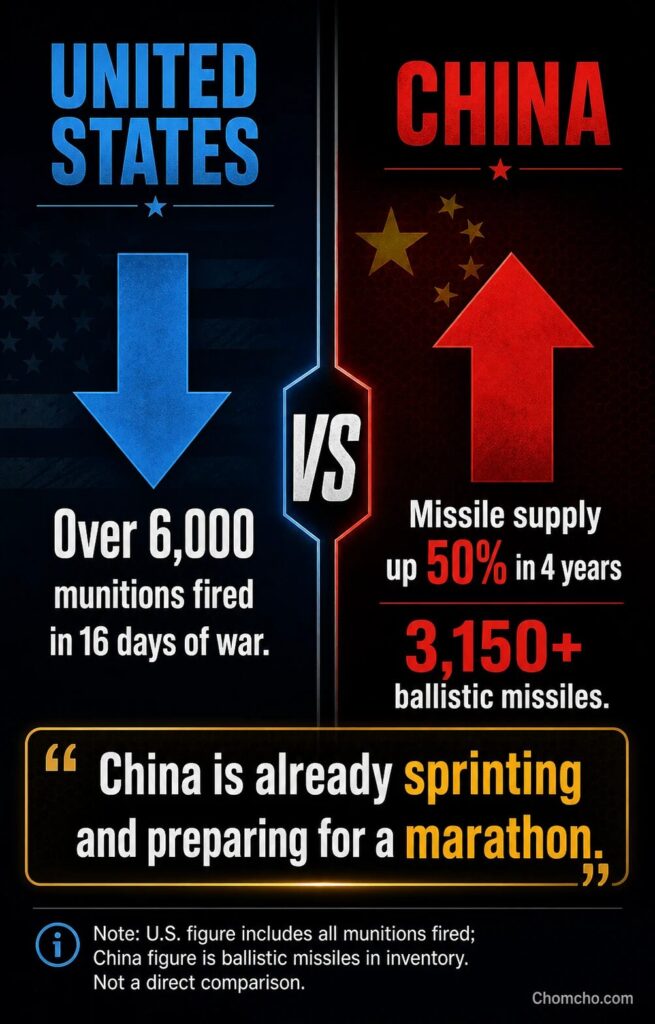
In the first 16 days alone, American forces used more than 6,000 munitions.
The replacement numbers are painful.
The Pentagon is currently receiving about 15 new Tomahawks and 20 new Patriot missiles per month. Zero THAAD deliveries are expected in 2026.
Analysts at the Center for Strategic and International Studies (CSIS), a respected Washington defense think tank, calculate that rebuilding these stockpiles to prewar levels will take three years or more.
Officially, the government denies any problem.
The Pentagon says the military “has everything it needs,” and Secretary Hegseth called the reports “a manufactured story that the media wants to peddle.”
Governments have always guarded their weaknesses from potential enemies, and this may be one of those moments. But CNN confirmed that the numbers match internal Pentagon estimates.
The 15 million dollar bullet nobody can replace
THAAD, or Terminal High Altitude Area Defense, is the crown jewel of American missile defense.
It destroys enemy ballistic missiles by hitting them directly at eight times the speed of sound. No explosives, just physics.
Each one costs about 15.5 million dollars, and America fired 198 of them in the first 16 days of the war, roughly 3,000 million dollars worth.
Why is the shelf getting empty? The factory only produces 96 per year for the entire world.
Foreign buyers like Saudi Arabia are waiting in the same line as the US Army. And missiles ordered back in 2021 will not arrive until 2027.
Modern wars consume in weeks what factories produce in years.
The money is stuck in Washington, and some is stuck in the Pentagon
The White House asked Congress for 87,600 million dollars, including 21,000 million specifically for munitions.
Democrats are blocking it, calling it payment for an unauthorized war. Republicans may need special budget procedures to pass it.
Here is the contradiction. Critics point out that the Pentagon has not yet signed contracts for most of the 152,000 million dollars it already received last year.
Defense contracting moves slowly by design, and much of that money is reserved for other programs. But the bottleneck is real on both ends.
Lockheed Martin signed a plan to quadruple THAAD production from 96 to 400 missiles per year, and that contract cannot be finalized until Congress approves the money.
The solution exists on paper. Paper does not intercept ballistic missiles.
The allies are finally building, from Patriots to sea drones
President Trump approved a license this week for Ukraine to produce Patriot interceptors on its own soil.
The fine print matters: Germany announced its Patriot missile production program in 2022, but large-scale new-build missile deliveries have not yet begun, and Japan needed three years to build its factory.
The drone front is moving much faster, because everyone is watching Ukraine, where a real ground war reveals what future conflicts will demand.
Ukraine now produces drones jointly with at least 20 countries, including smaller European allies like Lithuania, Latvia, and Czechia.
Taiwan plans to buy about 200,000 drones and more than 1,000 unmanned sea vessels, and its drone exports multiplied almost twenty times this year.
Japan lifted its old restrictions on arms exports.
Australia just became the first country outside America to produce GMLRS precision missiles, with a goal of 4,000 per year by 2029.
South Korea’s Hanwha is investing 1,000 million dollars in an ammunition propellant plant on American soil.
In April, U.S. Army Green Berets sank a decommissioned target ship near Taiwan using an explosive-laden sea drone modeled on Ukraine’s combat-proven Magura design, during a major joint exercise with the Philippines.
While America shoots, China stacks
China has not fought a war since 1979. It spends nothing and builds everything.
The Pentagon estimates that China increased its missile supply by 50 percent in just four years, reaching at least 3,150 ballistic missiles.
A CNN satellite investigation found that 60 percent of 136 Chinese missile facilities are expanding, adding more than 21 million square feet of production space.
Chinese missile suppliers reported record revenues in 2025.
Beijing also learned the key lesson of Ukraine. Cheap drones can exhaust expensive Western defenses until the big missiles get through.
A former NATO arms control director put it simply: “China is already sprinting and they’re preparing for a marathon.”
Count the missiles before the war comes
Preparing for war has always meant counting your resources before the enemy arrives.
This is not a modern idea. Jesus taught it two thousand years ago in Luke 14:31: “Or suppose a king is about to go to war against another king. Won’t he first sit down and consider whether he is able with ten thousand men to oppose the one coming against him with twenty thousand?”
God expects His people, and nations, to prepare honestly for the battles ahead. America must sit down, count its missiles, and be honest about the answer.
The Iran campaign did not leave America defenseless. But it exposed the real problem: the United States can consume years of missile production in a few weeks of war.
Peace through strength requires full stockpiles, not just powerful weapons.
Congress must pass the funding, and the Pentagon must sign the contracts fast.
America should keep using the Defense Production Act, produce cheap drones by the thousands alongside its advanced missiles, and expand licensed production with trusted allies.
The United States should also prepare contingency plans to convert civilian factories to military production when needed, just as it did in World War II.
Detroit built bombers once, and it can build missiles and drones now or in the future.
America has the money, the technology, and the allies.
What it needs now is the will, and with God’s help, the arsenal of democracy will be full again!