
This post is also available in:
 Português
  Español
  Français
  Deutsch
  Italiano
  Русский
The Iran war exposed America’s most dangerous vulnerability: US munitions shortage
For years, defense analysts warned that America’s missile stockpiles were dangerously thin. Washington nodded politely and moved on.
Then came Operation Epic Fury — and the warnings became reality in real time.
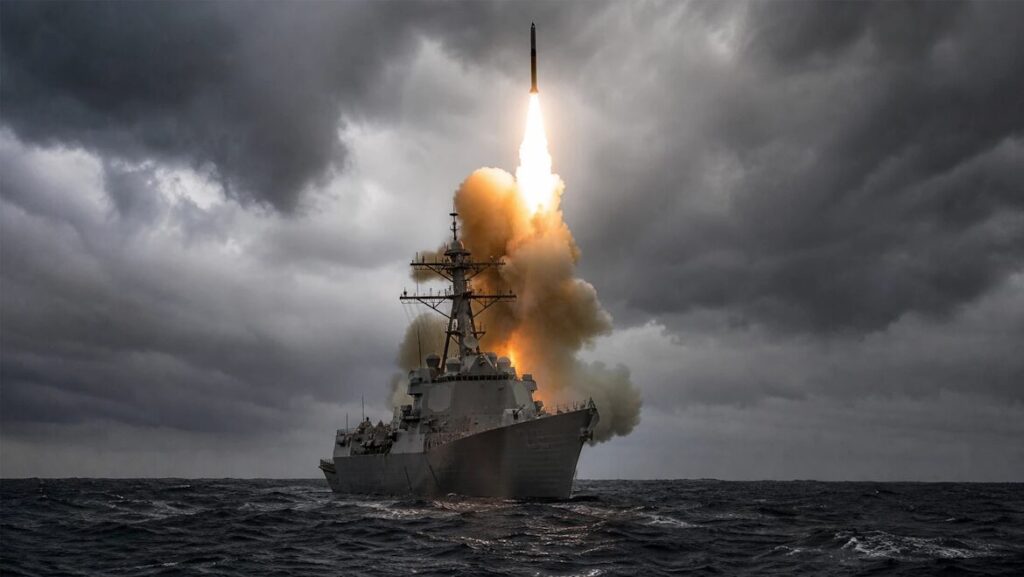
According to a May 2026 report by the Center for Strategic and International Studies (CSIS), authored by defense analyst Seth Jones, the United States burned through more than 45% of its Precision Strike Missiles in just seven weeks of combat against Iran.
Up to 80% of THAAD interceptors were consumed.
Tomahawk cruise missiles, Patriot interceptors, SM-3 and SM-6 naval missiles — all significantly depleted.
Acting Navy Secretary Hung Cao confirmed to the Senate that the US paused $14,000 million in approved Taiwan arms sales specifically to “ensure we have the munitions we need” for ongoing operations.
The official line from the Pentagon is “we have plenty.” The internal assessments tell a different story.
One of the biggest lessons from the wars in Ukraine and the Middle East is that many Western militaries were structured around the assumption that future wars would be relatively short and technologically decisive.
Instead, they discovered that modern industrial warfare consumes enormous quantities of precision weapons at a pace that production lines cannot match.
Patriot interceptors, Tomahawks, THAADs — these are not bullets.
They are manufactured one at a time, in small numbers, by a handful of specialized contractors operating on Cold War-era production models.
The US munitions shortage did not begin with Iran. Iran simply made it impossible to ignore.
What the numbers say — and why they should alarm every American
Wargames conducted by the Pentagon, CSIS, and the Heritage Foundation have repeatedly shown the same result: the United States would run out of critical munitions in approximately eight days of high-intensity conflict with China over Taiwan.
Eight days.
The opening salvoes of a Taiwan conflict would likely involve thousands of missile launches as both sides attempt to destroy airfields, ports, ships, radar sites, and command centers simultaneously.
Unlike counterterrorism campaigns, these weapons cannot be manufactured overnight.
A Tomahawk cruise missile takes 47 months to build.
A JASSM, the Joint Air-to-Surface Standoff Missile, takes 48 months.
SM-3 IIA interceptors take over four years to replenish.
THAAD and Patriot interceptors take three years or more.
Kelly Grieco, senior fellow at the Stimson Center, put it plainly: the US is “using munitions faster than we can replace them.”
Defense analyst Mark Cancian described the problem not as “tactical exhaustion” but as a “strategic inventory shock.”
America did not just fire a lot of missiles at Iran. America revealed to Beijing exactly where its ceiling is.
The production problem — a broken industrial base
The root cause of the US munitions shortage is not a lack of money. It is a lack of industrial capacity.
American defense manufacturing was designed for a post-Cold War world of small conflicts, precision strikes, and short wars.
The assumption was that America would never need to sustain high-tempo missile warfare across multiple theaters simultaneously.
That assumption is now broken.
The US military industrial base relies on production models that are decades out of date.
Expanding capacity for complex guided weapons requires new facilities, new supply chains, new workforce training, and long-term contracts that give manufacturers the certainty to invest.
Congress has historically been reluctant to fund multi-year procurement contracts at the scale needed.
The result is a defense industry that can produce missiles in small, expensive batches — but cannot surge production quickly when a real war demands it.
Trump has reportedly expressed personal frustration at the pace of weapons manufacturing.
The administration has begun meeting with major defense contractors specifically because of stockpile depletion.
This is the right instinct. But the timeline is brutal — even with emergency investment in June 2026, the most critical interceptors will not be back to pre-war levels for several years.
The China threat — why this crisis is about more than Iran
Why do analysts keep connecting the US munitions shortage to China? Because the missiles fired at Iran are the exact same weapons needed to defend Taiwan.
The CSIS May 2026 report states clearly that US stockpiles of long-range offensive missiles and air defense interceptors were already low before the Iran war — and were further depleted during the conflict.
The concern is not the operations of June 2026. The real danger, as analysts now describe it, is the possibility of a Taiwan crisis erupting before inventories are rebuilt.
If that happens, American commanders would face catastrophic allocation decisions between Middle East commitments, European and NATO obligations, and Indo-Pacific operations — all simultaneously, with empty magazines.
China is not unaware of this.
Bloomberg reported that China sharply accelerated missile production in 2025 — 81 Chinese companies now supply its missile industry, up from fewer than 40 when Xi Jinping took office, with combined sales rising 20% to $28,000 million in a single year.
Beijing is building faster than Washington can replenish. That gap is not academic. It is a strategic window of vulnerability that Xi Jinping is watching very carefully.
What America and its allies must do now
Trump is right that allies must carry more of the burden. And some are finally listening.
Japan’s Prime Minister Sanae Takaichi, the country’s first female prime minister and a strong America First ally, has pushed Japan’s defense budget to nearly 2% of GDP ahead of schedule — a historic break from Japan’s post-war pacifist constitution.
She visited Washington in March 2026 and Australia in May 2026, building a stronger Indo-Pacific alliance architecture.
Germany and Europe are rapidly increasing defense spending and military recruitment.
The Quad — the US, Japan, Australia, and India — is deepening security cooperation.
But allies cannot substitute for American industrial capacity.
The United States must rebuild its own manufacturing base — not just for national security, but because the lesson of Iran is that even the world’s greatest military power can find itself choosing between defending the Middle East, Europe, and Asia with the same finite stockpile of precision weapons.
The cancellation of Typhon missile deployment to Germany was not a random diplomatic spat.
Europe’s refusal to allow the US to use its own bases during the Iran conflict made that decision considerably easier for Trump to make — even if Washington never said so officially.
It was a symptom of a broader reality: when America runs short, hard choices follow.
The time to fix that is not after the next war starts. It is now.