
This post is also available in:
 Português
  Español
  Français
  Deutsch
  Italiano
  Русский
Europe stalls its Latin America strategy
Uruguay’s Foreign Minister Mario Lubetkin delivered a blunt warning to the European Union this week: ratify the Mercosur trade agreement or, he basically said, watch South America fall into China’s arms.
Speaking to Euronews during a visit to Brussels on July 6, Lubetkin reminded Europe that the four Mercosur nations, Brazil, Argentina, Paraguay, and Uruguay, ratified the agreement in barely two months, with governments of the right and the left voting together.
Europe, by contrast, froze its own process.
In January the European Parliament voted to send the deal to the EU Court of Justice, a legal opinion that could take more than a year. Lubetkin admitted full ratification may not arrive until 2027 or 2028.
When asked directly whether China would be the alternative partner if Europe walks away, the minister did not hesitate. His answer: “Obviously.”
Uruguay, which now holds the rotating presidency of Mercosur, is not waiting.
The bloc is simultaneously negotiating trade deals with Canada, the United Arab Emirates, and India, while deepening ties with Southeast Asia and Africa.
Everyone, it seems, is courting South America. Everyone except the superpower that shares the hemisphere with it.
But the real story here is not Brussels’ hesitation.
It is how three powers have looked at Latin America in completely different ways, and what that means for America’s future.
Washington looked south and saw threats
For two centuries, the U.S. Latin America strategy was designed almost entirely in terms of security.
The Monroe Doctrine of 1823 was a security doctrine: keep European empires out of the hemisphere.
During the Cold War, the region mattered because of Soviet influence, Cuban communism, and Marxist insurgencies.
After that came the drug war, then illegal migration, then failed states like Venezuela and Haiti.
These were legitimate concerns, every one of them. But they were reactive. Washington engaged with the region when something went wrong, and looked elsewhere when things were quiet.
Many Latin Americans have long felt that Washington viewed the region as a source of problems to manage rather than a partner to build with.
Whether or not that perception is entirely fair, it created an opening. Two other powers walked through it.
Europe sees the opportunity but cannot move
Europe’s view of Latin America has always been shaped by history, culture, and commerce.
Millions of Europeans emigrated to South America, and European companies have invested in the region for over a century.
More recently, Brussels discovered a strategic motive: reducing its dangerous dependence on China.
The EU-Mercosur agreement, negotiated for more than 25 years, would create one of the largest trade zones on earth and give Europe access to South American food and critical minerals.
The problem is that Europe is drowning in its own procedures.
After a quarter century of talks, after signing the deal, after provisional application began on May 1, the European Parliament still managed to freeze the process by sending it to court.
Farmers protest in France, Green parties object in Germany, and now judges will decide the timeline.
Lubetkin’s warning captured the reality perfectly. South America will not wait for Europe to finish arguing with itself.
China saw a market and invested
While Washington saw threats and Brussels saw procedures, Beijing saw iron ore, copper, lithium, and soybeans.
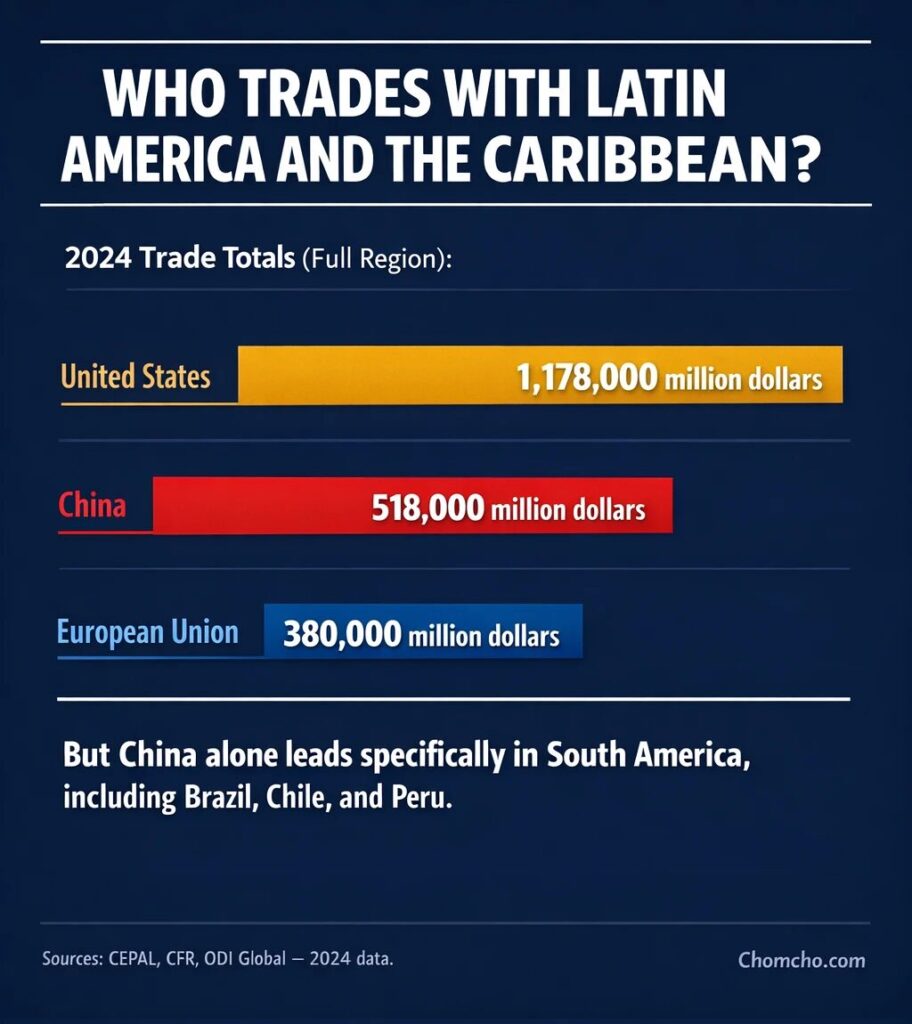
The numbers tell the story.
In 2000, China bought less than 2 percent of Latin America’s exports.
By 2024, trade between China and the region hit a record of more than 518,000 million dollars, and China had become South America’s largest trading partner and the region’s largest bilateral creditor.
China’s Latin America strategy has been about investment in mineral production and infrastructure development.
No lectures about democracy. No environmental conditions. Just checkbooks.
Chinese state firms financed ports, railways, dams, and power grids across the region.
The Chinese-controlled megaport of Chancay in Peru now serves as South America’s main direct maritime link to Asia.
Huawei controls roughly 45 percent of Brazil’s 5G infrastructure, and Chinese automaker BYD is now building an electric vehicle plant on Brazilian soil, part of a wave that saw Chinese EV shipments to Brazil grow tenfold in a single year.
At a summit with Latin American leaders in Beijing in May 2025, Xi Jinping announced a new credit line of 9,000 million dollars for the region.
That is how a serious power courts a region it wants to win.
What changed: from the oil age to the minerals age
During the Cold War, oil was the decisive strategic resource, and it made the Middle East the center of the world. That era is ending.
Today’s decisive resources are lithium, copper, rare earth elements, and graphite, the raw materials of AI infrastructure, advanced weapons, satellites, and semiconductors.
Latin America holds enormous reserves of all of them.
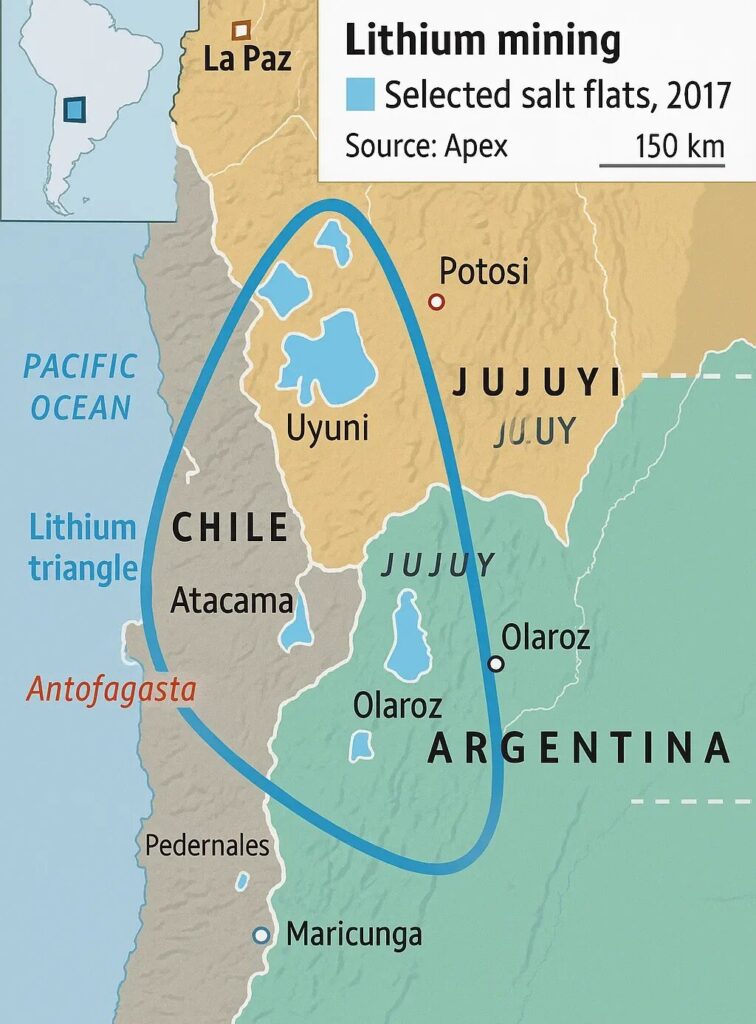
Chile and Argentina anchor the lithium triangle. Peru and Chile dominate global copper. Brazil is emerging as a major source of rare earths outside Chinese control.
In other words, the region Washington treated as a security buffer for a century has quietly become one of the most important strategic resource bases on the planet.
The one power that truly understood this early, China, positioned itself accordingly.
Should America treat its hemisphere the way China treats East Asia?
Here is a question rarely asked outside academic circles.
China builds deeply integrated supply chains with its own neighbors because geography lowers costs, strengthens resilience, and multiplies influence.
Why has the United States never done the same with its neighbors?
What would that actually mean?
There are two possibilities.
The first is political integration. President Trump has openly floated dramatic ideas, from making Canada a state to bringing a post-Maduro Venezuela into America’s orbit.
These proposals grab headlines, but formal political union faces obvious obstacles of sovereignty, culture, and law.
The second is strategic economic integration, and this is where the realistic opportunity lies.
Not blanket free trade, which would alarm American farmers and ranchers who compete directly with Mercosur agriculture.
Instead, targeted agreements: preferential access to critical minerals, joint investment in mining and processing, energy cooperation, and infrastructure financing that gives the region an alternative to Chinese loans.
America has advantages China can never match: proximity, family ties across millions of households, shared Christian faith, and decades of military cooperation.
A Monroe Doctrine for the 21st century
A consensus is forming among conservative policymakers and America First thinkers that the old doctrine needs an economic update.
The question is no longer only who has warships in the hemisphere. It is who controls the ports, the mines, the 5G networks, and the power grids.
Secretary of State Marco Rubio, the first Hispanic American to hold the office and a lifelong hawk on the region, embodies that shift.
And Panama shows what the new approach can achieve.
After President Trump charged that China was effectively running the Panama Canal, Panama withdrew from the Belt and Road Initiative.
Its Supreme Court then struck down the Chinese-linked port concession, and this February the government seized the terminals and handed operations to Western firms.
Beijing raged and threatened. Panama moved toward Washington anyway.
Pressure works. But pressure alone is not a strategy.
The emerging conservative view is that it must be paired with something positive: investment, trade, and partnership that make alignment with America the obvious choice.
Scripture reminds us: “The prudent sees danger and hides himself, but the simple go on and suffer for it” (Proverbs 22:3).
For decades, Washington did not see the danger growing in its own hemisphere. Now it does.
Prudence demands action, not just alarm.
America First should not mean America alone. It should mean making the Western Hemisphere America’s strongest strategic and economic partnership.
China is building its neighborhood into an economic fortress. The question for Washington is simple: why aren’t we?
God is not done with the Americas, and neither is freedom.