
This post is also available in:
 Português
  Español
  Français
  Deutsch
  Italiano
  Русский
  Nederlands
  日本語
日本語  Polski
Two hundred fifty years later, the Founders foreign policy still guides America
Today, July 4, 2026, the United States of America turns 250 years old.
Two and a half centuries ago, fifty-six men signed the Declaration of Independence in Philadelphia, pledging their lives, their fortunes, and their sacred honor to an idea the world had never seen tried at scale: a free republic, governed by its own people, beholden to no king.
Anniversaries like this one usually produce fireworks and speeches.
This article proposes something different: a look at what the Founders actually believed about America’s place in the world, because their answer is far more relevant to 2026 than most people imagine.
Consider what happened just weeks ago.
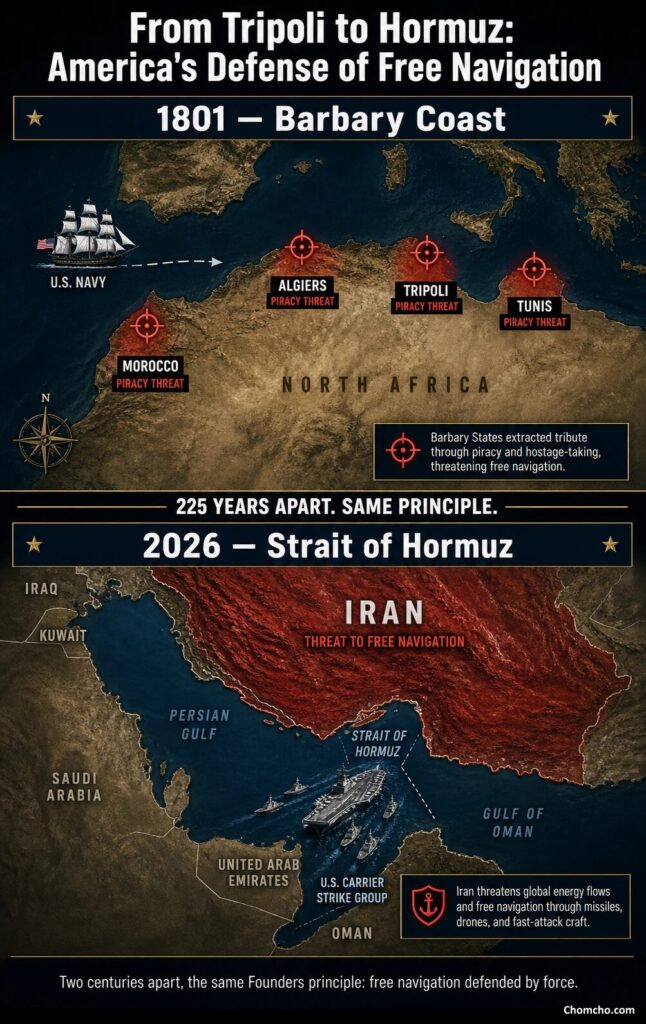
Iran closed the Strait of Hormuz, the narrow waterway through which roughly one-fifth of the world’s oil passes.
Tehran demanded that the world pay the price of its ambitions.
President Trump responded with decisive military force, launching a naval campaign to reopen the Strait of Hormuz, and signed a memorandum of understanding with Iran that ended active hostilities.
Here is what few commentators noticed: America has faced this exact situation before. Different ocean. Different century. Different pirates. Same principle.
In 1801, President Thomas Jefferson sent the young United States Navy and the Marines across the Atlantic to crush the Barbary pirates of North Africa, who had spent years seizing American merchant ships and demanding tribute for safe passage.
The parallels are not a coincidence.
They are evidence of something this article intends to demonstrate: the Founders left behind a foreign policy compass that still points true, 250 years later.
The sentence everyone skips: “The great rule of conduct”
Ask most educated Americans what George Washington said about foreign policy, and they will quote his Farewell Address of 1796: “Steer clear of permanent alliances with any portion of the foreign world.”
Almost nobody quotes the sentence that comes before it.
“The great rule of conduct for us in regard to foreign nations is in extending our commercial relations, to have with them as little political connection as possible.”
Read that carefully.
Washington’s great rule, his own words, begins with EXTENDING commercial relations. Engagement with the world comes first. The limitation on political connection comes second.
We mention this other quote because this single sentence demolishes the most common misconception about the Founders: that they were isolationists who wanted America to hide behind its oceans.
They were the opposite.
They were global traders who guarded their political sovereignty jealously. Commerce with everyone. Political entanglement with no one.
Washington went even further.
He warned against “permanent, inveterate antipathies against particular nations, and passionate attachments for others,” because a nation driven by emotional attachments becomes “in some degree a slave” to them.
National interest, not sentiment, should guide the republic.
And in one of the most beautiful phrases of the entire address, he looked forward to the day when America would be strong enough that it “may choose peace or war, as our interest, guided by justice, shall counsel.”
Interest, guided by justice. Strength, restrained by morality. That is the Founders foreign policy in five words.
A philosophy is born, then tested
Washington published his Farewell Address in September 1796.
It would have remained a beautiful theory if history had not immediately put it through three brutal tests, all within the lifetime of the men who wrote it.
The first test came almost instantly.
Test one: the Quasi-War with France (1798-1800). France, angry that America refused to join its war against Britain, began seizing American merchant ships.
In 1796 and 1797 alone, French raiders captured some 316 American vessels.
The pressure to abandon neutrality and pick a side in Europe’s war was enormous.
President John Adams refused to do either. Instead, he built a navy, including the famous frigates USS Constitution, USS United States, and USS Constellation.
That navy fought an undeclared war at sea strictly to defend American shipping. The result: peace with France, without a single permanent alliance.
The principle tested: America would defend its commerce with force, but it would not be dragged into Europe’s wars. Neutrality survived its first trial by fire.
Test two: the First Barbary War (1801-1805). For years, the Muslim states of the North African coast, Tripoli, Algiers, Tunis, and Morocco, had operated a protection racket on the Mediterranean.
Pay tribute, or your ships get seized and your sailors get enslaved.
Washington and Adams both paid the pirates.
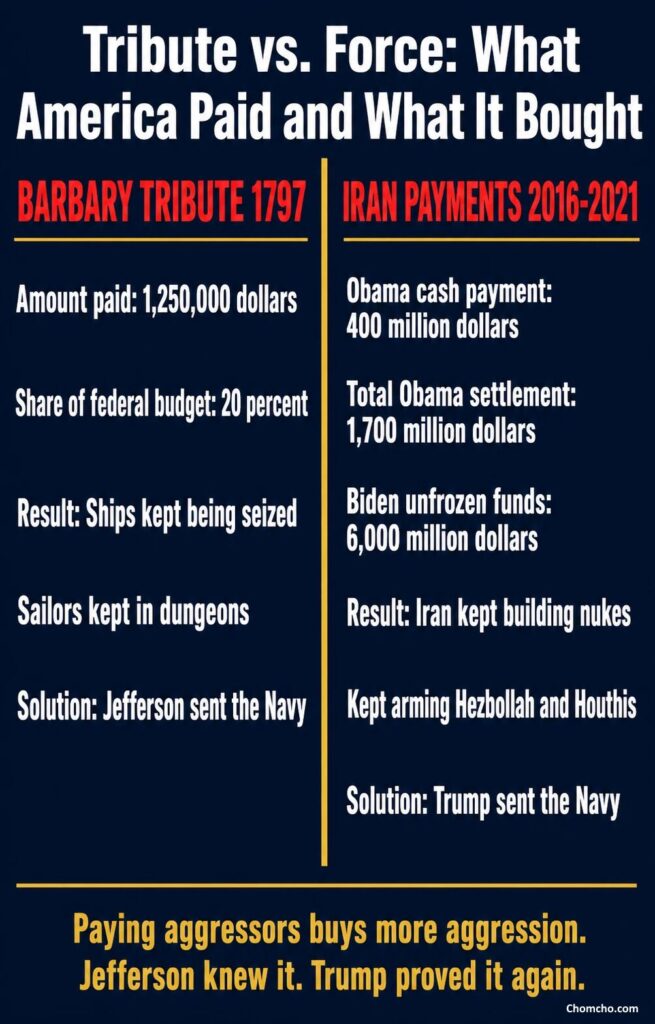
By 1797, the United States had paid out 1,250,000 dollars in tribute, a staggering one-fifth of the entire federal budget at the time.
The pirates took the money and kept seizing ships anyway.
When Jefferson became president in 1801, the ruler of Tripoli demanded even more tribute from the new administration.
Jefferson had reached his enough-is-enough moment. He refused to pay, and Tripoli declared war by chopping down the flagpole of the American consulate.
Jefferson, the small-government philosopher, the man who feared standing armies, sent the Navy and the Marines four thousand miles from home to bombard the pirate fortresses and blockade their harbors.
Lieutenant Stephen Decatur’s night raid to burn the captured frigate USS Philadelphia in Tripoli harbor was called “the most daring act of the age” by British Admiral Lord Nelson himself.
The Marines’ march on the shores of Tripoli lives forever in the opening line of the Marines’ Hymn.
The national slogan of that era says everything: “Millions for defense, but not one cent for tribute.”
The principle tested: freedom of navigation and commerce would be defended with force, anywhere on earth, no matter the distance.
Note what the war was NOT about: Jefferson did not try to change Tripoli’s government, occupy its territory, or transform its society.
He restored free passage for American ships and went home.
Test three: the War of 1812 (1812-1815). Britain, locked in its death struggle with Napoleon, refused to treat America as a truly sovereign nation.
The Royal Navy stopped American ships at sea and seized American sailors, forcing them to serve on British warships.
This practice was called impressment: the forced recruitment of American citizens on the theory that anyone born under the British crown remained a subject of the British crown forever, no matter what any Declaration of Independence said.
Thousands of American sailors were taken this way.
President James Madison, the father of the Constitution, led the nation into war to answer a simple question: was American sovereignty real, or was it negotiable?
The war was brutal.
The British burned Washington, including the White House. But America survived, Andrew Jackson shattered the British at New Orleans, and no European power ever again treated American citizenship as a technicality.
Meanwhile, the North African pirates had taken advantage of the War of 1812 to resume their attacks on American shipping, encouraged by Britain to do so. But with the British threat finally settled, America turned its attention back to the Mediterranean.
In 1815, Commodore Stephen Decatur, the U.S. Navy’s top operational commander, a rank equivalent to today’s admiral, sailed into Algiers harbor with a squadron of warships and ended the Barbary tribute system forever in a war that lasted all of three days.
Then, in 1823, came the culmination.
President James Monroe declared that the Western Hemisphere was closed to any new European colonization, a warning aimed not only at Britain, but equally at France, Spain, and Russia, all of whom had territorial ambitions in the Americas.
The Monroe Doctrine transformed the Founders’ defensive principles into a regional strategy: this half of the world is under American protection.
Look at the sequence as a whole. 1796: the philosophy is articulated. 1798: it is tested. 1801: it is applied offensively. 1812: it is defended at existential cost. 1823: it is expanded into a doctrine.
This was never theory. It was a working system, proven under fire, within a single generation.
Washington, Jefferson, Monroe: three stages of one strategy
The chronology above reveals a framework that explains early American foreign policy better than any textbook label.
Washington secured INDEPENDENCE.
America would choose its own foreign policy, serve its own interests, and be dragged into no one’s wars. The Farewell Address is the founding charter of American strategic freedom.
Jefferson secured COMMERCIAL EXPANSION.
America would trade with the entire world, and it would defend its right to navigate the seas with force whenever necessary, at any distance. The Barbary Wars established that American commerce sails under American protection.
Monroe secured REGIONAL STRATEGIC LEADERSHIP.
The Western Hemisphere would be shielded from outside domination. America’s security begins with a secure neighborhood.
Independence. Commerce. Regional leadership.
Each stage builds on the one before it.
A nation must first be free to act, then prosperous enough to matter, then strong enough to lead.
It is not merely a chronology. It is an evolution of strategic thought, and it remains the deep structure of American foreign policy to this day.
The Monroe Doctrine in particular deserves a modern reading.
In 1823, the threat was European empires planting flags in the Americas.
In 2026, the threat is economic colonization: Chinese state companies buying ports from Peru to Panama, Belt and Road debt traps across the region, and Beijing converting infrastructure into influence one loan at a time.
The flags changed. The game did not.
A twenty-first century Monroe Doctrine watches America’s hemisphere not for European frigates but for foreign creditors with geopolitical ambitions.
Hamilton: the Founder who sounds like he posts on X
One more Founder deserves a seat at this table, and he is the one most people associate with banking rather than foreign policy.
Alexander Hamilton argued, in his Report on Manufactures of 1791 and throughout his career, four propositions that sound remarkably like a 2026 policy platform.
Hamilton wrote that economic strength IS national security.
Domestic manufacturing guarantees independence in war and peace. Sound public credit is what funds military power when the crisis comes. And a navy exists, above all, to protect commerce.
He wanted America to make goods, build things, and owe its prosperity to no foreign power’s goodwill.
A nation that depends on a rival for its essential goods is not truly free, whatever its constitution says.
Now listen to the modern debate about tariffs, semiconductor plants, energy dominance, the defense industrial base, and industrial sovereignty — the principle that a nation must control its own critical production rather than depend on a rival for the goods it needs to survive.
The vocabulary has changed. The argument has not.
Today the debate centers on reshoring critical industries back to American soil.
The reason is not abstract: semiconductor chips, rare earth minerals, pharmaceuticals, steel, and advanced electronics are largely made in or controlled by China.
A nation that cannot produce its own weapons, medicines, or microchips in a crisis is not truly sovereign. That is exactly what Hamilton meant by economic strength as national security.
Industrial sovereignty is not a modern invention. Hamilton argued for it in 1791. The enemy he had in mind was British economic dominance. The enemy we face today wears a different name.
What the Founders opposed, in their own words
If the Founders were not isolationists, what exactly were they against?
The answer is precise: permanent political alliances. And their reasons were not abstract.
Why, they asked, should a farm boy from Virginia die in a quarrel between European kings?
Europe, Washington wrote, “has a set of primary interests which to us have none, or a very remote relation.” Her endless controversies were “essentially foreign to our concerns.”
Why should a young republic bury itself in debt to defend old empires?
The Founders had just fought a war financed by borrowing, and they knew that war debt means taxes, and taxes mean a heavier state pressing on a free people.
Prolonged foreign wars, many of them feared, would also require large standing armies, and standing armies had been the tool of tyrants throughout history.
And why should America trust that Europe’s powers would prove loyal allies when the bill came due?
The Founders had watched European monarchies switch sides, betray treaties, and abandon partners for a hundred years.
They had no illusions that gratitude governs nations.
Washington’s answer was structural, not emotional: keep a strong defense at home, and “we may safely trust to temporary alliances for extraordinary emergencies.”
Temporary alliances. For extraordinary emergencies. Not permanent ones, for ordinary politics.
The Founders’ logic was not fear of the world. It was a cold accounting of what wars cost, who pays, and who bleeds.
Any modern reader can decide for themselves which of today’s permanent arrangements would pass Washington’s test, and which would not.
From Barbary tribute to Tehran’s cash: the bribe that never works
History does not repeat itself, but it rhymes with embarrassing precision.
Before Jefferson’s Eureka moment, America’s policy toward the Barbary states was appeasement by installment plan.
Pay the tribute, ransom the hostages, and hope the pirates honor the deal.
They never did.
The demands always grew. One-fifth of the federal budget went out the door, and American sailors still rotted in North African dungeons.
Two centuries later, Washington tried the same failed policy with a different set of ayatollahs.
In January 2016, the Obama administration flew 400 million dollars in cash, on wooden pallets, in an unmarked plane, to Tehran, the same day Iran released four American prisoners.
It was the first installment of a 1,700 million dollar settlement. By May of that year, Iran’s Central Bank had transferred the money to the Iranian military.
The Biden administration later unfroze an additional 6,000 million dollars in Iranian funds.
And what did the tribute buy?
Iran took the money and kept building its nuclear program, kept arming Hezbollah, the Houthis, and its militias across the Middle East, and kept threatening the world’s shipping in the Strait of Hormuz.
Exactly as the Barbary pirates took the money and kept seizing ships.
Jefferson’s conclusion in 1801 was that force is cheaper than tribute, because tribute never ends and force does.
Trump reached the same conclusion with Iran’s nuclear threat in 2026.
What changed the equation was not another payment. It was ‘Project Freedom’ — a naval campaign with guided-missile destroyers, over 100 aircraft, and 15,000 service members that brought Tehran to the negotiating table. Force opened the door. Diplomacy walked through it.
The lesson survived 225 years because it is simply true: paying aggressors buys you more aggression.
Principles endure, policies adapt
Here we arrive at the philosophical heart of the argument.
Principles are answers to permanent questions. What is government for? What is worth fighting for? Who decides a nation’s course?
Policies are answers to temporary questions. Which enemy? Which weapon? Which ocean?
The Founders of American Independence answered the permanent questions so well that their answers still work.
The wooden frigate became the carrier strike group, and then the Air Force, the Space Force, and Cyber Command.
Freedom of navigation on the Barbary coast became freedom of navigation in the Strait of Hormuz and the South China Sea.
The common defense of harbors and coastlines became the defense of satellites, digital networks, and electrical infrastructure, because the Founders believed government exists largely to provide the common defense, and the common defense today includes cyberspace.
The enemies changed too.
America no longer worries about wars with Britain or France; today’s great-power rival is Communist China.
The Barbary corsairs are gone; their modern heirs are Islamic terrorists and a Tehran regime that treats a global waterway as its personal tollbooth.
There is no point in sugarcoating who the pirates of our age are.
Set the two eras side by side and the continuity is striking.
Protect commerce then meant frigates against corsairs; now it means keeping the sea lanes open, including Hormuz.
Protect sovereignty then meant resisting impressment; now it means resisting foreign coercion and cyber attacks.
A powerful naval force then; a strong Navy, Air Force, Space Force, and Cyber Command now.
Avoid permanent entanglements then; be deeply cautious about open-ended military commitments now.
Trade broadly then; trade globally under secure conditions now.
The tools evolve. The objectives remain recognizable.
One more dimension of the Founders’ worldview deserves to be named, because the modern retelling usually omits it.
These men reasoned within a mostly Christian moral framework, and it was not decoration. Many of their families had crossed an ocean fleeing religious persecution.
They believed in just war as a last resort, in honest dealings between nations, and in a providence that had given this continent a different destiny than Europe’s endless cycle of dynastic bloodshed.
Washington himself wrote it into the Farewell Address: “Observe good faith and justice towards all nations; cultivate peace and harmony with all. Religion and morality enjoin this conduct.”
Scripture teaches, in Proverbs 22:7, that “the borrower is slave to the lender.”
The Founders applied that wisdom to nations as much as to men: a republic buried in war debt, or dependent on foreign powers for its survival, is not fully free, whatever its constitution says.
Their foreign policy of strength, solvency, and independence was, at bottom, an application of biblical prudence to statecraft.
And this is why their vision was not merely national selfishness dressed in fine language.
Most nations in history pursued naked interest. The Founders pursued interest “guided by justice,” in Washington’s own phrase, because they genuinely believed liberty was a sacred trust.
That conviction is what made America different, and it is what still separates America First from mere cynicism.
Answering the objections
An honest thesis anticipates its critics. There are three serious objections to the argument of this article, and each deserves a straight answer.
Objection one: the Founders led a small coastal republic, not a global superpower. True. But principles scale.
Monroe extended the same principles from thirteen states to an entire hemisphere within one generation. The question was never the size of the nation; it was the logic of its conduct.
Objection two: the Founders could not have imagined nuclear weapons, cyberspace, or globalized supply chains.
Also true, and it does not matter, because they did not write operating manuals. They wrote principles. A compass does not need to know the terrain in advance to point north.
Objection three: some modern alliances arose in circumstances the 1790s never faced, and some have served America well.
Fair enough. The Founders themselves allowed for “temporary alliances for extraordinary emergencies.”
Their test was never “no cooperation, ever.”
Their test was: does the arrangement serve American interests, or has America ended up serving it?
Every alliance, every commitment, every treaty should have to answer that question, out loud, on a regular basis. Arrangements that pass the test continue.
Arrangements that cannot even face the question have answered it already.
To be clear about what this article does not claim: we are not saying the Founders invented the term America First. But the principles they established, sovereignty, commercial strength, strategic restraint, freedom of navigation, and the security of our own hemisphere, are the same principles that define America First today.
The claim is stronger for being precise.
America First is the modern application of the Founders’ principles, updated to today’s geopolitical realities, new military technologies, different enemies, different economic competitors, and different pirates.
The principles endure. The policies adapt.
That is not a slogan. It is the actual record of 250 years, from the shores of Tripoli to the Strait of Hormuz.
Two hundred fifty years young
On this and every Fourth of July, it is worth remembering who the Founders actually were.
They were not only warriors. They were farmers who read Cicero, soldiers who quoted Scripture, and statesmen who built a naval force while writing treatises on liberty.
They were fine intellectuals with deep convictions, most of them anchored in the Christian faith of families that had crossed an ocean to worship freely.
They pledged everything they had to a principle, and then, remarkably, they spent the rest of their lives proving the principle could govern.
They left their descendants a foreign policy worthy of the republic they founded: trade with all nations, entangling alliances with none, strength sufficient to command respect, war only when justice and interest demand it, and a jealous, unsleeping defense of American sovereignty.
Two hundred fifty years later, the compass they built still points true.
The ships are steel now. Some of them fly through space. The pirates have missiles and enrichment facilities.
But the great rule of conduct remains exactly where Washington left it, and the nation that follows it remains what the Founders prayed it would be: free, prosperous, sovereign, and, by the grace of God, still standing.
Happy 250th birthday, America.