
This post is also available in:
 Português
  Español
  Français
  Deutsch
  Italiano
  Русский
  Nederlands
  日本語
日本語  Polski
Australia and Vanuatu block possible China military expansion
Most Americans could not find Vanuatu on a map.
That is exactly what Beijing is counting on.
Vanuatu is a small island nation in the southwestern Pacific Ocean, about 1,100 miles east of Australia. It is an archipelago of 83 mostly volcanic and mountainous islands, stretching 400 miles from north to south in an irregular Y shape.
Its total population is roughly 341,500 people. Its economy runs on subsistence farming, fishing, and tourism. It has no known petroleum deposits and no significant mineral wealth.
But it sits on some of the most strategically valuable ocean real estate on earth.
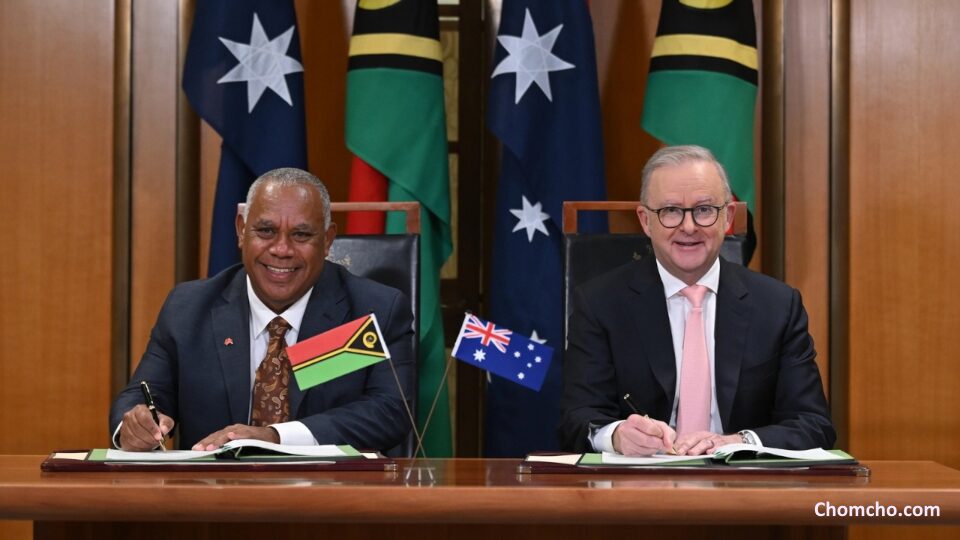
On June 29, 2026, in Canberra, Australian Prime Minister Anthony Albanese and Vanuatu Prime Minister Jotham Napat signed a landmark agreement called the Nakamal Agreement.
The deal does one thing above all else: it permanently prohibits any foreign military base from being established on Vanuatu’s territory.
China immediately expressed “concern.”
That reaction told you everything you need to know about who this agreement is really aimed at.
Why is Vanuatu strategically important?
To understand why a small island chain of 341,500 people matters to the world’s biggest powers, you need to look at a map and think like a military planner.
Vanuatu sits along critical maritime routes connecting the Pacific Ocean between Asia, Australia, and the Americas.
It lies east of Australia’s most populated coastline, north of New Zealand, and within reach of supply lines connecting the U.S. mainland to its Pacific military installations in Guam, Hawaii, and beyond.
History already proved its value.
During World War II, the island of Espiritu Santo hosted one of the largest United States military bases in the entire South Pacific.
It served as a massive Allied logistics and operations hub for the campaign against Japan. Hundreds of thousands of American troops passed through. The island still has sunken ships and old military equipment from that era.
As of June 30, 2026, military planners view the Pacific Islands with the same strategic logic.
Control over shipping lanes, surveillance opportunities, logistics facilities, and naval operations across the broader Indo-Pacific makes even small island nations enormously valuable during a crisis.
A Chinese military base in Vanuatu would place Beijing within striking distance of Australia’s eastern coastline. It would also sit dangerously close to American Pacific supply lines.
That is not a theoretical concern. It is a strategic nightmare.
What has China already been doing in Vanuatu?
China has not been waiting for an invitation.
Over the past decade, Beijing has systematically expanded its presence across the South Pacific through its Belt and Road Initiative: financing ports, roads, government buildings, and airports across multiple island nations.
In Vanuatu specifically, China funded the expansion of the wharf at Luganville, the country’s second-largest city.
Luganville sits on the island of Espiritu Santo, the same island that hosted the massive American military base in World War II.
The upgraded port immediately attracted alarm from Australian and American defense officials. Its size and historical military significance were not lost on anyone.
The Chinese navy has made multiple port calls to Vanuatu in recent years.
In 2023, Beijing donated drones, patrol boats, and vehicles to Vanuatu’s police force, deepening security ties in ways that go far beyond normal development assistance.
Both China and Vanuatu have repeatedly denied any military intent behind these projects.
However, Australian and American officials have consistently warned that infrastructure built with Chinese money could be converted to military use if political circumstances changed.
They have seen this playbook before.
The Nakamal Agreement closes that door.
Permanently.
Is this agreement really about blocking China’s military expansion?
The Nakamal Agreement never mentions China by name. It does not have to.
Beijing’s own reaction confirmed everything.
China’s Foreign Ministry spokesman Guo Jiakun immediately called on relevant countries to ensure their cooperation “does not target any third party or be used as a tool for geopolitical rivalry.”
When you are not named in an agreement and you still feel the need to complain about it publicly, you have answered the question yourself.
Australian Prime Minister Albanese was careful but unambiguous. “What this does do is provide certainty for Australia that there will be no foreign military base,” he told reporters.
Vanuatu Prime Minister Napat described the pact as balanced, protecting both national independence and regional security.
The agreement requires Vanuatu to consult Australia before allowing any third-party investment in critical infrastructure.
That is aimed directly at Chinese Belt and Road financing.
Australia in turn commits to increased economic support and development assistance, giving Vanuatu a credible alternative to Chinese loans.
This is the AUKUS and Quad strategy made real on the ground.
Not a military exercise. Not a press release. A legally binding agreement that blocks China’s military expansion before it can take root.
The bigger picture — China’s Pacific strategy and what it means
Vanuatu is not an isolated case. It is one piece of a much larger Chinese strategic pattern.
In 2022, China signed a security agreement with the Solomon Islands that nearly triggered a diplomatic crisis in Canberra and Washington.
Beijing also has an overseas naval base in Djibouti on the Horn of Africa, its first. It has been quietly seeking port access arrangements in Cambodia, Pakistan, Sri Lanka, and multiple African nations.
China’s approach is patient and methodical. Offer development loans. Build infrastructure. Establish economic dependence. Gain port access for naval vessels.
“A port visit here, a survey mission there, a new security agreement with a Pacific Island state — each may seem manageable in isolation. But together they point to a long-term effort to shift the balance of presence and influence across the Indo-Pacific.” — Australian Strategic Policy Institute (ASPI), April 2026.
Eventually convert temporary access into permanent presence. By the time anyone objects, the infrastructure is already built and the relationship is already deep.
The Belt and Road Initiative is not a foreign aid program. It is a global military positioning strategy disguised as development finance.
The Solomon Islands deal was a warning. The Vanuatu agreement is the counter-move.
Australia, backed by Washington, is systematically offering Pacific Island nations a better deal: genuine economic partnership without the strategic strings that come attached to Chinese money.
Trump’s pressure on Indo-Pacific allies to step up and take responsibility for their own strategic neighborhood is producing results.
Australia is stepping up.
The Quad is stepping up.
AUKUS is stepping up.
America First and the Pacific — why this matters for the U.S.
The United States has irreplaceable strategic interests in the Pacific.
Hawaii. Guam. Dozens of forward military installations. Undersea communication cables. Vital shipping lanes connecting American trade with Asia.
All of it depends on a Pacific Ocean that remains free, open, and not dominated by a rival military power.
A Chinese military base in Vanuatu or the Solomon Islands would represent a fundamental shift in the balance of power in America’s own strategic backyard.
It would give Beijing surveillance reach over Australian and American naval movements. It would complicate U.S. logistics during any future Taiwan crisis or Pacific confrontation.
The Nakamal Agreement prevents exactly that.
No shots were fired. No military confrontation. No headlines about war. Just quiet, smart diplomacy that blocked China’s military expansion in the Pacific before Beijing could make its next move.
This is what America First looks like in the Pacific.
Strength does not always come from a carrier strike group.
Sometimes it comes from a signed agreement in Canberra between two prime ministers that most of the world’s media barely noticed.
Beijing noticed. That is what matters.