
This post is also available in:
 Português
  Español
  Français
  Deutsch
  Italiano
  Русский
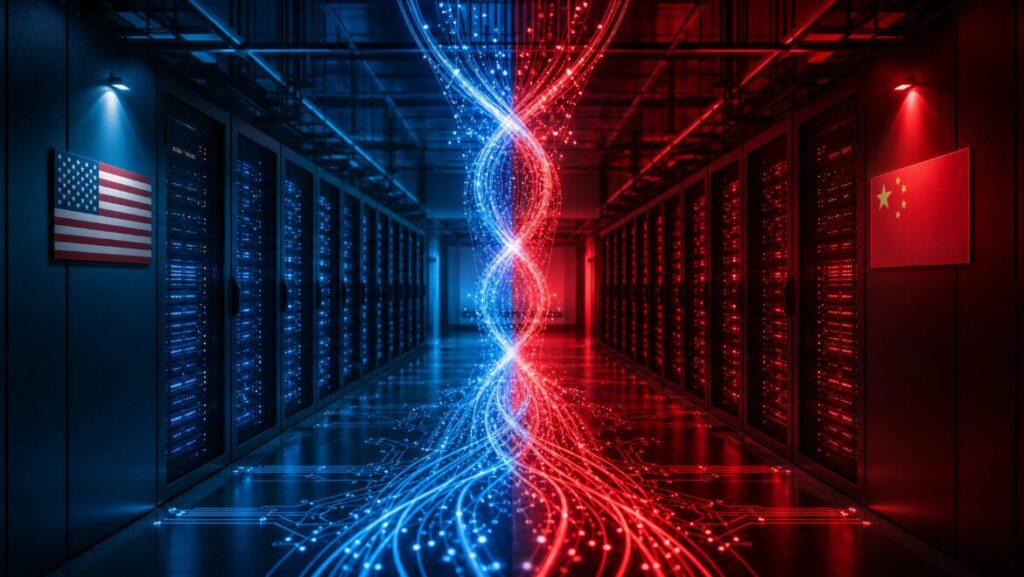
Inside the US-China AI War: Cost, Security, and Who Is Really Winning
The Telegraph reported on June 16, 2026, that Chinese open-source AI systems, DeepSeek, Tencent’s Hy3, and Shanghai-based MiniMax, now account for the five most popular models running through OpenRouter, a platform developers use to access hundreds of AI systems.
A year ago, all five top models were American.
The reason is price. DeepSeek’s most popular model costs 14 cents per million tokens. Anthropic’s Fable 5, before it was pulled from the market, cost $10 per million.
China is running the same playbook it used with furniture and electric cars. It does not need to be the best. It needs to be the cheapest.
Washington locks the door to advanced AI models, Beijing hands out the keys of cheap AI models
This week, the Trump administration issued an export control directive ordering Anthropic to immediately block all foreign nationals, including its own foreign employees, from accessing its newest models, Fable 5 and Mythos 5.
The U.S. government restricted access to Anthropic’s most advanced models because it was reported that these models’ highly capable cybersecurity features posed unmanaged national security risks.
Amazon researchers reportedly found a narrow jailbreak that could be used to ask the model to scan code for vulnerabilities.
Anthropic chose to disable both models entirely rather than risk partial compliance.
This marks the first time the US government has used export controls to pull a commercial AI model off the market, even for Americans at home.
Meanwhile, China’s open-source models are much less advanced than the restricted American versions. Anyone, anywhere, can still copy, modify, and run these basic Chinese systems on their own servers with zero US oversight.
While Washington locks its own advanced technology behind new rules, Beijing has thrown its doors open to the entire world. It sounds so altruistic, but we must note that the level of sophistication in these models is not the same.
This is because the free version is almost certainly not Beijing’s best work. China has a long history of guarding its true weapons programs behind a wall of secrecy, and AI is unlikely to be the exception.
We will come back to what that means for China’s military AI ambitions later in this article.
The price tag nobody saw coming
Sam Altman admitted at a recent industry event that companies are now telling him something he had never heard before: “My company spent my entire 2026 budget in Q1,” he said clients keep telling him, calling token costs “a huge issue” for business clients for the first time.
The numbers back him up.
Uber’s CTO Praveen Neppalli Naga told The Information that Uber burned through its entire 2026 AI coding budget, mostly spent on Anthropic’s Claude, in just four months.
Microsoft engineers reportedly did the same.
A study from MIT found that AI was actually cheaper than a human worker in only 23 percent of the tasks studied. In the other 77 percent, the AI cost more once implementation, maintenance, and hardware were counted.
Even an Nvidia vice president, Bryan Catanzaro, told Axios that for his own team, the cost of compute is now higher than the cost of paying employees.
Klarna laid off roughly 700 support workers for its AI chatbot, and is now hiring people back as flexible remote agents after its CEO admitted the company “went too far.”
Research firm Gartner projects half of all companies that cut customer service jobs for AI will be forced to restaff those same roles by 2027.
Against that backdrop, a Chinese model priced in pennies does not look like a bargain anymore. It looks like the only rational business decision left on the table.
Cheap has a price tag too: the security bill
Airbnb CEO Brian Chesky has said the company uses Qwen, a Chinese chatbot built by Alibaba, for customer service because it is “fast and cheap.”
The UK government has reportedly used it too.
However, cheap Chinese AI carries a catch.
South Korea’s data protection authority formally concluded that DeepSeek transferred South Korean users’ personal information, including the actual content of their AI prompts, to a Chinese cloud platform called Beijing Volcano Engine Technology, without consent.
Separately, cybersecurity firm Feroot Security found hidden code inside DeepSeek’s browser app capable of sending user data to China Mobile’s online registry, a state telecom company the FCC has already banned from US operations and labeled a national security threat.
A former Department of Homeland Security and NSA official compared the risk to TikTok, “plus you’re talking about information that is highly likely to be of more national security and personal significance.”
None of this happens in a vacuum either.
Most of the advanced chips powering this entire race, American and Chinese systems alike, are manufactured in Taiwan.
A Chinese move against the island would not just be a humanitarian and military crisis. It would be a supply chain crisis for the whole AI industry overnight.
The performance gap has closed, but America still spends more
The Stanford HAI 2026 AI Index Report states plainly that the performance gap between the top American and Chinese AI models has effectively closed.
As of March 2026, the top US model leads the top Chinese model by just 2.7 percent on the Arena leaderboard, after the two sides traded the lead multiple times since 2025.
China leads in publication volume, citations, patent output, and industrial robot installations, while the US still produces more top tier models and higher impact patents.
The consolation prize, and it is a real one, is investment.
The same report shows US private AI investment reached 285,900 million dollars in 2025, more than 23 times China’s 12,400 million.
However, Beijing also funnels money through state-directed guidance funds instead of only private venture capital, an estimated 184,000 million dollars into AI plus a new 138,000 million dollar state fund announced in 2025, none of which shows up in that 12,400 million dollar figure.
Counting that, Washington still leads. It just is not leading by 23 times.
The US also led the world with 1,953 newly funded AI companies last year, more than 10 times the next closest country.
The catch is that the number of AI researchers moving to the US has dropped 89 percent since 2017, with an 80 percent decline in the last year alone.
America is still writing the biggest checks. Fewer of the world’s best minds are showing up to cash them.
Is Trump right to lock down Anthropic’s most advanced AI models?
Critics say no. Some figures who briefly served in his own administration call the export directive self-defeating, pulling America’s best models off the market while China’s open systems spread freely with no equivalent restriction anywhere.
There is also the military question raised earlier. China’s open-source releases are civilian products built for market share and global influence.
Under Beijing’s military-civil fusion policy, private Chinese AI firms can be compelled to share their research and capabilities with the state.
That means China may already be sitting on far more powerful, closed, military-grade models the world has never seen, while handing out the free version to win hearts, minds, and data overseas.
Also, the security concerns are not invented.
The jailbreak that triggered the Fable 5 shutdown was flagged by Amazon’s own researchers, not dreamed up by Washington.
And DeepSeek’s documented data transfers to Chinese state-linked servers prove that “open” Chinese AI carries hidden costs of its own, paid in privacy instead of dollars.
A President charged with protecting American interests is right, in the worst case scenario, to err on caution, even when the rollout looks clumsy.
An imperfect lockdown beats an open backdoor to Beijing.
Vigilance protects freedom.