
This post is also available in:
 Português
  Español
  Français
  Deutsch
  Italiano
  Русский
America bets on Peru, Not China, to guard the Southern Pacific
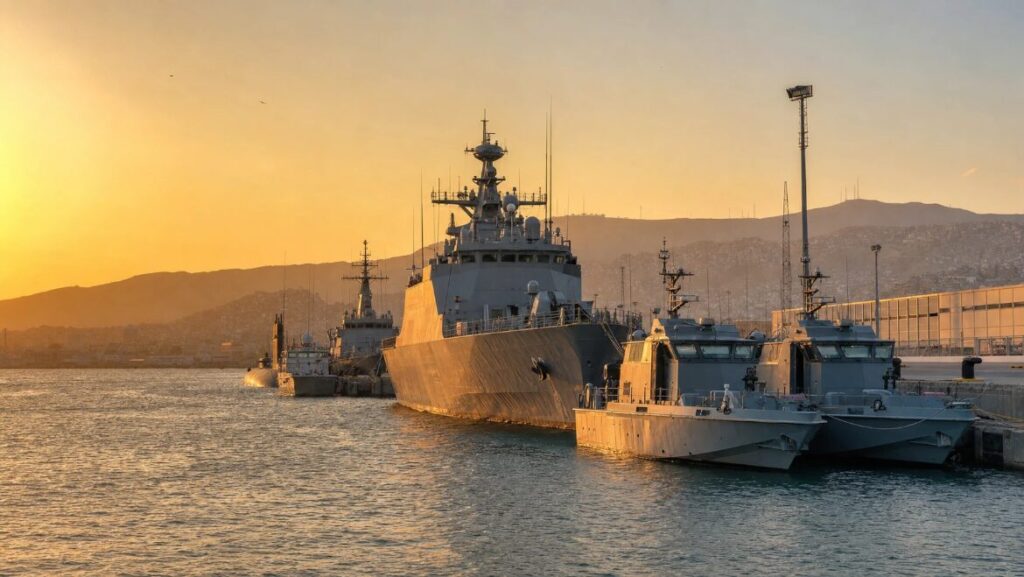
Earlier this year, the U.S. State Department approved a $1,500 million Foreign Military Sale to modernize and relocate Peru’s main naval facility, Callao Naval Base, located near Lima.
This is a real military installation, the headquarters of the Peruvian Navy, not a commercial port, and it is important to be clear about what this deal actually is.
It is not a new American base. The facility will remain 100% owned/operated by the Peruvian government, and the agreement explicitly excludes any transfer of weapons.
The U.S. Army Corps of Engineers serves as the main contractor, providing design, construction, engineering studies, project management, and logistics support.
Up to 20 American officials or contractors will offer technical supervision over a project expected to span up to 10 years.
In April 2026, Peru’s government approved issuing its own sovereign bonds worth up to $1,200 million specifically to fund this project.
And in a significant parallel move, Washington had just designated Peru a Major Non-NATO Ally, a status upgrade granting Peru’s armed forces privileged access to American defense technology and training.
Fair for Peru, fair for American taxpayers
This deal works because both countries genuinely benefit, and that fairness deserves to be spelled out clearly.
For Peru, the base stays entirely under Peruvian ownership and control.
Peru won’t host a foreign garrison or sign away sovereignty.
It is simply purchasing superior American engineering and construction expertise on commercial terms, the same way any sovereign nation buys infrastructure services on the open market.
For American taxpayers, this is not foreign aid and it is not a loan from Washington.
Peru is paying for the entire project itself, through its own sovereign bonds. Not one dollar of U.S. taxpayer money funds this project.
American companies get paid for real work, American engineering standards get exported, and Washington gains strategic influence in South America, all without spending a cent of public funds.
This is what an America First foreign policy should look like: strength and goodwill projected through commerce and expertise, not through handouts.
Why Washington actually cares: the Chancay problem next door
The reason this naval base modernization matters goes well beyond routine maintenance.
Less than 80 kilometers away sits the Chancay megaport, a deep-water facility where China’s Cosco Shipping holds a 60% ownership stake.
Cosco should not be confused with the American grocery store chain Costco, an unrelated company despite the similar name.
In January 2026, a Peruvian court ruled that Ositran, Peru’s own transport infrastructure regulator, cannot regulate, supervise, audit, or sanction activities at Chancay, siding with Cosco’s argument that the port was financed with private capital and therefore falls outside the state’s regulatory reach.
That characterization deserves real scrutiny.
Cosco describes itself as privately financed, but Cosco Shipping is not a private company in any meaningful sense.
It is wholly owned and controlled by the Chinese government through SASAC, the State-owned Assets Supervision and Administration Commission of China’s State Council.
The parent company is 100% state-owned, and even its publicly listed subsidiary remains majority-controlled by that same state parent.
Cosco’s chairman simultaneously holds a Chinese Communist Party committee secretary title within the company, underscoring direct party oversight at the highest level.
Calling an arm of the Chinese state a private investor, then using that label to escape Peruvian regulatory oversight, is a distinction that should not go unchallenged.
The U.S. State Department’s Bureau of Western Hemisphere Affairs called the court ruling a “regional warning,” stating on X: “We support Peru’s sovereign right to oversee critical infrastructure in its own territory. Let this be a cautionary tale for the region and the world: cheap Chinese money costs sovereignty.”
Cosco disputed the characterization, insisting Chancay remains “under the jurisdiction, sovereignty and control of Peruvian authorities.”
Peru’s Ositran has appealed the ruling, and Peru’s Comptroller General has opened a compliance review.
The contrast with Callao could not be sharper. At Chancay, a Peruvian court limited Peru’s own ability to oversee Chinese state-controlled territory inside its own borders.
At Callao, 80 kilometers away, Peru retains full sovereign control while modernizing with American technical help.
One arrangement may be quietly eroding Peruvian oversight. The other reinforces it.
A bonus storyline: Peru’s razor-thin election
This story unfolds against a remarkable political backdrop.
As of June 16, 2026, with 99.033% of ballots counted, conservative candidate Keiko Fujimori leads leftist Roberto Sánchez by roughly 33,000 votes, 50.090% to 49.910%, in Peru’s presidential runoff.
This is Fujimori’s fourth presidential run. She has never won before, falling narrowly short against Pedro Pablo Kuczynski in 2016 and against Pedro Castillo in 2021.
The remaining 897 contested ballots awaiting review, mostly from Lima, are estimated at roughly 180,000 votes and lean toward Fujimori.
Remaining overseas votes also favor Fujimori, although there are considerably fewer left to count.
Rural pending votes, historically a strength for the Peruvian left, are now largely exhausted.
A final official proclamation is expected by mid-July, but the math currently favors a Fujimori victory.
This matters directly for the naval base story.
Fujimori has long been considered a reliable U.S. ally, favoring closer defense cooperation with Washington and a firmer posture toward China’s growing economic footprint in Peru.
A Fujimori administration would likely continue, and possibly accelerate, the Callao modernization and take a tougher line on the Chancay oversight question.
A Sánchez administration, more closely aligned with the regional left, might have approached Beijing very differently.
The bigger picture: competing models, without an empire
This story is ultimately about two competing models of influence in Latin America.
China’s approach at Chancay involves a state-owned operator and a court ruling that limits the host country’s own regulatory reach over its own territory.
America’s approach at Callao involves the host country paying its own way, retaining full ownership and control, and simply purchasing American expertise on fair commercial terms.
For Washington, this is a low-cost, low-risk way to compete with Belt and Road-style influence without deploying troops or extending loans.
For Peru, it is a chance to modernize a vital military asset without surrendering an inch of sovereignty.
This is what effective, fiscally responsible foreign policy looks like: strengthening a strategic partner, countering Chinese encroachment, and protecting Peruvian sovereignty, all without spending a single American tax dollar.
That is the real promise of the Peru US naval base.