
This post is also available in:
 Português
  Español
  Français
  Deutsch
  Italiano
  Русский
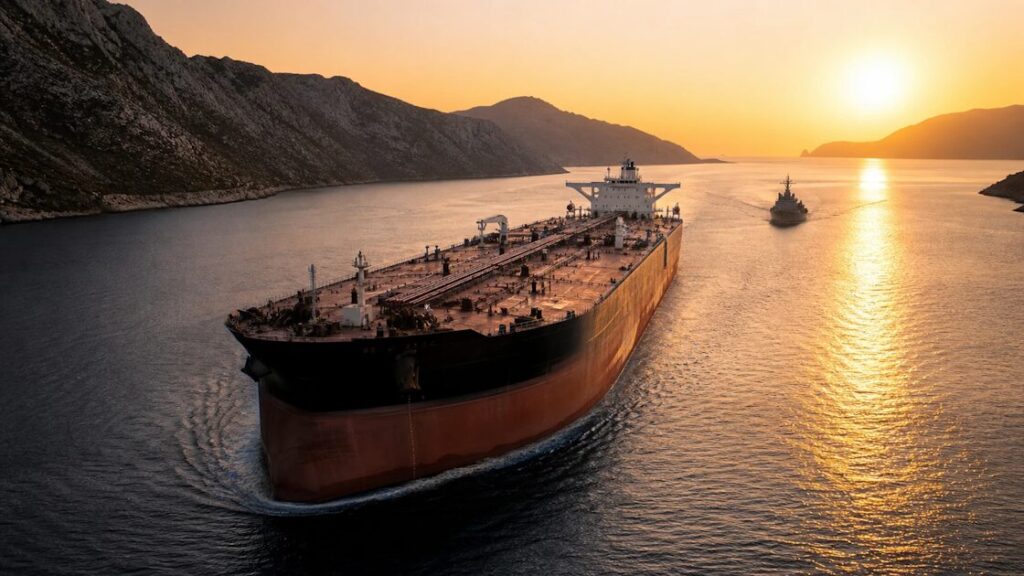
Japan South Korea energy: why the Strait of Hormuz matters more than Taiwan
When analysts talk about Asia’s biggest security threat, they almost always point to Taiwan. But for Japan and South Korea, there is a scenario even more immediately devastating than a Chinese invasion of Taiwan.
It is a prolonged closure of the Strait of Hormuz. And the Iran war just made that scenario feel very real.
Japan imports 95% of its crude oil from the Middle East. Every single day, 1.6 million barrels of oil pass through the Strait of Hormuz destined for Japanese refineries, factories, and power plants.
South Korea is not far behind — approximately 68 to 75% of its crude oil imports, totaling 1.7 million barrels per day, transit that same narrow waterway.
Together, these two industrial giants pump over 3.3 million barrels of oil through Hormuz every day.
When the Iran-US war intensified in early 2026, Brent crude surged from $72 per barrel to over $110 in weeks.
Japan authorized emergency releases of its strategic petroleum reserves.
South Korea also activated contingency planning.
South Korea’s net oil imports represent 2.7% of its entire GDP. Nomura, Japan’s largest investment bank, has flagged South Korea as one of the most vulnerable economies on earth to an energy supply shock.
Why diversifying away from the Middle East is harder than it sounds
Both nations have tried to reduce their Gulf dependency for decades.
South Korea managed to cut Middle East crude dependence from 87% in 2011 down to 60% in 2021 — a genuine achievement.
Then global supply tightened and prices spiked, and Seoul was forced to reverse course and go back to Gulf suppliers.
The economics of Middle Eastern crude are simply too competitive for Asian refiners to walk away from.
Japan still plans to get 30 to 40% of its total energy from fossil fuels as late as 2040.
Nuclear power is the most obvious alternative — Japan restarted 15 reactors with 33 gigawatts of combined capacity — but local opposition, safety reviews, and aging infrastructure limit how fast the fleet can grow.
Analysts estimate nuclear may only reach 12% of Japan’s electricity generation by 2030.
Renewables cover just 9% of South Korea’s power mix versus a 33% OECD average.
The structural obstacles are massive and the timelines are measured in decades, not years. For now, the Strait of Hormuz remains the economic lifeline of both nations.
The strategic calculation — Hormuz versus Taiwan
Here is the argument that rarely appears in mainstream coverage.
For Japan and South Korea, a prolonged Strait of Hormuz closure could be MORE economically devastating than a Chinese invasion of Taiwan.
A Taiwan conflict would disrupt semiconductor supply chains and regional security — serious, but manageable over months.
A Hormuz closure would immediately cut off 75 to 95% of Japan and South Korea’s oil supply. Industrial production would halt within weeks. Economic depression would follow.
That is why Prime Minister Takaichi has been aggressively building Indo-Pacific security alliances and why both nations watch every development in the Iran-US war with extraordinary anxiety.
Protecting maritime commerce for Tokyo and Seoul is not simply about trade. It is about national survival.
ChatGPT made an important observation about the full supply corridor these nations depend on.
It runs without interruption from the Persian Gulf through the Strait of Hormuz, across the Indian Ocean, through the Strait of Malacca, into the South China Sea, through the East China Sea, and finally to Japan and South Korea.
A disruption anywhere along that entire route affects the whole chain.
That is why Beijing has steadily expanded its blue-water navy and why Japan has dramatically increased defense spending.
Both nations understand that securing these sea lanes is inseparable from national economic survival.
The historical irony — and why America is different
There is a striking historical parallel that puts this all in perspective.
In 1941, Japan went to war across the Pacific largely because it feared being cut off from imported oil.
The United States imposed an oil embargo, and Tokyo decided conquest was preferable to economic strangulation.
In 2026, Japan remains just as dependent on imported oil — but now its security rests on alliances and the stability of international sea lanes rather than territorial expansion.
The strategic problem is identical. Only the solution has changed.
The deeper irony is this. The United States has become one of the world’s largest oil producers and is now largely insulated from a Hormuz disruption.
American shale production, Canadian oil sands, and Gulf of Mexico output mean Washington can absorb a Gulf closure far better than its Asian allies can.
China, Japan, and South Korea — the three largest industrial economies in Asia — would suffer the most severe direct consequences.
That is the hidden strategic reality behind every US Navy presence in the Persian Gulf, every American diplomatic effort in the Middle East, and every conversation between Trump and the Gulf state leaders.
America protects Hormuz not primarily for itself. It protects it for the allies whose economies would collapse without it.